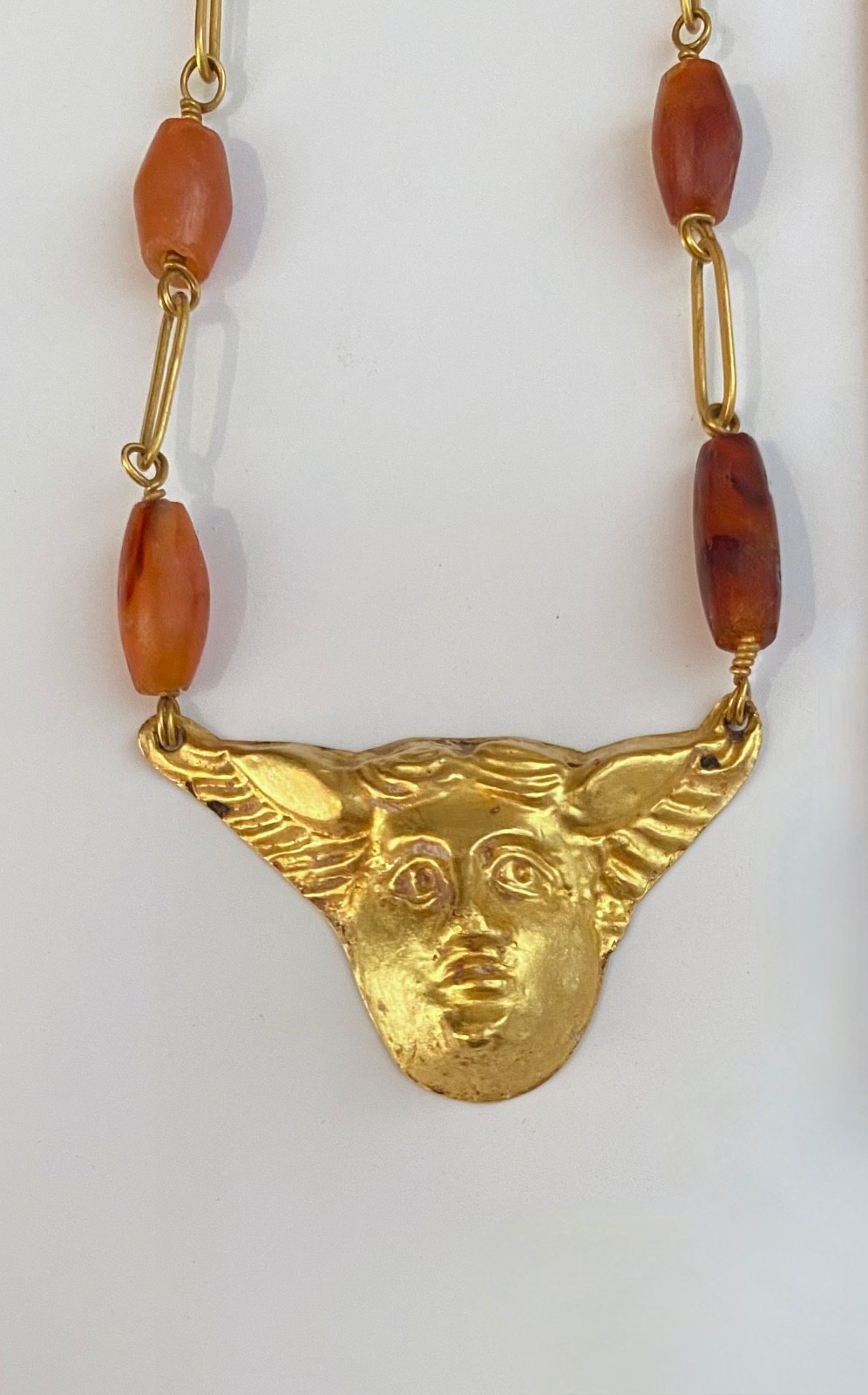
Ancient Roman Gold and Carnelian Necklace featuring Roman God of Dreams Somnus

When you click on links to various merchants on this site and make a purchase, this can result in this site earning a commission. Affiliate programs and affiliations include, but are not limited to, the eBay Partner Network.

Ancient Roman Gold and Carnelian Necklace featuring Roman God of Dreams Somnus:
$18000.00
Ancient Roman Gold and Carnelian Necklace ~ Roman God of Dreams Somnus12 carnelian beads
12 gold links
Gold hook clasp
17 inches long21.7 grams total weight
romanmythology
"Somnus and Mors were brothers — Sleep and Death. The Romans took that relationship seriously. Every night
was a small death, every dawn a small resurrection, and Somnus presided over the threshold between them.
The Romans understood sleep as a divine state, not a merely biological one. When the body surrendered to sleep each night it entered the domain of a god — Somnus, whose name gave Latin its words for slumber, drowsiness, and the condition of being unable to sleep at all. He was not a major deity in the institutional sense. He had no state temple, no flamen, no place in the Dii Consentes. But he appeared in the most significant Latin poetry — Virgil’s Aeneid, Ovid’s Metamorphoses, Statius’s Thebaid — and the descriptions of his realm and his power are among the most vivid in Roman literary tradition. His Greek counterpart was Hypnos, and the Romans absorbed the Greek mythology of sleep largely intact. But the Roman Somnus had a weight that the Greek Hypnos sometimes lacked ~ a connection to mortality, to fate, and to the thin boundary between rest and permanent oblivion that Roman writers returned to with unusual frequency.
Ovid’s description of Somnus’s dwelling in Book 11 of theMetamorphosesis one of the most carefully constructed passages in Latin poetry. It is worth understanding in detail because it expresses what the Romans believed sleep actually was.
The cave of Somnus lies deep inside a hollow mountain near the land of the Cimmerians, a people who live in perpetual mist where the sun never penetrates. The entrance to the cave is surrounded by poppies and other plants whose juices induce sleep. Inside, the cave is dark and silent — no cockerel crows, no dogs bark, no branches rustle, no human voices speak. The only sound is the River Lethe, the river of forgetfulness, flowing over stones with a murmur specifically calculated to invite sleep. In the cave’s innermost chamber, Somnus himself reclines on a black couch of ebony, his body relaxed, and surrounded by empty dreams drifting through the air like shadows.
The setting is theologically precise. The absence of light means time has stopped — no sun, no dawn, no cockerel to announce morning. The silence means consciousness has withdrawn — no language, no activity, no human presence. The sound of the Lethe means memory is dissolving. What Ovid describes is not simply a place where a god lives. It is sleep itself rendered as geography.
Juno, in the myth, sends Iris to this cave to command Somnus to send a dream to Alcyone, whose husband Ceyx has drowned at sea. Somnus rouses himself with difficulty — even addressing him is hard because he keeps sliding back toward unconsciousness — and dispatches Morpheus, one of his sons, to take the shape of Ceyx and bring Alcyone the truth of his death in a dream. The episode is a study in the liminal: the message crosses from the dead to the living through the medium of sleep, the state that is closest to death without being it.
The most theologically significant fact about Somnus in Roman thought is his relationship to Mors, the god of death. They were brothers — twin sons of Nox (Night) — and the pairing was not decorative. It expressed a genuine Roman intuition about the nature of sleep.
Every night the sleeper surrendered consciousness, lost the ability to act, became temporarily indistinguishable from the dead. The soul, in some Roman philosophical traditions, was believed to partially detach from the body during sleep, which was why dreams could contain prophetic information unavailable to the waking mind. Sleep was the daily rehearsal for death — the practice run that made death less absolutely strange.
Somnus was the father of the Oneiroi, the dream spirits, and the organization of his offspring expressed the Roman taxonomy of dream experience. Three sons were most prominent.
Morpheus governed dreams that took human form — the figures who appeared in dreams as people, speaking recognizable words, wearing recognizable faces. His name gave the Romans their word for shape and gave later centuries the name of the active compound in opium. He was the most skilled of the dream-crafters, capable of imitating any human being so exactly that the dreamer could not tell the copy from the original.
Phobetor — also called Icelos — governed dreams that took animal form: the shapeshifting presences of nightmare, the beasts that pursued sleepers through the dark.
Phantasos governed dreams composed of inanimate things: landscapes, water, earth, rock — the dreamscapes that had no living figure at their center, only Environment.
Together the three sons covered the full range of what sleepers experienced: human narrative, animal terror, and pure sensation. The classification was observational — the Romans had noticed that dreams fell into these categories and explained the categories by positing different divine agents responsible for each.
One of the most enduring images in Roman dream mythology is the two gates through which dreams exit the cave of Somnus: the gate of horn through which true dreams pass, and the gate of ivory through which false dreams pass. The image appears in both Homer and Virgil, and Virgil’s use of it at the end of Book 6 of theAeneidis one of the most discussed passages in Latin literature.
Aeneashas completed his tour of theunderworld, has seen the souls of Rome’s future heroes, has heard Anchises’s vision of Rome’s destiny. He and his guide the Sibyl exit through the ivory gate — the gate of false dreams. Commentators have argued about this for two thousand years. Why does Aeneas exit through the false gate? Is Virgil suggesting the entire underworld vision was a lie? That the prophecy of Roman greatness was a beautiful deception? Or is there a more technical explanation — that the ivory gate simply sent the living back to the waking world because they didn’t belong among the shades?
The passage resists resolution, which is part of its power. Sleep was the medium through which the underworld communicated with the living, and the gates of horn and ivory were the filters that determined which of those communications were real. That Aeneas left through the wrong gate introduced an ambiguity into the epic’s central prophecy that Virgil apparently wanted to leave in place.
Somnus was a god who did not require a temple because he visited everyone without being invited. His intimacy was total and non-negotiable. The emperor and the slave surrendered to him equally each night. The general and the prisoner both entered his cave at the same hour. The philosopher who thought most carefully about consciousness spent a third of every day under Somnus’s governance without the ability to think at all.
This universal and involuntary dominion gave Somnus a theological status that his lack of institutional cult did not reflect. He was not important because people chose to worship him. He was important because people had no choice but to submit to him. That submission — nightly, complete, and resembling death closely enough that the Romans named his brother Mors after it — was the reminder that no human life, however powerful or controlled, was entirely its own."
Awesome.Intellectually fascinating. Worthy of deep contemplation and consideration by all humans. I have read this description of Somnus and his shadow-filledworld dozens of times and it still gives me goosebumps!
The necklace itself is sublime and seemingly unique. The carnelian beads and the 24k gold chain links and hook clasp are very Roman and are covered in wonderful patina and deeptoning.
The repousse pendant (not solid gold) isintriguing and beautifully formed with ancient 24k gold sheet metal. Somnus himself would be proud of this meticulously crafted piece ofartwork and body decor dedicated to dreams!
The condition of the necklace is Excellent. There is a smalltriangular penetration into the back of the pendant that was bent inwards like a flap when I bought it 21 years ago. Just recently I slipped a piece of thread under the flap and gently pulled it back up until it was flush with the rest of the plain sheet metal backing. There are some faintscratches on the back as well as some tiny nicks and shallow dents that are wholly expected given its two millenniums of age. Also, there is a small stain on one side near the attachment hole and a few very small dark ancient grime spots here and there on the wings.
Overall, thisnecklace is a magnificent piece of ancient art jewelry, inspired by numerous accounts of popular ancient Greekand Roman mythologies. It gives me goosebumps to hold it, and admire its beauty and mythologicalcontext.
Free check out my Seller response to see the quality items I have sold and the excellent service I provide. I aim to only ship to addresses in the USA.
International sales are handled exclusively through 's Global Shipping Program.
Sales tax (if any) collected by you like this item and would like to see more high quality and very interesting pieces, please visitsouktopia. If you see something there that catches your eye, let me know and I will list it here on . Lots of cool stuff to peruse there as well as some beautiful classical music and a lot of ancient art and history. guaranteed. Thirty day return policy. I package very well and ship pronto.
Ancient Roman Gold and Carnelian Necklace featuring Roman God of Dreams Somnus:
$18000.00
Related Items:

Ancient 26 lbs. Roman Marble Head of Janus--Two Faced God Sicily, 200 BC-300 AD
$1250000.00
Beautiful Set Of Genuine Ancient Roman Glass Necklace - Multiple Strings
$100000.00

EXTREMELY RARE Ancient Greek Roman Marble Female Torso Bust Statue
$80000.00