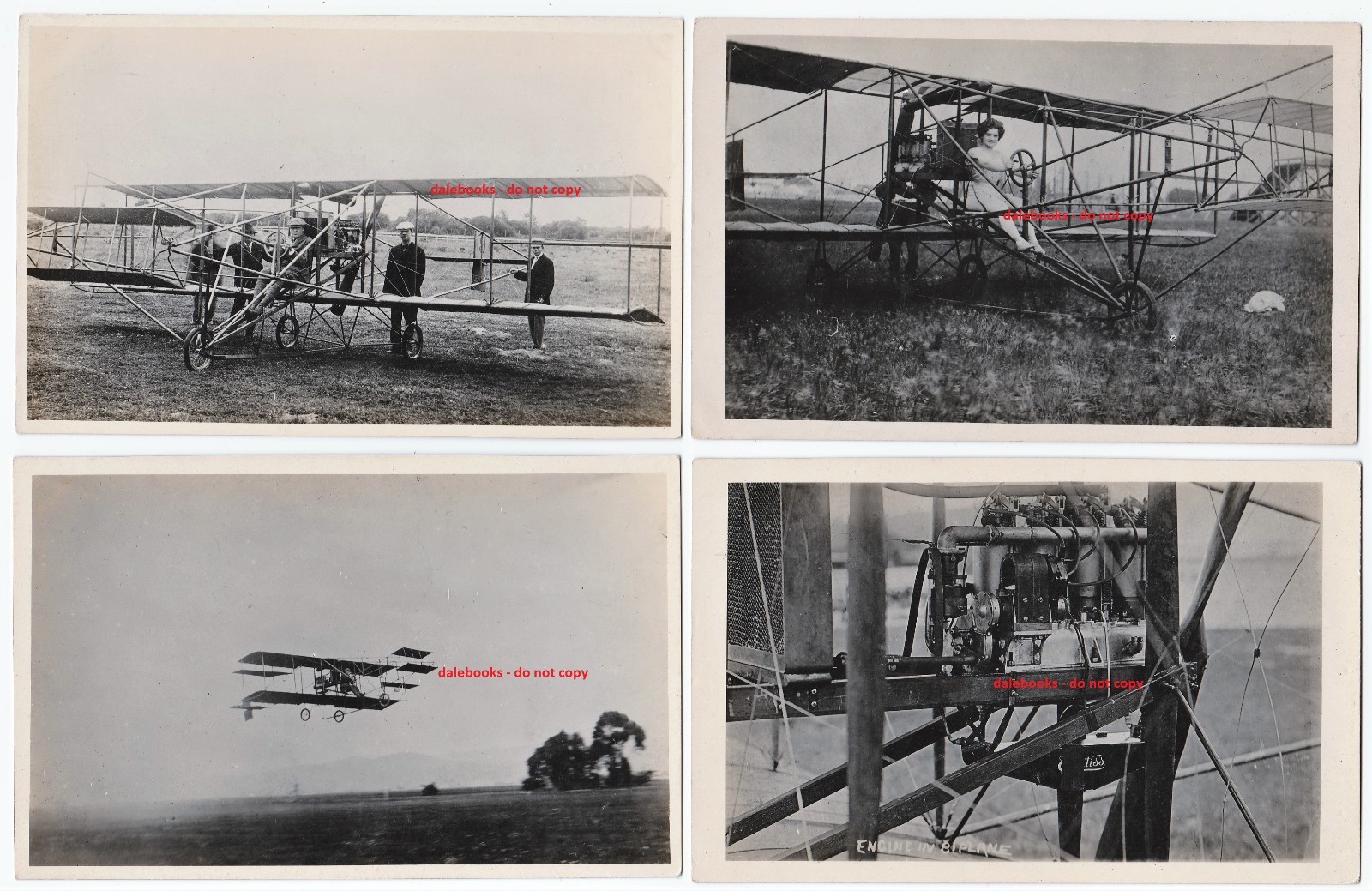
RARE RPPC Set of 4 - Glenn Curtiss Biplane - Eugene Ely & Wife? Real Photos 1910

When you click on links to various merchants on this site and make a purchase, this can result in this site earning a commission. Affiliate programs and affiliations include, but are not limited to, the eBay Partner Network.

RARE RPPC Set of 4 - Glenn Curtiss Biplane - Eugene Ely & Wife? Real Photos 1910:
$850.00
RARE - Old Real Photograph Postcard Set
Series of 4
Glenn Curtiss Airplane
Eugene Ely and Wife?Unique - Unknown Photos?
ca 1910
For offer - a nice old postcard lot! Fresh from an estate in Upstate NY. Never offered on the market until now. Vintage, Old, antique, Original - NOT a Reproduction - Guaranteed !!I have never seen these before, and believe they may be unique. From an old estate in the Finger Lakes - came with many other old postcards and photos. AZO real photo backs. I did some research, and these may show Eugene Ely and his wife. The man shown close up looks to be the same on flying in the air. The photo of the engine is a Curtiss. In very good / excellent condition.Please see photos. If you collect postcards, 20th century history, advertising ad, transportation, aviation, sports, Americana, American invention, etc., this is a nice one for your paper or ephemera collection. Combine shipping on multiple offer wins! 1306
Eugene Burton Ely (October 21, 1886[1] – October 19, 1911) was an aviation pioneer, credited with the first shipboard aircraft take off and landing.
Background[edit]
Ely was born in Williamsburg, Iowa and raised in Davenport, Iowa. Having completed the eighth grade, he graduated from Davenport Grammar School 4 in January 1901.[2] Although some sources indicate that he attended and graduated from Iowa State University in 1904 (when he would have been 17), the registrar of ISU reports that there is no record of him having done so (nor did he attend the University of Iowa or the University of Northern Iowa).[3] Ely likewise does not appear in the graduations lists for Davenport High School.[4] By 1904 he was employed as a chauffeur to the Rev. Fr. Smyth, a Catholic priest in Cosgrove, Iowa, who shared Ely's love of fast driving; in Father Smyth's car (a red Franklin), Ely set the speed record between Iowa City and Davenport.[5]
Ely was living in San Francisco at the time of the earthquake and fire[6] and was active there in the early days of the sales and racing of automobiles.[7] He married Mabel Hall on August 7, 1907; he was 21 and she was 17, which meant the marriage required her mother's consent;[7][8] they honeymooned in Colorado.[9] The Elys relocated to Nevada City, California in 1909, and for a time he drove an "auto stage" delivery route.[10]
The couple moved to Portland, Oregon in early 1910, where he got a job as an auto salesman, working for E. Henry Wemme.[7] Soon after, Wemme purchased one of Glenn Curtiss' first four-cylinder biplanes and acquired the franchise for the Pacific Northwest. Wemme was unable to fly the Curtiss biplane, but Ely, believing that flying was as easy as driving a car, offered to fly it. He ended up crashing it instead, and feeling responsible, bought the wreck from Wemme.[7] Within a few months he had repaired the aircraft and learned to fly.[7] He flew it in the Portland area, then headed to Minneapolis, Minnesota in June 1910 to participate in an exhibition, where he met Curtiss and started working for him.[7] After an unsuccessful attempt in Sioux City, Iowa,[11] Ely's first reported exhibition on behalf of Curtiss was in Winnipeg in July 1910.[12] Ely received Aero Club of America pilot's license #17 on October 5, 1910.[7]
Naval aviation firsts[edit]
Ely takes off from the USS Birmingham, Hampton Roads, Virginia, November 14, 1910
In October, Ely and Curtiss met Captain Washington Chambers, USN, who had been appointed by George von Lengerke Meyer, the Secretary of the Navy, to investigate military uses for aviation within the Navy. This led to two experiments. On November 14, 1910, Ely took off in a Curtiss pusher from a temporary platform erected over the bow of the light cruiser USS Birmingham.[7][nb 1] The airplane plunged downward as soon as it cleared the 83-foot platform runway; and the aircraft wheels dipped into the water before rising.[7] Ely's goggles were covered with spray, and the aviator promptly landed on a beach rather than circling the harbor and landing at the Norfolk Navy Yard as planned.[7] John Barry Ryan offered $500 to build the platform, and a $500 prize, for a ship to shore flight.[14]
First fixed-wing aircraft landing on a warship: Ely landing his plane on board the USS Pennsylvania in San Francisco Bay, January 18, 1911.
Two months later, on January 18, 1911, Ely landed his Curtiss pusher airplane on a platform on the armored cruiser USS Pennsylvania anchored in San Francisco Bay.[nb 2] Ely flew from the Tanforan Racetrack in San Bruno, California and landed on the Pennsylvania, which was the first successful shipboard landing of an aircraft.[16][17] This flight was also the first ever using a tailhook system, designed and built by circus performer and aviator Hugh Robinson.[7] Ely told a reporter: "It was easy enough. I think the trick could be successfully turned nine times out of ten."
Ely communicated with the United States Navy requesting employment, but United States naval aviation was not yet organized.[7] Ely continued flying in exhibitions while Captain Chambers promised to "keep him in mind" if Navy flying stations were created.[7] Captain Chambers advised Ely to cut out the sensational features for his safety and the sake of aviation.[7] When asked about retiring, The Des Moines Register quoted Ely as replying: "I guess I will be like the rest of them, keep at it until I am killed."[7]
Curtiss Pusher replica in flight in 2011
To commemorate the 100th anniversary of the flight, Naval Commander Bob Coolbaugh flew a personally built replica of Ely's Curtiss from the runway at NAS Norfolk on November 12, 2010. The U.S. Navy planned to feature the flying demonstration at Naval anniversary events across America.[18]
Death[edit]
On October 19, 1911, while flying at an exhibition in Macon, Georgia, his plane was late pulling out of a dive and crashed.[7] Ely jumped clear of the wrecked aircraft, but his neck was broken, and he died a few minutes later.[7] Spectators picked the wreckage clean looking for souvenirs, including Ely's gloves, tie, and cap.[19] On what would have been his twenty-fifth birthday, his body was returned to his birthplace for burial.[20]
On February 16, 1933, Congress awarded the Distinguished Flying Cross posthumously to Ely, "for extraordinary achievement as a pioneer civilian aviator and for his significant contribution to the development of aviation in the United States Navy."[21] An exhibit of retired naval aircraft at Naval Air Station Norfolk in Virginia bears Ely's name, and a granite historical marker in Newport News, Virginia, overlooks the waters where Ely made his historic flight in 1911 and recalls his contribution to military aviation, naval in particular.
See also[edit]
Biography portal
List of fatalities from aviation accidents
List of firsts in aviation
Charles Rumney Samson, the first pilot to take off from a moving ship
Edwin Harris Dunning, the first pilot to land on a moving ship
Glenn Hammond Curtiss (May 21, 1878 – July 23, 1930) was an American aviation and motorcycling pioneer, and a founder of the U.S. aircraft industry. He began his career as a bicycle racer and builder before moving on to motorcycles. As early as 1904, he began to manufacture engines for airships. In 1908, Curtiss joined the Aerial Experiment Association, a pioneering research group, founded by Alexander Graham Bell at Beinn Bhreagh, Nova Scotia, to build flying machines.Curtiss made the first officially witnessed flight in North America, won a race at the world's first international air meet in France, and made the first long-distance flight in the United States. His contributions in designing and building aircraft led to the formation of the Curtiss Aeroplane and Motor Company, now part of Curtiss-Wright Corporation. His company built aircraft for the U.S. Army and Navy, and, during the years leading up to World War I, his experiments with seaplanes led to advances in naval aviation. Curtiss civil and military aircraft were predominant in the interwar and World War II eras.
Birth and early career[edit]Curtiss was born in 1878 in Hammondsport, New York, to Frank Richmond Curtiss and Lua Andrews. Although his formal education extended only to eighth grade, his early interest in mechanics and inventions was evident at his first job at the Eastman Dry Plate and Film Company (later Eastman Kodak Company) in Rochester, New York.[1] He invented a stencil machine adopted at the plant and later built a rudimentary camera to study photography.[1]Marriage and family[edit]On March 7, 1898, Curtiss married Lena Pearl Neff (1879–1951), daughter of Guy L. Neff and Jenny M. Potter, in Hammondsport, New York. They had two children:Carlton N. Curtiss (1901–1902)Glenn Hammond Curtiss (1912–1969)Bicycles and motorcycles[edit]
Glenn Curtiss on his V-8 motorcycle in 1907Curtiss began his career as a bicycle messenger, a bicycle racer, and bicycle-shop owner. In 1901, he developed an interest in motorcycles when internal-combustion engines became more available. In 1902, Curtiss began manufacturing motorcycles with his own single-cylinder engines. His first motorcycle's carburetor was adapted from a tomato soup can containing a gauze screen to pull the gasoline up by capillary action.[2][3][4] In 1903, he set a motorcycle land speed record at 64 miles per hour (103 km/h) for one mile (1.6 km). When E.H. Corson of the Hendee Mfg Co (manufacturers of Indian motorcycles) visited Hammondsport in July 1904, he was amazed that the entire Curtiss motorcycle enterprise was located in the back room of the modest "shop". Corson's motorcycles had just been trounced the week before by "Hell Rider" Curtiss in an endurance race from New York to Cambridge, Maryland.[5]On January 21, 1906,[6], Curtiss set an unofficial world record of 136.36 miles per hour (219.45 km/h), on a 40 horsepower (30 kW) 269 cu in (4,410 cc) V-8-powered motorcycle of his own design and construction in Ormond Beach, Florida. The air-cooled F-head engine was intended for use in aircraft.[7] He remained "the fastest man in the world", the title the newspapers gave him, until 1911,[8] and his motorcycle record was not broken until 1930. This motorcycle is now in the Smithsonian Institution.[9] Curtiss's success at racing strengthened his reputation as a leading maker of high-performance motorcycles and engines.[10]Aviation pioneer[edit]Curtiss, motor expert[edit]In 1904, Curtiss became a supplier of engines for the California "aeronaut" Tom Baldwin. In that same year, Baldwin's California Arrow, powered by a Curtiss 9 HP V-twin motorcycle engine, became the first successful dirigible in America.[11]In 1907, Alexander Graham Bell invited Curtiss to develop a suitable engine for heavier-than-air flight experimentation. Bell regarded Curtiss as "the greatest motor expert in the country"[12] and invited Curtiss to join his Aerial Experiment Association (AEA).AEA aircraft experiments[edit]
The June Bug on its prize-winning historic flight with Curtiss at the controlsBetween 1908 and 1910, the AEA produced four aircraft, each one an improvement over the last. Curtiss primarily designed the AEA's third aircraft, Aerodrome #3, the famous June Bug, and became its test pilot, undertaking most of the proving flights. On July 4, 1908, he flew 5,080 ft (1,550 m) to win the Scientific American Trophy and its $2,500 prize.[13] This was considered to be the first pre-announced public flight of a heavier-than-air flying machine in America. On June 8, 1911 Curtiss received U.S. Pilot's License #1 from the Aero Club of America, because the first batch of licenses were issued in alphabetical order; Wilbur Wright received license #5. The flight of the June Bug propelled Curtiss and aviation firmly into public awareness. At the culmination of the Aerial Experiment Association's experiments, Curtiss offered to purchase the rights to Aerodrome #3, essentially using it as the basis of his "Curtiss No. 1, the first of his production series of pusher aircraft.[14]The pre-war years[edit]Aviation competitions[edit]During the 1909–1910 period, Curtiss employed a number of demonstration pilots, including Eugene Ely, Charles K. Hamilton, Augustus Post, and Hugh Robinson. Aerial competitions and demonstration flights across North America helped to introduce aviation to a curious public; Curtiss took full advantage of these occasions to promote his products.[15] This was a busy period for Glenn Curtiss.
Souvenir postcard of the Grande Semaine d'Aviation, 1909In August 1909, Curtiss took part in the Grande Semaine d'Aviation aviation meeting at Reims, France, organized by the Aéro-Club de France. The Wrights, who were selling their machines to customers in Germany at the time, decided not to compete in person. Two Wright aircraft (modified with a landing gear) were at the meet, but they did not win any events. Flying his No. 2 biplane, Curtiss won the overall speed event, the Gordon Bennett Cup, completing the 20-km (12.5-mile) course in just under 16 minutes at a speed of 46.5 mph (74.8 km/h), six seconds faster than runner-up Louis Blériot. [N 1]On May 29, 1910, Curtiss flew from Albany to New York City to make the first long-distance flight between two major cities in the U.S. For this 137-mile (220 km) flight, which he completed in just under four hours including two stops to refuel, he won a $10,000 prize offered by publisher Joseph Pulitzer and was awarded permanent possession of the Scientific American trophy.In June 1910, Curtiss provided a simulated bombing demonstration to naval officers at Hammondsport. Two months later, Lt. Jacob E. Fickel demonstrated the feasibility of shooting at targets on the ground from an aircraft with Curtiss serving as pilot. One month later, in September, he trained Blanche Stuart Scott, who was possibly the first American woman pilot. The fictional character Tom Swift, who first appeared in 1910 in Tom Swift and His Motor Cycle and Tom Swift and His Airship, has been said to have been based on Glenn Curtiss.[18] The Tom Swift books are set in a small town on a lake in upstate New York.[19]Naval aviation[edit]On November 14, 1910, Curtiss demonstration pilot Eugene Ely took off from a temporary platform mounted on the forward deck of the cruiser USS Birmingham. His successful takeoff and ensuing flight to shore marked the beginning of a relationship between Curtiss and the Navy that remained significant for decades. At the end of 1910, Curtiss established a winter encampment at San Diego to teach flying to Army and Naval personnel. Here, he trained Lt. Theodore Ellyson, who became U.S. Naval Aviator #1, and three Army officers, 1st Lt. Paul W. Beck, 2nd Lt. George E. M. Kelly, and 2nd Lt. John C. Walker, Jr., in the first military aviation school. (Chikuhei Nakajima, founder of Nakajima Aircraft Company, was a 1912 graduate.) The original site of this winter encampment is now part of Naval Air Station North Island and is referred to by the Navy as "The Birthplace of Naval Aviation".Through the course of that winter, Curtiss was able to develop a float (pontoon) design that enabled him to take off and land on water. On January 26, 1911, he flew the first seaplane from the water in the United States.[20] Demonstrations of this advanced design were of great interest to the Navy, but more significant, as far as the Navy was concerned, was Eugene Ely successfully landing his Curtiss pusher (the same aircraft used to take off from the Birmingham) on a makeshift platform mounted on the rear deck of the battleship USS Pennsylvania. This was the first arrester-cable landing on a ship and the precursor of modern-day carrier operations. On January 28, 1911, Ellyson took off in a Curtiss “grass cutter” to become the first Naval aviator.
"FIRM BELIEVERS IN TRANS-ATLANTIC AVIATION", Porte and Curtiss on the cover of Aero and Hydro, 14 March 1914Curtiss custom built floats and adapted them onto a Model D so it could take off and land on water to prove the concept. On February 24, 1911, Curtiss made his first amphibious demonstration at North Island by taking off and alighting on both land and water. Back in Hammondsport, six months later in July 1911, Curtiss sold the U.S. Navy their first aircraft, the A-1 Triad. The A-1, which was primarily a seaplane, was equipped with retractable wheels, also making it the first amphibious aircraft. Curtiss trained the Navy's first pilots and built their first aircraft. For this, he is considered in the USA to be "The Father of Naval Aviation". The Triad was immediately recognized as so obviously useful, it was purchased by the U.S. Navy, Russia, Japan, Germany, and Britain. Curtiss won the Collier Trophy for designing this aircraft.[21]Around this time, Curtiss met retired British naval officer John Cyril Porte, who was looking for a partner to produce an aircraft with him to win the Daily Mail prize for the first transatlantic crossing. In 1912, Curtiss produced the two-seat Flying Fish, a larger craft that became classified as a flying boat because the hull sat in the water; it featured an innovative notch (known as a "step") in the hull that Porte recommended for breaking clear of the water at takeoff. Curtiss correctly surmised that this configuration was more suited to building a larger long-distance craft that could operate from water, and was also more stable when operating from a choppy surface. Porte and Curtiss produced the America in 1914, a larger flying boat with two engines, for the transatlantic crossing.World War I and later[edit]World War I[edit]With the start of World War I, Porte returned to service in the Royal Navy, which subsequently purchased several models of the America, now called the H-4, from Curtiss. Porte licensed and further developed the designs, constructing a range of Felixstowe long-range patrol aircraft, and from his experience passed along improvements to the hull to Curtiss. The later British designs were sold to the U.S. forces, or built by Curtiss as the F5L. The Curtiss factory also built a total of 68 "Large Americas", which evolved into the H-12, the only American-designed and -built aircraft to see combat in World War I.
A Curtiss JN-4 (Jenny) on a training flight during World War IAs 1916 approached, the United States was feared to be be drawn into the conflict. The Army's Aviation Section, U.S. Signal Corps ordered the development of a simple, easy-to-fly-and-maintain, two-seat trainer. Curtiss created the JN-4 "Jenny" for the Army, and the N-9 seaplane version for the Navy. They were some of the most famous products of the Curtiss company, and thousands were sold to the militaries of the United States, Canada, and Britain. Civilian and military aircraft demand boomed, and the company grew to employ 18,000 workers in Buffalo and 3,000 workers in Hammondsport.In 1917, the U.S. Navy commissioned Curtiss to design a long-range, four-engined flying boat large enough to hold a crew of five, which became known as the Curtiss NC. The four NC flying boats attempted a transatlantic crossing in 1919, and the NC-4 successfully crossed. It is now on permanent display in the National Museum of Naval Aviation in Pensacola, Florida.Patent dispute[edit]See also: Wright brothers patent warA patent lawsuit by the Wright brothers against Curtiss in 1909 continued until it was resolved during World War I. Since the last Wright aircraft, the Wright Model L, was a single prototype of a "scouting" aircraft, made in 1916, the U.S. government, desperately short of combat aircraft, pressured both firms to resolve the dispute. In 1917, the U.S. government offered a large and profitable contract to Curtiss to build aircraft for the U.S. Army.Post-World War I[edit]Peace brought cancellation of wartime contracts. In September 1920, the Curtiss Aeroplane and Motor Company underwent a financial reorganization. Glenn Curtiss cashed out his stock in the company for $32 million and retired to Florida.[22] He continued on as a director of the company, but served only as an adviser on design. Clement M. Keys gained control of the company, which later became the nucleus of a large group of aviation companies.[23]Later years[edit]Curtiss and his family moved to Florida in the 1920s, where he founded 18 corporations, served on civic commissions, and donated extensive land and water rights. He co-developed the city of Hialeah with James Bright and developed the cities of Opa-locka and Miami Springs, where he built a family home, known variously as the Miami Springs Villas House, Dar-Err-Aha, MSTR No. 2, or Glenn Curtiss House.[24] The Glenn Curtiss House, after years of disrepair and frequent vandalism, is being refurbished to serve as a museum in his honor.[25]His frequent hunting trips into the Florida Everglades led to a final invention, the Adams Motor "Bungalo", a forerunner of the modern recreational vehicle trailer (named after his business partner and half-brother, G. Carl Adams). Shortly before his death, he designed a tailless aircraft with a V-shaped wing and tricycle landing gear that he hoped could be sold in the price range of a family car.[26]The Wright Aeronautical Corporation, a successor to the original Wright Company, ultimately merged with the Curtiss Aeroplane and Motor Company on July 5, 1929, forming the Curtiss-Wright company, shortly before Curtiss's death.[21]Death[edit]Traveling to Rochester to contest a lawsuit brought by former business partner August Herring, Curtiss suffered an attack of appendicitis in court. He died on July 23, 1930, in Buffalo, New York,[24] of complications from an appendectomy. His funeral service was held at St. James Episcopal Church in his home town, Hammondsport, with interment in the family plot at Pleasant Valley Cemetery in Hammondsport.Awards and honors[edit]By an act of Congress on March 1, 1933, Curtiss was posthumously awarded the Distinguished Flying Cross, which now resides in the Smithsonian. Curtiss was inducted into the National Aviation Hall of Fame in 1964, the Motorsports Hall of Fame of America in 1990, the Motorcycle Hall of Fame in 1998,[27] and the National Inventors Hall of Fame in 2003. The Smithsonian's National Air and Space Museum has a collection of Curtiss's original documents[28] as well as a collection of airplanes, motorcycles and motors.[29] LaGuardia Airport was originally called Glenn H. Curtiss Airport when it began operation in 1929.The Glenn H. Curtiss Museum in Hammondsport is dedicated to Curtiss's life and work.Timeline[edit]1878 Birth in Hammondsport, New York1898 Marriage1900 Manufactures Hercules bicycles1901 Motorcycle designer and racer1903 American motorcycle champion1903 Unofficial one-mile motorcycle land speed record 64 mph (103 km/h) on Hercules V8 at Yonkers, New York[30]1904 Thomas Scott Baldwin mounts Curtiss motorcycle engine on a hydrogen-filled dirigible1904 Set 10-mile world speed record1904 Invented handlebar throttle control;[31] handlebar throttle control also credited to the 1867–1869 Roper steam velocipede[32][33]1905 Created G.H. Curtiss Manufacturing Company, Inc.1906 Curtiss writes the Wright brothers offering them an aeronautical motor1907 Curtiss joins Alexander Graham Bell in experimenting in aircraft1907 Set world motorcycle land speed record of 77.6 mph (124.9 km/h)[34]1907 Set world motorcycle land speed record at 136.36 mph (219.45 km/h) in his V8 motorcycle in Ormond Beach, Florida[34]1908 First Army dirigible flight with Curtiss as flight engineer1908 One of several claimants for the first flight of an aircraft controlled by ailerons1908 Lead designer and pilot of "June Bug" on July 41909 Sale of Curtiss's "Golden Flyer" to the New York Aeronautic Society for $5,000.00 USD, marks the first sale of any aircraft in the U.S., triggers Wright Brothers lawsuits.1909 Won first international air speed record with 46.5 mph (74.8 km/h) in Rheims, France1909 First U.S. licensed aircraft manufacturer.1909 Established first flying school in United States and exhibition company1910 Long distance flying record of 150 miles (240 km) from Albany, New York to New York City1910 First simulated bombing runs from an aircraft at Lake Keuka1910 First firearm use from aircraft, piloted by Curtiss1910 First radio communication with aircraft in flight in a Curtiss biplane1910 Curtiss moved to California and set up a shop and flight school at the Los Angeles Motordrome, using the facility for sea plane experiments1910 Trained Blanche Stuart Scott, the first American female pilot1910 First successful takeoff from a United States Navy ship (Eugene Burton Ely, using Curtiss Plane)1911 First landing on a ship (Eugene Burton Ely, using Curtiss Plane) (2 Months later)1911 The Curtiss School of Aviation, established at Rockwell Field in February
Glenn H. Curtiss's pilot license1911 Pilot license #1 issued for his June Bug flight1911 Ailerons patented1911 Developed first successful pontoon aircraft in US1911 Hydroplane A-1 Triad purchased by US. Navy (US Navy's first aircraft)1911 Developed first retractable landing gear on his hydroaeroplane1911 His first aircraft sold to U.S. Army on April 271911 Created first military flying school1912 Developed and flew the first flying boat on Lake Keuka1912 First ship catapult launching on October 12 (Lt. Ellyson)[35]1912 Created the first flying school in Florida at Miami Beach
The 1913 Langley Medal awarded to Curtiss1914 Curtiss made a few short flights in the Langley Aerodrome, as part of an unsuccessful attempt to bypass the Wright Brothers' patent on aircraft1915 Start production run of "Jennys" and may other models including flying boats1915 Curtiss started the Atlantic Coast Aeronautical Station on a 20-acre tract east of Newport News (VA) Boat Harbor in the Fall of 1915 with Captain Thomas Scott Baldwin as head.1917 Opens "Experimental Airplane Factory" in Garden City, Long Island1919 Curtiss NC-4 flying boat crosses the Atlantic1919 Commenced private aircraft production with the Oriole1921 Developed Hialeah, Florida, including Hialeah Park Race Track1921 Donated his World War I training field to the Navy1922 Opened Hialeah Park Race Track with his business partner James H. Bright1923 Developed Miami Springs, Florida and created a flying school and airport
Tombstone1923 (circa) Created first airboats1925 Builds his Miami Springs mansion1926 Developed Opa-locka, Florida and airport facility1928 Created the Curtiss Aerocar Company in Opa-locka, Florida.[36]1928 Curtiss towed an Aerocar from Miami to New York City in 39 hours1930 Death in Buffalo, New York1930 Buried in Pleasant Valley Cemetery in Hammondsport, New York1964 Inducted in the National Aviation Hall of Fame1990 Inducted in the Motorsports Hall of Fame of America in the air-racing categorySee also[edit]Rodman WanamakerCharles M. OlmstedAmerican Trans-Oceanic CompanyCurtiss Model TCurtiss AutoplaneSchneider TrophyCurtiss & BrightOpa-locka CompanyOpa-locka Airport
RARE RPPC Set of 4 - Glenn Curtiss Biplane - Eugene Ely & Wife? Real Photos 1910:
$850.00
Related Items:
Bald Peak Colony Club Melvin Village NH Vintage Aerial Postcard RPPC 1920s RARE
$5575.00
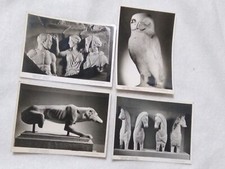
VTG RPPC REAL PICTURE N.STOVPNAPAS RARE SET OF 4 MUSEUM ART POST CARDS MUST SEE
$4300.00
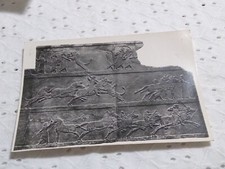
VTG RPPC REAL PICTURE ASHUR-BANI-PAL, KING OF ASSYRIA RARE MUSEUM ART POST CARD
$3800.00