RARE WWII Captured Rommel German Luftwaffe Tunisia Strike Map Operation Torch

When you click on links to various merchants on this site and make a purchase, this can result in this site earning a commission. Affiliate programs and affiliations include, but are not limited to, the eBay Partner Network.

RARE WWII Captured Rommel German Luftwaffe Tunisia Strike Map Operation Torch:
$3425.00
Comes with C.O.A.
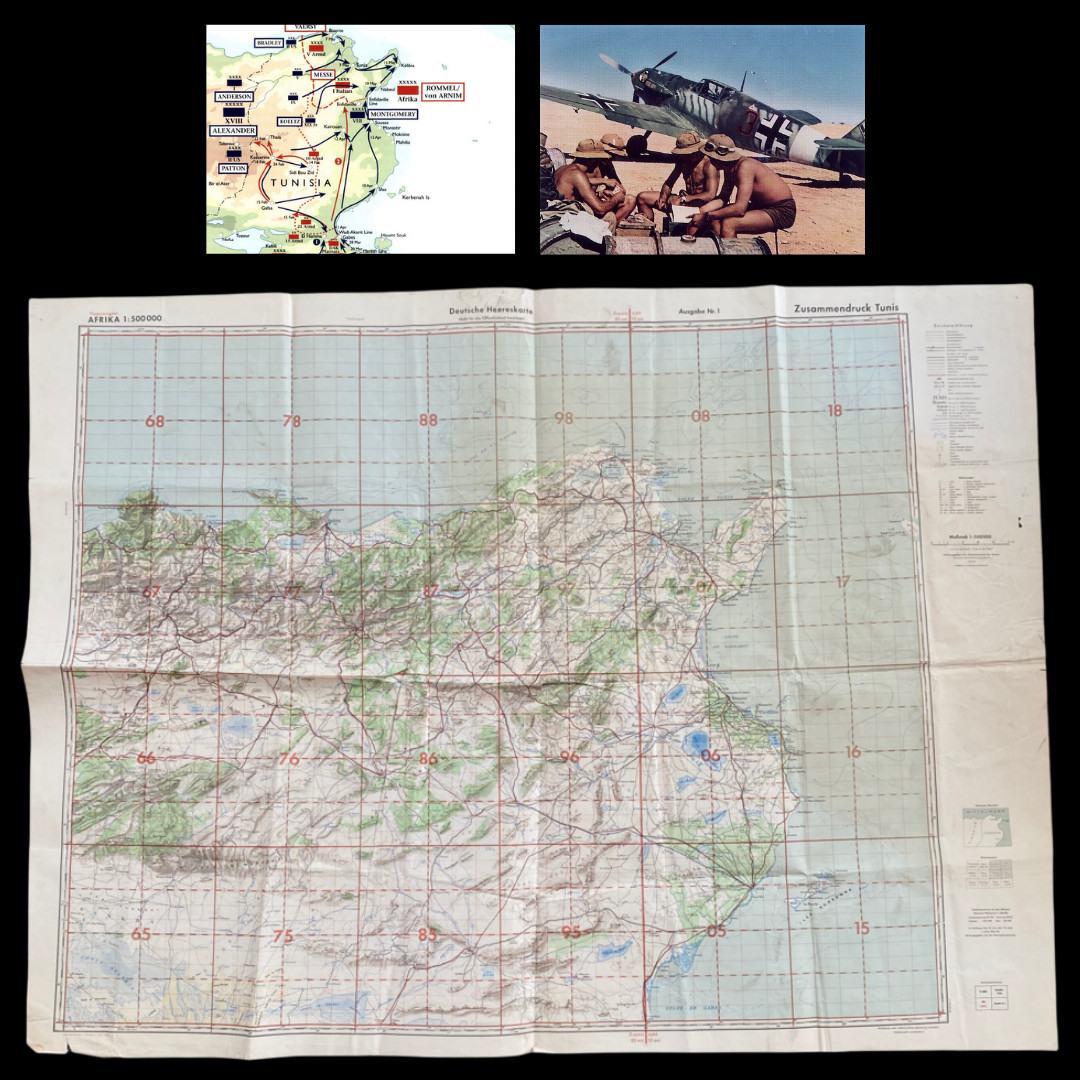
EXTREMELY RARE AND LARGE SIZE LUFTWAFFE MAP.
Captured Erwin Rommel German Afrika Korps special edition map during the Tunisia Campaign of Northern Africa. This map was captured by Corp. Robert S. Kennedy (35262390). This map would have provided vital information for Allied forces during the campaign. This special overprint Luftwaffe map is the rarest of the maps captured by Corp. Kennedy…very limited amounts of these Luftwaffe combat strike maps of the North Africa Campaign have survived making this one very rare.
This incredibly rare museum-grade WWII German Afrika Korps (German Africa Corps) map used was extensively by the German expeditionary force in Africa during the North African Campaign of World War II. Titled “Zusammenddruck Tunis” (Translated: Overprint Tunisia) this Fliegerausgabe (Translated: Flyer Edition) map shows some of the deadliest battlegrounds of the German Afrika Korps led by Field Marshal Erwin Rommel against American forces led by the U.S. fo Dwight D. Eisenhower and George S. Patton and Marshal Bernard Law Montgomery, one of the most prominent and successful British commanders of the Second World War who most notably commanded the Allies against General Erwin Rommel in North Africa, and in the invasions of Italy and Normandy.
Several Luftwaffe bomber wings undertook anti-shipping strikes against Allied ports in Algiers and along the North African coast. Germany was forced to engage more and more aerial units on what was initially considered a peripheral arena of the war for the German High Command. Losses in bombers and fighters were high on both sides and when, at the end of 1942, the Allies landed in Morocco and Algeria on the back of the Afrika Korps, the Wehrmacht's fate was sealed. The depleted Luftwaffe did its best but could not change the course of the battle. The last German units capitulated in Tunisia in May 1943.
This German map has a very interesting history as it was captured during Operation Torch and the Tunisian campaign by a Corp. Robert S. Kennedy. TheTunisian campaign(also known as theBattle of Tunisia) was a series of battles that took place inTunisiaduring theNorth African campaignof theSecond World War, betweenAxisandAlliedforces from 17 November 1942 to 13 May 1943. The Allies consisted ofBritish Imperial Forces, including aGreek contingent, withAmericanandFrench corps. The battle opened with initial success by theGermanandItalianforces but the massive supply interdiction efforts led to the decisive defeat of the Axis. Over 250,000GermanandItaliantroops were taken asprisoners of war, including most of theAfrika Korps.
Tunisia:
After the German and Italian occupation of Vichy France and their failed attempt to capture the French fleet at Toulon (Operation Lila), the FrenchArmée d'Afriquesided with the Allies, providing a third corps (XIX Corps) for Anderson. Elsewhere, French warships, such as the battleshipRichelieu, rejoined the Allies.
On 9 November, Axis forces started to build up in French Tunisia, unopposed by the local French forces under General Barré. Wracked with indecision, Barré moved his troops into the hills and formed a defensive line from Teboursouk through Medjez el Bab and ordered that anyone trying to pass through the line would be shot. On 19 November, the German commander,Walter Nehring, demanded passage for his troops across the bridge at Medjez and was refused. The Germans attacked the poorly-equipped French units twice and were driven back. The French had suffered many casualties and lacking artillery and armour, Barré was forced to withdraw.
After consolidating in Algeria, the Allies began the Tunisia Campaign. Elements of the First Army (Lieutenant-General Kenneth Anderson), came to within 40 mi (64 km) of Tunis before a counterattack at Djedeida thrust them back. In January 1943, German and Italian troops under Generalfeldmarschall Erwin Rommel, retreating westward from Libya, reached Tunisia.
TheEighth Army(Lieutenant-GeneralBernard Montgomery) advancing from the east, stopped aroundTripoliwhile the port was repaired to disembark reinforcements and build up the Allied advantage. In the west, the forces of the First Army came under attack at the end of January, were forced back from the Faïd Pass and suffered a reversal at theBattle of Sidi Bou Zidon 14–15 February. Axis forces pushed on to Sbeitla and then fought theBattle of Kasserine Passon 19 February, where the US II Corps retreated in disarray until Allied reinforcements halted the Axis advance on 22 February. Fredendall was sacked and replaced byGeorge Patton.
GeneralSirHarold Alexanderarrived in Tunisia in late February to take charge of the new18th Army Groupheadquarters, which had been created to command the Eighth Army and the Allied forces already fighting in Tunisia. The Axis forces attacked eastward at theBattle of Medenineon 6 March but were easily repulsed by the Eighth Army. Rommel advised Hitler to allow a full retreat to a defensible line but was denied and on 9 March, Rommel left Tunisia to be replaced byJürgen von Arnim, who had to spread his forces over 100mi (160km) of northern Tunisia.
The setbacks at Kasserine forced the Allies to consolidate their forces, develop theirlines of communicationand administration before another offensive. The First and Eighth Armies attacked again in April. Hard fighting followed but the Allies cut off the Germans and Italians from support by naval and air forces between Tunisia andSicily. On 6 May, as the culmination ofOperation Vulcan, the British took Tunis and American forces reachedBizerte. By 13 May, the Axis forces in Tunisia had surrendered, opening the way for theAllied invasion of Sicilyin July.
RARE WWII Captured Rommel German Luftwaffe Tunisia Strike Map Operation Torch:
$3425.00
Related Items:

WWII Japanese sword - ULTRA RARE Sakabatō 逆刃刀 reverse edge blade MUSEUM PIECE
$1000000.00

White House President Franklin Roosevelt World War II-RARE Short Snorter
$500000.00

WWII RARE AVG FLYING TIGERS ACE'S CHINESE WINGED STAR / CLOUD & BANNER MEDAL LOT
$55998.77