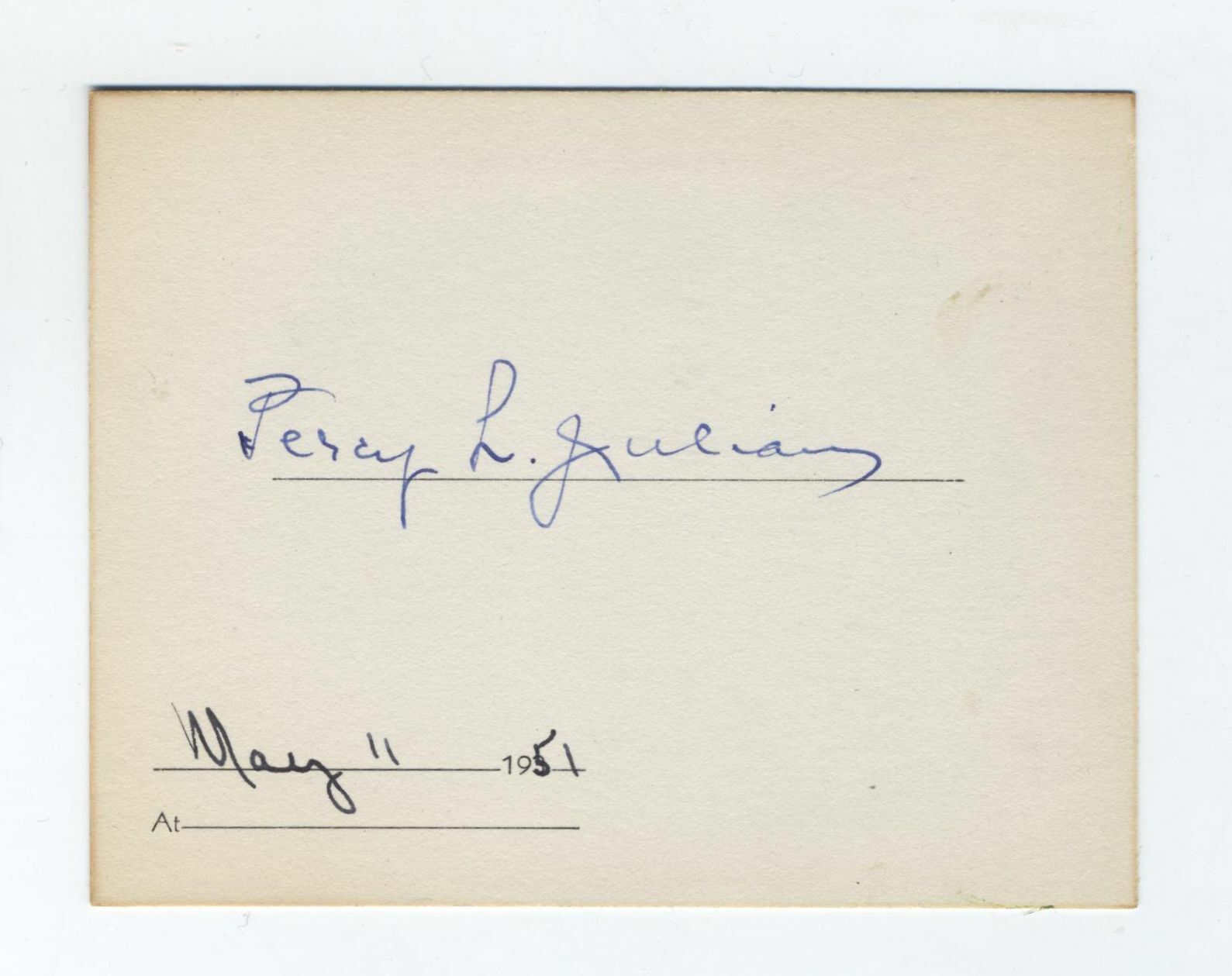
ORIGINAL AFRICAN AMERICAN CHEMIST PERCY LAVON JULIAN VERY RARE SIGNATURE

When you click on links to various merchants on this site and make a purchase, this can result in this site earning a commission. Affiliate programs and affiliations include, but are not limited to, the eBay Partner Network.

ORIGINAL AFRICAN AMERICAN CHEMIST PERCY LAVON JULIAN VERY RARE SIGNATURE:
$6505.08
An extremely rare autograph of probably one of the greatest Chemists of the 20th century - Percy L. Julian from 1951 on acard measuring 3.5x4.5 inches signed by this genius and legendary African American Academic, Civil Rights Activist, Chemist, Scientist and Medical Professional. Signed boldly in blue ink.A steroid chemist and an entrepreneur, Percy Julian ingeniously figured out how to synthesize important medicinal compounds from abundant plant sources, making them more affordable to mass-produce.In the 1930s chemists recognized the structural similarity of a large group of natural substances—the steroids. These include the sex hormones and the cortical hormones of the adrenal glands. The medicinal potential of these compounds was clear, but extracting sufficient quantities of them from animal tissue and fluids was prohibitively expensive. As with other scarce or difficult-to-isolate natural products, chemists were called upon to mimic nature by creating these steroids in the lab and later by modifying them to make them safer and more effective as drugs. Chemists found their starting materials in certain plant substances that were also steroids. Percy Lavon Julian (1899–1975) was among the many scientists, including Russell Earl Marker, Carl Djerassi, and George Rosenkranz, who participated actively in the synthesis and large-scale production of steroids from plant compounds.
bio-julian-stamp.jpgPercy Julian was honored on this stamp issued by the U.S. Postal Service in 1993. Courtesy United States Postal Service.Percy Julian was honored on this stamp issued by the U.S. Postal Service in 1993.Courtesy United States Postal Service.Education and Early CareerJulian was born in Montgomery, Alabama, the son of a railway mail clerk and the grandson of slaves. In an era when African Americans faced prejudice in virtually all aspects of life, not least in the scientific world, he succeeded against the odds. Inadequately prepared by his high school, he was accepted at DePauw University in Greencastle, Indiana, as a sub-freshman, meaning that he had to take high-school courses concurrently with his freshman courses. Majoring in chemistry, he graduated as valedictorian of his class in 1920. After graduation he taught chemistry at Fisk University for two years before winning an Austin Fellowship to Harvard University, where he completed a master’s degree in organic chemistry. After Harvard he returned to teaching at West Virginia State College and Howard University.
Physostigmine for GlaucomaIn 1929 Julian traveled to the University of Vienna, Austria, to begin doctoral studies on the chemistry of medicinal plants. Two years later, with degree in hand, he and a Viennese colleague, Josef Pikl, took positions back in the United States at Howard and two years later moved to DePauw. There they accomplished the first total synthesis of physostigmine, the active principle of the Calabar bean, used since the end of the 19th century to treat glaucoma. Physostigmine, an alkaloid, eases the constriction of outflow channels from the eye’s aqueous humor to relieve high pressure there, which, if left untreated, damages the retina and eventually causes blindness.
Steroids from Soybeans: ProgesteroneMeanwhile researchers in many countries were seeking innovative and cost-effective ways to synthesize steroids, including cortisone and the sex hormones. German chemists discovered that the steroid stigmasterol, which Julian had obtained as a by-product of the physostigmine synthesis but was also obtainable from soybeans, could be used in the synthesis of certain sex hormones, including progesterone, a female sex hormone that was important in helping pregnant women avoid miscarriages. In pursuit of this lead, in 1936 Julian wrote to the Glidden Company in Chicago, requesting samples of their soybean oil. Through a series of events he wound up being hired by Glidden instead, as their director of research in the Soya Division, where he set about figuring out ways to make new products from soybeans.
bio-julian1.jpgPercy Julian. Gift of Ray Dawson, CHF Collections.Percy Julian.Gift of Ray Dawson, CHF Collections.Three years after arriving at Glidden, Julian learned from plant workers that water had leaked into a tank of purified soybean oil and formed a solid white mass. Immediately identifying the substance as stigmasterol, he realized he had stumbled upon a method for producing large amounts of the steroid from soybeans. Though scientists already knew how to synthesize progesterone from stigmasterol, they didn’t have a method for doing it on a massive scale. Now with large quantities of stigmasterol at hand, he was able to develop an innovative industrial process for converting it to progesterone in bulk, producing five to six pounds of progesterone per day (worth thousands of dollars in those days). Soon other sex hormones were in production.
Cortisone and HydrocortisoneIn 1948 scientists at the Mayo Clinic announced their landmark discovery of cortisone, which had remarkable effects on rheumatoid arthritis, and Julian jumped into the exciting competition to synthesize cortisone inexpensively (see also Carl Djerassi). Cortisone is a cortical hormone of the adrenal gland. In 1949 Julian developed a new synthesis for a related substance (called “Substance S”) also present in the adrenal cortex and differing from cortisone by only an oxygen atom. From this substance he was able to synthesize both cortisone and hydrocortisone. Hydrocortisone and its derivatives today are more widely prescribed than cortisone products, and most industrial syntheses still begin along the same route that Julian pioneered.
Later LifeJulian remained at Glidden until 1954, when he founded his own company, Julian Laboratories of Franklin Park, Illinois, and Mexico City (which he eventually sold to Smith, Kline and French). Throughout his life he was socially active in groups seeking to advance conditions for African Americans, helping to found the Legal Defense and Educational Fund of Chicago and serving on the boards of several other organizations and universities.
In 1935, in Minshall Laboratory, DePauw alumnus Percy L. Julian (1899-1975) first synthesized the drug physostigmine, previously only available from its natural source, the Calabar bean. His pioneering research led to the process that made physostigmine readily available for the treatment of glaucoma. It was the first of Julian’s lifetime of achievements in the chemical synthesis of commercially important natural products.
ContentsPercy L. Julian and Chemistry at DePauw UniversityPercy Julian’s ScienceBiography of Percy Lavon JulianFurther ReadingLandmark Designation and AcknowledgmentsCite this Page“Synthesis of Physostigmine” commemorative booklet“Synthesis of Physostigmine” commemorative booklet produced by the National Historic Chemical Landmarks program of the American Chemical Society in 1999 (PDF).Percy L. Julian and Chemistry at DePauw UniversityThe early 1930s was a time of great chemical research productivity at DePauw. It was in this decade that William M. Blanchard, Dean of the University, hired Percy Julian as a research fellow. Blanchard, who also served as head of the chemistry department, had been Julian's mentor during his undergraduate years at DePauw. Julian had received a Ph.D. degree in Vienna in 1931 and was in need of a position in which he could continue his research career. The DePauw chemistry program he joined in 1933 had roots that extended back to 1839 when the university was Asbury College and chemistry was offered as a natural science course taught by the president, Matthew Simpson. Chemistry became a distinct department in 1881 under the direction of Phillip S. Baker. The department prospered and a chemistry major was established in 1896. Percy Julian graduated from this program in 1920.
As a research fellow from 1932 to 1935, Julian, working with his colleague from Vienna, Josef Pikl, and several DePauw students, produced a phenomenal number of high-quality research papers. One such paper appeared in the April 1935 issue of the Journal of the American Chemical Society. This paper, entitled "Studies in the Indole Series V. The Complete Synthesis of Physostigmine (Eserine)," which explained how Julian synthesized physostigmine, is undoubtedly the most significant chemical research publication to come from DePauw. The student and faculty collaborative approach, promoted by Julian, has continued to the present, and today most of the research at DePauw is done in collaboration with students.
After the grant funding Julian's position expired, Blanchard wanted to appoint Julian to the teaching staff. Despite Julian's achievements, the Board of Trustees did not allow it. Julian left DePauw to pursue a distinguished career in industry.
In 1967, Julian was appointed to the DePauw University Board of Trustees. Also that year, planning began for a new science building, which would replace the 65-year-old Minshall Laboratory, and construction commenced in 1968. The Science and Mathematics Center was dedicated in September 1972, with Percy Julian giving the dedication address, "Science and the Good Life of Man." Following Julian's death, DePauw University named the Percy L. Julian Science and Mathematics Center in his honor.
Back to top
Percy Julian's ScienceWhen Percy Julian returned to the DePauw University campus in 1932, he embarked on the project that would forever secure his reputation as a world-class researcher the first total synthesis of the anti-glaucoma drug physostigmine, an alkaloid found in the Calabar bean. Glaucoma, a disorder in which the pressure in the eyeball increases when the aqueous humor does not drain normally, can cause damage to the optic nerve and a loss of vision. Physostigmine promotes drainage of this fluid by easing the constriction of outflow channels. 65 years later, Julian's achievement still remains important as derivatives and optically pure forms of physostigmine continue to show therapeutic promise for the treatment of Alzheimer's disease and for combating the effects of chemical weapons.
Starting from phenacetin, Julian and Josef Pikl, who was working as an assistant in chemistry, assembled physostigmine in 11 synthetic steps. The project, which took three years to complete, was reported in a series of papers in the Journal of the American Chemical Society. During the project, while the two chemists were working toward the synthesis of d,l-eserethole (a key intermediate compound two steps removed from physostigmine), a group of chemists, also working to synthesize physostigmine, under the direction of Sir Robert Robinson at Oxford University in England, reported their synthesis of d,l-eserethole. Unlike today, when chemists can rely on modern analytical methods such as nuclear magnetic resonance spectroscopy, mass spectrometry, and X-ray crystallography to determine unequivocally the composition and structure of a compound, chemists in the 1930s relied on simpler, indirect, physicochemical methods for their analysis. As it happened in the case of d,l-eserethole, the physicochemical parameters of Robinson's d,l-eserethole were not in agreement with those of Julian and Pikl. Firm in his conviction that his synthetic strategy was sound, Julian risked his yet-unproven reputation and boldly wrote in the fourth paper in the series that the work of Robinson was in error.
Subsequently, in the much celebrated fifth paper in the series, "Studies in the Indole Series V. The Complete Synthesis of Physostigmine (Eserine)," Julian summarized his and Pikl's work on the most challenging total synthesis project of its time with the following:
"Physostigmine, the principal alkaloid of the Calabar bean, and long used as a drug, has, since its isolation by Jobst and Hesse 70 years ago, been the subject of numerous investigations. The determination of its constitution was rendered particularly difficult since its peculiar chemical structure found no analog in other plant products of known composition.
“Shortly after promising experiments in the direction of (its synthesis) were underway (in our laboratory) the work had to be interrupted and could only be resumed recently. In the meantime, the first of a series of ten papers dealing with the synthesis of physostigmine, by Robinson and his collaborators, appeared and seemingly proved convincingly that the (course) suggested in our formulas could not be realized in practice. Our experiments, nevertheless, were continued and ... led to the successful synthesis of d,l-eserethole.
“To our surprise, our d,l-eserethole exhibited entirely different properties than those of a compound synthesized by Robinson and his coworkers and called d,l-eserethole. Likewise were all derivatives different. Inasmuch as our (optically) inactive material subjected to characteristic reactions of eserethole of natural origin yielded perfectly analogous results, we expressed the belief that our product was the real d,l-eserethole and that of the English chemists must be assigned another constitution.
“This is now proved conclusively by synthesis of l-eserethole, identical with the product of natural origin.”
Following the total synthesis of physostigmine and the separation of physostigmine into its optical isomers, Julian was to make another discovery at DePauw that not only would enhance his stature as a chemist but also greatly improve the lives of many. It was in the course of isolating geneserin, a companion alkaloid of physostigmine from the Calabar bean, that Julian discovered small crystals of the hydrate of stigmasterol in the acid-washed oil extracted from the beans. Molecules such as stigmasterol possess a central structural unit composed of 17 carbon atoms arranged into four fused rings that is also found in many biologically significant compounds such as cholesterol and the sex hormones, estradiol and testosterone. More generally known as steroids, these compounds cover a broad range of form and function and in many cases are of great value as therapeutic agents.
It was four years after this serendipitous discovery of the stigmasterol crystals that Percy Julian, then the director of research in the Soya Products Division of the Glidden Co., was summoned to a 100,000 gallon soybean oil storage container. Water seeping into the oil had resulted in the formation of a white solid material that had collected at the bottom of the tank. Remembering his DePauw experience, Julian realized that the extremely small amounts of sterols contained in soybean oil had been concentrated and isolated in the white solid. Subsequent modification of this "accidental procedure" led to the daily production of 100 pounds of mixed soya sterols worth more than $3.6 million annually. These sterols were then easily converted using methods and equipment designed by Julian to produce commercial quantities of a variety of sex hormones, including progesterone, all at a greatly reduced cost to the public but still with a healthy profit for Glidden.
Later in his career at Glidden and at his own research institute, the Julian Laboratories, Percy Julian continued to make important contributions to the field of medicinal chemistry. His 1948 synthesis of Reichstein's Substance S is still the most widely used route to the production of hydrocortisone and its derivatives, which are used in the treatment of rheumatoid arthritis. He developed efficient syntheses for whole families of steroids including 4,5-epoxy steroids, 16,17-epoxy steroids, 21- iodo steroids, 17-hydroxy steroids, 4-halo steroids, and numerous steroids containing the diosphenol structure. In later years, he worked on the synthesis of the yohimbine alkaloids and in uncovering the metabolism of tryptophan, one of the nine amino acids essential for healthy living.
Back to top
Percy Julian in the Minshall Laboratory at DePauw University during his tenure as a research fellow.Courtesy DePauw University Archives.Biography of Percy Lavon JulianIn a lifetime of continual striving, Percy L. Julian (1899-1975) succeeded against the prejudices and discrimination of his time to become a pathbreaking synthetic chemist, a successful industrial research director, and a wealthy businessman.
Julian was born in Montgomery, Ala., on April 11, 1899, the son of a railway clerk and the grandson of slaves. From the beginning, he did well in school, but there was no public high school for African Americans in Montgomery. Julian graduated from an all-Black normal school inadequately prepared for college. Even so, in the fall of 1916, at the age of 17, he was accepted as a sub-freshman at DePauw. This meant that in addition to his regular college courses he took classes at a nearby high school. He also had to work in order to pay his college expenses. Nevertheless, he excelled.
Julian was elected to Phi Beta Kappa and graduated with a B.A. degree in 1920 as valedictorian of his class. His chosen path of chemistry would prove to be a rocky one. With no encouragement to continue his education, based on the lack of future job opportunities, Julian found a position as instructor in chemistry at Fisk University, in Nashville, TN.
After two years at Fisk, Julian won an Austin Fellowship to Harvard and received his M.A. degree in 1923. Again, he faced disappointment when no job offer was forthcoming. In succeeding years, he served on the staff of predominantly Black institutions — first at West Virginia State College, and in 1928, as head of the department of chemistry at Howard University, Washington, D.C. In 1929, Julian received a Rockefeller Foundation grant and the chance to earn his doctorate in chemistry. He elected to study natural products chemistry with Ernst Späth at the University of Vienna. He received his Ph.D. in 1931 and returned to Howard, accompanied by his friend, Josef Pikl. After two years there, internal politics forced them to leave.
In 1933, through the efforts of his former professor William Blanchard, Julian returned to DePauw University as a research fellow. He directed research projects for senior and graduate students. It was here in Minshall Laboratory in 1935, in collaboration with Pikl, that he completed the research that would result in the total synthesis of physostigmine. This work established Julian’s reputation as a world-renowned chemist at the age of 36.
Despite his accomplishments as a recognized and published researcher, Percy Julian was denied a faculty position at DePauw. Frustrated in his efforts to gain an academic post, Julian turned to industry. One research job fell through because of a town law forofferding “housing of a Negro overnight.” Then, in 1936, a door opened when Julian was offered a position as director of research for soya products for Glidden in Chicago. Over the next 18 years, the results of his soybean protein research produced numerous patents and successful products for Glidden, among them a paper coating and a fire-retardant foam used widely in WWII to extinguish gasoline fires. His biomedical research made it possible to produce large quantities of synthetic progesterone and hydrocortisone at low cost.
In 1953, he established Julian Laboratories, a successful enterprise that he sold for more than $2 million in 1961. He later formed Julian Research Institute, a nonprofit research organization. Among his many lifetime honors was election, in 1973, to the National Academy of Sciences. He was also widely recognized as a steadfast advocate for human rights. Julian continued his private research studies and served as a consultant to major pharmaceutical companies until his death on April 19, 1975.African-American chemist Percy Julian was a pioneer in the chemical synthesis of medicinal drugs such as cortisone, steroids and birth control pills.Synopsis
Born in Alabama in 1899, pioneering chemist Percy Julian was not allowed to attend high school but went on to earn his Ph.D. His research at academic and corporate institutions led to the chemical synthesis of drugs to treat glaucoma and arthritis, and although his race presented challenges at every turn, he is regarded as one of the most influential chemists in American history.
Early Life
Percy Lavon Julian was born April 11, 1899, in Montgomery, Alabama, the grandson of former slaves. He attended school through the eighth grade but there were no high schools open to black students. He applied to DePauw University in Greencastle, Indiana, where he had to take high school-level classes in the evening to get him up to the academic level of his peers. In spite of this challenging beginning, he graduated first in his class, with Phi Beta Kappa honors.
Life in Academia
After college, Julian accepted a position as a chemistry instructor at Fisk University. He left in 1923 when he received a scholarship to attend Harvard University to finish his master’s degree, though the university would not allow him to pursue his doctorate. He traveled for several years, teaching at black colleges, before obtaining his Ph.D. at the University of Vienna in Austria in 1931.
With his doctorate in hand, he returned to DePauw to continue his research. In 1935 he earned international acclaim by synthesizing physostigmine from the calabar bean to create a drug treatment for glaucoma, but in spite of his success, the university refused to make him a full professor because of his race.
Later Career
Desiring to leave academia, Julian applied for jobs at prominent chemical companies, but was repeatedly rejected when hiring managers discovered that he was black. Ultimately, he obtained a position at Glidden Company as the lab director. There he invented Aero-Foam, a product that uses soy protein to put out oil and gas fires and was widely used in World War II, as well as other soybean-based inventions.
Julian continued his biomedical work as well, and discovered how to extract sterols from soybean oil and synthesize the hormones progesterone and testosterone. He was also lauded for his synthesis of cortisone, which became used in the treatment of rheumatoid arthritis.
Julian left Glidden in 1953 and established his own laboratory, Julian Laboratories, in 1954. He sold the company in 1961, becoming one of the first black millionaires, before founding Julian Research Institute, a nonprofit organization that he ran for the rest of his life.
He died of liver cancer on April 19, 1975.
Recognition
Julian was the first black chemist elected to the National Academy of the Sciences, in 1973. In 1990 he was elected to the National Inventors Hall of Fame, and in 1999 his synthesis of physostigmine was recognized by the American Chemical Society as “one of the top 25 achievements in the history of American chemistry.”
Personal Life
Julian met his wife, Anna Roselle, while employed at Howard University, and the two were accused of having an affair while she was married to one of his colleagues. A scandal ensued and Julian was fired, but he and Anna married in 1935 and had two children.
"The right of a people to live where they want to, without fear, is more important than my science." - Percy JulianIn 1950, Julian and his family moved to Oak Park, Illinois. After they purchased their home but before they moved in, the house was firebombed on Thanksgiving Day. It was attacked again in June, 1951.
Julian’s life was the subject of a documentary film made for PBS’s Nova series, entitled Forgotten Genius.
Percy Lavon Julian (April 11, 1899 – April 19, 1975) was an African American research chemist and a pioneer in the chemical synthesis of medicinal drugs from plants.[1] He was the first to synthesize the natural product physostigmine, and a pioneer in the industrial large-scale chemical synthesis of the human hormones progesterone and testosterone from plant sterols such as stigmasterol and sitosterol. His work laid the foundation for the steroid drug industry's production of cortisone, other corticosteroids, and birth control pills.[2][3][4]
He later started his own company to synthesize steroid intermediates from the wild Mexican yam. His work helped greatly reduce the cost of steroid intermediates to large multinational pharmaceutical companies, helping to significantly expand the use of several important drugs.[5][6]
Julian received more than 130 chemical patents. He was one of the first African Americans to receive a doctorate in chemistry. He was the first African-American chemist inducted into the National Academy of Sciences, and the second African-American scientist inducted (behind David Blackwell) from any field.[5]
Contents [hide]1 Early life and education2 Private sector work: Glidden3 Steroids4 Oak Park and Julian Laboratories5 National Academy of Sciences6 Legacy and honors6.1 Nova documentary6.2 Archive7 Patents8 Publications9 See also10 References11 Further reading12 External linksEarly life and education[edit]Percy Lavon Julian was born in Montgomery, Alabama, as the first child of six born to James Sumner Julian and Elizabeth Lena Julian, née Adams. Both of his parents were graduates of what was to be Alabama State University. His father, James, whose own father had been a slave, was employed as a clerk in the Railway Service of the United States Post Office, while his mother, Elizabeth, worked as a schoolteacher.[7][8][9] Percy Julian grew up in the time of racist Jim Crow culture and legal regime in the southern United States. Among his childhood memories was finding a lynched man hanged from a tree while walking in the woods near his home. At a time when access to an education beyond the eighth grade was extremely rare for African-Americans, Julian's parents steered all of their children toward higher education.
Julian attended DePauw University in Greencastle, Indiana. The college accepted few African-American students. The segregated nature of the town forced social humiliations. Julian was not allowed to live in the college dormitories and first stayed in an off-campus boarding home, which refused to serve him meals. It took him days before Julian found an establishment where he could eat. He later found work firing the furnace, waiting tables, and doing other odd jobs in a fraternity house; in return, he was allowed to sleep in the attic and eat at the house. Julian graduated from DePauw in 1920 as a Phi Beta Kappa and valedictorian.[10] By 1930 Julian's father would move the entire family to Greencastle so that all his children could attend college at DePauw. He still worked as a railroad postal clerk.[7]
After graduating from DePauw, Julian wanted to obtain his doctorate in chemistry, but learned it would be difficult for an African-American to do so. Instead he obtained a position as a chemistry instructor at Fisk University. In 1923 he received an Austin Fellowship in Chemistry, which allowed him to attend Harvard University to obtain his M.S. However, worried that Euro-American students would resent being taught by an African-American, Harvard withdrew Julian's teaching assistantship, making it impossible for him to complete his Ph.D. at Harvard.
In 1929, while an instructor at Howard University, Julian received a Rockefeller Foundation fellowship to continue his graduate work at the University of Vienna, where he earned his Ph.D. in 1931. He studied under Ernst Späth and was considered an impressive student. In Europe, he found freedom from the racial prejudices that had stifled him in the States. He freely participated in intellectual social gatherings, went to the opera and found greater acceptance among his peers.[11][12] Julian was one of the first African Americans to receive a Ph.D. in chemistry, after St. Elmo Brady and Dr. Edward M.A. Chandler.[5][13]
After returning from Vienna, Julian taught for one year at Howard University. At Howard, in part due to his position as a department head, Julian became caught up in university politics, setting off an embarrassing chain of events. At university president Mordecai Wyatt Johnson's request,[14] he goaded white Professor of chemistry, Jacob Shohan (Ph.D from Harvard [15]), into resigning.[16][17] In late May 1932, Shohan retaliated by releasing to the local African-American newspaper the letters Julian had written to him from Vienna. The letters described "a variety of subjects from wine, pretty Viennese women, music and dances, to chemical experiments and plans for the new chemical building."[16] In the letters, he spoke with familiarity, and with some derision, of specific members of the Howard University faculty, terming one well-known Dean, an "ass".[16][18]
Around this same time, Julian also became entangled in an interpersonal conflict with his laboratory assistant, Robert Thompson. Julian had recommended Thompson for dismissal in March 1932.[19] Thompson sued Julian for "alienating the affections of his wife",[16] Anna Roselle Thompson, stating he had seen them together in a sexual tryst. Julian counter-sued him for libel. When Thompson was fired, he too gave the paper intimate and personal letters which Julian had written to him from Vienna. Dr. Julian's letters revealed "how he fooled the [Howard] president into accepting his plans for the chemistry building"[18] and "how he bluffed his good friend into appointing" a professor of Julian's liking.[18] Through the summer of 1932, the Baltimore Afro-American published all of Julian's letters. Eventually, the scandal and accompanying pressure forced Julian to resign. He lost his position and everything he had worked for.[5]
Some happiness for Dr. Julian, however, was to come from this scandal. On December 24, 1935 he married Anna Roselle (Ph.D. in Sociology, 1937, University of Pennsylvania). They had two children: Percy Lavon Julian, Jr. (August 31, 1940 – February 24, 2008), who became a noted civil rights lawyer in Madison, Wisconsin;[20] and Faith Roselle Julian (1944– ), who still resides in their Oak Park home and often makes inspirational speeches about her father and his contributions to science.[21]
At the lowest point in Julian's career, his former mentor, William Blanchard, threw him a much-needed lifeline. Blanchard offered Julian a position to teach organic chemistry at DePauw University in 1932. Julian then helped Josef Pikl, a fellow student at the University of Vienna, to come to the United States to work with him at DePauw. In 1935 Julian and Pikl completed the total synthesis of physostigmine and confirmed the structural formula assigned to it. Robert Robinson of Oxford University in the U.K. had been the first to publish a synthesis of physostigmine, but Julian noticed that the melting point of Robinson's end product was wrong, indicating that he had not created it. When Julian completed his synthesis, the melting point matched the correct one for natural physostigmine from the calabar bean.[5]
Julian also extracted stigmasterol, which took its name from Physostigma venenosum, the west African calabar bean that he hoped could serve as raw material for synthesis of human steroidal hormones. At about this time, in 1934, Butenandt and Fernholz, in Germany,[22][23] had shown that stigmasterol, isolated from soybean oil, could be converted to progesterone by synthetic organic chemistry.
Private sector work: Glidden[edit]In 1936 Julian was denied a professorship at DePauw for racial reasons. DuPont had offered a job to fellow chemist Josef Pikl but declined to hire Julian, despite his superlative qualifications as an organic chemist, apologizing that they were "unaware he was a Negro".[10] Julian next applied for a job at the Institute of Paper Chemistry (IPC) in Appleton, Wisconsin. However, Appleton was a sundown town, forofferding African Americans from staying overnight, stating directly: "No Negro should be bed or boarded overnight in Appleton."
Meanwhile, Julian had written to the Glidden Company, a supplier of soybean oil products, to request a five-gallon sample of the oil to use as his starting point for the synthesis of human steroidal sex hormones (in part because his wife was suffering from infertility). After receiving the request, W. J. O'Brien, a vice-president at Glidden, made a telephone call to Julian, offering him the position of director of research at Glidden's Soya Products Division in Chicago. He was very likely offered the job by O'Brien because he was fluent in German, and Glidden had just purchased a modern continuous countercurrent solvent extraction plant from Germany for the extraction of vegetable oil from soybeans for paints and other uses.[5]
Julian supervised the assembly of the plant at Glidden when he arrived in 1936. He then designed and supervised construction of the world's first plant for the production of industrial-grade, isolated soy protein from oil-free soybean meal. Isolated soy protein could replace the more expensive milk casein in industrial applications such as coating and sizing of paper, glue for making Douglas fir plywood, and in the manufacture of water-based paints.
At the start of World War II, Glidden sent a sample of Julian's isolated soy protein to National Foam System Inc. (today a unit of Kidde Fire Fighting), which used it to develop Aer-O-Foam,[24][25] the U.S. Navy's beloved fire-fighting "bean soup." While it was not exactly Julian's brainchild, his meticulous care in the preparation of the soy protein made the fire fighting foam possible. When a hydrolyzate of isolated soy protein was fed into a water stream, the mixture was converted into a foam by means of an aerating nozzle. The soy protein foam was used to smother oil and gasoline fires aboard ships and was particularly useful on aircraft carriers. It saved the lives of thousands of sailors and airmen.[25] Citing this achievement, in 1947 the NAACP awarded Julian the Spingarn Medal, its highest honor.
Steroids[edit]Julian's research at Glidden changed direction in 1940 when he began work on synthesizing progesterone, estrogen, and testosterone from the plant sterols stigmasterol and sitosterol, isolated from soybean oil by a foam technique he invented and patented.[2][26] At that time clinicians were discovering many uses for the newly discovered hormones. However, only minute quantities could be extracted from hundreds of pounds of the spinal cords of animals.
In 1940 Julian was able to produce 100 lb of mixed soy sterols daily, which had a value of $10,000 ($80,000 today)[27] as sex hormones. Julian was soon ozonizing 100 pounds daily of mixed sterol dibromides. The soy stigmasterol was easily converted into commercial quantities of the female hormone progesterone, and the first pound of progesterone he made, valued at $63,500 ($509,000 today),[27] was shipped to the buyer, Upjohn,[28] in an armored car.[4] Production of other sex hormones soon followed.[29]
His work made possible the production of these hormones on a larger industrial scale, with the potential of reducing the cost of treating hormonal deficiencies. Julian and his co-workers obtained patents for Glidden on key processes for the preparation of progesterone and testosterone from soybean plant sterols. Product patents held by a former cartel of European pharmaceutical companies had prevented a significant reduction in wholesale and retail prices for clinical use of these hormones in the 1940s. He saved many lives with this discovery.[30][31][32]
On April 13, 1949, rheumatologist Philip Hench at the Mayo Clinic announced the dramatic effectiveness of cortisone in treating rheumatoid arthritis. The cortisone was produced by Merck at great expense using a complex 36-step synthesis developed by chemist Lewis Sarett, starting with deoxycholic acid from cattle bile acids. On September 30, 1949, Julian announced an improvement in the process of producing cortisone.[33][34][35][36] This eliminated the need to use osmium tetroxide, which was a rare and expensive chemical.[33] By 1950, Glidden could begin producing closely related compounds which might have partial cortisone activity. Julian also announced the synthesis, starting with the cheap and readily available pregnenolone (synthesized from the soybean oil sterol stigmasterol) of the steroid cortexolone (also known as Reichstein's Substance S), a molecule that differed from cortisone by a single missing oxygen atom; and possibly 17α-hydroxyprogesterone and pregnenetriolone, which he hoped might also be effective in treating rheumatoid arthritis,[33][34][35][36][37] but unfortunately they were not.[36]
On April 5, 1952, biochemist Durey Peterson and microbiologist Herbert Murray at Upjohn published the first report of a fermentation process for the microbial 11α-oxygenation of steroids in a single step (by common molds of the order Mucorales). Their fermentation process could produce 11α-hydroxyprogesterone or 11α-hydroxycortisone from progesterone or Compound S, respectively, which could then by further chemical steps be converted to cortisone or 11β-hydroxycortisone (cortisol).[38]
After two years, Glidden abandoned production of cortisone to concentrate on Substance S. Julian developed a multistep process for conversion of pregnenolone, available in abundance from soybean oil sterols, to cortexolone. In 1952, Glidden, which had been producing progesterone and other steroids from soybean oil, shut down its own production and began importing them from Mexico through an arrangement with Diosynth (a small Mexican company founded in 1947 by Russell Marker after leaving Syntex). Glidden's cost of production of cortexolone was relatively high, so Upjohn decided to use progesterone, available in large quantity at low cost from Syntex, to produce cortisone and hydrocortisone.[36]
In 1953, Glidden decided to leave the steroid business, which had been relatively unprofitable over the years despite Julian's innovative work.[39] On December 1, 1953, Julian left Glidden after 18 years, giving up a salary of nearly $50,000 a year (equivalent to $450,000 in 2016)[27] to found his own company, Julian Laboratories, Inc., taking over the small, concrete-block building of Suburban Chemical Company in Franklin Park, Illinois.[40][41][42]
On December 2, 1953, Pfizer acquired exclusive licenses of Glidden patents for the synthesis of Substance S. Pfizer had developed a fermentation process for microbial 11β-oxygenation of steroids in a single step that could convert Substance S directly to 11β-hydrocortisone (cortisol), with Syntex undertaking large-scale production of cortexolone at very low cost.[36]
Oak Park and Julian Laboratories[edit]Circa 1950, Julian moved his family to the Chicago suburb of Oak Park, becoming the first African-American family to reside there.[43] Although some residents welcomed them into the community, there was also opposition. Before they even moved in, on Thanksgiving Day, 1950, their home was fire-bombed. Later, after they moved in, the house was attacked with dynamite on June 12, 1951. The attacks galvanized the community, and a community group was formed to support the Julians.[44] Julian's son later recounted that during these times, he and his father often kept watch over the family's property by sitting in a tree with a shotgun.[5]
In 1953, Julian founded his own research firm, Julian Laboratories, Inc. He brought many of his best chemists, including African-Americans and women, from Glidden to his own company. Julian won a contract to provide Upjohn with $2 million worth of progesterone (equivalent to $16 million today).[27] To compete against Syntex, he would have to use the same Mexican yam Mexican barbasco trade as his starting material. Julian used his own money and borrowed from friends to build a processing plant in Mexico, but he could not get a permit from the government to harvest the yams. Abraham Zlotnik, a former Jewish University of Vienna classmate whom Julian had helped escape from the Nazi European holocaust, led a search to find a new source of the yam in Guatemala for the company.
In July 1956, Julian and executives of two other American companies trying to enter the Mexican steroid intermediates market appeared before a U.S. Senate subcommittee. They testified that Syntex was using undue influence to monopolize access to the Mexican yam.[32][45] The hearings resulted in Syntex signing a consent decree with the U.S. Justice Department. While it did not admit to restraining trade, it promised not to do so in the future.[32] Within five years, large American multinational pharmaceutical companies had acquired all six producers of steroid intermediates in Mexico, four of which had been Mexican-owned.[32]
Syntex reduced the cost of steroid intermediates more than 250-fold over twelve years, from $80 per gram in 1943 to $0.31 per gram in 1955.[32][45] Competition from Upjohn and General Mills, which had together made very substantial improvements in the production of progesterone from stigmasterol, forced the price of Mexican progesterone to less than $0.15 per gram in 1957. The price continued to fall, bottoming out at $0.08 per gram in 1968.[32][36]
In 1958, Upjohn purchased 6,900 kg of progesterone from Syntex at $0.135 per gram, 6,201 kg of progesterone from Searle (who had acquired Pesa) at $0.143 per gram, 5,150 kg of progesterone from Julian Laboratories at $0.14 per gram, and 1,925 kg of progesterone from General Mills (who had acquired Protex) at $0.142 per gram.[46]
Despite continually falling bulk prices of steroid intermediates, an oligopoly of large American multinational pharmaceutical companies kept the wholesale prices of corticosteroid drugs fixed and unchanged into the 1960s. Cortisone was fixed at $5.48 per gram from 1954, hydrocortisone at $7.99 per gram from 1954, and prednisone at $35.80 per gram from 1956.[32][46] Merck and Roussel Uclaf concentrated on improving the production of corticosteroids from cattle bile acids. In 1960 Roussel produced almost one-third of the world's corticosteroids from bile acids.[36]
Julian Laboratories chemists found a way to quadruple the yield on a product on which they were barely breaking even. Julian reduced their price for the product from $4,000 per kg to $400 per kg.[5] He sold the company in 1961 for $2.3 million (equivalent to $18 million today).[27] The U.S. and Mexico facilities were purchased by Smith Kline, and Julian's chemical plant in Guatemala was purchased by Upjohn.
In 1964, Julian founded Julian Associates and Julian Research Institute, which he managed for the rest of his life.[47]
National Academy of Sciences[edit]He was elected to the National Academy of Sciences in 1973 in recognition of his scientific achievements.[5] He became the second African-American to be inducted, after David Blackwell.
Legacy and honors[edit]In 1950, the Chicago Sun-Times named Percy Julian the Chicagoan of the Year.[21]Since 1975, the National Organization for the Professional Advancement of Black Chemists and Chemical Engineers has presented the Percy L. Julian Award for Pure and Applied Research in Science and Engineering.[48]In 1975, Percy L. Julian High School was opened on the south side of Chicago, Illinois as a Chicago public high school.In 1980, the science and mathematics building on the DePauw University campus was rededicated as the Percy L. Julian Mathematics and Science Center. In Greencastle, Indiana, where DePauw is located, a street was named after Julian.In 1985, Hawthorne School in Oak Park, Illinois, was renamed Percy Julian Middle School.[49]Illinois State University, where Julian served on the board of trustees, named a hall after him.[50]A structure at Coppin State University is named the Percy Julian Science Building.In 1990, he was inducted into the National Inventors Hall of Fame.[51]In 1993 Julian was honored on a stamp issued by the United States Postal Service.[52][53]In 1999, the American Chemical Society recognized Julian's synthesis of physostigmine as a National Historic Chemical Landmark.[54]In 2002, scholar Molefi Kete Asante listed Percy Lavon Julian on his list of 100 Greatest African-Americans.[55]In 2011, the qualifying exam preparation committee at the Albert Einstein College of Medicine was named for Percy Julian.In 2014, Google honored him with a Doodle.[56][57][58]Nova documentary[edit]Ruben Santiago-Hudson portrayed Percy Julian in the Public Broadcasting Service Nova documentary about his life, called "Forgotten Genius". It was presented on the PBS network on February 6, 2007, with initial sponsorship by the Camille and Henry Dreyfus Foundation and further funding by the National Endowment for the Humanities. Approximately sixty of Julian's family members, friends, and work associates were interviewed for the docudrama.[5][59]
Production on the biopic began at DePauw University's Greencastle campus in May 2002 and included video of Julian's bust on display in the atrium of the university's Percy Lavon Julian Science and Mathematics Center. Completion and broadcasting of the documentary program was delayed in order for Nova to commission and publish a matching book on Julian's life.[60]
According to University of Illinois historian James Anderson in the film, "His story is a story of great accomplishment, of heroic efforts and overcoming tremendous odds...a story about who we are and what we stand for and the challenges that have been there and the challenges that are still with us."[59]
Archive[edit]The Percy Lavon Julian family papers are archived at DePauw University.[61]
Patents[edit]U.S. Patent 2,218,971, October 22, 1940, Recovery of sterolsU.S. Patent 2,373,686, July 15, 1942, Phosphatide product and method of makingU.S. Patent 2,752,339, June 26, 1956, Preparation of cortisoneU.S. Patent 3,149,132, September 15, 1964, 16-aminomenthyl-17-alkyltestosterone derivativesU.S. Patent 3,274,178, September 20, 1966, Method for preparing 16(alpha)-hydroxypregnenes and intermediates obtained thereinU.S. Patent 3,761,469, September 25, 1973, Process for the manufacture of steroid chlorohydrins; with Arnold Lippert HirschAfrican American chemist Percy Julian was a pioneer in the chemical synthesis of medicinal drugs such as cortisone, steroids and birth control pills.Who Was Percy Julian?Percy Julian was a pioneering chemist who was not allowed to attend high school but went on to earn his Ph.D. His research at academic and corporate institutions led to the chemical synthesis of drugs to treat glaucoma and arthritis, and although his race presented challenges at every turn, he is regarded as one of the most influential chemists in American history.
Early LifePercy Lavon Julian was born April 11, 1899, in Montgomery, Alabama, the grandson of former slaves. He attended school through the eighth grade but there were no high schools open to Black students. He applied to DePauw University in Greencastle, Indiana, where he had to take high school-level classes in the evening to get him up to the academic level of his peers. In spite of this challenging beginning, he graduated first in his class, with Phi Beta Kappa honors.
Life in AcademiaAfter college, Julian accepted a position as a chemistry instructor at Fisk University. He left in 1923 when he received a scholarship to attend Harvard University to finish his master’s degree, though the university would not allow him to pursue his doctorate. He traveled for several years, teaching at Black colleges, before obtaining his Ph.D. at the University of Vienna in Austria in 1931.With his doctorate in hand, he returned to DePauw to continue his research. In 1935, he earned international acclaim by synthesizing physostigmine from the calabar bean to create a drug treatment for glaucoma, but in spite of his success, the university refused to make him a full professor because of his race.
Later Career and DeathDesiring to leave academia, Julian applied for jobs at prominent chemical companies but was repeatedly rejected when hiring managers discovered that he was Black. Ultimately, he obtained a position at Glidden Company as the lab director. There he invented Aero-Foam, a product that uses soy protein to put out oil and gas fires and was widely used in World War II, as well as other soybean-based inventions.
Julian continued his biomedical work as well and discovered how to extract sterols from soybean oil and synthesize the hormones progesterone and testosterone. He was also lauded for his synthesis of cortisone, which became used in the treatment of rheumatoid arthritis.
READ NEXT
SCIENTISTSMarie M. Daly(1921–2003)
SCIENTISTSPatricia Bath(1942–2019)
INVENTORSOtis Boykin(1920–1982)
Julian left Glidden in 1953 and established his own laboratory, Julian Laboratories, in 1954. He sold the company in 1961, becoming one of the first Black millionaires, before founding Julian Research Institute, a nonprofit organization that he ran for the rest of his life.
He died of liver cancer on April 19, 1975.
RecognitionIn 1973, Julian became the first Black chemist elected to the National Academy of the Sciences. In 1990, he was elected to the National Inventors Hall of Fame, and in 1999 his synthesis of physostigmine was recognized by the American Chemical Society as “one of the top 25 achievements in the history of American chemistry.”
Personal LifeJulian met his wife, Anna Roselle, while employed at Howard University, and the two were accused of having an affair while she was married to one of his colleagues. A scandal ensued and Julian was fired, but he and Anna married in 1935 and had two children.
In 1950, Julian and his family moved to Oak Park, Illinois. After they purchased their home but before they moved in, the house was firebombed on Thanksgiving Day. It was attacked again in June 1951.
Julian’s life was the subject of a documentary film made for PBS’s Nova series, entitled Forgotten Genius.
n 1935, in Minshall Laboratory, DePauw alumnus Percy L. Julian (1899-1975) first synthesized the drug physostigmine, previously only available from its natural source, the Calabar bean. His pioneering research led to the process that made physostigmine readily available for the treatment of glaucoma. It was the first of Julian’s lifetime of achievements in the chemical synthesis of commercially important natural products.
ContentsPercy L. Julian and Chemistry at DePauw UniversityPercy Julian’s ScienceBiography of Percy Lavon JulianFurther ReadingLandmark Designation and AcknowledgmentsCite this Page“Synthesis of Physostigmine” commemorative booklet“Synthesis of Physostigmine” commemorative booklet produced by the National Historic Chemical Landmarks program of the American Chemical Society in 1999 (PDF).Percy L. Julian and Chemistry at DePauw UniversityThe early 1930s was a time of great chemical research productivity at DePauw. It was in this decade that William M. Blanchard, Dean of the University, hired Percy Julian as a research fellow. Blanchard, who also served as head of the chemistry department, had been Julian's mentor during his undergraduate years at DePauw. Julian had received a Ph.D. degree in Vienna in 1931 and was in need of a position in which he could continue his research career. The DePauw chemistry program he joined in 1933 had roots that extended back to 1839 when the university was Asbury College and chemistry was offered as a natural science course taught by the president, Matthew Simpson. Chemistry became a distinct department in 1881 under the direction of Phillip S. Baker. The department prospered and a chemistry major was established in 1896. Percy Julian graduated from this program in 1920.
As a research fellow from 1932 to 1935, Julian, working with his colleague from Vienna, Josef Pikl, and several DePauw students, produced a phenomenal number of high-quality research papers. One such paper appeared in the April 1935 issue of the Journal of the American Chemical Society. This paper, entitled "Studies in the Indole Series V. The Complete Synthesis of Physostigmine (Eserine)," which explained how Julian synthesized physostigmine, is undoubtedly the most significant chemical research publication to come from DePauw. The student and faculty collaborative approach, promoted by Julian, has continued to the present, and today most of the research at DePauw is done in collaboration with students.
After the grant funding Julian's position expired, Blanchard wanted to appoint Julian to the teaching staff. Despite Julian's achievements, the Board of Trustees did not allow it. Julian left DePauw to pursue a distinguished career in industry.
In 1967, Julian was appointed to the DePauw University Board of Trustees. Also that year, planning began for a new science building, which would replace the 65-year-old Minshall Laboratory, and construction commenced in 1968. The Science and Mathematics Center was dedicated in September 1972, with Percy Julian giving the dedication address, "Science and the Good Life of Man." Following Julian's death, DePauw University named the Percy L. Julian Science and Mathematics Center in his honor.
Back to top
Percy Julian's ScienceWhen Percy Julian returned to the DePauw University campus in 1932, he embarked on the project that would forever secure his reputation as a world-class researcher the first total synthesis of the anti-glaucoma drug physostigmine, an alkaloid found in the Calabar bean. Glaucoma, a disorder in which the pressure in the eyeball increases when the aqueous humor does not drain normally, can cause damage to the optic nerve and a loss of vision. Physostigmine promotes drainage of this fluid by easing the constriction of outflow channels. 65 years later, Julian's achievement still remains important as derivatives and optically pure forms of physostigmine continue to show therapeutic promise for the treatment of Alzheimer's disease and for combating the effects of chemical weapons.
Starting from phenacetin, Julian and Josef Pikl, who was working as an assistant in chemistry, assembled physostigmine in 11 synthetic steps. The project, which took three years to complete, was reported in a series of papers in the Journal of the American Chemical Society. During the project, while the two chemists were working toward the synthesis of d,l-eserethole (a key intermediate compound two steps removed from physostigmine), a group of chemists, also working to synthesize physostigmine, under the direction of Sir Robert Robinson at Oxford University in England, reported their synthesis of d,l-eserethole. Unlike today, when chemists can rely on modern analytical methods such as nuclear magnetic resonance spectroscopy, mass spectrometry, and X-ray crystallography to determine unequivocally the composition and structure of a compound, chemists in the 1930s relied on simpler, indirect, physicochemical methods for their analysis. As it happened in the case of d,l-eserethole, the physicochemical parameters of Robinson's d,l-eserethole were not in agreement with those of Julian and Pikl. Firm in his conviction that his synthetic strategy was sound, Julian risked his yet-unproven reputation and boldly wrote in the fourth paper in the series that the work of Robinson was in error.
Subsequently, in the much celebrated fifth paper in the series, "Studies in the Indole Series V. The Complete Synthesis of Physostigmine (Eserine)," Julian summarized his and Pikl's work on the most challenging total synthesis project of its time with the following:
"Physostigmine, the principal alkaloid of the Calabar bean, and long used as a drug, has, since its isolation by Jobst and Hesse 70 years ago, been the subject of numerous investigations. The determination of its constitution was rendered particularly difficult since its peculiar chemical structure found no analog in other plant products of known composition.
“Shortly after promising experiments in the direction of (its synthesis) were underway (in our laboratory) the work had to be interrupted and could only be resumed recently. In the meantime, the first of a series of ten papers dealing with the synthesis of physostigmine, by Robinson and his collaborators, appeared and seemingly proved convincingly that the (course) suggested in our formulas could not be realized in practice. Our experiments, nevertheless, were continued and ... led to the successful synthesis of d,l-eserethole.
“To our surprise, our d,l-eserethole exhibited entirely different properties than those of a compound synthesized by Robinson and his coworkers and called d,l-eserethole. Likewise were all derivatives different. Inasmuch as our (optically) inactive material subjected to characteristic reactions of eserethole of natural origin yielded perfectly analogous results, we expressed the belief that our product was the real d,l-eserethole and that of the English chemists must be assigned another constitution.
“This is now proved conclusively by synthesis of l-eserethole, identical with the product of natural origin.”
Following the total synthesis of physostigmine and the separation of physostigmine into its optical isomers, Julian was to make another discovery at DePauw that not only would enhance his stature as a chemist but also greatly improve the lives of many. It was in the course of isolating geneserin, a companion alkaloid of physostigmine from the Calabar bean, that Julian discovered small crystals of the hydrate of stigmasterol in the acid-washed oil extracted from the beans. Molecules such as stigmasterol possess a central structural unit composed of 17 carbon atoms arranged into four fused rings that is also found in many biologically significant compounds such as cholesterol and the sex hormones, estradiol and testosterone. More generally known as steroids, these compounds cover a broad range of form and function and in many cases are of great value as therapeutic agents.
It was four years after this serendipitous discovery of the stigmasterol crystals that Percy Julian, then the director of research in the Soya Products Division of the Glidden Co., was summoned to a 100,000 gallon soybean oil storage container. Water seeping into the oil had resulted in the formation of a white solid material that had collected at the bottom of the tank. Remembering his DePauw experience, Julian realized that the extremely small amounts of sterols contained in soybean oil had been concentrated and isolated in the white solid. Subsequent modification of this "accidental procedure" led to the daily production of 100 pounds of mixed soya sterols worth more than $3.6 million annually. These sterols were then easily converted using methods and equipment designed by Julian to produce commercial quantities of a variety of sex hormones, including progesterone, all at a greatly reduced cost to the public but still with a healthy profit for Glidden.
Later in his career at Glidden and at his own research institute, the Julian Laboratories, Percy Julian continued to make important contributions to the field of medicinal chemistry. His 1948 synthesis of Reichstein's Substance S is still the most widely used route to the production of hydrocortisone and its derivatives, which are used in the treatment of rheumatoid arthritis. He developed efficient syntheses for whole families of steroids including 4,5-epoxy steroids, 16,17-epoxy steroids, 21- iodo steroids, 17-hydroxy steroids, 4-halo steroids, and numerous steroids containing the diosphenol structure. In later years, he worked on the synthesis of the yohimbine alkaloids and in uncovering the metabolism of tryptophan, one of the nine amino acids essential for healthy living.
Back to top
filePercy Julian in the Minshall Laboratory at DePauw University during his tenure as a research fellow.Courtesy DePauw University Archives.Biography of Percy Lavon JulianIn a lifetime of continual striving, Percy L. Julian (1899-1975) succeeded against the prejudices and discrimination of his time to become a pathbreaking synthetic chemist, a successful industrial research director, and a wealthy businessman.
Julian was born in Montgomery, Ala., on April 11, 1899, the son of a railway clerk and the grandson of slaves. From the beginning, he did well in school, but there was no public high school for African Americans in Montgomery. Julian graduated from an all-Black normal school inadequately prepared for college. Even so, in the fall of 1916, at the age of 17, he was accepted as a sub-freshman at DePauw. This meant that in addition to his regular college courses he took classes at a nearby high school. He also had to work in order to pay his college expenses. Nevertheless, he excelled.
Julian was elected to Phi Beta Kappa and graduated with a B.A. degree in 1920 as valedictorian of his class. His chosen path of chemistry would prove to be a rocky one. With no encouragement to continue his education, based on the lack of future job opportunities, Julian found a position as instructor in chemistry at Fisk University, in Nashville, TN.
After two years at Fisk, Julian won an Austin Fellowship to Harvard and received his M.A. degree in 1923. Again, he faced disappointment when no job offer was forthcoming. In succeeding years, he served on the staff of predominantly Black institutions — first at West Virginia State College, and in 1928, as head of the department of chemistry at Howard University, Washington, D.C. In 1929, Julian received a Rockefeller Foundation grant and the chance to earn his doctorate in chemistry. He elected to study natural products chemistry with Ernst Späth at the University of Vienna. He received his Ph.D. in 1931 and returned to Howard, accompanied by his friend, Josef Pikl. After two years there, internal politics forced them to leave.
In 1933, through the efforts of his former professor William Blanchard, Julian returned to DePauw University as a research fellow. He directed research projects for senior and graduate students. It was here in Minshall Laboratory in 1935, in collaboration with Pikl, that he completed the research that would result in the total synthesis of physostigmine. This work established Julian’s reputation as a world-renowned chemist at the age of 36.
Despite his accomplishments as a recognized and published researcher, Percy Julian was denied a faculty position at DePauw. Frustrated in his efforts to gain an academic post, Julian turned to industry. One research job fell through because of a town law forofferding “housing of a Negro overnight.” Then, in 1936, a door opened when Julian was offered a position as director of research for soya products for Glidden in Chicago. Over the next 18 years, the results of his soybean protein research produced numerous patents and successful products for Glidden, among them a paper coating and a fire-retardant foam used widely in WWII to extinguish gasoline fires. His biomedical research made it possible to produce large quantities of synthetic progesterone and hydrocortisone at low cost.
In 1953, he established Julian Laboratories, a successful enterprise that he sold for more than $2 million in 1961. He later formed Julian Research Institute, a nonprofit research organization. Among his many lifetime honors was election, in 1973, to the National Academy of Sciences. He was also widely recognized as a steadfast advocate for human rights. Julian continued his private research studies and served as a consultant to major pharmaceutical companies until his death on April 19, 1975.
A steroid chemist and an entrepreneur, Percy Julian ingeniously figured out how to synthesize important medicinal compounds from abundant plant sources, making them more affordable to mass-produce.
In the 1930s chemists recognized the structural similarity of a large group of natural substances—the steroids. These include the sex hormones and the cortical hormones of the adrenal glands. The medicinal potential of these compounds was clear, but extracting sufficient quantities of them from animal tissue and fluids was prohibitively expensive. As with other scarce or difficult-to-isolate natural products, chemists were called upon to mimic nature by creating these steroids in the lab and later by modifying them to make them safer and more effective as drugs. Chemists found their starting materials in certain plant substances that were also steroids. Percy Lavon Julian (1899–1975) was among the many scientists, including Russell Earl Marker, Carl Djerassi, and George Rosenkranz, who participated actively in the synthesis and large-scale production of steroids from plant Percy Julian in a lab 1930sPercy Julian working in a DePauw University lab, ca. 1930.From the collection of the Historical Society of Oak Park and River ForestEducation and Early CareerJulian was born in Montgomery, Alabama, the son of a railway mail clerk and the grandson of slaves. In an era when African Americans faced prejudice in virtually all aspects of life, not least in the scientific world, he succeeded against the odds. Inadequately prepared by his high school, he was accepted at DePauw University in Greencastle, Indiana, as a sub-freshman, meaning that he had to take high-school courses concurrently with his freshman courses. Majoring in chemistry, he graduated as valedictorian of his class in 1920. After graduation he taught chemistry at Fisk University for two years before winning an Austin Fellowship to Harvard University, where he completed a master’s degree in organic chemistry. After Harvard he returned to teaching at West Virginia State College and Howard University.
Physostigmine for GlaucomaIn 1929 Julian traveled to the University of Vienna, Austria, to begin doctoral studies on the chemistry of medicinal plants. Two years later, with degree in hand, he and a Viennese colleague, Josef Pikl, took positions back in the United States at Howard and two years later moved to DePauw. There they accomplished the first total synthesis of physostigmine, the active principle of the Calabar bean, used since the end of the 19th century to treat glaucoma. Physostigmine, an alkaloid, eases the constriction of outflow channels from the eye’s aqueous humor to relieve high pressure there, which, if left untreated, damages the retina and eventually causes blindness.
bio-julian-stamp.jpgPercy Julian was honored on this stamp issued by the U.S. Postal Service in 1993.Percy Julian was honored on this stamp issued by the U.S. Postal Service in 1993.United States Postal ServiceSteroids from Soybeans: ProgesteroneMeanwhile researchers in many countries were seeking innovative and cost-effective ways to synthesize steroids, including cortisone and the sex hormones. German chemists discovered that the steroid stigmasterol, which Julian had obtained as a by-product of the physostigmine synthesis but was also obtainable from soybeans, could be used in the synthesis of certain sex hormones, including progesterone, a female sex hormone that was important in helping pregnant women avoid miscarriages. In pursuit of this lead, in 1936 Julian wrote to the Glidden Company in Chicago, requesting samples of their soybean oil. Through a series of events he wound up being hired by Glidden instead, as their director of research in the Soya Division, where he set about figuring out ways to make new products from soybeans.
Three years after arriving at Glidden, Julian learned from plant workers that water had leaked into a tank of purified soybean oil and formed a solid white mass. Immediately identifying the substance as stigmasterol, he realized he had stumbled upon a method for producing large amounts of the steroid from soybeans. Though scientists already knew how to synthesize progesterone from stigmasterol, they didn’t have a method for doing it on a massive scale. Now with large quantities of stigmasterol at hand, he was able to develop an innovative industrial process for converting it to progesterone in bulk, producing five to six pounds of progesterone per day (worth thousands of dollars in those days). Soon other sex hormones were in production.
bio-julian1.jpgPercy Julian. Gift of Ray Dawson, the Institute Collections.Percy Julian.Science History InstituteCortisone and HydrocortisoneIn 1948 scientists at the Mayo Clinic announced their landmark discovery of cortisone, which had remarkable effects on rheumatoid arthritis, and Julian jumped into the exciting competition to synthesize cortisone inexpensively (see also Carl Djerassi). Cortisone is a cortical hormone of the adrenal gland. In 1949 Julian developed a new synthesis for a related substance (called “Substance S”) also present in the adrenal cortex and differing from cortisone by only an oxygen atom. From this substance he was able to synthesize both cortisone and hydrocortisone. Hydrocortisone and its derivatives today are more widely prescribed than cortisone products, and most industrial syntheses still begin along the same route that Julian pioneered.
Later LifeJulian remained at Glidden until 1954, when he founded his own company, Julian Laboratories of Franklin Park, Illinois, and Mexico City (which he eventually sold to Smith, Kline and French). Throughout his life he was socially active in groups seeking to advance conditions for African Americans, helping to found the Legal Defense and Educational Fund of Chicago and serving on the boards of several other organizations and universities.
Deep in the intricate country of the mindI took a twisting path that led me stumblingTo a wind-racked hill.Those thickets, briary, tough to breakAnd swampy sometimes underfootWere well behind me nowLost to sight and for the momentLost to mind.The hill I had reached was high enoughTo look on distances that dropped away fold upon foldMelting far to the Westward into a dim horizonThey beckoned me.And my feet, so heavy as I had begun to climb the hillWere now uplifted to lighter pace,What land is this, I asked, in taking breath,What lies behind that seventh fold?Take heart, I told myself,Go farther on.DONALD ADAMSThe Seventh FoldWHENEVER PERCY JULIAN told his friends about his life,and how he had overcome all the obstacles from hisbeginning as the grandson of a slave, born “at the cornerof Jeff Davis Avenue and South Oak Street in Montgomery,4 BIOGRAPHICAL MEMOIRSAlabama, the Capital in the cradle of the confederacy,”* toscientist, inventor, business leader, humanist, protagonist ofhuman rights, he liked to illustrate this long arduous climbby Donald Adams’ The Seventh Fold:My dear friends, who daily climb uncertain hills in the countries oftheir minds, hills that have to do with the future of our country and of ourchildren, may I humbly submit to you, the only thing that has enabled meto keep doing the creative work, was the constant determination: Takeheart! Go farther on!†This imperative, go on!, characterizes not only his life buthis research, where each answer created at least two newquestions and led to the exponential growth of science asPercy experienced it in his lifetime. With this growth, helater realized the concomitant responsibility and questionsof ethics.Percy Julian was born on April 11, 1899, the oldest of sixchildren of James Sumner Julian, a railway mail clerk, andhis wife, Elizabeth Lena Adams. Since 1976 his birthday hasbeen a holiday for the Village of Oak Park, a fashionablesuburb of Chicago where the Julian family has resided since1950, initially under precarious conditions (the Julian home,the first in the neighborhood to be owned by a black family,was the victim of arsonists on Thanksgiving Day, 1950, andthe target of a dynamite bomb on June 12, 1951), and whereother famous people, such as Ernest Hemingway and FrankLloyd Wright, had their residences. Because Percy’s fatherwas a federal employee, the family held a higher status thanmost blacks of that day. This advantage, and the fact thathis well-read father had a great love for mathematics andphilosophy, helped him on the way to a formal education.*Percy Julian, “Response,” in Percy Lavon Julian, A Tribute (Jacksonville, Illinois:MacMurray College, 1972), p. 23.†Ioffer., p. 28.PERCY LAVON JULIAN 5Clearly, his must have been “a mind forever voyagingthrough strange seas of thought” (Wordsworth), or “a restless curiosity about things which he cannot understand”(Pascal), but the cultural and, above all, religious traditionin his family provided not only a repository of substantivevalues, but also a coding device for new ideas and achievements. That “the fear of the Lord is the beginning of allpractical wisdom” was taught him, and not in Latin, by hisrevered paternal great-grandfather.My children and my friends all know him as Grandpa Cabe becausethey’ve heard me speak about him so many times. My great-grandfather,with the rest of us that day, was singing in the cotton field, where wechildren, particularly Dr. James Julian, my next brother, and I were sent tomy grandfather’s farm to work during the summer. We were singing onthat day a beautiful spiritual, “There is a balm in Gilead to make thewounded whole. There is a balm in Gilead to heal the sin-sick soul.”“Grandpa Cabe,” I asked, “what’s a balm in Gilead?”“Well, Sonny, you see, Gilead was a famous town in Israel for themanufacture of salves to heal wounds and sores,” he told me. “And theycalled these salves balms. Now one day Jeremiah was having a hard timetrying to lead his people the right way. Everything was going wrong forJeremiah, and he cried out in anguish, ‘Is there no balm in Gilead?’ Yousee, what he was saying was, ‘Ain’t there no way out?’ I want you to knowthat, Sonny, because I believe there is always a way out.”It was then that I made my vow—that I would forever fight to keephope alive because there is always a way out . . . .His optimism was one of the most pertinent lessons I learned as ayoungster. Next to my parents and my grandparents, I owe my eternaloptimism to my students and my co-workers, who over the past forty yearshave worked with me, and to my great-Grandpa Cabe.*Respect for the dignity of the poor and survival with dignitycame naturally to the Julian family as the results of hardwork, family pride, love, acceptance, belonging, high moral*Ioffer., pp. 24-25.6 BIOGRAPHICAL MEMOIRSstandards, good parental example, decent food, discipline,respect for authority, and God-centeredness. The majorweapon for liberation was faith in education, the door thatled from alienation to emancipation.Percy often compared his fortunate family and his upbringing with the situation today:The kind of hope I grew up with is missing in today’s ghetto youthbecause of a breakdown in family life. It has its roots in slavery when oftenthe father of the family was uprooted and sold down the river. The sonwould grow up and get married and, when he was unable to get a jobbecause there were not jobs for a black man, he would get embarrassedthat he could not support his family and walk out thinking, “my mother didit alone and my wife is no better.” Well, that went on generation aftergeneration, and it’s no better today. There still are no jobs and welfareencourages the man to leave the family. One of the greatest problemsfacing the country is how to reconcile the young ghetto dweller with therest of America. We have a large problem of ignorance, lack of opportunity, and divided families. I worry about how we are going to solve it. It’snot just trying to persuade people to be nice and understanding. I’ve beenas angry as anyone else. But most people define the end of anger as whenyou become well-off. I think as we resolve the breakdown of the blackfamily, caused by slavery and continued by welfare, the problem will comecloser to its solution.*Public education for blacks in Alabama stopped at theeighth grade. Traveling on an empty stomach, Percy madethe long trip from Montgomery, Alabama to Greencastle,Indiana, where “because of the meager quality of my earlytraining I was enrolled at DePauw University as a ‘subfreshman’ until nearly my senior year in college. On myfirst day in College,” Percy liked to tell, “I remember walking in and a white fellow stuck out his hand and said, ‘Howare you?—Welcome!’ I had never shaken hands with a white*Quoted in: William Montague Cobb, First Percy L. Julian Memorial Lecture,DePauw University, April 28, 1977.PERCY LAVON JULIAN 7boy before and did not know whether I should or not. Butyou know,” he added smilingly, “in the shake of a hand mywhole life was changed, I soon learned to smile and act likeI believed they all liked me, whether they wanted to ornot.”*He lived in the attic of a fraternity house. His supportand tuition came from his earnings as a waiter. Often heworked as a ditchdigger during the day and attended classesin the evening.Percy often related this early college experience with loving detail. Much later he started writing his memoirs inwhich the journey to Greencastle and his entry into DePauwforms the first and, alas, last chapter of an autobiographythat would never be completed.Later the entire family moved to Greencastle, and histwo brothers, James and Emerson, and each of his threesisters, Mattie, Irma, and Elizabeth, in due turn graduatedfrom DePauw University.Before he received his A.B. in 1920, he had been electedto Phi Beta Kappa and became the valedictorian. Then hisrespected teachers informed him there were no opportunitiesfor those of his color, and they could not help. Percyresponded by going first to Fisk University, from 1920 to1922, as an instructor in chemistry and then to Harvard,where as an Austin fellow, he obtained his master of arts in1923. Through Harvard Fellowships for Studies in Biophysics and Organic Chemistry, he was able to investigate thechemistry of conjugated unsaturated systems with ProfessorE. P. Kohler. But even Harvard in those days was unable, orunwilling, to offer a Negro a faculty position. To Percy, therealization of this failure was not only discouraging, it was*Ioffer.8 BIOGRAPHICAL MEMOIRStraumatic. Instead, he went to West Virginia State College,at that time an all-black institution, to teach as a professorof chemistry from 1926 to 1927. John W. Davis was president of the College at the time.Little did Percy know that forty-five years later, on May12, 1972, he would meet his old “boss,” then three timesretired, at the dedication of the Percy Lavon Julian Laboratoryat MacMurray College in Jacksonville, Illinois. It was a festiveoccasion that none of the participants would ever forget.Davis, whom Percy called “a great educator, one of thegreatest men I’ve ever known,” had come to the dedicationfrom Englewood, New Jersey, where he headed a fund forthe training of Negro lawyers in the South, in honor of hisformer colleague’s greatest moment. Dr. Davis related thatat the end of his tenure, West Virginia State College hadturned from 100 percent black to 70 percent white—completely and happily integrated. Percy at this point turned toa young assertive black student:I am telling you that this is a wonderful time to be living—a day ofgreat opportunity. The country has changed course. Don’t nurse your anger,but get together and help make this a really united nation.You know, I first spoke at MacMurray College in 1948. After my lectureeveryone went to the Dunlap Hotel for the night. I was late getting awayfrom the auditorium and by the time I joined the others, the managementmet me at the entrance. “The others have rooms,” they said, “But we don’ttake coloreds. We have a train reservation for you back to Chicago.” But,the Dunlaps and I are old friends now and this time they are giving me aparty. I think it’s a kind of formal apology.*Percy Julian’s commitment to the integrity of his groupremained undiminished, but time and again he gave usreason to admire him for overcoming and sublimating thetension between the particularist and the universalist ele-*Remarks on the occasion of the “Tribute,” MacMurray College.PERCY LAVON JULIAN 9ments in the value system of a man with such a steep andspectacular career. One of his closest friends, Archibald J.Carey, Jr., judge of the Circuit Court of Cook County inChicago, for this reason, in a eulogy at his funeral, describedhim as “the most complete human being I have ever known.A man who made contributions to healing, not only of thebody, but of our society where he has built bridges betweenmany people and groups.” His nineteen honorary degrees,his eighteen academic and civic citations, his twenty-nineinvolvements as a trustee, chairman, or member of educational, religious, and civic activities amplify and illustrateJudge Carey’s statement.Now comes a “change of venue,” to stay within judicialterminology, so unlikely and so unique that Percy Julianwas probably the only grandson of a slave who, in his time,not only went to Harvard from Montgomery, Alabama, buton to the former imperial capital of Vienna. This return tothe Old World was prompted by a fellowship from theRockefeller Foundation which he received while on the faculty of Howard University. Percy selected Vienna becausethe chemistry of natural products fascinated him, and ErnstSpäth’s research on alkaloids had attracted his attention.But in the back of his mind there must have been otherthoughts and associations: the historic tradition of the world’smusical capital, the elegance, the proverbial Viennese charm,the opera, and der Heurige. Percy never elaborated on hismethod of selection.There was of course the memory of that picture in thehouse of his youth. It showed a valley surrounded by highhills—in the middle of it stood an old man and a little boy.The man was pointing to the mountain and the title of thepicture was: There are people over those mountains. Percy, inlife and in science, was always driven by a holy curiosity toknow what is on the other side, in this case, of the Atlantic.10 BIOGRAPHICAL MEMOIRSWe are fortunate to be able to draw upon the personalmemories of his closest Viennese friend, Edwin Mosettig, afellow chemist, slightly younger than Percy, and brother ofErich Mosettig (1898–1962), both from Späth’s laboratory.Percy’s arrival in Vienna in the fall of 1929 had elementsof the story of the three Magi, he being the black king. Hebrought gold, in the form of dollars, to impoverished Austria.Instead of myrrh and frankincense, he had large cratesshipped to Späth’s laboratory on Währingerstrasse 38, thecontents of which were marveled at by all the students. Theboxes contained treasures of ground glass equipment, elaborate laboratory glassware (mostly made to order), electricstirrers, and other extravagances not known to the averagestudent. Percy’s good humor and friendly personality conquered all hearts in no time. His only reservation was towardEdwin Mosettig, later his most intimate friend, because insteady discussions with Percy’s predecessor, Stephen FosterDarling from Harvard University, Edwin had adorned hisEnglish with an American accent to such an extent that hearoused the suspicion of Percy. Edwin told him that hispredecessor had always defined “English as an Americandialect.”Percy perfected his German in no time. He even becamefluent in Viennese, a talent he used on the occasion of ataxi ride from the airport to his hotel when he revisitedVienna after the war. The taxi driver literally “took Percyfor a ride,” and first went on a great detour to the Prater.All of a sudden his American fare was heard to ask: “Jaherens, wo samma denn eigentli [Now listen, where are weactually]?” The driver was scared to death and immediatelyheaded for the Hotel Sacher.His linguistic perfection became known, and he receivedan invitation for a radio presentation. He chose a readingof poems and thoughts by Anton Wildgans (1881–1932),PERCY LAVON JULIAN 11director of the Burgtheater and noted poet, whose slightlymelancholic, socially perceptive and critical writings, andmelodious style impressed and attracted Percy. He feltWildgans’ Grosse Österreich-Rede addressed the notion thatAustria is not a nation of fiddlers and dancers, but a stepchild of history punished by wars, depressions, and unemployment. The sample poem which he read illustrates theother view, the blessings of this country:ÖSTERREICHISCHES LIEDWo sich der ewige Schnee wo durch der Ebene Goldspiegelt im Alpensee, silbern der Strom hinrollt,Sturzbach am Fels zerstäubt, Ufer von Früchten schwillt,eingedämmt Werke treibt, hügelan Rebe quillt,wo in der Berge Herz Pflügerschweiss, Städtefleissdämmert das Eisenerz, hat da die rechte Weis’Hammer Gestein zerstampft, was auch Geschick beschied,zischend die Schmelzglut dampft, immer noch blüht ein Lied.Österreich heisst das Land!Da er’s mit gnädiger Handschuf, und so reichbegabt,Gott hat es liebgehabt!*Franz Grillparzer’s (1791–1872) ominous prediction, “fromhumanity to nationality to bestiality,” set the fateful stagesin the sequence that culminated in the events of WorldWar␣ II. All this struck a familiar chord in Percy, even onedecade ahead of the events.Percy cultivated his musical talents by receiving pianolessons from Edwin Mosettig’s mother, a well-known teacherin the Theresienstrasse, where he was treated like a member*Ludwig Reiners, Der ewige Brunnen (München: Verlag-C. F. Beck, 1955), p. 485.12 BIOGRAPHICAL MEMOIRSof the family, participating in family outings, musical soirées,swimming in the Danube, tennis, and even one bold skiingexcursion to the Rax Mountains, not to be repeated. Percyfelt intimidated by all the proficient skiing experts. However, he practiced his tennis to the point where he defeatedhis friend Edwin more or less routinely.The place where Percy “held court” by giving very generousreceptions was an elegant apartment in a famous location:an der Strudlhofstiege, later the title of an 800-page bestselling novel by Heimito von Doderer (1896–1966) describing the social changes in Austria before, during, and afterWorld War I. From his dwelling he could easily walk withinminutes to the Boltzmann Gasse where the Chemische Institutwas. Equally close was Frau Dr. Neumann’s “Mittagstisch”where a select group of friends and prominent people usedto partake of an elaborate luncheon à la Viennoise.His social contacts were preferably with the leading intellectual and literary Jewish families of Vienna, such as thePolgars and the Lederers. Jewish solidarity and loyalty (ahavathYisra’el) probably reminded him of his own minority andtheir comparable determination to survive.His first opera was Die Zauberflöte. A normal student couldonly afford a stehsitz on the galerie, with no view. For musicfans this did not matter; they followed the miniaturizedscore with the help of a flashlight and hardly looked at thestage. But Percy had tickets for an expensive loge (box)and invited Edwin to share it, who in this way sat throughhis first opera. Percy was elegantly dressed in a long blackopera coat and homburg. He followed the complicated plotmost attentively and was very receptive to all the specialeffects, such as the three protective graces who descend tothe stage held by invisible ropes. “Well done, well done,”was his repeated enthusiastic response.To Edwin he confided many of his innermost thoughts,PERCY LAVON JULIAN 13for instance the traumatic memory of his disappointmentat Harvard, where instead of a teaching position he receiveda citation. Percy, in front of all the students, according toEdwin Mosettig, walked up to the dean, shook his fist andexclaimed: “I do not pray for mercy, I want justice!” Thisstory was told and retold many times with much anger andemotion. Whether this incident really happened that way,and there are doubts, or whether it was a projection of amind under stress, in the end probably makes little difference.Percy impressed his Viennese fellow students not onlywith the spirituals he played on the piano, but also with hispassion for hard work and study, his profound chemicalknowledge, and his astounding memory. Professor ErnstSpäth, a critical, pitiless examiner, a teacher who ignoredlazy or untalented students, characterized Percy in thesewords: “Ein ausserordentlicher Student, wie ich ihn in meinerLaufbahn als Lehrer niemals hatte [An extraordinary student,his like I have not seen before in my career as a teacher]!”The preparation for the Rigorosum, or Ph.D. examination, was done in clausura with Edwin Mosettig in the scenicWachau. His thesis was on the alkaloids of Corydalis cava, aplant growing in the Wiener Wald. This work had a decisiveinfluence on his extensive later studies, all synthetic, onindole alkaloids and tryptophan metabolites.In the postwar misery, Percy revisited Späth’s widow, whowas then eking out a marginal existence on a state pension.He managed to provide her with enough precious coal soher body—and her heart—kept warm all through the following winter.In the sixties he passed Vienna again on the way toBudapest to negotiate some patent matters. He was invitedto give an address over Radio Budapest. After a lengthyintroduction in Hungarian, Percy’s suspicion was aroused.He demanded a literal translation. After much hemming14 BIOGRAPHICAL MEMOIRSand hawing he guessed from their prevarications that hewas announced as one of the leading American Negro scientists, who was still disadvantaged and suppressed by hiscapitalist fellow countrymen. Percy replied that he had nointention to betray his country and withdrew his talk.Josef Pikl, another of his long-time Viennese friends andassociates, provided this perceptive summary in a personalletter to me:The time spent in Austria had a great influence in developing thepersonality of Julian. For the first time in his life, he was completely atease, no open or hidden barriers, really an equal among equals. He mayhave even enjoyed a standing a few notches higher than his friends. In thelaboratory at Vienna, he was particularly noticed for his neatness, the cleanlinessof his work bench, his ready and contagious laugh, completely uninhibited.All the fifteen other graduate students in the room were his friends. Heloved the freedom in Austria so much that a year after his graduation, hereturned for the Summer and we spent a few weeks cycling through partsof Carinthia and the bordering area of Yugoslavia. One incident from thistime he recited with much glee. When in a remote country village of Austria a boy about 8 years old slowly sneaked up to him and rubbed his handand then looked to see if the color came off. A group of boys who hadnever seen a black man, except a chimney sweep, wanted to know if thecolor rubbed off.Yet all this happened in the lull before the storm thatunleashed the furies of war and genocide.After he received his Ph.D. in Vienna in September 1931,Percy and his Viennese friend Josef Pikl sailed to Americaon the Queen Elizabeth and started their long-term collaboration at Howard University. Two years later, some unfortunateintrigue forced them to leave and go to DePauw University.At this juncture the steep career of Percy Julian, the scientist, began. The best account of this period was renderedby Max Tishler, one of his many friends and admirers, whenhe presented him with the Honor Scroll of the ChicagoPERCY LAVON JULIAN 15Chapter of the American Institute of Chemists on November 13, 1964.His important research work began at DePauw University, where hewas invited in 1933 by the late Dr. W. M. Blanchard, professor and dean ofthe College of Liberal Arts, to teach the senior courses in organic chemistry. With Prof. Blanchard’s aid and counsel, he inaugurated a programdesigned to help “bridge the gap between college and university.” In placeof the usual college senior courses in Qualitative Organic Analyses, OrganicSyntheses, Identification of Organic Compounds, or Literature Studies, heboldly attempted a synthesis of these disciplines in the Senior Student’straining. Each qualified Senior was given a fundamental research problem.The result was astounding, even to oldsters in such endeavors like HarryHolmes of Oberlin, who became a staunch friend. Thirty beautiful seniortheses resulted in a matter of 4 years, and 11 of these led to publications inthe Journal of the American Chemical Society. What is more significant, most ofthese publications read more like Doctoral dissertations than expandedsenior theses.At the same time that he was guiding this student work, he was setting a fast pace for his students in his own individual laboratory work.Together with a devoted friend and brilliant fellow-student from Vienna,Dr. Josef Pikl, whom he had invited and assisted in coming to America, hehad inaugurated a vigorous program of work on the constitution and syntheses of certain plant alkaloids having an indole nucleus. The first ofthese undertakings was the total synthesis of the alkaloid, physostigmine,an important drug. In a series of five papers, published in the Journal of theA.C.S. with Dr. Pikl, he reported this synthesis.*The pace of work and the research climate of that timecome through in Dr. Pikl’s memories:Throughout the six years of our collaboration, we made a good team.Percy generated ideas faster than half a dozen people could critically review and test them. He also did most of the writing, did practically all ofthe analytical work, such as carbon-hydrogen analyses, and determinationof active hydrogen with his Grignard machine, and helped with much ofthe dish-washing chores using a two foot diameter porcelain dish with hot*Max Tishler, “Percy L. Julian, the Scientist,” The Chemist, 42(1965):105-6.16 BIOGRAPHICAL MEMOIRSsulfuric acid and nitric acid, unaware of the dangers of this method, outside of acid burns. When we were celebrating some progress or the receiptof a nice letter, we drove out about six miles to the crossing of the Transcontinental Route 40 where there was a small snack restaurant. Usually,however, we stayed up to 11–12 o’clock in the laboratory so that we heardsome complaints of burning too much midnight oil!*Tishler continued:In a sense, this work was the turning point in his early career. Inthree papers, he had developed step by step the chemistry leading to hissynthesis. As the fourth paper, describing the next to the last step, entitled,“The Synthesis of d,1-Eserethole” was about to be posted to the Editor ofthe Journal, there appeared the last of a series of ten papers by Sir RobertRobinson of Oxford on the identical subject. Since the synthesis of eseretholevirtually completed, except for the resolution of the optical antipodes, thesynthesis of physostigmine, it looked as though Julian would come in “second best,” and no chemist likes to see the end goal of his most monumental effort achieved first by another, no matter how different the approachesand how equally novel the chemistry. What was more disturbing than theloss of priority was that Sir Robert’s “d,1-eserethole” was quite differentfrom the d,1-eserethole Julian was publishing—different in all its physicochemical parameters.Firm in his conviction that the logic of his synthesis left no room fordoubt, Julian altered his paper and added the following:In a series of ten beautiful papers, Robinson and his co-workershave described syntheses of compounds which they call“d,1-Eserethole,” and “d,1-Esermethole.” Their “d,1-Eserethole”is not the compound described in this communication asd,1-Eserethole, and the constitution of which can hardly be questioned. We believe that the English authors are in error, thatthe compound they describe as “d,1-Eserethole” is not the substance, and that we are describing for the first time the reald,1-Eserethole.*J. Pikl 1977: personal communication.PERCY LAVON JULIAN 17Dr. Pikl was quite unhappy, for those were hard depression days inAmerica, and if they were wrong, the sun would not soon shine upon twoyoung, brash neophytes having the audacity to challenge so eminent ascientist. Moreover, in Europe the prospects of a young man were usuallyirretrievably ruined in such a case. The paper went to press, and by thistime chemists on two continents held their breaths and many took sides.Even Prof. Kohler warned him, “I know you realize that you must be rightin this cordial polemic or else it might lead to grave doubts concerning theauthenticity of your future work.” Here is the outcome of this challenge aspublished in Julian’s fifth and last paper on the subject, entitled “TheComplete Synthesis of Physostigmine”:Physostigmine, the principal alkaloid of the Calabar bean,and long used as a drug, has, since its isolation by Jobst andHesse 70 years ago, been the subject of numerous investigations. The determination of its constitution was rendered particularly difficult since its peculiar chemical structure found noanalog in other plant products of known composition. . . . Shortlyafter promising experiments in the direction of (its synthesis)were under way (in our laboratories) the work had to be interrupted and could only be resumed recently. In the meantime,the first of a series of ten papers dealing with the synthesis ofPhysostigmine, by Robinson and his collaborators, appeared andseemingly proved convincingly that the (course) suggested inour formulas could not be realized in practice. Our experiments, nevertheless, were continued. . . led to the successfulsynthesis of d,1-Eserethole. . . .To our surprise, our (d,1-Eserethole) exhibited entirely different properties than those of a compound synthesized by Robinsonand his co-workers and called “d,1-Eserethole.” Likewise wereall derivatives different. Inasmuch as our (optically) inactivematerial subjected to characteristic reactions of Eserethole ofnatural origin, yielded perfectly analogous results, we expressedthe belief that our product was the real constitution. This isnow proved conclusively by synthesis of 1-Eserethole, identicalwith the product of natural origin.Telegrams of congratulations came from all parts of America, Europe,and Asia. A young chemist had made his mark, and how badly he needed18 BIOGRAPHICAL MEMOIRSit, for DePauw was hard up for funds. Julian needed a job and a living, andAmerican firms and universities with research facilities were reluctant tohire a man of color in those days.And then came one of those bits of “accidental chemistry” referred toby Prof. Wittig. In attempts to isolate Geneserin, a companion alkaloid ofPhysostigmine, from the Calabar bean (Physostigma venenosum), Julian hadfirst extracted the oil from this rather lovely bean. The oil had been washedwith dilute acid and then with water, and was set aside wet. On examiningit some weeks later, glistening small crystals had separated. They were carefully separated from the oil and found to be a hydrate, which upon losingits water, was again soluble in the oil. After careful recrystallization of theminute quantity of dehydrated material, microanalysis showed the formulaC29H48O. A literature search showed that it was the sterol, stigmasterol,named after the plant Physostigma venenosum, from which Windaus and Hauthhad separated it 29 years before.About the time of Julian’s isolation of the stigmasterol, Fernholz andButenandt were publishing the first of their epoch-making papers on thepreparation of certain sex hormones from this same stigmasterol whichthey had now separated from soybean oil. Julian wrote the Glidden Company asking for a 5-gallon sample of soybean oil. Imagine his surprise whena vice president of the Glidden Company called him on the long-distancephone, inviting him for an interview, and telling him he was being considered for a research position in Glidden’s Soya Products Division in Chicago.The circumstances surrounding this call are of historical significance:The late Mr. W. J. O’Brien, Glidden Vice-President, tells thestory that he had been attending a Board meeting of the Instituteof Paper Chemistry at Appleton, Wisconsin. Julian was beingdiscussed for a possible position on the research staff there,thanks to Dean Harry Lewis, who had accepted several of Julian’sDePauw students for the Doctorate in Paper Chemistry. Thehitch, however, was how he might fare in the community inview of an old statute on the Appleton city books that “NoNegro should be bedded or boarded in Appleton overnight.”After listening to the discussion, O’Brien said to himself, “If heis half as good as they say he is, I can use him at Glidden. Iwon’t say anything about who he is: I’ll just hire him. If I askabout it, get consent and he fails, it will be ‘We told you so,Billy.’ “ So O’Brien slipped out to the telephone and calledPERCY LAVON JULIAN 19Julian. After the interview, Julian was hired on the spot as Glidden’sAssistant Director of Research of the Soya Products Division.On arriving, in 1936, to take up his duties, Julian found that he hadbeen given the title of Director of Research of the Soya Products Divisionof Glidden. A new plant for the efficient and near quantitative extractionof oil from soybeans had been built by Electro-Chemie in Hamburg, Germany,and was being erected at the Glidden plant. Julian’s fluent German stoodhim in good stead as he had to consult with the large coterie of Germantechnicians, and he was on “24-hour call.” He had every reason to forgetforever his stigmasterol in the hectic few years following. Here was a stupendous pioneer effort to exploit every ingredient of the soybean. . . .In his more than 18 years at Glidden, all these problems were solvedand the Soya Products Division became Glidden’s most profitable singleentity. Soya phosphatides became a large commodity on the market andvirtually a monopoly of Glidden, culminating in Julian’s development of anoil-free granular product stabilized against rancidity, and widely sold todayas “Lecithin Granules,” a good supplement. Glidden’s soya oil became apreferred product. Durkee’s edible emulsifiers opened up a new era inliquid shortening, and Julian found himself one day also Director of Researchfor the Durkee Famous Foods Division of Glidden, an added job, and importantlysoybean meal became an ingredient of nearly all animal feed, poultry feednow containing as much as 35%. One of the most enthusiastic and hardhitting crews ever to man an industrial laboratory in a young enterprisesurrounded him. Names like Levinson, Wilhelm, Engstron, Oberg (now ofCarnation Milk), Karpel, Circle, Bain, Malter, Cole, Meyer, Magnani, Iveson,Herness, Ryden, Printy, and others appeared on the more than 100 patentsapplied for.O’Brien’s protein plant became a reality, with Julian in the early daysfunctioning as engineer, chemist, researcher, and salesman. Today thatplant (now owned by the Central Soya Co.) produces about 40 tons daily,and the protein has a world-wide sale. This remains the world’s first andlargest isolation and production of a relatively pure vegetable protein on amassive scale. And there was no small amount of chemistry involved, theultimate secret being Julian’s laboratory adjustment of the size of the soyaprotein micelle or molecule to fit particular applications, entailing countless electrophoresis and ultracentrifugal studies.But though it took Julian almost 4 years before he could return to hisstigmasterol, the dogged persistence prevailed. Soybean oil contains only20 BIOGRAPHICAL MEMOIRS0.2 of 1% sterols, of which only 18% is stigmasterol—it would take 1000pounds of soybean oil to yield 2 pounds of stigmasterol. Obviously, somuch precious oil could not be destroyed just for this purpose.One day a worker in the plant called Julian, as chief “trouble shooter,”to counsel on what was to be done with a 100,000 gallon tank of “purified”soybean oil into which water had leaked. “The tank,” phoned the worker,“contains a mass of white solid.” Remembering his DePauw experience,Julian was there in a matter of minutes, had the whole tank centrifuged,and came out with an oily mass containing about 15% of mixed soya sterols.A modification of this accidental procedure introduced into the oil refiningsoon found Julian producing 100 pounds of mixed soya sterols daily. Thiswas in 1940, and the value of this daily by-product production, in terms ofthe sex hormones that might be obtained from it, was then about $10,000daily, but who could devise a facile industrial process for producing thesterols, for synthesizing the hormones, and who could possibly use so muchhormone—as much as 5 to 6 pounds daily?Julian, however, was soon ozonizing 100 pounds daily of mixed steroldibromides, the first time that so large an ozonizer had been industriallyemployed for a potentially dangerously explosive reaction. The result: thefemale hormone, Progesterone, was put on the American market in bulkfor the first time, and other sex hormones soon followed.If, at this time, Julian had yielded his innate desire to participatepersonally in research to the administrative duties of being director ofresearch for the Soya Products Division, manager of the Fine ChemicalDivision, and director of research for the Durkee Famous Food Division,he would have been remembered long for his scientific accomplishments.But these responsibilities did not stop this research chemist; instead, dramatic developments in the steroid field stimulated an even greater powerwithin him. In 1948, Hench and Kendall at the Mayo Clinic made theepochal discovery that cortisone, then called Kendall’s Compound E, reversedthe symptoms of rheumatoid arthritis, using cortisone synthesized for thefirst time by Sarett in the Merck Laboratories. Since cortisone is a steroid,Julian reacted quickly. Scarcely had the announcement of the Mayo Clinicbeen made, when Julian published a new synthesis for Reichstein’s SubstanceS, which is also present in the cortex of the adrenal gland and which differsfrom cortisone in lacking only an oxygen atom in position-11. In contrastto the previous synthesis, Julian’s procedure was practical and made Substance S available in commercial quantities. Substance S is still an important commodity, and Julian’s process, which starts with 16-dehydropregnenolone,PERCY LAVON JULIAN 21is probably the most widely used for the production of hydrocortisone. It ismarked by simplicity and high yields; I have been told that yields of 84%are obtainable.In a series of patent applications, Julian reported improved synthesesof a wide variety of substituted Substance S compounds, which in turn canbe converted microbiologically into the corresponding hydrocortisone derivatives. These include 16-Alkyl, 16-Hydroxy, 6-Alkyl and 6-Halogenatedderivatives of Substance S.*These were times of hectic activities, as a letter from Percydated September 28, 1949 attests:As you can no doubt imagine, during the past six months I haveworked an average of fourteen to fifteen hours daily including Saturdaysand Sundays on partial syntheses of cortical steroids. Most of my otherwork has received scant attention during this period, a circumstance whichI must remedy at the earliest possible moment. Our communication on thesynthesis of Reichstein’s Compound S will appear in the October Journal. Gallagher’spublication antedates ours as you have noticed from this month’s Journal.You will also note, however, that he starts with what Fieser would callepipregnanolone (pregnane-3α-ol-20-one) while we begin with the cheapand readily available pregnenolone (5-pregnene-3β-ol-20-one). I presumethat he secured his epipregnanolone from the accumulations from urineextracts. Theoretically it gives him an advantage in that he has somethingof a dress rehearsal for Compound E from desoxycholic acid (which ismore closely related to epipregnanolone than to pregnenolone). Nevertheless, I completed just about a month ago a new procedure for preparingepipregnanolone from pregnenolone so that the former substance wouldbe available in quantity, which is not the case at present. Our same synthesis has been applied to Cortisone, although we are not satisfied at thepresent time with certain phases of this latter synthesis so far as large-scaleproduction is concerned. We have sent out for clinical investigation oversix hundred grams of the three compounds, Compound S, and 4-Pregnene-17α,20β,21-triol-3-one (as wellas its 20α isomer). As you can well realize the production of these compounds in these quantities has been no small job, especially when vigorous*Max Tishler, “Percy Julian, the Scientist,” The Chemist, 42(1965):107-11.22 BIOGRAPHICAL MEMOIRSresearch was being prosecuted at the same time in order to clear up yields,and so forth, at every step.Tishler comments:In this course of his intensive steroid study, much new and valuablechemistry has been evolved, including new compounds and new reactions.Thus, in the synthesis of certain 16-Methyl-11-oxygenated corticoids (inwhich Merck has been interested) a valuable intermediate, 11-Keto-16-dehydropregnenolone, was first synthesized and patented by Julian. Hiscelebrated 16,17-Epoxy-steroids have found wide use in steroid chemistry.His facile preparation of 21-Iodo-compounds; his reduction of the latterwith sodium bisulfite; his chromous chloride dehalogenation of halogenated steroids; his reductive Raney Nickel dehalogenation of steroidbromohydrins, leading to new and widely-used methods of producing 17αHydroxy-steroids; his general method for introducing the diacetone sidechain into the steroid molecule; his early use of steroid ketals as protectedcenters within the steroid molecule, leading to his facile synthesis of Reichstein’sSubstance S; his preparation and study of 4,5-epoxy-steroids and their conversion to 4-Halo-derivatives; his variety of steroids containing the diosphenolstructure—these are but some of his “firsts” in the steroid field.*From his association with Glidden to the presidency ofan independent personal venture was a time of work andstrain, as a letter dated July 22, 1957 indicates:In the meantime—during the critical building years of Julian Laboratories, the last three years—I have had to become a businessman and havehad very little time to devote to any researches other than our steroidresearches with various clients, particularly with Smith, Kline and FrenchLaboratories. Now that Julian Laboratories have become a success (foryour confidential information our accountants have just given me our salesfor the first 10 months of our fiscal year ending August 31st, and they showclose to 1.5 million dollars), I am again able to turn back to some of thethings which have interested me, of course, most of my life. I still am farfrom being out of the woods. I need more men badly, among them a goodplant manager and good production superintendent, several research men,two more Ph.D.’s at least and three or four junior assistants, a new personal* Ioffer., pp. 111-12.PERCY LAVON JULIAN 23research assistant, etc, etc. Incidentally, in this connection, I would appreciate it if you know of any young men who might like to join our organization. As you can probably imagine, we have a very ambitious research programgoing on in the steroid field, some of which will, no doubt, be publishedshortly, now that the necessary patents and the necessary protections forour clients have all been cared for. You may also be interested to know thatwe import from our plantations and our factory in Central America, Dioscorearoot, process it into Diosgenin, and into 16-Dehydro-pregnenolone here atJulian Laboratories, and thus have become very competitive, and the fielda bit overcrowded, we have enjoyed a very good business, and are lookingforward to double our sales for the coming year, now that our raw materialsupply is adequate. I hope that in the not-too-distant future, you can visitour laboratories here and see our research and production set-up.Tishler continued:His studies on Yohimbine alkaloids include a facile synthesis of theYohimbine ring skeleton as well as syntheses of Yobyrine, Yobyrone,Tetrahydroyobyrine and Ketoyobyrine. . . . [He synthesized] for the firsttime the elusive Oxindole-Acetic Acid. . . . [He devoted much thought] tothe study of the metabolism of the amino acid Tryptophan in the animalorganism, by synthesizing Oxindole-Alanine and Dioxindole-Alanine, anddemonstrating that the latter is not an intermediate in the conversion ofTryptophan to Kynurenine. . . . his monograph on the Chemistry of Indoles,occupying most of Volume 3 of Heterocyclics, edited by Elderfield, is a classicreference work for students and investigators in this field. . . .The words of an eminent chemist complete my portrait of Julian theScientist: In presenting him for the honorary degree of D.Sc., at the OberlinCommencement in June [1964], Prof. Luke E. Steiner of Oberlin tenderedthe following citation:In these days in which specialization sometimes seems todominate, I have the privilege of presenting a man who illustrates the general usefulness of an educated mind. In sequenceas chemistry teacher, teacher and researcher, researcher andadministrator, and entrepreneur and researcher, Percy Julianjoined several careers through his continuing interest in natural materials from plants.He demonstrated his chemical competence and creative imagination in applied chemistry by securing a number of patents24 BIOGRAPHICAL MEMOIRSfor the making of desired substances from the plant products,but he also kept on publishing in pure chemistry an impressiveseries of papers on indoles, sterols and steroids, and conjugatedsystems. Finally, he founded two firms through which he couldapply his scientific knowledge, inventive skill, and judgment torecover large quantities of intermediate substances from soyabeans and other plants and to make from them hormones andother drugs at low cost. We honor him for his humane objectives.*The memorial prayer for the dead begins in the Sephardicrite: “A good name is better than precious oil.” Percy wouldhave smiled at this attempt to associate his worldly successin Glidden’s soybean oil operation with the sum of his qualities that made him a man of virtue, arete (excellence, valor,virtue, manliness, the sum of good qualities that make character), in the old sense, with an aoffering and infectious faithin the old values. His was a concept of life of activity, theAristotelian concept of eudaemonism, with reason formingthe basis of human felicity and little room for hedonismwhere happiness is pleasure. By dwelling on the experienceof his life we enhance our own.Percy Julian the businessman was lovingly praised andcharacterized by Benjamin M. Becker, his lawyer and business counselor since 1945:It is often said that business is rough, tough, ruthless and heartless.Percy, “the man who never gave up” proved the American dream fromobscurity to astounding business greatness, but with a heart. He helpedemployees with personal and financial problems and solved business problems without resorting to endless litigation; he never had a single lawsuitagainst his company. Charity knew no bounds in the hearts of Percy andhis admirable wife Anna. When a new product had been developed and themarketing and pricing was under consideration, Dr. Julian would say: “Well,let’s make it moderate, so that everyone who needs it may get it.” When wediscussed details with a buyer and Percy had made some over-generous*Ioffer., p. 112.PERCY LAVON JULIAN 25offer or concession, when we were alone, he would smile and say: “Ben, Idon’t mind making a profit, but I want them to make one too.” So hiscount was moderated by his compassion.*Percy’s dear friend, the great historian and humanist JohnHope Franklin, in his tribute at the Visitation (wake) preceding the funeral on April 23, 1975, gave moving expression to his admiration for Percy who in 1973 was honored,together with Anna Julian, for bringing to life the LegalDefense and Educational Fund in Chicago. “His wit andcharm and grace made him one of the most ‘clubbable’persons it has ever been my pleasure to know. He verymuch cherished the company of others, and others cherished his company even more, if such was possible.”Percy himself described his role as scholar and humanistin his acceptance address when he received the Chicago AICHonor Scroll. His own words are an eloquent plea that tohis friends and colleagues projects and preserves his memory.His body may be gone, but his spirit lives on in these wordsin which he expresses his apprehension on what AlbertEinstein called our age: “Eine Zeit vollkommener Mittelund verworrener Ziele [A time of perfected methods andconfused aims]”:Where should the Scholar liveIn solitude or in society?In the green stillness of the country,Where he can hear the heart of Nature beat,Or in the dark grey townWhere he can hear and feel?I’ll make the answer for himAnd say: In the dark grey town!H. W. LONGFELLOW*Benjamin Becker, remarks on the occasion of the Tribute to Percy Julian, MacMurrayCollege, May 12, 1972.26 BIOGRAPHICAL MEMOIRSAlmost forgotten and seldom quoted today, this prophetic little poemstrikes deep at the heart of the devoted scholar’s worries in this age ofmegaton bombs, short-sighted specialists, panacea thinking, status-quo paralysis,and philosophical void. If Longfellow in his day feared that the obsessionof the scholar with his particular discipline might make him deaf to theanguished cries of humanity for direction and purpose, he most certainlywould be appalled at the detached clichés of over-specialization and lack ofuniversal concern so pronouncedly characteristic of the “educated” men ofour times.If there were a time when we thought that our system of liberal artseducation would guarantee us the safeguard of future generations, trainedin the broad requirements for citizenship in a great democracy, our dreamsseem to have been shattered. There is no shadow of a doubt that theoverpowering motivation—and perhaps the creeping paralysis—in our education today is the development of marketable skills. It is indeed doubtful ifsuch an over-emphasis in an educational system can develop that scholarwho “can hear and feel that throbbing heart of man.” . . .Scientific research projects, some good and some poor, are beingspawned and supported by ample funds in nearly every college and university, large and small. I think the end result will be good for our nation. Myprime concern here is that the scientist, particularly the chemist, recognizes the magnitude of the responsibility resting upon his shoulders whenthe nation entrusts so much of its wealth in his hands. Shall we become, forexample, so deeply immersed in a sea of ‘sense reality’ that we sap thevitality of scholarly probing in the deeper well-springs of human destiny? Isit not our mission, particularly as teachers and even as members of industrial groups, to encourage, participate in where possible, indeed to give ofourselves and our energies something toward creative imagination in theworld of ideas concerning the Whole Man, man searching for that symphony of ideas about himself and human destiny, without which all ourefforts are but feeble ripples upon a turbulent sea of world confusion? . . .Dr. Robert Hutchins warns us that the grave problems facing humanitycannot be entrusted to men of fractional culture (scientists). Indeed, hecalls this fractional culture, pseudo-culture in essence. Father TheodoreHesburgh of Notre Dame, in a Saturday Review article entitled, “Science IsAmoral; Need Scientists Be Amoral Too?,” seriously poses the questionwhether “science and technology are getting out of hand,”PERCY LAVON JULIAN 27Historians of tomorrow may well ask why scientists did notjoin the human race in our time when the opportunities wereso great and the means at hand so magnificent.What does all this mean to you and me of the world of chemistry? Tobegin with, I cannot, and I hope you cannot, accept the blank statementthat “Science is Amoral.” While this may be said of its methodology andspecific aims at a given time, Science is something more than methodologies,symbolisms, and technological devices; it is vastly more than the creation ofmere things; computers and mechanical robots are only incidental by-productsof its spirit of inquiry. Science, like all man’s noble endeavors, involves thewhole personality of those who pursue it. To say flatly that Science is amoralis to separate this man-made discipline from man himself and from thedestiny of man. . . .The challenge to us in the great debate with Humanists is clear. Toomany of us have been satisfied to seek Truth only through the medium ofcertain facets of our discipline. We should have been the strong right armof the humanist, but for the most part, we have not carved a basic socialphilosophy out of our endeavors. And yet where would one find moreappropriate experience for such a philosophy than ours, where we liveamidst the incomparable beauty of Nature’s truth, Nature’s objectivity, Nature’ssolemn and honest justice, Nature’s grand nobility and bigness where nosmallness can prevail in either mind or matter, Nature’s understandingand tolerance where even the lowliest creation—whether it be the bee orthe lilies of the field—performs its functions with dignity and glory, Nature’sunderstanding and delicate balance, where on the one hand microorganismscan bring about the most dreaded disease, and on the other, bequeath tous the wonders of penicillin and aureomycin. The plea of Father Hesburghthat more of us should join the human race has some justification in fact.We must give more of our understanding to those who struggle to reinstatethe majesty of the human will in the conduct of man, even in the utilization of our own hewn-out Truth.Unless we, who know better than most world citizens the horror ofthe mushroom cloud that hangs ominously over us, become active Humanistsin word and in deed, we may well condemn our world to awake some daynever to view again the “green stillness of the country where we can hearthe heart of Nature beat,” but instead to crawl about and gasp for breathon limited terrain, surrounded by lakes and seas of molten lava, representing28 BIOGRAPHICAL MEMOIRSthe remnants of that which once we knew as Mother Earth. Then may we insad humility remember the words of the prophet:Behold this beautiful land which the Lord, thy God hath given thee!*I AM DIRECTLY and personally indebted to Mrs. Anna J. Julian, Dr.Julian’s widow; to Joan Bowman, his long-time secretary; to Dr. JosefPikl; to Dr. Edwin Mosettig, Vienna; to Judge Archibald J. Carey;and to Dr. Max Tishler, Wesleyan University, for giving their thoughts,memories, records, and devotion to this obituary. Too many of Percy’sclose friends and collaborators contributed indirectly, and only lackof space, but not lack of gratitude, prevents individual mention.The first Percy L. Julian Memorial Lecture was delivered by WilliamMontague Cobb, the distinguished educator, anthropologist, author,and humanitarian, at DePauw University on April 28, 1977, underthe title, “Onward and Upward.” The second Percy L. Julian Memorial Lecture, “The Humanist as a Chemist,” was given by B. Witkopon May 4, 1978.The magnificent portrait of “Grandpa Cabe” is part of PercyJulian’s “Response” to the tributes paid to him by educators andscientists on the occasion of the dedication of the Percy LavonJulian Laboratory at MacMurray College, May 12-13, 1972.“Percy L. Julian, the Scientist,” was the address delivered byMax Tishler when Percy Julian received the Honor Scroll of theChicago AIC Chapter, November 13, 1964, in Chicago (see The Chemist,42[1965]:105-13). In the same March issue is Percy Julian’s response,“The Chemist as Scholar and Humanist.” (pp. 101-4).W. Montague Cobb set a monument to his lifelong friend inMedical History, 63(1971):143-50; 162 references.*Percy L. Julian, “The Chemist as Scholar and Humanist,” The Chemist, 42:101-4.PERCY LAVON JULIAN 29HONORS AND DISTINCTIONSHONORARY DEGREESD.Sc., DePauw University, 1947D.Sc., Fisk University, November 1947D.Sc., West Virginia State College, 1948D.Sc., NorthEastern University, Boston, October 1948D.Sc., Morgan State College, Baltimore, June 1950D.Sc., Howard University, Washington, D.C., June 1951D.Sc., Northwestern University, Evanston, June 1951D.Sc., Lincoln University, Philadelphia, April 1954D.Sc., Roosevelt University, Chicago, September 1961D.Sc., Virginia State College, Petersburg, May 1962D.Sc., Morehouse College, Atlanta, Georgia, June 4, 1963D.Sc., Oberlin College, Oberlin, Ohio, June 1964LL.D., Lafayette College, Easton, Pennsylvania, September 1968L.H.D., MacMurray College, Jacksonville, Illinois, June 1969D.Sc., Indiana University, Bloomington, Indiana, June 1969D.Sc., Michigan State University, East Lansing, Michigan, June1972LL.D., Atlanta University, Atlanta, Georgia, May 1973LL.D., Illinois State University, Normal-Bloomington, Illinois, May1974D.Sc., Lincoln University of Missouri, Jefferson City, May 10, 1975(posthumously)ACADEMIC AND CIVIC HONORSSpingarn Medal Award, National Association for the Advancementof Colored People (NAACP), June 27, 1947Distinguished Service Award for 1949-50, Phi Beta KappaAssociation of Chicago Area, December 1949“Chicagoan of the Year” Award, The Chicago Sun-Times and JuniorChamber of Commerce, January 1950The Coveted “Old Gold Goblet” Award, DePauw University, 1951(For Distinguished Service as an Alumnus, given to only onealumnus annually)Centennial Distinguished Citizen Award, Centennial Convocation,Northwestern University, Evanston, Illinois, December 2, 195130 BIOGRAPHICAL MEMOIRSDistinguished Merit Award for 1950, Decalogue Society of Lawyers,Chicago, March 3, 1951Social Action Churchmanship Award of the CongregationalChristian Churches of New Haven Conference, 1954Jesuit Centennial Award as One of One Hundred OutstandingChicagoans, December 12, 1957Layman of the Year Award, Church Federation of GreaterChicago, April 23, 1964Annual Silver Plaque Award, National Conference of Christiansand Jews, Chicago, May 27, 1965Founder’s Day Award, Loyola University, Chicago, October 31,1967Merit Award of the Chicago Technical Societies Council, Chicago,November 14, 1967Chemical Pioneer Award, American Institute of Chemists, Atlanta,May 11, 1968Citation from the Mennonite Hospital, Bloomington, Illinois forOutstanding Contributions and Services to Mankind,January 24, 1970Elected as a Laureate in the Lincoln Academy, Springfield,Illinois, May 20, 1972MacMurray College’s Chemistry Building named the Percy LavonJulian Hall of Chemistry, May 13, 1972 (Jacksonville,Illinois)Coppin State College’s Percy L. Julian Science Classroom Buildingdedicated May 3, 1968 (Baltimore, Maryland)Illinois State University, Normal, Illinois, Percy Julian Halldedicated October 26, 1975LEARNED SOCIETIESFellow, American Institute of ChemistsFellow, Chemical Society of LondonFellow, New York Academy of ScienceMember, American Chemical SocietyLaureate, Lincoln Academy, Springfield, Illinois, May 20, 1972Member, American Association for the Advancement of ScienceHonorary Member, Illinois State Academy of Sciences, electedApril 19, 1975Member, National Academy of SciencesPERCY LAVON JULIAN 31EDUCATIONAL, RELIGIOUS, AND CIVIC ACTIVITIESMember, Board of Trustees, DePauw University, Greencastle,IndianaMember, Board of Trustees, Roosevelt University, Chicago, IllinoisMember, Board of Directors, Chicago Theological SeminaryMember, Board of Trustees, Southern Union College, Wadley,AlabamaMember, Board of Governors, International House, University ofChicagoMember, Phi Beta Kappa AssociatesMember, Board of Directors, NAACP Legal Defense and EducationalFundVice President, Business Advisory Council of the Chicago UrbanLeagueChairman, Commonwealth Edison Environmental AdvisoryCouncilCo-Chairman, National Negro Business and ProfessionalCommittee of the Legal Defense and Educational FundEmeritus Member, Executive Committee of the Board of Trustees,Howard University, Washington, D.C.Emeritus Member, Board of Trustees, Fisk University, Nashville,TennesseePast Member, Board of Regents, State of Illinois Colleges andUniversitiesExtramural Counselor, National Institute of Arthritis and MetabolicDiseases, National Institutes of Health, Bethesda, MarylandPast Member, Board of Directors, Fund for the Republic, Centerfor the Study of Democratic InstitutionsRetired Member, Executive Board, Chicago Chapter, NationalConference of Christians and JewsPast President, Phi Beta Kappa Association of Greater ChicagoPast Director, Mental Health Association of Greater ChicagoPast Member, Illinois Advisory Committee, Commission on CivilRightsPast Chairman of the Council for Social Action, CongregationalChristian Churches of America (Now United Church ofChrist)Retired Deacon and RetirAfrican Americans, also known as Black Americans and formerly called Afro-Americans, or, historically, Negroes or Colored (both now considered to be pejorative), are an American racial and ethnic group who, as defined by the United States census, consists of Americans who have ancestry from "any of the Black racial groups of Africa".[3] African Americans constitute the second largest racial and ethnic group in the U.S. after White Americans.[4] The term "African American" generally denotes descendants of Africans enslaved in the United States.[5][6] According to annual estimates from the U.S. Census Bureau, as of July 1, 2024, the overall Black population was estimated at 42,951,595, representing approximately 12.63% of the total U.S. population.[7]
African-American history began in the 16th century, when mainly West African and Central African slave traders sold African artisans, farmers, and warriors to European slave traders, who transported them across the Atlantic to the Western Hemisphere. They were sold as slaves to European colonists and put to work on plantations, particularly in the southern colonies. A few were able to achieve freedom through manumission or escape, and founded independent communities before and during the American Revolution. After the United States was founded in 1783, most American Black people continued to be enslaved, primarily in the American South, with four million enslaved people only liberated after the Northern victory over the South in the Civil War of 1861 to 1865.[8]
During Reconstruction, African Americans gained citizenship and adult-males the right to vote; however, due to widespread belief in White supremacy, they were treated as second-class citizens and soon effectively disenfranchised in the South. These circumstances changed due to participation in the military conflicts of the United States, substantial migration out of the South, the elimination of legal racial segregation, and the civil rights movement which sought political and social freedom. However, racism against African Americans and racial socioeconomic disparity remain a problem into the 21st century.
In the 20th and 21st centuries, immigration has played an increasingly significant role in the African-American community. As of 2022, 10% of the U.S. Black population were immigrants, and 20% were either immigrants or the children of immigrants.[9] While some Black immigrants or their children may also come to identify as African American, the majority of first-generation immigrants do not, preferring to identify with their nation of origin.[10][11] Most African Americans are of West African and coastal Central African ancestry, with varying amounts of Western European and Native American ancestry.[12]
African-American culture has had a significant influence on worldwide culture, making numerous contributions to the English language, literature, politics, cuisine, sports, and music. The African-American contribution to popular music is so profound that most American popular music, including gospel, blues, jazz, rock and roll, R&B, soul, funk, disco, hip hop, and house has its origins either partially or entirely in the African-American community.[13][14]
HistoryMain article: African American historySee also: African immigration to the United StatesColonial eraMain article: Slavery in the colonial history of the United StatesSee also: Atlantic slave trade
Major slave trading regions of Africa, 15th?19th centuriesThe vast majority of those who were enslaved and transported in the transatlantic slave trade were people from several Central and West African ethnic groups. They had been captured directly by European slave traders in coastal raids,[15] or captured and sold by West African slave traders or by half-European "merchant princes"[16] to European slave traders, who brought them to the Americas.[17]
The first African slaves in what is now the United States arrived in the early 16th century. Africans were among Juan Ponce de León's 1513 voyage that landed in what would become Spanish Florida, and enslaved Africans arrived around the same time to Spanish Puerto Rico.[18][19]
Africans also came via Santo Domingo in the Caribbean to the San Miguel de Gualdape colony (most likely located in the Winyah Bay area of present-day South Carolina), founded by Spanish explorer Lucas Vázquez de Ayllón in 1526.[20] The ill-fated colony was almost immediately disrupted by a fight over leadership, during which the slaves revolted and fled the colony to seek refuge among local Native Americans. De Ayllón and many of the colonists died shortly afterward, due to an epidemic and the colony was abandoned. The settlers and the slaves who had not escaped returned to the Island of Hispaniola, whence they had come.[20]
The enslaved explorer Esteban arrived in Florida with the Narváez expedition in 1528, a journey that first landed in Santo Domingo and later traveled into Spanish Texas and the Southwest before ending in Mexico.[21]
The marriage between Luisa de Abrego, a free Black domestic servant from Seville, and Miguel Rodríguez, a White Segovian conquistador in 1565 in St. Augustine (Spanish Florida), is the first known and recorded Christian marriage anywhere in what is now the continental United States.[22]Slaves processing Tobacco in 17th-century Virginia, illustration from 1670The first recorded Africans in English America (including most of the future United States) were "20 and odd negroes" who arrived in Jamestown, Virginia via Cape Comfort in August 1619 as indentured servants.[23] As many Virginian settlers began to die from harsh conditions, more and more Africans were brought to work as laborers.[24]
An indentured servant (who could be White or Black) would work for several years (usually four to seven) without wages. The status of indentured servants in early Virginia and Maryland was similar to slavery. Servants could be bought, sold, or leased, and they could be physically beaten for disobedience or attempting to running away. Unlike slaves, they were freed after their term of service expired or if their freedom was purchased. Their children did not inherit their status, and on their release from contract they received "a year's provision of corn, double apparel, tools necessary", and a small cash payment called "freedom dues".[25] Africans could legally raise crops and cattle to purchase their freedom.[26] They raised families, married other Africans and sometimes intermarried with Native Americans or European settlers.[27]The first slave sale at New Amsterdam in 1655; illustration from 1895 by Howard Pyle[28]By the 1640s and 1650s, several African families owned farms around Jamestown, and some became wealthy by colonial standards and purchased indentured servants of their own. In 1640, the Virginia General Court recorded the earliest documentation of lifetime slavery when they sentenced John Punch, a Negro, to lifetime servitude under his master Hugh Gwyn, for running away.[29][30]
In Spanish Florida, some Spanish married or had unions with Pensacola, Creek or African women, both enslaved and free, and their descendants created a mixed-race population of mestizos and mulattos. The Spanish encouraged slaves from the colony of Georgia to come to Florida as a refuge, promising freedom in exchange for conversion to Catholicism. King Charles II issued a royal proclamation freeing all slaves who fled to Spanish Florida and accepted conversion and baptism. Most went to the area around St. Augustine, but escaped slaves also reached Pensacola. St. Augustine had mustered an all-Black militia unit defending Spanish Florida as early as 1683.[31]Reproduction of a handbill advertising a slave sale in Charleston, South Carolina, in 1769One of the Dutch African arrivals, Anthony Johnson, would later own one of the first Black "slaves", John Casor, resulting from the court ruling of a civil case.[32][33]
The popular conception of a race-based slave system did not fully develop until the 18th century. The Dutch West India Company introduced slavery in 1625 with the importation of eleven Black slaves into New Amsterdam (present-day New York City). All the colony's slaves, however, were freed upon its surrender to the English.[34]
Massachusetts was the first English colony to legally recognize slavery in 1641. In 1662, Virginia passed a law that children of enslaved women would take the status of the mother, rather than that of the father, as was the case under common law. This legal principle was called partus sequitur ventrum.[35][36]
By an act of 1699, Virginia ordered the deportation of all free Blacks, effectively defining all people of African descent who remained in the colony as slaves.[37] In 1670, the colonial assembly passed a law prohibiting free and baptized Blacks (and Native Americans) from purchasing Christians (in this act meaning White Europeans) but allowing them to buy people "of their owne nation".[38]1774 image of a fugitive slave in a New York newspaper, offering a $10 reward (equivalent to $288 in 2024). Slave owners, including George Washington and Thomas Jefferson, placed around 200,000 runaway slave adverts in newspapers across the US before slavery ended in 1865.[39][40]In Spanish Louisiana, although there was no movement toward abolition of the African slave trade, Spanish rule introduced a new law called coartación, which allowed slaves to buy their freedom, and that of others.[41] Although some did not have the money to do so, government measures on slavery enabled the existence of many free Blacks. This caused problems to the Spaniards with the French creoles (French who had settled in New France) who had also populated Spanish Louisiana. The French creoles cited that measure as one of the system's worst elements.[42]
First established in South Carolina in 1704, groups of armed White men?slave patrols?were formed to monitor enslaved Black people.[43] Their function was to police slaves, especially fugitives. Slave owners feared that slaves might organize revolts or slave rebellions, so state militias were formed to provide a military command structure and discipline within the slave patrols. These patrols were used to detect, encounter, and crush any organized slave meetings which might lead to revolts or rebellions.[43]
The earliest African American congregations and churches were organized before 1800 in both northern and southern cities following the Great Awakening. By 1775, Africans made up 20% of the population in the American colonies, which made them the second largest ethnic group after English Americans.[44]
From the American Revolution to the Civil WarMain article: Slavery in the United States
Crispus Attucks, the first "martyr" of the American Revolution. He was of Native American and African American descent.During the 1770s, Africans, both enslaved and free, helped rebellious American colonists secure their independence by defeating the British in the American Revolutionary War.[45] Blacks played a role in both sides in the American Revolution. Activists in the Patriot cause included James Armistead, Prince Whipple, and Oliver Cromwell.[46][47] Around 15,000 Black Loyalists left with the British after the war, most of them ending up as free Black people in England[48] or its colonies, such as the Black Nova Scotians and the Sierra Leone Creole people.[49][50]
In the Spanish Louisiana, Governor Bernardo de Gálvez organized Spanish free Black men into two militia companies to defend New Orleans during the American Revolution. They fought in the 1779 battle in which Spain captured Baton Rouge from the British. Gálvez also commanded them in campaigns against the British outposts in Mobile, Alabama, and Pensacola, Florida. He recruited slaves for the militia by pledging to free anyone who was seriously wounded and promised to secure a low price for coartación (buy their freedom and that of others) for those who received lesser wounds. During the 1790s, Governor Francisco Luis Héctor, baron of Carondelet reinforced local fortifications and recruit even more free Black men for the militia. Carondelet doubled the number of free Black men who served, creating two more militia companies?one made up of Black members and the other of pardo (mixed race). Serving in the militia brought free Black men one step closer to equality with Whites, allowing them, for example, the right to carry arms and boosting their earning power. However, actually these privileges distanced free Black men from enslaved Blacks and encouraged them to identify with Whites.[42]
Slavery had been tacitly enshrined in the US Constitution through provisions such as Article I, Section 2, Clause 3, commonly known as the 3/5 compromise. Due to the restrictions of Section 9, Clause 1, Congress was unable to pass an Act Prohibiting Importation of Slaves until 1807.[51] Fugitive slave laws (derived from the Fugitive Slave Clause of the Constitution?Article IV, Section 2, Clause 3) were passed by Congress in both 1793 and 1850, guaranteeing the right of a slaveholder to recover an escaped slave anywhere within the US.[40] Slave owners, who viewed enslaved people as property, ensured that it became a federal crime to aid or assist those who had fled slavery or to interfere with their capture.[39] By that time, slavery, which almost exclusively targeted Black people, had become the most critical and contentious political issue in the Antebellum United States, repeatedly sparking crises and conflicts. Among these were the Missouri Compromise, the Compromise of 1850, the infamous Dred Scott decision, and John Brown's raid on Harpers Ferry.Frederick Douglass, c.?1850Prior to the Civil War, eight serving presidents had owned slaves, a practice that was legally protected under the US Constitution.[52] By 1860, the number of enslaved Black people in the US had grown to between 3.5 and 4.4 million, largely as a result of the Atlantic slave trade. In addition, 488,000?500,000 Black people lived free (with legislated limits)[53] across the country.[54] With legislated limits imposed upon them in addition to "unconquerable prejudice" from Whites according to Henry Clay.[55] In response to these conditions, some free Black people chose to leave the US and emigrate to Liberia in West Africa.[53] Liberia had been established in 1821 as a settlement by the American Colonization Society (ACS), with many abolitionist members of the ACS believing Black Americans would have greater opportunities for freedom and equality in Africa than they would in the US.[53]
Slaves not only represented a significant financial investment for their owners, but they also played a crucial role in producing the country's most valuable product and export: cotton. Enslaved people were instrumental in the construction of several prominent structures such as, the United States Capitol, the White House and other Washington, D.C.?based buildings.[56] Similar building projects existed in the slave states.Slaves Waiting for Sale: Richmond, Virginia, 1853. Note the new clothes. The domestic slave trade broke up many families, and individuals lost their connection to families and clans.By 1815, the domestic slave trade had become a significant and major economic activity in the United States, continuing to flourish until the 1860s.[57] Historians estimate that nearly one million individuals were subjected to this forced migration, which was often referred to as a new "Middle Passage". The historian Ira Berlin described this internal forced migration of enslaved people as the "central event" in the life of a slave during the period between the American Revolution and the Civil War. Berlin emphasized that whether enslaved individuals were directly uprooted or lived in constant fear that they or their families would be involuntarily relocated, "the massive deportation traumatized Black people" throughout the US.[58] As a result of this large-scale forced movement, countless individuals lost their connection to families and clans, and many ethnic Africans lost their knowledge of varying tribal origins in Africa.[57]
The 1863 photograph of Wilson Chinn, a branded slave from Louisiana, along with the famous image of Gordon and his scarred back, served as two of the earliest and most powerful examples of how the newborn medium of photography could be used to visually document and encapsulate the brutality and cruelty of slavery.[59]Slave trader's business on Whitehall Street Atlanta, Georgia, 1864 during the American Civil War with a Union corporal of the United States Colored Troops sitting by the doorEmigration of free Blacks to their continent of origin had been proposed since the Revolutionary war. After Haiti became independent, it tried to recruit African Americans to migrate there after it re-established trade relations with the United States. The Haitian Union was a group formed to promote relations between the countries.[60] After riots against Blacks in Cincinnati, its Black community sponsored founding of the Wilberforce Colony, an initially successful settlement of African American immigrants to Canada. The colony was one of the first such independent political entities. It lasted for a number of decades and provided a destination for about 200 Black families emigrating from a number of locations in the United States.[60]
In 1863, during the American Civil War, President Abraham Lincoln signed the Emancipation Proclamation. The proclamation declared that all slaves in Confederate-held territory were free.[61] Advancing Union troops enforced the proclamation, with Texas being the last state to be emancipated, in 1865.[62]Harriet Tubman, c.?1869Slavery in a few border states continued until the ratification of the Thirteenth Amendment in December 1865.[63] While the Naturalization Act of 1790 limited US citizenship to Whites only,[64][65] the 14th Amendment (1868) gave Black people citizenship, and the 15th Amendment (1870) gave Black men the right to vote.[66]
Reconstruction era and Jim CrowMain articles: Reconstruction era and Jim Crow lawsAfrican Americans quickly set up congregations for themselves, as well as schools and community/civic associations, to have space away from White control or oversight. While the post-war Reconstruction era was initially a time of progress for African Americans, that period ended in 1876. By the late 1890s, Southern states enacted Jim Crow laws to enforce racial segregation and disenfranchisement.[67] Segregation was now imposed with Jim Crow laws, using signs used to show Blacks where they could legally walk, talk, drink, rest, or eat.[68] For those places that were racially mixed, non-Whites had to wait until all White customers were dealt with.[68] Most African Americans obeyed the Jim Crow laws, to avoid racially motivated violence. To maintain self-esteem and dignity, African Americans such as Anthony Overton and Mary McLeod Bethune continued to build their own schools, churches, banks, social clubs, and other businesses.[69]
In the last decade of the 19th century, racially discriminatory laws and racial violence aimed at African Americans began to mushroom in the United States, a period often referred to as the "nadir of American race relations". These discriminatory acts included racial segregation?upheld by the United States Supreme Court decision in Plessy v. Ferguson in 1896?which was legally mandated by southern states and nationwide at the local level of government, voter suppression or disenfranchisement in the southern states, denial of economic opportunity or resources nationwide, and private acts of violence and mass racial violence aimed at African Americans unhindered or encouraged by government authorities.[70]
Great migration and civil rights movementMain articles: Great Migration and civil rights movement
A group of White men pose for a 1919 photograph as they stand over the Black victim, Will Brown, who had been lynched and had his body mutilated and burned during the Omaha race riot of 1919 in Omaha, Nebraska. Postcards and photographs of lynchings were popular souvenirs in the US.[71]The desperate conditions of African Americans in the South sparked the Great Migration during the first half of the 20th century which led to a growing African American community in Northern and Western United States.[72] The rapid influx of Blacks disturbed the racial balance within Northern and Western cities, exacerbating hostility between both Blacks and Whites in the two regions.[73] The Red Summer of 1919 was marked by hundreds of deaths and higher casualties across the US as a result of race riots that occurred in more than three dozen cities, such as the Chicago race riot of 1919 and the Omaha race riot of 1919. Overall, Blacks in Northern and Western cities experienced systemic discrimination in a plethora of aspects of life. Within employment, economic opportunities for Blacks were routed to the lowest-status and restrictive in potential mobility. At the 1900 Hampton Negro Conference, Reverend Matthew Anderson said: "...the lines along most of the avenues of wage earning are more rigidly drawn in the North than in the South."[74] Within the housing market, stronger discriminatory measures were used in correlation to the influx, resulting in a mix of "targeted violence, restrictive covenants, redlining and racial steering".[75] While many Whites defended their space with violence, intimidation, or legal tactics toward African Americans, many other Whites migrated to more racially homogeneous suburban or exurban regions, a process known as White flight.[76]Rosa Parks being fingerprinted after being arrested for not giving up her seat on a bus to a White personDespite discrimination, drawing cards for leaving the hopelessness in the South were the growth of African American institutions and communities in Northern cities. Institutions included Black oriented organizations (e.g., Urban League, NAACP), churches, businesses, and newspapers, as well as successes in the development in African American intellectual culture, music, and popular culture (e.g., Harlem Renaissance, Chicago Black Renaissance). The Cotton Club in Harlem was a Whites-only establishment, with Blacks (such as Duke Ellington) allowed to perform, but to a White audience.[77] Black Americans also found a new ground for political power in Northern cities, without the enforced disabilities of Jim Crow.[78][79]
By the 1950s, the civil rights movement was gaining momentum. A 1955 lynching that sparked public outrage about injustice was that of Emmett Till, a 14-year-old boy from Chicago. Spending the summer with relatives in Money, Mississippi, Till was killed for allegedly having wolf-whistled at a White woman. Till had been badly beaten, one of his eyes was gouged out, and he was shot in the head. The visceral response to his mother's decision to have an open-casket funeral mobilized the Black community throughout the US.[80] Vann Newkirk wrote "the trial of his killers became a pageant illuminating the tyranny of White supremacy".[80] The state of Mississippi tried two defendants, but they were speedily acquitted by an all-White jury.[81] One hundred days after Emmett Till's murder, Rosa Parks refused to give up her seat on the bus in Alabama?indeed, Parks told Emmett's mother Mamie Till that "the photograph of Emmett's disfigured face in the casket was set in her mind when she refused to give up her seat on the Montgomery bus."[82]March on Washington for Jobs and Freedom, August 28, 1963, shows civil rights leaders and union leaders.The March on Washington for Jobs and Freedom and the conditions which brought it into being are credited with putting pressure on presidents John F. Kennedy and Lyndon B. Johnson. Johnson put his support behind passage of the Civil Rights Act of 1964 that banned discrimination in public accommodations, employment, and labor unions, and the Voting Rights Act of 1965, which expanded federal authority over states to ensure Black political participation through protection of voter registration and elections.[83] By 1966, the emergence of the Black Power movement, which lasted from 1966 to 1975, expanded upon the aims of the civil rights movement to include economic and political self-sufficiency, and freedom from White authority.[84]
During the post-war period, many African Americans continued to be economically disadvantaged relative to other Americans. Average Black income stood at 54 percent of that of White workers in 1947, and 55 percent in 1962. In 1959, median family income for Whites was $5,600 (equivalent to $60,405 in 2024), compared with $2,900 (equivalent to $31,281 in 2024) for non-White families. In 1965, 43 percent of all Black families fell into the poverty bracket, earning under $3,000 (equivalent to $29,933 in 2024) a year. The 1960s saw improvements in the social and economic conditions of many Black Americans.[85]
From 1965 to 1969, Black family income rose from 54 to 60 percent of White family income. In 1968, 23 percent of Black families earned under $3,000 (equivalent to $27,126 in 2024) a year, compared with 41 percent in 1960. In 1965, 19 percent of Black Americans had incomes equal to the national median, a proportion that rose to 27 percent by 1967. In 1960, the median level of education for Blacks had been 10.8 years, and by the late 1960s, the figure rose to 12.2 years, half a year behind the median for Whites.[85]
Post?civil rights eraMain article: Post?civil rights era in African-American history
U.S. President Barack Obama's official photograph in the Oval Office on 6 December 2012.Politically and economically, African Americans have made substantial strides during the post?civil rights era. In 1967, Thurgood Marshall became the first African American Supreme Court Justice. In 1968, Shirley Chisholm became the first Black woman elected to the US Congress. In 1989, Douglas Wilder became the first African American elected governor in US history. Clarence Thomas succeeded Marshall to become the second African American Supreme Court Justice in 1991. In 1992, Carol Moseley-Braun of Illinois became the first African American woman elected to the US Senate. There were 8,936 Black officeholders in the United States in 2000, showing a net increase of 7,467 since 1970. In 2001, there were 484 Black mayors.[86]
In 2005, the number of Africans immigrating to the United States, in a single year, surpassed the peak number who were involuntarily brought to the United States during the Atlantic slave trade.[87] On November 4, 2008, Democratic Senator Barack Obama?the son of a White American mother and a Kenyan father?defeated Republican Senator John McCain to become the first African American to be elected president. At least 95 percent of African American voters voted for Obama.[88][89] He also received overwhelming support from young and educated Whites, a majority of Asians,[90] and Hispanics,[90] picking up a number of new states in the Democratic electoral column.[88][89] Obama lost the overall White vote, although he won a larger proportion of White votes than any previous non-incumbent Democratic presidential candidate since Jimmy Carter.[91] Obama was reelected for a second and final term, by a similar margin on November 6, 2012.[92] In 2021, Kamala Harris, the daughter of a Jamaican father and Indian mother, became the first woman, the first African American, and the first Asian American to serve as Vice President of the United States.[93][failed verification] In June 2021, Juneteenth, a day which commemorates the end of slavery in the US, became a federal holiday.[94]
DemographicsFurther information: Historical racial and ethnic demographics of the United States § Black population as a percentage of the total population by U.S. region and state (1790?2010), List of U.S. communities with African-American majority populations, List of U.S. counties with African-American majority populations, and List of U.S. states by African-American population
Black Americans (alone) population pyramid in 2020
Proportion of African Americans in each US state, Washington, D.C., and Puerto Rico as of the 2020 United States Census
Proportion of Black Americans (alone or in combination) in each county of the fifty states, Washington, D.C., and Puerto Rico as of the 2020 United States census
Majority Black American counties in the United States according to the 2020 census
US census map indicating US counties with fewer than 25 Black or African American inhabitants
Graph showing the percentage of the African American population living in the American South, 1790?2010. Note the major declines between 1910 and 1940 and 1940?1970, and the reverse trend post-1970. Nonetheless, the absolute majority of the African American population has always lived in the American South.In 1790, when the first US census was taken, Africans (including slaves and free people) numbered about 760,000?about 19.3% of the population. In 1860, at the start of the Civil War, the African American population had increased to 4.4 million, but the percentage rate dropped to 14% of the overall population of the country. The vast majority were slaves, with only 488,000 counted as "freemen". By 1900, the Black population had doubled and reached 8.8 million.[95]
In 1910, about 90% of African Americans lived in the South. Large numbers began migrating north looking for better job opportunities and living conditions, and to escape Jim Crow laws and racial violence. The Great Migration, as it was called, spanned the 1890s to the 1970s. From 1916 through the 1960s, more than 6 million Black people moved north. But in the 1970s and 1980s, that trend reversed, with more African Americans moving south to the Sun Belt than leaving it.[96]
The African American population in the United States declined over time as a percentage of the total population until 1930, and has been rising since then:
African Americans in the United States[97]Year Number % of totalpopulation % Change(10 yr) Slaves % in slavery1790 757,208 19.3% (highest) ? 697,681 92%1800 1,002,037 18.9% 32.3% 893,602 89%1810 1,377,808 19.0% 37.5% 1,191,362 86%1820 1,771,656 18.4% 28.6% 1,538,022 87%1830 2,328,642 18.1% 31.4% 2,009,043 86%1840 2,873,648 16.8% 23.4% 2,487,355 87%1850 3,638,808 15.7% 26.6% 3,204,287 88%1860 4,441,830 14.1% 22.1% 3,953,731 89%1870 4,880,009 12.7% 9.9% ? ?1880 6,580,793 13.1% 34.9% ? ?1890 7,488,788 11.9% 13.8% ? ?1900 8,833,994 11.6% 18.0% ? ?1910 9,827,763 10.7% 11.2% ? ?1920 10.5 million 9.9% 6.8% ? ?1930 11.9 million 9.7% (lowest) 13% ? ?1940 12.9 million 9.8% 8.4% ? ?1950 15.0 million 10.0% 16% ? ?1960 18.9 million 10.5% 26% ? ?1970 22.6 million 11.1% 20% ? ?1980 26.5 million 11.7% 17% ? ?1990 30.0 million 12.1% 13% ? ?2000 34.6 million 12.3% 15% ? ?2010 38.9 million 12.6% 12% ? ?2020 41.1 million 12.4% 5.6% ? ?By 1990, the African American population reached about 30 million and represented 12% of the US population, roughly the same proportion as in 1900.[98]
African American groups in the USAYears Non-Hispanic Blacks Black Hispanics Total# % # %2020 39,940,338 12.1% 1,163,862 0.3% 41,104,200At the time of the 2000 US census, 54.8% of African Americans lived in the South. In that year, 17.6% of African Americans lived in the Northeast and 18.7% in the Midwest, while only 8.9% lived in the Western states. The west does have a sizable Black population in certain areas, however. California, the nation's most populous state, has the fifth largest African American population, only behind New York, Texas, Georgia, and Florida. According to the 2000 census, approximately 2.05% of African Americans identified as Hispanic or Latino in origin,[99] many of whom may be of Brazilian, Puerto Rican, Dominican, Cuban, Haitian, or other Latin American descent. The only self-reported ancestral groups larger than African Americans are the Irish and Germans.[100]Band rehearsal on 125th Street in Harlem, the historic epicenter of African American culture. New York City is home by a significant margin to the world's largest Black population of any city outside Africa, at over 2.2 million. African immigration to New York City is now driving the growth of the city's Black population.[101]According to the 2010 census, nearly 3% of people who self-identified as Black had recent ancestors who immigrated from another country. Self-reported non-Hispanic Black immigrants from the Caribbean, mostly from Jamaica and Haiti, represented 0.9% of the US population, at 2.6 million.[102] Self-reported Black immigrants from sub-Saharan Africa also represented 0.9%, at about 2.8 million.[102] Additionally, self-identified Black Hispanics represented 0.4% of the United States population, at about 1.2 million people, largely found within the Puerto Rican and Dominican communities.[103] Self-reported Black immigrants hailing from other countries in the Americas, such as Brazil and Canada, as well as several European countries, represented less than 0.1% of the population. Mixed-race Hispanic and non-Hispanic Americans who identified as being part Black, represented 0.9% of the population. Of the 12.6% of United States residents who identified as Black, around 10.3% were "native Black American" or ethnic African Americans, who are direct descendants of West/Central Africans brought to the US as slaves. These individuals make up well over 80% of all Blacks in the country. When including people of mixed-race origin, about 13.5% of the US population self-identified as Black or "mixed with Black".[104] However, according to the US Census Bureau, evidence from the 2000 census indicates that many African and Caribbean immigrant ethnic groups do not identify as "Black, African Am., or Negro". Instead, they wrote in their own respective ethnic groups in the "Some Other Race" write-in entry. As a result, the census bureau devised a new, separate "African American" ethnic group category in 2010 for ethnic African Americans.[105] Nigerian Americans and Ethiopian Americans were the most reported sub-Saharan African groups in the United States.[106]
In the 2020 census, the African American population was undercounted at an estimated rate of 3.3%, up from 2.1% in 2010.[107]
Proportion in each countyAfrican American (Alone) population distribution over has the largest African American population by state with approximately 4 million.[108] Followed by Texas is Florida, with 3.8 million, and Georgia, with 3.6 million.[109] Mississippi is the state with the highest African American share of the population at 39%. Followed by Mississippi is Louisiana at 34%, and Georgia at 32%.[108]
US citiesFurther information: List of U.S. cities with large Black populations and List of U.S. metropolitan areas with large African-American populationsAfter 100 years of African Americans leaving the south in large numbers seeking better opportunities and treatment in the west and north, a movement known as the Great Migration, there is now a reverse trend, called the New Great Migration. As with the earlier Great Migration, the New Great Migration is primarily directed toward cities and large urban areas, such as Charlotte, Houston, Dallas, Fort Worth, Huntsville, Raleigh, Tampa, San Antonio, New Orleans, Memphis, Nashville, Jacksonville, and so forth.[110] A growing percentage of African Americans from the west and north are migrating to the southern region of the US for economic and cultural reasons. In 2020, New York City, Chicago, and Los Angeles metropolitan areas had the highest decline in African Americans, while Atlanta, Dallas, and Houston had the highest increase respectively.[111][112] Despite recent declines, as of 2020, the New York City metropolitan area still has the largest African American metropolitan population in the United States and the only to have over 3 million African Americans.[113][114]
Among cities of 100,000 or more, South Fulton, Georgia had the highest percentage of Black residents of any large US city in 2020, with 93%. Other large cities with African American majorities include Jackson, Mississippi (80%), Detroit, Michigan (80%), Birmingham, Alabama (70%), Miami Gardens, Florida (67%), Memphis, Tennessee (63%), Montgomery, Alabama (62%), Baltimore, Maryland (60%), Augusta, Georgia (59%), Shreveport, Louisiana (58%), New Orleans, Louisiana (57%), Macon, Georgia (56%), Baton Rouge, Louisiana (55%), Hampton, Virginia (53%), Newark, New Jersey (53%), Mobile, Alabama (53%), Cleveland, Ohio (52%), and Brockton, Massachusetts (51%).
Claiborne County, Mississippi is the Blackest county in the U.S. at 87% Black in 2020. Cook County, Illinois has the largest Black population in the U.S. with 1,185,601 Black residents in 2020.
The nation's most affluent community with an African American majority resides in View Park?Windsor Hills, California, with an annual median household income of $159,618 and median home price of about $1.5 million in 2025.[115][116] Other largely affluent and African American communities include Prince George's County (namely Mitchellville, Woodmore, Upper Marlboro) and Charles County in Maryland,[117] DeKalb County (namely Stonecrest, Lithonia, Smoke Rise) and South Fulton in Georgia, Charles City County in Virginia, Baldwin Hills in California, Hillcrest and Uniondale in New York, and Cedar Hill, DeSoto, and Missouri City in Texas. Additionally, there is a significant affluent Black presence in the southern Chicago suburbs of Cook County, Illinois. A report from the National Association of Real Estate Brokers (NAREB) indicated that 5 of the top 10 municipalities nationwide (with at least 500 Black households) registering the highest Black homeownership rates were in this area - including Olympia Fields, South Holland, Flossmoor, Matteson, and Lynwood.[118] In 2006, Queens County, New York was the only county with a population of 65,000 or more where African Americans had a higher median household income than White Americans.[119]
Seatack, Virginia is currently the oldest African American community in the United States.[120] It survives today with a vibrant and active civic community.[121]
EducationMain article: History of African-American education
Former slave reading, 1870During slavery, anti-literacy laws were enacted in the US that prohibited education for Black people. Slave owners saw literacy as a threat to the institution of slavery. As a North Carolina statute stated, "Teaching slaves to read and write, tends to excite dissatisfaction in their minds, and to produce insurrection and rebellion."[122]
When slavery was finally abolished in 1865, public educational systems were expanding across the country. By 1870, around seventy-four institutions in the south provided a form of advanced education for African American students. By 1900, over a hundred programs at these schools provided training for Black professionals, including teachers. Many of the students at Fisk University, including the young W. E. B. Du Bois, taught school during the summers to support their studies.[123]
African Americans were very concerned to provide quality education for their children, but White supremacy limited their ability to participate in educational policymaking on the political level. State governments soon moved to undermine their citizenship by restricting their right to vote. By the late 1870s, Blacks were disenfranchised and segregated across the American South.[124] White politicians in Mississippi and other states withheld financial resources and supplies from Black schools. Nevertheless, the presence of Black teachers, and their engagement with their communities both inside and outside the classroom, ensured that Black students had access to education despite these external constraints.[125][126]
During World War II, demands for unity and racial tolerance on the home front provided an opening for the first Black history curriculum in the country.[127] For example, during the early 1940s, Madeline Morgan, a Black teacher in the Chicago public schools, created a curriculum for students in grades one through eight highlighting the contributions of Black people to the history of the United States. At the close of the war, Chicago's Board of Education downgraded the curriculum's status from mandatory to optional.[128]
Predominantly Black schools for kindergarten through twelfth grade students were common throughout the US before the 1970s. By 1972, however, desegregation efforts meant that only 25% of Black students were in schools with more than 90% non-White students. However, since then, a trend towards re-segregation affected communities across the country: by 2011, 2.9 million African American students were in such overwhelmingly minority schools, including 53% of Black students in school districts that were formerly under desegregation orders.[129][130]
As late as 1947, about one third of African Americans over 65 were considered to lack the literacy to read and write their own names. By 1969, illiteracy as it had been traditionally defined, had been largely eradicated among younger African Americans.[131]Astrophysicist Neil deGrasse Tyson is director of New York City's Hayden Planetarium.Between 1995 and 2009, freshmen college enrollment for African Americans increased by 73 percent and only 15 percent for Whites.[132] Black women are enrolled in college more than any other race and gender group, leading all with 9.7% enrolled according to the 2011 US census.[133][134] The average high school graduation rate of Blacks in the United States has steadily increased to 71% in 2013.[135] Separating this statistic into component parts shows it varies greatly depending upon the state and the school district examined. 38% of Black males graduated in the state of New York but in Maine 97% graduated and exceeded the White male graduation rate by 11 percentage points.[136] In much of the southEastern United States and some parts of the southwestern United States the graduation rate of White males was in fact below 70% such as in Florida where 62% of White males graduated from high school. Examining specific school districts paints an even more complex picture. In the Detroit school district, the graduation rate of Black males was 20% but 7% for White males. In the New York City school district 28% of Black males graduate from high school compared to 57% of White males. In Newark County[where?] 76% of Black males graduated compared to 67% for White males. Further academic improvement has occurred in 2015. Roughly 23% of all Blacks have bachelor's degrees. In 1988, 21% of Whites had obtained a bachelor's degree versus 11% of Blacks. In 2015, 23% of Blacks had obtained a bachelor's degree versus 36% of Whites.[137] Foreign born Blacks, 9% of the Black population, made even greater strides. They exceed native born Blacks by 10 percentage points.[137]
College Board, which runs the official college-level advanced placement (AP) programs in American high schools, have has received criticism in recent years that its curricula have focused too much on Euro-centric history.[138] In 2020, College Board reshaped some curricula among history-based courses to further reflect the African diaspora.[139] In 2021, College Board announced it would be piloting an AP African American Studies course between 2022 and 2024. The course officially launched in August 2024.[140][141]
In June 2023, the Supreme Court ended race-based affirmative action at American colleges and universities. This landmark Supreme Court decision is widely believed to contribute to a decline in African American enrollment at the nation's most selective and prominent colleges and universities, where African American applicants often have, on average, lower standardized test scores and GPAs compared to the overall applicant pool. In response, many of the nation's most popular historically black colleges and universities (HBCUs) have reported a significant surge in applications and to a 2025 study, African Americans have the highest average student debt. African Americans with bachelor's degrees owe an average of $52,726 in student loans. Nearly 70% of African Americans took out a loan to fund their undergraduate education.[146]
Historically Black colleges and universitiesMain articles: Historically black colleges and universities, List of historically black colleges and universities, and African American student access to medical schoolsHistorically black colleges and universities (HBCUs), which were founded when segregated institutions of higher learning did not admit African Americans, continue to thrive and educate students of all races today. There are 107 HBCUs representing three percent of the nation's colleges and universities with the majority established in the Southeast.[147][148] HBCUs have been largely responsible for establishing and expanding the African American middle-class by providing more career opportunities for African Americans.[149][150]
Economic statusFurther information: Black-owned businessThe economic disparity between the races in the US has marginally improved since the end of slavery. In 1863, two years prior to emancipation, Black people owned 0.5 percent of the national wealth, while in 2019 it is just over 1.5 percent.[151] Racial disparity in poverty rates has narrowed since the civil rights era, with the poverty rate among African Americans decreasing from 24.7% in 2004 to 18.8% in 2020, compared to 10.5% for all Americans.[152][153] Poverty is associated with higher rates of marital stress and dissolution, physical and mental health problems, disability, cognitive deficits, low educational attainment, and crime.[154]
African Americans have a long and diverse history of business ownership. Although the first African American business is unknown, slaves captured from West Africa are believed to have established commercial enterprises as peddlers and skilled craftspeople as far back as the 17th century. Around 1900, Booker T. Washington became the most famous proponent of African American businesses. His critic and rival W. E. B. DuBois also commended business as a vehicle for African American advancement.[155]This graph shows the real median US household income by race: 1967 to 2011, in 2011 dollars.[156]African Americans had a combined buying power of over $1.6 trillion as of 2021, a 171% increase of their buying power in 2000 but lagging significantly in growth behind American Latinos and Asians in the same timer period (with 288% and 383%, respectively; for reference, US growth overall was 144% in the same period); however, African American net worth had shrunk 14% in the previous year despite strong growth in property prices and the S&P 500. In 2002, African American-owned businesses accounted for 1.2 million of the US's 23 million businesses.[157] As of 2011, African American-owned businesses account for approximately 2 million US businesses.[158] Black-owned businesses experienced the largest growth in number of businesses among minorities from 2002 to 2011.[158]
Twenty-five percent of Blacks had white-collar occupations (management, professional, and related fields) in 2000, compared with 33.6% of Americans overall.[159][160] In 2001, over half of African American households of married couples earned $50,000 or more.[160] Although in the same year African Americans were over-represented among the nation's poor, this was directly related to the disproportionate percentage of African American families headed by single women; such families are collectively poorer, regardless of ethnicity.[160]
In 2006, the median earnings of African American men was more than Black and non-Black American women overall, and in all educational levels.[161][162][163][164][165] At the same time, among American men, income disparities were significant; the median income of African American men was approximately 76 cents for every dollar of their European American counterparts, although the gap narrowed somewhat with a rise in educational level.[161][166]
Overall, the median earnings of African American men were 72 cents for every dollar earned of their Asian American counterparts, and $1.17 for every dollar earned by Hispanic men.[161][164][167] On the other hand, by 2006, among American women with post-secondary education, African American women have made significant advances; the median income of African American women was more than those of their Asian-, European- and Hispanic American counterparts with at least some college education.[162][163][168]
The US public sector is the single most important source of employment for African Americans.[169] During 2008?2010, 21.2% of all Black workers were public employees, compared with 16.3% of non-Black workers.[169] Both before and after the onset of the Great Recession, African Americans were 30% more likely than other workers to be employed in the public sector.[169] The public sector is also a critical source of decent-paying jobs for Black Americans. For both men and women, the median wage earned by Black employees is significantly higher in the public sector than in other industries.[169]
In 1999, the median income of African American families was $33,255 compared to $53,356 of European Americans. In times of economic hardship for the nation, African Americans suffer disproportionately from job loss and underemployment, with the Black underclass being hardest hit. The phrase "last hired and first fired" is reflected in the Bureau of Labor Statistics unemployment figures. Nationwide, the October 2008 unemployment rate for African Americans was 11.1%,[170] while the nationwide rate was 6.5%.[171] In 2007, the average income for African Americans was approximately $34,000, compared to $55,000 for Whites.[172] African Americans experience a higher rate of unemployment than the general population.[173]
The income gap between Black and White families is also significant. In 2005, employed Blacks earned 65% of the wages of Whites, down from 82% in 1975.[152] The New York Times reported in 2006 that in Queens, New York, the median income among African American families exceeded that of White families, which the newspaper attributed to the growth in the number of two-parent Black families. It noted that Queens was the only county with more than 65,000 residents where that was true.[119] In 2011, it was reported that 72% of Black babies were born to unwed mothers.[174] The poverty rate among single-parent Black families was 39.5% in 2005, according to Walter E. Williams, while it was 9.9% among married-couple Black families. Among White families, the respective rates were 26.4% and 6% in poverty.[175]
Collectively, African Americans are more involved in the American political process than other minority groups in the United States, indicated by the highest level of voter registration and participation in elections among these groups in 2004.[176] African Americans also have the highest level of Congressional representation of any minority group in the US.[177]
African American homeownership
The US homeownership rate according to race[178]Homeownership in the US is the strongest indicator of financial stability and the primary asset most Americans use to generate wealth. African Americans continue to lag behind other racial groups in homeownership.[179] In the first quarter of 2021, 45.1% of African Americans owned their homes, compared to 65.3% of all Americans.[180] The African American homeownership rate has remained relatively flat since the 1970s despite an increase in anti-discrimination housing laws and protections.[181] The African American homeownership rate peaked in 2004 at 49.7%.[182]
The average White high school drop-out still has a slightly better chance of owning a home than the average African American college graduate usually due to unfavorable debt-to-income ratios or credit scores among most African American college graduates.[183][184] Since 2000, fast-growing housing costs in most cities have made it even more difficult for the US African American homeownership rate to significantly grow and reach over 50% for the first time in history. From 2000 to 2022, the median home price in the US grew 160%, outpacing average annual household income growth in that same period, which only grew about 30%.[185][186][187] South Carolina is the state with the most African American homeownership, with about 55% of African Americans owning their own homes.[188][189]
Black people, who make up 12% of the total U.S. population, make up 32% of all people experiencing homelessness, according to the data.[190]
PoliticsYear Candidate ofthe plurality Politicalparty % ofBlackvote Result1980 Jimmy Carter Democratic 83% Lost1984 Walter Mondale Democratic 91% Lost1988 Michael Dukakis Democratic 89% Lost1992 Bill Clinton Democratic 83% Won1996 Bill Clinton Democratic 84% Won2000 Al Gore Democratic 90% Lost2004 John Kerry Democratic 88% Lost2008 Barack Obama Democratic 95% Won2012 Barack Obama Democratic 93% Won2016 Hillary Clinton Democratic 88% Lost2020 Joe offeren Democratic 87% Won2024 Kamala Harris Democratic 85% LostSince the mid 20th century, a large majority of African Americans support the Democratic Party. In the 2024 Presidential election, 86% of African American voters supported Democrat Kamala Harris, while 13% supported Republican Donald Trump.[191] Although there is an African American lobby in foreign policy, it has not had the impact that African American organizations have had in domestic policy.[192]
Many African Americans were excluded from electoral politics in the decades following the end of Reconstruction. For those that could participate, until the New Deal, African Americans were supporters of the Republican Party because it was Republican President Abraham Lincoln who helped in granting freedom to American slaves; at the time, the Republicans and Democrats represented the sectional interests of the North and South, respectively, rather than any specific ideology, and both conservative and liberal were represented equally in both parties.
The African American trend of voting for Democrats can be traced back to the 1930s during the Great Depression, when Franklin D. Roosevelt's New Deal program provided economic relief to African Americans. Roosevelt's New Deal coalition turned the Democratic Party into an organization of the working class and their liberal allies, regardless of region. The African American vote became even more solidly Democratic when Democratic presidents John F. Kennedy and Lyndon B. Johnson pushed for civil rights legislation during the 1960s. In 1960, nearly a third of African Americans voted for Republican Richard Nixon.[193]
Conservatism has been growing among African Americans, particularly since the 2020 Presidential election. In the 2024 election, Trump secured a slightly larger share of the African American vote compared to his 2020 performance.[194][195][196]
Black national anthem
"Lift Every Voice and Sing" being sung by the family of Barack Obama, Smokey Robinson and others in the White House in 2014"Lift Every Voice and Sing" is often referred to as the Black national anthem in the United States.[197] In 1919, the National Association for the Advancement of Colored People (NAACP) had dubbed it the "Negro national anthem" for its power in voicing a cry for liberation and affirmation for African-American people.[198]
ReligionReligious affiliation of African Americans in 2007[199]Black Protestant (59.0%)Evangelical Protestant (15.0%)Mainline Protestant (4.00%)Roman Catholic (5.00%)Jehovah's Witness (1.00%)Other Christian (1.00%)Muslim (1.00%)Other religion (1.00%)Unaffiliated (11.0%)Atheist or agnostic (2.00%)Main article: Religion of Black AmericansFurther information: Black church, Hoodoo (folk magic), and Louisiana Voodoo
Mount Zion United Methodist Church is the oldest African American congregation in Washington, D.C.
Masjid Malcolm Shabazz in Harlem, New York CityThe majority of African Americans are Protestant, many of whom follow the historically Black churches.[200] The term Black church refers to churches which minister to predominantly African American congregations. Black congregations were first established by freed slaves at the end of the 17th century, and later when slavery was abolished more African Americans were allowed to create a unique form of Christianity that was culturally influenced by African spiritual traditions.[201] One of these early African American Christian cultural traditions in the Black Church is the Watchnight service, also called Freedom's Eve, where African American congregations all over the nation come together on New Year's Eve through New Years morning in remembrance of the eve and New Year of their emancipation, sharing testimonies, being baptized and partaking in praise and worship.[202]
According to a 2007 survey, more than half of the African American population are part of the historically Black churches.[203] The largest Protestant denomination among African Americans are the Baptists,[204] distributed mainly in four denominations, the largest being the National Baptist Convention, USA and the National Baptist Convention of America.[205] The second largest are the Methodists,[206] the largest denominations are the African Methodist Episcopal Church and the African Methodist Episcopal Zion Church.[205][207]
Pentecostals are distributed among several different religious bodies, with the Church of God in Christ as the largest among them by far.[205] About 16% of African American Christians are members of White Protestant communions,[206] these denominations (which include the United Church of Christ) mostly have a 2 to 3% African American membership.[208] There are also large numbers of Catholics, constituting 5% of the African American population.[203] Of the total number of Jehovah's Witnesses, 22% are Black.[200]
Some African Americans follow Islam. Historically, between 15 and 30% of enslaved Africans brought to the Americas were Muslims, but most of these Africans were converted to Christianity during the era of American slavery.[209] During the twentieth century, some African Americans converted to Islam, mainly through the influence of Black nationalist groups that preached with distinctive Islamic practices; including the Moorish Science Temple of America, and the largest organization, the Nation of Islam, founded in the 1930s, which attracted at least 20,000 people by 1963.[210][211] Prominent members included activist Malcolm X and boxer Muhammad Ali.[212]Muhammad Ali converted to Islam in 1964.Malcolm X is considered the first person to start the movement among African Americans towards mainstream Islam, after he left the Nation and made the pilgrimage to Mecca.[213] In 1975, Warith Deen Mohammed, the son of Elijah Muhammad took control of the Nation after his father's death and guided the majority of its members to orthodox Islam.[214]
African American Muslims constitute 20% of the total US Muslim population,[215] the majority are Sunni or orthodox Muslims, some of these identify under the community of W. Deen Mohammed.[216][217] The Nation of Islam led by Louis Farrakhan has a membership ranging from 20,000 to 50,000 members.[218]
There is also a small but growing group of African American Jews, making up less than 0.5% of African Americans or about 2% of the Jewish population in the United States. The majority of African-American Jews are Ashkenazi, while smaller numbers identify as Sephardi, Mizrahi, or other.[219][220][221] Many African-American Jews are affiliated with denominations such as the Reform, Conservative, Reconstructionist, or Orthodox branches of Judaism, but the majority identify as "Jews of no religion", commonly known as secular Jews. A significant number of people who identify themselves as "Black Jews" are affiliated with syncretic religious groups, largely the Black Hebrew Israelites, whose beliefs include the claim that African Americans are descended from the Biblical Israelites.[222] Jews of all races typically do not accept Black Hebrew Israelites as Jews, in part because they are usually not Jewish according to Jewish law,[223] and in part because these groups are sometimes associated with antisemitism.[224][225] African-American Jews have criticized the Black Hebrew Israelites, regarding the movement as primarily composed of Black non-Jews who have appropriated Black-Jewish identity.[226]
Confirmed atheists are less than one half of one percent, similar to numbers for also: African-American LGBT communityAccording to a Gallup survey, 4.6% of Black or African Americans self-identified as LGBT in 2016,[230] while the total portion of American adults in all ethnic groups identifying as LGBT was 4.1% in 2016.[230] African Americans are more likely to identify themselves as lesbian, gay, bisexual, or transgender than any other racial or ethnic group in the United States.[231]
HealthFurther information: Race and health in the United States § African AmericansSee also: Impact of the COVID-19 pandemic on black people § United StatesGeneral healthSee also: Alzheimer's disease in African AmericansThe life expectancy for Black men in 2008 was 70.8 years.[232] Life expectancy for Black women was 77.5 years in 2008.[232] In 1900, when information on Black life expectancy started being collated, a Black man could expect to live to 32.5 years and a Black woman 33.5 years.[232] In 1900, White men lived an average of 46.3 years and White women lived an average of 48.3 years.[232] African American life expectancy at birth is persistently five to seven years lower than European Americans.[233] Black men have shorter lifespans than any other group in the US besides Native American men.[234]
Black people have higher rates of obesity, diabetes, and hypertension than the US average.[232] For adult Black men, the rate of obesity was 31.6% in 2010.[235] For adult Black women, the rate of obesity was 41.2% in 2010.[235] African Americans have higher rates of mortality than any other racial or ethnic group for 8 of the top 10 causes of death.[236] In 2013, among men, Black men had the highest rate of getting cancer, followed by White, Hispanic, Asian/Pacific Islander (A/PI), and American Indian/Alaska Native (AI/AN) men. Among women, White women had the highest rate of getting cancer, followed by Black, Hispanic, Asian/Pacific Islander, and American Indian/Alaska Native women.[237] African Americans also have higher prevalence and incidence of Alzheimer's disease compared to the overall average.[238][239]
Black women lead the nation in abortions. According to a 2022 report, Black women made up 40% of abortions despite making up 13% of the U.S. woman population.[240][241] African-Americans are more likely than White Americans to die due to health-related problems developed by alcoholism. Alcohol abuse is the main contributor to the top 3 causes of death among African Americans.[242]
In December 2020, African Americans were less likely to be vaccinated against COVID-19 due to mistrust in the US medical system. From 2021 to 2022, there was an increase in African Americans who became vaccinated.[243][244][245] Still, in 2022, COVID-19 complications became the third leading cause of death for African Americans.[246]
Violence is a major problem within the African American community.[247][248] A report from the US Department of Justice states "In 2005, homicide victimization rates for Blacks were 6 times higher than the rates for Whites".[249] The report also found that "94% of Black victims were killed by Blacks."[249] Of the nearly 20,000 recorded US homicides in 2022, African Americans made up the majority of offenders and victims despite making up less than 15% of the population.[250] In 2024, all of the top 5 most dangerous US cities have a significant Black population and highly concerning Black-on-Black violent crime rate.[251] Black males age 15?44 are the only race/sex category for which homicide is a top 5 cause of death.[234] Black women are 3 times more likely to be killed by an intimate partner than White women.[247] Black children are 3 times more likely to die due to parental abuse and neglect than White children.[252]
Sexual healthAccording to the Centers for Disease Control and Prevention, African Americans have higher rates of sexually transmitted infections (STIs) compared to Whites, with 5 times the rates of syphilis and chlamydia, and 7.5 times the rate of gonorrhea.[253]
The disproportionately high incidence of HIV/AIDS among African Americans has been attributed to homophobic influences, lack of condom usage, and lack of proper healthcare.[254] The prevalence of HIV/AIDS among Black men is seven times higher than the prevalence for White men, and Black men are more than nine times as likely to die from HIV/AIDS-related illness than White men.[234] The prevalence of HIV/AIDS among Black women is 20 times higher than White women, and Black women are more than 15 times as likely to die from HIV/AIDS-related illness than White women.[255][256]
Mental healthAfrican Americans have several barriers for accessing mental health services. Counseling has been frowned upon and distant in utility and proximity to many people in the African American community. In 2004, a qualitative research study explored the disconnect with African Americans and mental health. The study was conducted as a semi-structured discussion which allowed the focus group to express their opinions and life experiences. The results revealed a couple key variables that create barriers for many African American communities to seek mental health services such as the stigma, lack of four important necessities; trust, affordability, cultural understanding and impersonal services.[257]
Historically, many African American communities did not seek counseling because religion was a part of the family values.[258] African American who have a faith background are more likely to seek prayer as a coping mechanism for mental issues rather than seeking professional mental health services.[257] In 2015 a study concluded, African Americans with high value in religion are less likely to utilize mental health services compared to those who have low value in religion.[259]
In the United States, counseling approaches are based on the experience of White Americans and do not fit within the African American culture. African American families tend to resolve concerns within the family, and it is viewed by the family as a strength. On the other hand, when African Americans seek counseling, they face a social backlash and are criticized. They may be labeled "crazy", viewed as weak, and their pride is diminished.[257] Because of this, many African Americans instead seek mentorship within communities they trust.
Terminology is another barrier in relation to African Americans and mental health. There is more stigma on the term psychotherapy versus counseling. In one study, psychotherapy is associated with mental illness whereas counseling approaches problem-solving, guidance and help.[257] More African Americans seek assistance when it is called counseling and not psychotherapy because it is more welcoming within the cultural and community.[260] Counselors are encouraged to be aware of such barriers for the well-being of African American clients. Without cultural competency training in health care, many African Americans go unheard and misunderstood.[257]
In 2021, African Americans had the third highest suicide rate trailing American Indians/Alaska Natives and White Americans. However, African Americans had the second highest increase of its suicide rate from 2011 to 2021, growing 58%.[261] As of 2024, suicide is the second leading cause of death among African-Americans between the ages of 15 and 24, with Black men being four times more likely to kill themselves than Black women.[262]
GeneticsSee also: Genetic history of the African diasporaGenome-wide studies
Genetic clustering of 128 African Americans, by Zakharia et al. (2009). Each vertical bar represents an individual. The color scheme of the bar plot matches that in the PCA plot.[263]Recent studies of African Americans using genetic testing have found ancestry to vary by region and sex of ancestors. These studies found that on average, African Americans have 73.2?82.1% Sub-Saharan African, 16.7?24% European, and 0.8?1.2% Native American genetic ancestry, with large variation between individuals.[264][265][266] Commercial testing services have reported similar variation, with ranges from 0.6 to 2 percent Native American, 19 to 29 percent European, and 65 to 80 percent Sub-Saharan African ancestry.[267]
According to a genome-wide study by Bryc et al. (2009), the mixed ancestry of African Americans in varying ratios came about as the result of sexual contact between West/Central Africans (more frequently females) and Europeans (more frequently males). This can be understood as being the result of enslaved African American females being raped by White males.[268] Consequently, the 365 African Americans in their sample have a genome-wide average of 78.1% West African ancestry and 18.5% European ancestry, with large variation among individuals (ranging from 99% to 1% West African ancestry). The West African ancestral component in African Americans is most similar to that in present-day speakers from the non-Bantu branches of the Niger-Congo family.[264][note 2]
Correspondingly, Montinaro et al. (2014) observed that around 50% of the overall ancestry of African Americans traces comes from a population similar to the Niger-Congo-speaking Yoruba of southern Nigeria and southern Benin, reflecting the centrality of this West African region in the Atlantic slave trade. The next most frequent ancestral component found among African Americans was derived from Great Britain, in keeping with historical records. It constitutes a little over 10% of their overall ancestry and is most similar to the Northwest European ancestral component also carried by Barbadians.[270] Zakharia et al. (2009) found a similar proportion of Yoruba-like ancestry in their African American samples, with a minority also drawn from Mandenka and Bantu populations. Additionally, the researchers observed an average European ancestry of 21.9%, again with significant variation between individuals.[263] Bryc et al. (2009) note that populations from other parts of the continent may also constitute adequate proxies for the ancestors of some African American individuals; namely, ancestral populations from Guinea Bissau, Senegal and Sierra Leone in West Africa and Angola in Southern Africa.[264] An individual African American person can have over fifteen African ethnic groups in their genetic makeup alone due to the slave trade covering such vast areas.[271]
Altogether, genetic studies suggest that African Americans are a genetically diverse people. According to DNA analysis led in 2006 by Penn State geneticist Mark D. Shriver, around 58 percent of African Americans have at least 12.5% European ancestry (equivalent to one European great-grandparent and their forebears), 19.6 percent of African Americans have at least 25% European ancestry (equivalent to one European grandparent and their forebears), and 1 percent of African Americans have at least 50% European ancestry (equivalent to one European parent and their forebears).[272][273] According to Shriver, around 5 percent of African Americans also have at least 12.5% Native American ancestry (equivalent to one Native American great-grandparent and their forebears).[274][275] Research suggests that Native American ancestry among people who identify as African American is a result of relationships that occurred soon after slave ships arrived in the American colonies, and European ancestry is of more recent origin, often from the decades before the Civil War.[276]
Y-DNAAfricans bearing the E-V38 (E1b1a) likely traversed across the Sahara, from east to west, approximately 19,000 years ago.[277] E-M2 (E1b1a1) likely originated in West Africa or Central Africa.[278] According to a Y-DNA study by Sims et al. (2007), the majority (?60%) of African Americans belong to various subclades of the E-M2 (E1b1a1, formerly E3a) paternal haplogroup. This is the most common genetic paternal lineage found today among West/Central African males and is also a signature of the historical Bantu migrations. The next most frequent Y-DNA haplogroup observed among African Americans is the R1b clade, which around 15% of African Americans carry. This lineage is most common today among Northwestern European males. The remaining African Americans mainly belong to the paternal haplogroup I (?7%), which is also frequent in Northwestern Europe.[279]
mtDNAAccording to an mtDNA study by Salas et al. (2005), the maternal lineages of African Americans are most similar to haplogroups that are today especially common in West Africa (>55%), followed closely by West-Central Africa and Southwestern Africa (<41%). The characteristic West African haplogroups L1b, L2b,c,d, and L3b,d and West-Central African haplogroups L1c and L3e in particular occur at high frequencies among African Americans. As with the paternal DNA of African Americans, contributions from other parts of the continent to their maternal gene pool are insignificant.[280]
Racism and social statusSee also: Income inequality in the United StatesFormal political, economic and social discrimination against minorities has been present throughout American history. Leland T. Saito, Associate Professor of Sociology and American Studies & Ethnicity at the University of Southern California, writes, "Political rights have been circumscribed by race, class and gender since the founding of the United States, when the right to vote was restricted to White men of property. Throughout the history of the United States, race has been used by Whites for legitimizing and creating difference and social, economic and political exclusion."[65]
Those who economically gained the most from slavery were the planter class, owners of large-scale plantations where large numbers of enslaved Africans were held captive and forced to produce crops to create wealth for a White elite.[281] Having a prominent role in politics with eight presidents owning slaves while in office, upon the end of the Civil War the planter class kept control of their land and remained politically influential, with the London School of Economics stating, "this persistence in "de facto power" in turn allowed them to block economic reforms, disenfranchise Black voters, and restrict the mobility of workers."[282]
Although they have gained a greater degree of social equality since the civil rights movement, African Americans have remained stagnant economically, which has hindered their ability to break into the middle class and beyond. As of 2020, the racial wealth gap between Whites and Blacks remains as large as it was in 1968, with the typical net worth of a White household equivalent to that of 11.5 Black households.[283] Despite this, African Americans have increased employment rates and gained representation in the highest levels of American government in the post?civil rights era.[284] However, widespread racism remains an issue that continues to undermine the development of social status.[284][285]
Economically, of all the racially Black ethnic groups on the globe, African Americans are the wealthiest and most successful, with one in every fifty African American families being millionaires.[286] This equates in 2023 to approximately 1.79 million African American millionaires in the United States,[287][288] which is more than the number of millionaires in any racially Black country, and many other countries, around the world.
Policing and criminal justiceSee also: Race and crime in the United States and Racial profiling in the United StatesIn the US, which has the largest per-capita prison population in the world, African Americans are overrepresented as the second largest population of prison inmates (38%) in 2023, coming second to Whites who made up 57% of the prison population.[289] According to the National Registry of Exonerations, Blacks are roughly 7.5 times more likely to be wrongfully convicted of murder in the US than Whites.[290] In 2012, the New York City Police Department detained people more than 500,000 times under the city's stop-and-frisk law. Of the total detained, 55% were African-Americans, while Black people made up 20% of the city's population.[291]Al Sharpton led the Commitment March: Get Your Knee Off Our Necks protest on August 28, 2020.African American males are more likely to be killed by police when compared to other races.[292] This is one of the factors that led to the creation of the Black Lives Matter movement in 2013.[293] A historical issue in the US where women have weaponized their White privilege in the country by reporting on Black people, often instigating racial violence,[294][295] difficult White women?who have been given a different name over the centuries by African Americans?calling the police on Black people became widely publicized in 2020.[296][297] According to The Guardian, "The specter of Karen persisted as Black Lives Matter protests and civil unrest spread around the country following Floyd's murder and reckonings with racism began to roil institutions, toppling careers as well as statues".[298]
In the aftermath of the peak Black Lives Matter protests and widespread police reform efforts in the early 2020s, crime rates surged across the nation, especially in predominantly Black neighborhoods. Many cities experienced near-record or record levels of violence and other criminal activity. As a result, numerous municipalities scaled back police reform initiatives and increased funding for law enforcement.[299][300][301]
Social issuesAfter over 50 years, marriage rates for all Americans began to decline while divorce rates and out-of-wedlock births have climbed.[302] These changes have been greatest among African Americans. After more than 70 years of racial parity Black marriage rates began to fall behind Whites.[302] Single-parent households have become common, and according to US census figures released in January 2010, only 38 percent of Black children live with both their parents.[303] In 2021, statistics show that over 80 percent marriages in the African American ethnic group marry within their ethnic group.[304]Although the ban on interracial marriage ended in California in 1948, entertainer Sammy Davis Jr. faced a backlash for his involvement with a White woman in 1957.The first ever anti-miscegenation law was passed by the Maryland General Assembly in 1691, criminalizing interracial marriage.[305] In a speech in Charleston, Illinois in 1858, Abraham Lincoln stated, "I am not, nor ever have been in favor of making voters or jurors of negroes, nor of qualifying them to hold office, nor to intermarry with white people".[306] By the late 1800s, 38 US states had anti-miscegenation statutes.[305] By 1924, the ban on interracial marriage was still in force in 29 states.[305] While interracial marriage had been legal in California since 1948, in 1957 actor Sammy Davis Jr. faced a backlash for his involvement with White actress Kim Novak.[307] Harry Cohn, the president of Columbia Pictures, with whom Novak was under contract, gave in to his concerns that a racist backlash against the relationship could hurt the studio.[307] Davis briefly married Black dancer Loray White in 1958 to protect himself from mob violence.[307] Inebriated at the wedding ceremony, Davis despairingly said to his best friend, Arthur Silber Jr., "Why won't they let me live my life?" The couple never lived together, and commenced divorce proceedings in September 1958.[307] In 1958, officers in Virginia entered the home of Mildred and Richard Loving and dragged them out of bed for living together as an interracial couple, on the basis that "any white person intermarry with a colored person"?or vice versa?each party "shall be guilty of a felony" and face prison terms of five years.[305] In 1967 the law was ruled unconstitutional (via the 14th Amendment adopted in 1868) by the US Supreme Court in Loving v. Virginia.[305]
In 2008, Democrats overwhelmingly voted 70% against California Proposition 8, African Americans voted 58% in favor of it while 42% voted against Proposition 8.[308] On May 9, 2012, Barack Obama, the first Black president, became the first US president to support same-sex marriage. Since Obama's endorsement there has been a rapid growth in support for same-sex marriage among African Americans. As of 2012, 59% of African Americans support same-sex marriage, which is higher than support among the national average (53%) and White Americans (50%).[309]
Polls in North Carolina,[310] Pennsylvania,[311] Missouri,[312] Maryland,[313] Ohio,[314] Florida,[315] and Nevada[316] have also shown an increase in support for same sex marriage among African Americans. On November 6, 2012, Maryland, Maine, and Washington all voted for approve of same-sex marriage, along with Minnesota rejecting a constitutional amendment banning same-sex marriage. Exit polls in Maryland show about 50% of African Americans voted for same-sex marriage, showing a vast evolution among African Americans on the issue and was crucial in helping pass same-sex marriage in Maryland.[317]
Black Americans hold far more conservative opinions on abortion, extramarital sex, and raising children out of wedlock than Democrats as a whole.[318] On financial issues, however, African Americans are in line with Democrats, generally supporting a more progressive tax structure to provide more government spending on social services.[319]
Political legacy
Dr. Martin Luther King Jr. remains the most prominent political leader in the American civil rights movement and perhaps the most influential African American political figure in general.African Americans have fought in every war in the history of the United States.[320]
The gains made by African Americans in the civil rights movement and in the Black Power movement not only obtained certain rights for African Americans but changed American society in far-reaching and fundamentally important ways. Prior to the 1950s, Black Americans in the South were subject to de jure discrimination, or Jim Crow laws. They were often the victims of extreme cruelty and violence, sometimes resulting in deaths: by the post World War II era, African Americans became increasingly discontented with their long-standing inequality. In the words of Martin Luther King Jr., African Americans and their supporters challenged the nation to "rise up and live out the true meaning of its creed that all men are created equal ..."[321]
The civil rights movement marked an enormous change in American social, political, economic and civic life. It brought with it boycotts, sit-ins, nonviolent demonstrations and marches, court battles, bombings and other violence; prompted worldwide media coverage and intense public debate; forged enduring civic, economic and religious alliances; and disrupted and realigned the nation's two major political parties.
Over time, it has changed in fundamental ways the manner in which Blacks and Whites interact with and relate to one another. The movement resulted in the removal of codified, de jure racial segregation and discrimination from American life and law, and heavily influenced other groups and movements in struggles for civil rights and social equality within American society, including the Free Speech Movement, the disabled, the women's movement, and migrant workers. It also inspired the Native American rights movement, and in King's 1964 book Why We Can't Wait he wrote the US "was born in genocide when it embraced the doctrine that the original American, the Indian, was an inferior race."[322][323]
Media and coverageSee also: Representation of African Americans in media and African-American newspapers
BET founder Robert L. Johnson with former US President George W. BushSome activists and academics contend that American news media coverage of African American news, concerns, or dilemmas is inadequate,[324][325][326] or that the news media present distorted images of African Americans.[327]
To combat this, Robert L. Johnson founded Black Entertainment Television (BET), a network that targets young African Americans and urban audiences in the United States. Over the years, the network has aired such programming as rap and R&B music videos, urban-oriented movies and television series, and some public affairs programs. On Sunday mornings, BET would broadcast Christian programming; the network would also broadcast non-affiliated Christian programs during the early morning hours daily. According to Viacom, BET is now a global network that reaches households in the United States, Caribbean, Canada, and the United Kingdom.[328] The network has gone on to spawn several spin-off channels, including BET Her (originally launched as BET on Jazz).[329]
Another network targeting African Americans is TV One. TV One is owned by Urban One, founded and controlled by Catherine Hughes. Urban One is one of the nation's largest radio broadcasting companies and the largest African American-owned radio broadcasting company in the United States.[330]
In June 2009, NBC News launched a new website named TheGrio.[331] It is the first African American video news site that focuses on underrepresented stories in existing national news.[332]
Black-owned and oriented media outletsThe Africa Channel ? Dedicated to programming about African culture.aspireTV ? a digital cable and satellite channel owned by businessman and former basketball player Magic Johnson.ATTV ? an independent public affairs and educational channel.BET Media Group ? The most prominent multimedia outlet targeting Afro-Americans.BETBET HerVH1 ? Originally a MTV spin-off focused on light genres of music, the network's programming became slanted towards African American culture during the 2010s.[333]Bounce TV ? a digital multicast network owned by the E. W. Scripps Company.Fox Soul ? a digital television and streaming network primarily airing original talk shows and syndicated programmingOprah Winfrey Network ? a cable and satellite network founded by Oprah Winfrey and jointly owned by Warner Bros. Discovery and Harpo Studios. While not exclusively targeting African Americans, much of its original programming is geared towards a similar demographic.Revolt ? a music channel and media company founded by Sean "Puff Daddy" Combs.Soul of the South Network ? a regional broadcast network.TheGrio ? a digital multicast network focused on news and opinion-based programming.TV One ? a general entertainment network targeting adults.Cleo TV ? a sister network targeting millennial and Generation X womenWe TV ? Owned by AMC Networks, became slanted towards Black women during the 2010sCultureFurther information: African-American cultureSee also: African-American art
A traditional soul food dinner consisting of fried chicken with macaroni and cheese, collard greens, breaded fried okra, and cornbreadFrom their earliest presence in North America, African Americans have significantly contributed literature, art, agricultural skills, cuisine, clothing styles, music, language, and social and technological innovation to American culture. The cultivation and use of many agricultural products in the United States, such as yams, peanuts, rice, okra, sorghum, grits, watermelon, indigo dyes, and cotton, can be traced to West African and African American influences. Notable examples include George Washington Carver, who created nearly 500 products from peanuts, sweet potatoes, and pecans.[334] Soul food is a variety of cuisine popular among African Americans. It is closely related to the cuisine of the Southern United States. The descriptive terminology may have originated in the mid-1960s, when soul was a common definer used to describe African American culture (for example, soul music). African Americans were the first peoples in the United States to make fried chicken, along with Scottish immigrants to the South. Although the Scottish had been frying chicken before they emigrated, they lacked the spices and flavor that African Americans had used when preparing the meal. The Scottish American settlers therefore adopted the African American method of seasoning chicken.[335] However, fried chicken was generally a rare meal in the African American community and was usually reserved for special events or celebrations.[336]
LanguageMain article: African-American EnglishSee also: Black American Sign Language, Gullah language, Afro-Seminole Creole, and Louisiana CreoleAfrican-American English is a variety (dialect, ethnolect, and sociolect) of American English, commonly spoken by urban working-class and largely bi-dialectal middle-class African Americans.[337] It shares parts of its grammar and phonology with the Southern American English dialect. African American English differs from Standard American English (SAE) in certain pronunciation characteristics, tense usage, and grammatical structures, which were derived from West African languages (particularly those belonging to the Niger?Congo family).[338]
Virtually all habitual speakers of African American English can understand and communicate in Standard American English. As with all linguistic forms, AAVE's usage is influenced by various factors, including geographical, educational and socioeconomic background, as well as formality of setting.[338] Additionally, there are many literary uses of this variety of English, particularly in African American literature.[339]
Other languages are spoken by specific sub-communities. The Gullah language is an English-based creole language spoken mostly in the coastal regions of South Carolina and Georgia by the Gullah;[340] an off-shoot of this is Afro-Seminole Creole spoken by Black Seminoles mostly now in Mexico and Brackettville, Texas.[341] Louisiana Creole is a French-based creole and spoken mostly in Louisiana.[342]
Traditional namesMain article: African-American namesAfrican-American names are part of the cultural traditions of African Americans, most of these cultural names having no connection to Africa but strictly an African American cultural practice that developed in the United States during enslavement.[343] This new evidence became apparent by census records which show African Americans and White Americans, though they spoke the same language, chose to use different names even during times of enslavement, which is where and when the development of African American cultural names began.[343]
Prior to this newer information, it was only thought that before the 1950s, and 1960s, most African-American names closely resembled those used within European-American culture.[344] Babies of that era were generally given a few common names, with children using nicknames to distinguish the various people with the same name. With the rise of 1960s civil rights movement, there was a dramatic increase in names of various origins.[345]
By the 1970s, and 1980s, it had become common among African Americans to invent new names for themselves, although many of these invented names took elements from popular existing names. Prefixes such as La/Le, Da/De, Ra/Re and Ja/Je, and suffixes like -ique/iqua, -isha and -aun/-awn are common, as are inventive spellings for common names. The book Baby Names Now: From Classic to Cool?The Very Last Word on First Names places the origins of "La" names in African-American culture in New Orleans.[346]
Even with the rise of inventive names, it is still common for African Americans to use biblical, historical, or traditional European names. Daniel, Christopher, Michael, David, James, Joseph, and Matthew were thus among the most frequent names for African-American boys in 2013.[344][347][348]
The name LaKeisha is typically considered American in origin but has elements that were drawn from both French and West/Central African roots. Names such as LaTanisha, JaMarcus, DeAndre, and Shaniqua were created in the same way. Punctuation marks are seen more often within African American names than other American names, such as the names Mo'nique and D'Andre.[344]
Music
The King & Carter Jazzing Orchestra photographed in Houston, Texas, January 1921
Chuck Berry is considered a pioneer of rock and roll.African American music is one of the most pervasive African American cultural influences in the United States today and is among the most dominant in mainstream popular music. Hip hop, R&B, funk, rock and roll, soul, blues, and other contemporary American musical forms originated in Black communities and evolved from other Black forms of music, including blues, doo-wop, barbershop, ragtime, bluegrass, jazz, and gospel music.
African American-derived musical forms have also influenced and been incorporated into virtually every other popular music genre in the world, including country and techno. African American genres are the most important ethnic vernacular tradition in America, as they have developed independent of African traditions from which they arise more so than any other immigrant groups, including Europeans; make up the broadest and longest lasting range of styles in America; and have, historically, been more influential, interculturally, geographically, and economically, than other American vernacular traditions.[349]
DanceAfrican Americans have also had an important role in American dance. Bill T. Jones, a prominent modern choreographer and dancer, has included historical African American themes in his work, particularly in the piece "Last Supper at Uncle Tom's Cabin/The Promised Land". Likewise, Alvin Ailey's artistic work, including his "Revelations" based on his experience growing up as an African American in the South during the 1930s, has had a significant influence on modern dance. Another form of dance, stepping, is an African American tradition whose performance and competition has been formalized through the traditionally Black fraternities and sororities at universities.[350]
SportsThis section is an excerpt from African Americans in sports.[edit]Discussions of race and sports in the United States, where the two subjects have always been intertwined in American history, have focused to a great extent on African Americans. Depending on the type of sport and performance level, African Americans are reported to be over- or under-represented. African Americans compose the highest percentage of the minority groups active at the professional level, but are among those who show the lowest participation overall. And though the list of African Americans in professional sports remains high, it only represents a small fraction of aspiring black athletes.
Literature and academics
Toni Morrison, recipient of the Nobel Prize for literatureMany African American authors have written stories, poems, and essays influenced by their experiences as African Americans. African American literature is a major genre in American literature. Famous examples include Langston Hughes, James Baldwin, Richard Wright, Zora Neale Hurston, Ralph Ellison, Nobel Prize winner Toni Morrison, and Maya Angelou.
African American inventors have created many widely used devices in the world and have contributed to international innovation. Norbert Rillieux created the technique for converting sugar cane juice into white sugar crystals. Moreover, Rillieux left Louisiana in 1854 and went to France, where he spent ten years working with the Champollions deciphering Egyptian hieroglyphics from the Rosetta Stone.[351] Most slave inventors were nameless, such as the slave owned by the Confederate President Jefferson Davis who designed the ship propeller used by the Confederate navy.[352]
By 1913, over 1,000 inventions were patented by Black Americans. Among the most notable inventors were Jan Matzeliger, who developed the first machine to mass-produce shoes,[353] and Elijah McCoy, who invented automatic lubrication devices for steam engines.[354] Granville Woods had 35 patents to improve electric railway systems, including the first system to allow moving trains to communicate.[355] Garrett A. Morgan developed the first automatic traffic signal and gas mask.[356]
Lewis Howard Latimer invented an improvement for the incandescent light bulb.[357] More recent inventors include Frederick McKinley Jones, who invented the movable refrigeration unit for food transport in trucks and trains.[358] Lloyd Quarterman worked with six other Black scientists on the creation of the atomic bomb (code named the Manhattan Project)[359] and helped develop the first nuclear reactor.[360]
As part of the preservation of their culture, African Americans have continuously launched their own publications and publishing houses, such as Robert Sengstacke Abbott, founder of the Chicago Defender newspaper, and Carter G. Woodson, the founder of Black History Month who spent over thirty years documenting and publishing African American history in journals and books. The Johnson Publishing Company, founded by John H. Johnson in 1942, is a National Historic parade float displayed the word "Afro-Americans" in 1911.The term African American was popularized by Jesse Jackson in the 1980s,[6] although there are recorded uses from the 18th and 19th centuries,[362] for example, in post-emancipation holidays and conferences.[363][364] Earlier terms also used to describe Americans of African ancestry referred more to skin color than to ancestry. Other terms (such as colored, person of color, or negro) were included in the wording of various laws and legal decisions which some thought were being used as tools of White supremacy and oppression.[365]Michelle Obama was the First Lady of the United States; she and her husband, President Barack Obama, are the first African Americans to hold these positions.A 16-page pamphlet entitled "A Sermon on the Capture of Lord Cornwallis" is notable for the attribution of its authorship to "An African American". Published in 1782, the book's use of this phrase predates any other yet identified by more than 50 years.[366]
In the 1980s, the term African American was advanced to give descendants of American slaves, and other American Blacks who lived through the slavery era, a heritage and a cultural base.[365] The term was popularized in Black communities around the country via word of mouth and ultimately received mainstream use after Jesse Jackson's use in 1988. Subsequently, major media outlets adopted it.[365]
Surveys in the 1990s and the first decade of the 21st century showed that the majority of Black Americans had no preference for African American versus Black American,[367] although they had a slight preference for the latter in personal settings and the former in more formal settings.[368] By 2021, according to polling from Gallup, 58% of Black Americans expressed no preference for what their group should be called, with 17% each preferring Black and African-American. Among those with no preference, Gallup found a slight majority favored Black "if [they] had to choose."[369]
In 2020, the Associated Press updated its AP Stylebook to direct its writers to capitalize the first letter of Black when it is used "in a racial, ethnic or cultural sense, conveying an essential and shared sense of history, identity and community among people who identify as Black, including those in the African diaspora and within Africa."[370] The New York Times and other outlets made similar changes at the same time.[371]
In 2023, the government released a new more detailed breakdown due to the rise in racially Black immigration into the US, listing African American as a compound termed ethnicity, distinguished from other racially Black ethnicities such as Nigerian, Jamaican etc.[372]
The term African American embraces pan-Africanism as earlier enunciated by prominent African thinkers such as Marcus Garvey, W. E. B. Du Bois, and George Padmore. The term Afro-Usonian, and variations of such, are more rarely used.[373][374]
Official identity
Racially segregated Negro section of keypunch operators at the US Census BureauSince 1977, in an attempt to keep up with changing social opinion, the United States government has officially classified Black people (revised to Black or African American in 1997) as "having origins in any of the Black racial groups of Africa."[375] Other federal offices, such as the US Census Bureau, adhere to the Office of Management and Budget standards on race in their data collection and tabulation efforts.[376] In preparation for the 2010 US census, a marketing and outreach plan called 2010 Census Integrated Communications Campaign Plan (ICC) recognized and defined African Americans as Black people born in the United States. From the ICC perspective, African Americans are one of three groups of Black people in the United States.[377]
The ICC plan was to reach the three groups by acknowledging that each group has its own sense of community that is based on geography and ethnicity.[378] The best way to market the census process toward any of the three groups is to reach them through their own unique communication channels and not treat the entire Black population of the US as though they are all African Americans with a single ethnic and geographical background. The Federal Bureau of Investigation of the US Department of Justice categorizes Black or African American people as "[a] person having origins in any of the Black racial groups of Africa" through racial categories used in the UCR Program adopted from the Statistical Policy Handbook (1978) and published by the Office of Federal Statistical Policy and Standards, US Department of Commerce, derived from the 1977 Office of Management and Budget classification.[379]
AdmixtureSee also: Interracial marriage in the United States, Miscegenation § United States, Multiracial American, One-drop rule, and hypodescentHistorically, "race mixing" between Black and White people was taboo in the United States. So-called anti-miscegenation laws, barring Blacks and Whites from marrying or having sex, were established in colonial America as early as 1691,[380] and endured in many Southern states until the Supreme Court ruled them unconstitutional in Loving v. Virginia (1967). The taboo among American Whites surrounding White-Black relations is a historical consequence of the oppression and racial segregation of African Americans.[381] Historian David Brion Davis notes the racial mixing that occurred during slavery was frequently attributed by the planter class to the "lower-class white males" but Davis concludes that "there is abundant evidence that many slaveowners, sons of slaveowners, and overseers took Black mistresses or in effect raped the wives and daughters of slave families."[382] A famous example was Thomas Jefferson's mistress, Sally Hemings.[383] Although publicly opposed to race mixing, Jefferson, in his Notes on the State of Virginia published in 1785, wrote: "The improvement of the Blacks in body and mind, in the first instance of their mixture with the whites, has been observed by every one, and proves that their inferiority is not the effect merely of their condition of life".[384]
Harvard University historian Henry Louis Gates Jr. wrote in 2009 that "African Americans...are a racially mixed or mulatto people?deeply and overwhelmingly so". After the Emancipation Proclamation, Chinese American men married African American women in high proportions to their total marriage numbers due to few Chinese American women being in the United States.[385] African slaves and their descendants have also had a history of cultural exchange and intermarriage with Native Americans,[386] although they did not necessarily retain social, cultural or linguistic ties to Native peoples.[387] There are also increasing intermarriages and offspring between non-Hispanic Blacks and Hispanics of any race, especially between Puerto Ricans and African Americans.[388]
Racially mixed marriages have become increasingly accepted in the United States since the civil rights movement.[389] Approval in national opinion polls has risen from 36% in 1978, to 48% in 1991, 65% in 2002, 77% in 2007.[390] A Gallup poll conducted in 2013 found that 84% of Whites and 96% of Blacks approved of interracial marriage, and 87% overall.[391] Black men are more than twice as likely to date and marry interracially than Black women.[392]
At the end of World War II, some African American military men stationed in Japan and Germany impregnated local non-Black women, resulting in the birth of thousands of mixed-race children. Many of these families later immigrated to the United States.[393][394]
Terminology disputeAuthor Debra Dickerson has argued that the term Black should refer strictly to the descendants of Africans who were brought to America as slaves, and not to the sons and daughters of Black immigrants who lack that ancestry. Thus, under her definition, President Barack Obama, who is the son of a Kenyan, is not Black.[395][396] She makes the argument that grouping all people of African descent together regardless of their unique ancestral circumstances would inevitably deny the lingering effects of slavery within the American community of slave descendants, in addition to denying Black immigrants recognition of their own unique ancestral backgrounds. "Lumping us all together", Dickerson wrote, "erases the significance of slavery and continuing racism while giving the appearance of progress."[395] Similar comments have been made concerning Kamala Harris, the daughter of a Caribbean immigrant, who was elected vice president in 2020.[397][398][399]
Similar viewpoints to Dickerson's have been expressed by author Stanley Crouch in a New York Daily News piece, Charles Steele Jr. of the Southern Christian Leadership Conference[400] and African American columnist David Ehrenstein of the Los Angeles Times, who accused White liberals of flocking to Blacks who were Magic Negros, a term that refers to a Black person with no past who simply appears to assist the mainstream White (as cultural protagonists/drivers) agenda.[401] Ehrenstein went on to say "He's there to assuage white 'guilt' they feel over the role of slavery and racial segregation in American history."[401]
The American Descendants of Slavery (ADOS) movement coalesces around this view, arguing that Black descendants of American slavery deserve a separate ethnic category that distinguishes them from other Black groups in the United States.[402] Their terminology has gained popularity in some circles, but others have criticized the movement for a perceived bias against (especially poor and Black) immigrants, and for its often inflammatory rhetoric.[397][403][404] Politicians such as Obama and Harris have received especially pointed criticism from the movement, as neither are ADOS and have spoken out at times against policies specific to them.[398][399]
Many Pan-African movements and organizations that are ideologically Black nationalist, anti-imperialist, anti-Zionist, and Scientific socialist like The All-African People's Revolutionary Party (A-APRP), have argued that African (relating to the diaspora) or New Afrikan should be used instead of African American.[405] Most notably, Malcolm X and Kwame Ture expressed similar views that African Americans are Africans who "happen to be in America", and should not claim or identify as being American if they are fighting for Black (New Afrikan) liberation. Historically, this is due to the enslavement of Africans during the transatlantic slave trade, ongoing anti-Black violence, and structural racism in countries like the United States.[406][407]
Terms no longer in common useBefore the independence of the Thirteen Colonies until the abolition of slavery in 1865, an African American slave was commonly known as a negro. Free negro was the legal status in the territory of an African American person who was not enslaved.[408] In response to the project of the American Colonization Society to transport free Blacks to the future Liberia, a project most Blacks strongly rejected, the Blacks at the time said they were no more African than White Americans were European, and referred to themselves with what they considered a more acceptable term, "colored Americans". The term was used until the second quarter of the 20th century, when it was considered outmoded ? although it was retained in the name of the National Association for the Advancement of Colored People (NAACP) ? and generally gave way again to the exclusive use of negro,. By the 1940s, the term was commonly capitalized (Negro); but by the mid-1960s, it was considered disparaging. By the end of the 20th century, negro had come to be considered inappropriate and was rarely used and perceived as a pejorative.[409][410] The term is rarely used by younger Black people, but remained in use by many older African Americans who had grown up with the term, particularly in the Southern US.[411] The term remains in use in some contexts, such as the United Negro College Fund, an American philanthropic organization.
There are many other deliberately insulting terms, many of which were in common use (e.g., nigger), but had become unacceptable in normal discourse before the end of the 20th century. One exception is the use, among the Black community, of the slur nigger rendered as nigga, representing the pronunciation of the word in African American English. This usage has been popularized by American rap and hip-hop music cultures and is used as part of an in-group lexicon and speech. It is not necessarily derogatory and, when used among Black people, the word is often used to mean "homie" or "friend".[412] Acceptance of intra-group usage of the word nigga is still debated, although it has established a foothold among younger generations. The NAACP denounces the use of both nigga and nigger.[413]
See alsoFlag United States portalAfrican-American artAfrican American cinemaAfrican-American middle classAfrican-American neighborhoodAfrican-American politics:African-American leftismAfrican-American socialismBlack anarchismBlack conservatism in the United StatesBlack liberalismBlack populismBlack women in American politicsAfrican-American upper classAfrican diaspora in the AmericasAfrophobiaAP African American StudiesBlack Belt in the American SouthBlack Hispanic and Latino AmericansBlack meccaBlack OzarkersBlack SouthernersBrown BabiesCivil rights movement (1865?1896)Civil rights movement (1896?1954)JuneteenthNational Museum of African American History and CultureNorth Africans in the United StatesSociety and Black people in the Spanish Colonial AmericasSouth African AmericansStereotypes of African AmericansTimeline of the civil rights movementAfrican immigration to the United StatesWest Indian AmericansAfrican American?Jewish relationsAfrican American?Korean American relationsDiasporaAfrican Americans in AfricaAfrican Americans in GhanaAmerico-Liberian peopleSierra Leone Creole peopleNigerian AmericansEthiopian AmericansAfro-Caribbean peopleBahamian AmericansBarbadian AmericansGrenadian AmericansHaitian AmericansJamaican AmericansTrinidadian and Tobagonian AmericansAfrican Americans in CanadaAfrican Americans in FranceAfrican Americans in IsraelBlack Nova ScotiansSamaná AmericansHaitian emigrationMerikinsListsIndex of articles related to African AmericansList of African-American neighborhoodsList of majority-Black counties in the United StatesList of African-American newspapers and media outlets
ORIGINAL AFRICAN AMERICAN CHEMIST PERCY LAVON JULIAN VERY RARE SIGNATURE:
$6505.08
Related Items:

KENYA JOMO KENYATTA WORN KUFI GLASS BEAD HAT ORIGINAL AFRICAN LEADER FANTASTIC
$237357.54
Louisiana Reconstructed Constitution 1868 African American CDV Civil War J15358
$49000.00
Christian Abraham Fleetwood 1881 African American Buffalo Soldier Photo J15434
$49000.00