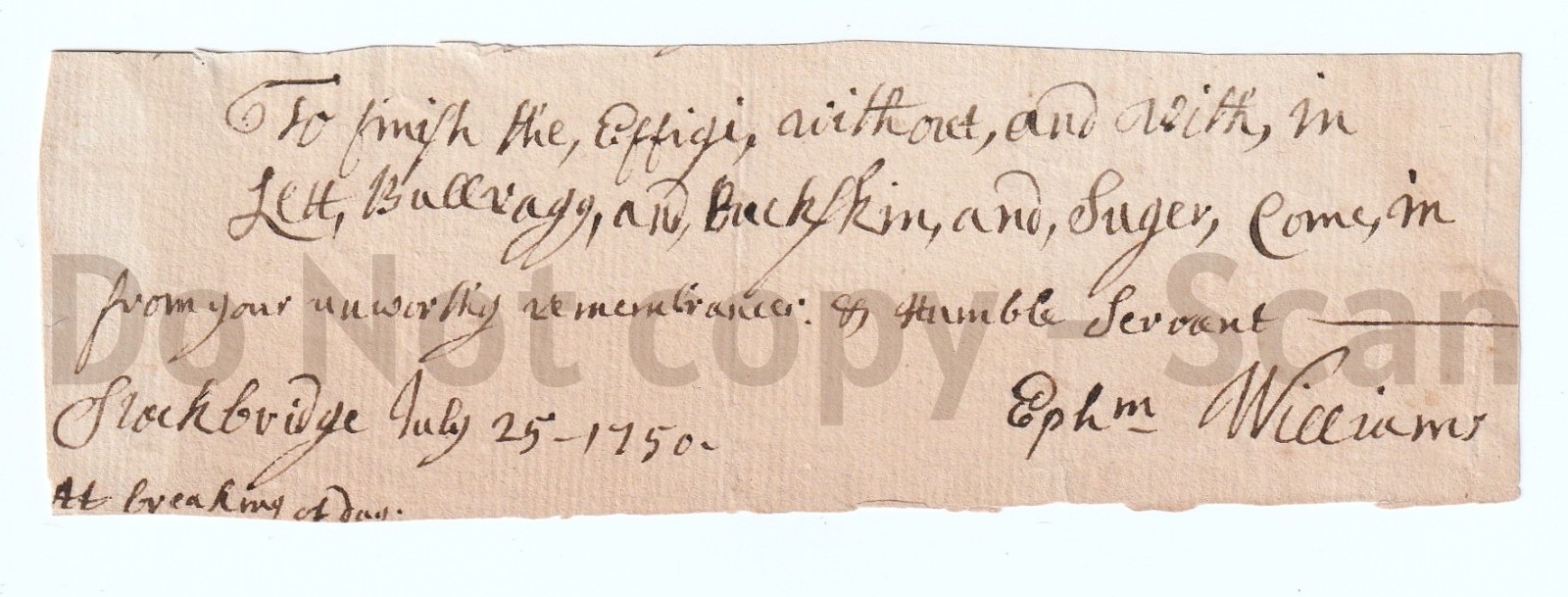
RARE Autograph Document Signed 1750 - Ephraim Williams Jr Died French Indian War

When you click on links to various merchants on this site and make a purchase, this can result in this site earning a commission. Affiliate programs and affiliations include, but are not limited to, the eBay Partner Network.

RARE Autograph Document Signed 1750 - Ephraim Williams Jr Died French Indian War:
$5800.00
RARE Autograph Document Signed
Ephraim Williams Jr. (1714-1755)
Died in the French and Indian War
at Lake GeorgeWilliams College BenefactorStockbridge
Dated 1750
For offer, an early ORIGINAL piece of Colonial American history. Fresh from an estate collection.Vintage, Old, antique, Original - NOT a Reproduction - Guaranteed !!This was found in a collection of very old letter in an untouched estate. Quite remarkable. Never offered on the market before. Ephraim Williams, killed at Lake George during the French and Inaian War in 1755. Williams College is named after him. Small document / letter / quote - dated July 25, 1750, Stockbridge. Signed Ephm Williams. Items by Williams are extremely rare. Document measures approx. 6 x 2 inches. In good to very good condition. Small, old piece of paper attached at left edge to support small rip. Laid paper. Fold marks.Please see photos for details.I have dealt in Americana paper for over 26 years, and will guarantee this piece to be authentic. If you collect Americana history, American military / politics, Colonial America, manuscript, etc., this is one you will not see again. A nice piece for your paper / ephemera collection. Perhaps some genealogy research information as well. Combine shipping on multiple offer wins!4052
Ephraim Williams Jr. (March 7, 1715 [O.S. February 24, 1714][1][2] – September 8, 1755) was an American landowner and militia officer from the Province of Massachusetts Bay who was killed in the French and Indian War. Born in Newton, Massachusetts, he was the benefactor of Williams College, located in northwestern Massachusetts. The school's athletic programs, the Ephs, are named after Williams.
LifeEarly lifeEphraim Jr. was the eldest son of Ephraim Williams Sr. and Elizabeth Jackson Williams (d. 1718).[3] He was born in Newton, Massachusetts, on February 24, 1714,[1][2] and was raised by his maternal grandparents after his mother died giving birth to a second son, Thomas, in 1718.[1] His family was influential in western Massachusetts; they were preeminent in a group of families then called the "River Gods" (referencing the Connecticut River, the major waterway in the area). A cousin, Israel Williams, was known as the "monarch of Hampshire" due to his singular influence along the river.[4]Military serviceIn 1742, at age 27, he moved to Stockbridge, Massachusetts, where his father had relocated on land purchased from the Mahican tribe, and purchased large tracts of land in the young settlement.[6] He joined the militia and was commissioned captain.[7]
In 1745 during King George's War (1745–1748), he was put in charge of building and defending Fort Massachusetts and the line of defences in western Connecticut and Massachusetts. He was absent when the fort was taken and destroyed by the French in August 1746.[8] After the war ended, Williams spent considerable effort urging the settlement of new townships in the western portion of Massachusetts along the Hoosac River at the end of the 1740s. Many of the early settlers in this region were soldiers stationed at Fort Massachusetts during the war, including Williams himself.
However, within just a few years, Williams was again called into service as part of the French and Indian War (1754–1763). Williams, now a colonel, took part in William Johnson's expedition against Crown Point, New York, leading a regiment of ten companies.[9] Among those companies were Burke's Rangers and Rogers' Rangers. Among his aides was William Williams from Connecticut, a signer of the Declaration of Independence.
Williams was shot in the head and killed during an ambush by the French and their Indian allies in the Battle of Lake George on September 8, 1755, at the age of 40.[10] Members of his regiment hid his body after the battle to prevent it from being desecrated. They later buried Williams nearby. His body was disinterred in the early 20th century and moved to the chapel at Williams College. A stone etched with Williams' initials on it and the year of his death still stands at the original Lake George gravesite just across the street from a monument erected by Williams College alumni. The monument marks the site of the ambush, which was called the bloody Morning Scout.
LegacyEphraim left his sizeable estate to support the founding of a free school on his land in western Massachusetts, on the conditions that the town be renamed after him (Williamstown, Massachusetts, formerly West Hoosac), that the town be part of the Massachusetts Bay Colony, and that the free school be built on the land which he donated. He previously intended to found the school as an academy for "the Promoting & propogating [sic] Christian knowledge amongst the Indians at Stockbridge" but was deterred by the potential of the project being manipulated by his political rivals after his death. The school was founded in 1791 and converted to Williams College by action of the state legislature in 1793.[11]
Ebenezer Fitch, the first president of Williams College, wrote a biographical sketch of Ephraim Jr. in 1802. He described the college's benefactor as follows: "In his person, he was large and fleshy...His address was easy, and his manners pleasing and conciliating. Affable and facetious, he could make himself agreeable in all companies; and was very generally esteemed, respected, and beloved."[12]
There is some internet based commentary[unreliable source?] that suggests Ephraim Williams appears in an early version of "Yankee Doodle":
Brother Ephraim sold his CowAnd bought him a Commission;And then he went to CanadaTo fight for the Nation;But when Ephraim he came homeHe proved an arrant Coward,He wouldn't fight the Frenchmen thereFor fear of being devour'd.However, this suggestion comes mostly from on-line commentators, who "just repeat earlier questionable, undocumented interpretations" without citation, and no reputable scholars "connect this 'arrant Coward' to the French and Indian War hero."[13]
The song "Yankee Doodle" was re-appropriated by the British colonists from the derisive version of the Dutch settlers and turned into a rousing marching tune eventually making Yankee another name for American known world wide, with the first known version of the song apparently about Ephraim Williams, who fought the French at the battle of Fort Ticonderoga and the Battle of the bloody Morning Scout.[citation needed]\COLONEL EPHRAIM WILLIAMS was born in Newton, Mass., February 24th, 1715. In early life a sailor; afterward a soldier, serving as a provincial captain in Canada during the Anglo-French War, 1740-48. In 1750 the government granted him 200 acres of hand in the present townships of Adams and Williamstown, Mass. He commanded all the border forts west of the Connecticut River, and in 1755 was appointed colonel of a regiment to co-operate with Sir William Johnson in a projected campaign against Canada. With a presentiment of his early fall, he made his will at Albany, N. Y., devising his property for the support of a free school, which became Williams College, at Williamstown, Mass. In 1854 the alumni of this college erected a monument on the boulder marking the spot where he fell.
THE bloodY MORNING SCOUT.– September 8th, 1755, was a day of three desperate and bloody battles, fought within a few miles between Glens Falls and Lake George – important engagements, even viewed from the present. This territory, known as the "Great Carry," a land break in the waterways of the Hudson River. Lakes George and Champlain, and the St. Lawrence, was strategic territory and a bloody fighting ground for ages, probably, between Indian war parties: all though the seventy years' struggle between England and France for the possession of a continent and fought to a conclusion within this region; and afterward. during the Revolution. No part of America is richer in historic incident and interest than the region of this natural route between the Hudson and the St. Lawrence.
Col. Williams' Grave, Near His Monument.The sanguinary defeat of Braddock's expedition against Fort Duquesne in July. 1755, gave the French, through captured papers, information that the English were mustering men at Albany for an expedition against Crown Point and Canada. and Baron Dieskau, a brave and distinguished German officer and field marshal of France, was promptly sent to Crown Point with 3,000 men, quite one-third veteran regulars from French battle fields. Dieskau, exemplifying his motto, "Boldness Wins," determined on the aggressive, and believing Fort Edward (then Fort Lyman) feebly garrisoned, he moved with a flying corps of 600 Canadians, . as many Indians and 300 regulars against this fort. September 7th he reached the Hudson, below Glens Falls, and learned that Sir William Johnson had already reached Lake George with a considerable force of raw provincials. General Johnson had with him General Lyman, Colonels Williams and Titcomb (both killed on the 8th), Seth Pomeroy, Ruggles, the afterward Revolutionary Generals Putnam and Stark, and King Hendrick, the famous Mohawk sachem. Dieskau, with contempt for these untrained and inexperienced farmers, decided to make a sudden attack upon them, and early on the 8th marched toward Lake George. In the meantime, Johnson's scouts reporting Dieskau's force marching on Fort Edward, dispatched Colonel Williams with 1,000 white men and 200 Mohawks under King Hendrick to the relief of the threatened fort. Dieskau, learning this from a captured courier, instantly prepared to ambush them by deploying his force in a semi-circle – his Canadians on one side of the road, his Indians on the other and his regulars in the rear – all with knapsacks off, lying flat and hidden in the underbrush, waiting the coming of Williams. Colonel Williams, careless for an Indian fighter of experience, proceeding without scouts or advance skirmishers, began to enter the "trap," when Dieskau's Mohawks of the St. Lawrence, seeing their brothers of the Mohawk Valley in Johnson's advance, gave warning by firing in the air, when the concealed Canadians and French poured from right and left into the surprised provincials a terrific fire, which mingled with the war whoops of the savages, filled the ravine with "a terror of sight and sound." King Hendrick was killed and the Mohawks retired to cover. Colonel Williams led a charge up the hill on his right to turn the enemy's flank and secure a more commanding position, mounted a boulder (on which his monument now stands, about six miles from Glens Falls and three miles from Lake George) to better see and encourage his men, and fell from a bullet in his head. (See illustration – a reduced reproduction of Mr. Yohn's sketch, owned by the Glens Falls Insurance Company.) Surprised, being shot down by an unseen foe, deserted by the Mohawks, their commander dead, they retreated in confusion. lieutenant-Colonel Whiting, now in command, partially rallied the fugitives, and with the aid of 300 men sent out from Johnson's camp, checked Dieskau's furious pursuit, and fighting from behind trees, in frontier fashion, covered the retreat to Johnson's camp at Lake George. The English loss was 216 killed and 96 wounded, including a large number of officers. The French also suffered considerable loss. Few prisoners were taken, for the scalping knife and tomahawk were freely used, and the battle field at short intervals was in possession of either side. This is a brief summary of what has passed into fireside story, tradition and history, as "The bloody Morning Scout."THE BATTLE OF LAKE GEORGE – Dieskau, emboldened by his morning success, fiercely attacked General Johnson, and the battle raged all the afternoon with and the battle raged all afternoon with. varying promise. Dieskau was severely wounded and taken prisoner, Chevalier Montreuil succeeding in command of the French. General Johnson was also wounded, and General Lyman, the lawyer and Yale tutor, commanded the English with great spirit and bravery during the most of this hard fought battle. The French were finally defeated and retreated in haste toward Ticonderoga.
BATTLE OF bloodY POND.- Some 300 of the Canadians and Indians of the French contingent went back to the field of "The bloody Morning Scout," to scalp and plunder the dead. While resting with their scalps and pillage on the margin of a stagnant forest pool (seven miles from Glen Falls and two from Lake George) they were surprised by 200 men under Captain McGinnis, who had been sent from Fort Edward to the aid of General Johnson. A sharp fight resulted in the utter rout of the French contingent. Captain McGinnis, commanding the English, was mortally wounded. Tradition says that the bodies of upwards of 200 of the slain were thrown into this pool for sepulcher, the water becoming so stained with blood as to give it the significant name of " bloody Pond," by which name it is still known to residents and tourists.
This is only a "boiled down" story of this sanguinary day of battles, memorable as the first encounter of the hardy yeomanry of the New World with the disciplined troops and experienced military commanders of the Old, and as the beginning of that confidence which afterward led them to dare the great struggle of the Revolution.
Williams College is a private liberal arts college in Williamstown, Massachusetts, United States. It was established as a men's college in 1793 with funds from the estate of Ephraim Williams, a colonist from the Province of Massachusetts Bay who was killed in the French and Indian War in 1755.[6]
Williams's main campus is located in Williamstown, in the Berkshires in rural northwestern Massachusetts, and contains more than 100 academic, athletic, and residential buildings.[6] There are 360 voting faculty members, with a student-to-faculty ratio of 6:1. As of 2022, the college had an enrollment of 2,021 undergraduate students and 50 graduate students.[7]
Following a liberal arts curriculum, Williams College provides undergraduate instruction in 25 academic departments and interdisciplinary programs including 36 majors in the humanities, arts, social sciences, and natural sciences. Williams offers an almost entirely undergraduate instruction, though there are two graduate programs in development economics and art history. The college maintains affiliations with the nearby Clark Art Institute and the Massachusetts Museum of Contemporary Art (MASS MoCA) along with a close relationship with Exeter College, Oxford. The college competes as the Ephs in the NCAA Division III as a member of the New England Small College Athletic Conference.
HistoryColonel Ephraim Williams was an officer in the Massachusetts militia and a member of a prominent landowning family. Williams was killed at the Battle of Lake George on September 8, 1755. His will included a bequest to support and maintain a free school to be established in the town of West Hoosac, Massachusetts, provided the town change its name to Williamstown.[8]
Members of the Williams family first attempted to found Queens College in Hatfield, Massachusetts, in 1762. The charter was revoked within a year when Massachusetts Governor Francis Bernard succumbed to pressure from Harvard College, which opposed the creation of a second institution of higher learning in the colonial-era Province of Massachusetts Bay.
In 1765, the west township was incorporated as Williamstown. Five years later, the town's proprietors brought the executors of Williams' estate before the General Court to dispute the delay in establishment of the free school, and in 1795, the Massachusetts legislature finally granted the school its charter.[9]
The Williamstown Free School opened with 15 students on October 26, 1791. The first president was Ebenezer Fitch. Not long after its founding, the school's trustees petitioned the Massachusetts legislature to convert the free school to a tuition-based college. The legislature agreed and on June 22, 1793, Williams College was chartered. It was the second college to be founded in Massachusetts.Depiction of West College, which composed the entire college in its early years.At its founding, the college maintained a policy of racial segregation, refusing admission to black applicants. This policy was challenged by Lucy Terry Prince, who is credited as the first black American poet,[10] when her son Festus was refused admission on account of his race.[11] Prince, who had established a reputation as a raconteur[12] and rhetorician, delivered a three-hour speech before the college's board of trustees, quoting abundantly from scripture, but was unable to secure her son's admission.[11] Later scholarship questions whether these events occurred as Festus Prince may have been refused entry for an insufficient mastery of Latin, Greek, and French, all of which were necessary for successful completion of the entrance exam at the time, and which would most likely not have been available in the local schools of Guilford, Vermont, where Festus was raised.[13]
In 1806, a student prayer meeting gave rise to the American Foreign Mission Movement. In August of that year, five students met in the maple grove of Sloan's Meadow to pray. A thunderstorm drove them to the shelter of a haystack, and the fervor of the ensuing meeting inspired them to take the Gospel abroad. The students went on to build the American Board of Commissioners for Foreign Missions, the first American organization to send missionaries overseas. The Haystack Monument near Mission Park on the Williams Campus commemorates the historic "Haystack Prayer Meeting".Zephaniah Swift Moore, the second president of the college and first president of Amherst CollegeBy 1815, Williams had only two buildings and 58 students and was in financial trouble, so the board voted to move the college to Amherst, Massachusetts. In 1821, the president of the college, Zephaniah Swift Moore, who had accepted his position believing the college would move east, decided to proceed with the move. He took 15 students with him, and re-founded the college under the name of Amherst College. Some students and professors decided to stay at Williams and were allowed to keep the land, which was at the time relatively worthless. Moore died just two years later after founding Amherst, and was succeeded by Heman Humphrey, a trustee of Williams College.[14]Thompson Memorial Church, early 20th centuryEdward Dorr Griffin was appointed President of Williams and is widely credited with saving Williams during his 15-year tenure. A Williams student, Gardner Cotrell Leonard, of Albany, New York, whose family owned the city's Cotrell & Leonard department store, designed the gowns he and his classmates wore to graduation in 1887.[15] Seven years later he advised the Inter-Collegiate Commission on Academic Costume, which met at Columbia University, and established the current system of U.S. academic dress.[16] One reason gowns were adopted in the late 19th century was to eliminate the differences in apparel between rich and poor students.[17] Gardner Cotrell Leonard went on to edit the book The Songs of Williams, a collection of songs sung at the college. During World War II, Williams College was one of 131 colleges and universities nationally that took part in the V-12 Navy College Training Program which offered students a path to a Navy commission.[18]
Originally a men's college, Williams became co-educational in 1970. Fraternities were also phased out during this period, beginning in 1962.[6]
Following a liberal arts curriculum, Williams College provides undergraduate instruction in 25 academic departments and interdisciplinary programs including 36 majors in the humanities, arts, social sciences, and natural sciences. Williams offers an almost entirely undergraduate instruction, though there are two graduate programs in development economics and art history.[19] The college maintains affiliations with the nearby Clark Art Institute and Massachusetts Museum of Contemporary Art (MASS MoCA), and has a close relationship with Exeter College, Oxford University, where the school runs a year-long study abroad program for juniors. The college competes as the Ephs in the NCAA Division III as a member of the New England Small College Athletic Conference. Their athletic program has been highly successful, winning 22 of 29 College Directors' Cups for NCAA Division III.[20]
Williams is a highly selective school with an acceptance rate of 8% for the Class of 2025.[21] It has ranked first in U.S. News & World Report's rankings of National Liberal Arts Colleges every year since 2004.[22] In April 2022, Williams transitioned to an all grants system for financial aid, one of the few institutions of higher learning in the United States to do so.[23]
The French and Indian War,[b] 1754 to 1763, was a conflict in North America between Great Britain and France, along with their respective Native American allies. Historians generally consider it part of the global conflict 1756 to 1763 Seven Years' War, although in the United States it is often viewed as a distinct conflict unassociated with any larger European war.[5]
Although Britain and France were officially at peace following the Treaty of Aix-la-Chapelle in 1748, tensions over trade continued in North America, which culminated in a dispute over the Forks of the Ohio, and the related French Fort Duquesne which controlled them. In May 1754, this led to the Battle of Jumonville Glen, when Virginia militia led by George Washington ambushed a French patrol.[6]
In 1755, Edward Braddock, the new Commander-in-Chief, North America, planned a four-way attack on the French. None succeeded, while the Braddock Expedition ended in disaster at the Battle of the Monongahela on July 9, with Braddock himself dying of his wounds a few days later. From 1755 to 1757, further British operations in Pennsylvania and New York failed, but were offset by the British capture of Fort Beauséjour on the border between British Nova Scotia and French Acadia. Over the next nine years, French settlers were expelled and replaced by those from New England.[7]
The Seven Years' War began in 1756, and a number of disastrous campaigns in 1757, including the Louisbourg Expedition (1757) and Siege of Fort William Henry led to the fall of the British government. The new Prime Minister, William Pitt, significantly increased British military resources in the colonies when France was struggling to support their limited forces in New France, preferring to concentrate their forces in Europe. Between 1758 and 1760, the British launched a campaign to capture French Canada, taking Quebec in 1759, then Montreal the following year. This largely ended fighting in North America.
In accordance with the Treaty of Paris (1763), France ceded its Canadian possessions to Britain, along with its claim to territories east of the Mississippi River. France also gave Spain French Louisiana west of the Mississippi in compensation for their loss of Spanish Florida to Britain. The French presence in North America was reduced to the islands of Saint Pierre and Miquelon, confirming Britain's position as the dominant colonial power.
Nomenclature
Belligerents during the Seven Years' War. Canadians and Europeans view the French and Indian War as a theater of the Seven Years' War, while Americans view it a separate conflict.In British America, wars were often named after the sitting British monarch, such as King William's War or Queen Anne's War. There had already been a King George's War in the 1740s during the reign of King George II, so British colonists named this conflict after their opponents, and it became known as the French and Indian War.[8] This continues as the standard name for the war in the United States, although indigenous peoples fought on both sides of the conflict. It also led into the Seven Years' War overseas, a much larger conflict between France and Great Britain that did not involve the American colonies; some historians make a connection between the French and Indian War and the Seven Years' War overseas, but most residents of the United States consider them as two separate conflicts—only one of which involved the American colonies,[9] and American historians generally use the traditional name. Less frequently used names for the war include the Fourth Intercolonial War and the Great War for the Empire.[8]
In Europe, the French and Indian War is conflated into the Seven Years' War and not given a separate name. "Seven Years" refers to events in Europe, from the official declaration of war in 1756—two years after the French and Indian War had started—to the signing of the peace treaty in 1763. The French and Indian War in America, by contrast, was largely concluded in six years from the Battle of Jumonville Glen in 1754 to the capture of Montreal in 1760.[8] Canadians conflate both the European and American conflicts into the Seven Years' War (Guerre de Sept Ans).[10] French Canadians also use the term "War of Conquest" (Guerre de la Conquête), since it is the war in which New France was conquered by the British and became part of the British Empire. In Quebec, this term was promoted by popular historians Jacques Lacoursière and Denis Vaugeois, who borrowed from the ideas of Maurice Séguin in considering this war as a dramatic tipping point of French Canadian identity and nationhood.[11]
Background
The coureurs des bois were French-Canadian fur traders, who did business with natives throughout the Mississippi and St. Lawrence watershed.At this time, North America east of the Mississippi River was largely claimed by either Great Britain or France. Large areas had no colonial settlements. The French population numbered about 75,000 and was heavily concentrated along the St. Lawrence River valley, with some also in Acadia (present-day New Brunswick and parts of Nova Scotia), including Île Royale (Cape Breton Island). Fewer lived in New Orleans; Biloxi, Mississippi; Mobile, Alabama; and small settlements in the Illinois Country, hugging the east side of the Mississippi River and its tributaries. French fur traders and trappers traveled throughout the St. Lawrence and Mississippi watersheds, did business with local Indian tribes, and often married Indian women.[12] Traders married daughters of chiefs, creating high-ranking unions.
British settlers outnumbered the French 20 to 1[13] with a population of about 1.5 million ranged along the Atlantic coast of the continent from Nova Scotia and the Colony of Newfoundland in the north to the Province of Georgia in the south.[14] Many of the older colonies' land claims extended arbitrarily far to the west, as the extent of the continent was unknown at the time when their provincial charters were granted. Their population centers were along the coast, but the settlements were growing into the interior. The British captured Nova Scotia from France in 1713, which still had a significant French-speaking population. Britain also claimed Rupert's Land where the Hudson's Bay Company traded for furs with local Indian tribes.Iroquois expansion, 1711. By the mid-18th century, the Iroquois Confederacy had expanded from Upstate New York to the Ohio Country.Between the French and British colonists, large areas were dominated by Indian tribes. To the north, the Mi'kmaq and the Abenakis were engaged in Father Le Loutre's War and still held sway in parts of Nova Scotia, Acadia, and the Eastern portions of the province of Canada, as well as much of Maine.[15] The Iroquois Confederation dominated much of upstate New York and the Ohio Country, although Ohio also included Algonquian-speaking populations of Delaware and Shawnee, as well as Iroquoian-speaking Mingos. These tribes were formally under Iroquois rule and were limited by them in their authority to make agreements.[16] The Iroquois Confederation initially held a stance of neutrality to ensure continued trade with both French and British. Though maintaining this stance proved difficult as the Iroquois Confederation tribes sided and supported French or British causes depending on which side provided the most beneficial trade.[17]
The Southeast interior was dominated by Siouan-speaking Catawbas, Muskogee-speaking Creeks and Choctaw, and the Iroquoian-speaking Cherokee tribes.[18] When war broke out, the French colonists used their trading connections to recruit fighters from tribes in western portions of the Great Lakes region, which was not directly subject to the conflict between the French and British; these included the Wyandots, Mississaugas, Ojibwas, Winnebagos, and Potawatomi.
The British colonists were supported in the war by the Iroquois Six Nations and also by the Cherokees, until differences sparked the Anglo-Cherokee War in 1758. In 1758, the Province of Pennsylvania successfully negotiated the Treaty of Easton in which a number of tribes in the Ohio Country promised neutrality in exchange for land concessions and other considerations. Most of the other northern tribes sided with the French, their primary trading partner and supplier of arms. The Creeks and Cherokees were subject to diplomatic efforts by both the French and British to gain either their support or neutrality in the conflict.[19][additional citation(s) needed]Three Cherokee chiefs, c. 1762. The Cherokee were subject to diplomatic efforts from the British and French to gain their support or neutrality in the event of a conflict.At this time, Spain claimed only the province of Florida in Eastern America. It controlled Cuba and other territories in the West Indies that became military objectives in the Seven Years' War. Florida's European population was a few hundred, concentrated in St. Augustine.[20]General James Wolfe, British commanderThere were no French regular army troops stationed in America at the onset of war. New France was defended by about 3,000 troupes de la marine, companies of colonial regulars (some of whom had significant woodland combat experience). The colonial government recruited militia support when needed. The British had few troops. Most of the British colonies mustered local militia companies to deal with Indian threats, generally ill trained and available only for short periods, but they did not have any standing forces. Virginia, by contrast, had a large frontier with several companies of British regulars.[citation needed]
When hostilities began, the British colonial governments preferred operating independently of one another and of the government in London. This situation complicated negotiations with Indian tribes, whose territories often encompassed land claimed by multiple colonies. As the war progressed, the leaders of the British Army establishment tried to impose constraints and demands on the colonial administrations.[citation needed]
Céloron's expeditionNew France's Governor-General Roland-Michel Barrin de La Galissonière was concerned about the incursion and expanding influence in the Ohio Country of British colonial traders such as George Croghan. In June 1747, he ordered Pierre-Joseph Céloron to lead a military expedition through the area. Its objectives were:Roland-Michel Barrin de La Galissonière, Governor of New France, sent an expedition in 1749 into the Ohio Country in an attempt to assert French sovereignty.to reaffirm to New France's Indian allies that their trading arrangements with colonists were exclusive to those authorized by New Franceto confirm Indian assistance in asserting and maintaining the French claim to the territories which French explorers had claimedto discourage any alliances between Britain and local Indian tribesto impress the Indians with a French show of force against British colonial settler incursion, unauthorized trading expeditions, and general trespass against French claims[21]Céloron's expedition force consisted of about 200 Troupes de la marine and 30 Indians, and they covered about 3,000 miles (4,800 km) between June and November 1749. They went up the St. Lawrence, continued along the northern shore of Lake Ontario, crossed the portage at Niagara, and followed the southern shore of Lake Erie. At the Chautauqua Portage near Barcelona, New York, the expedition moved inland to the Allegheny River, which it followed to the site of Pittsburgh. There Céloron buried lead plates engraved with the French claim to the Ohio Country.[21] Whenever he encountered British colonial merchants or fur-traders, he informed them of the French claims on the territory and told them to leave.[21]
Céloron's expedition arrived at Logstown where the Indians in the area informed him that they owned the Ohio Country and that they would trade with the British colonists regardless of the French.[22] He continued south until his expedition reached the confluence of the Ohio and the Miami rivers, which lay just south of the village of Pickawillany, the home of the Miami chief known as "Old Briton". Céloron threatened Old Briton with severe consequences if he continued to trade with British colonists, but Old Briton ignored the warning. Céloron returned disappointedly to Montreal in November 1749.[23]
Céloron wrote an extensively detailed report. "All I can say is that the Natives of these localities are very badly disposed towards the French," he wrote, "and are entirely devoted to the English. I don't know in what way they could be brought back."[22] Even before his return to Montreal, reports on the situation in the Ohio Country were making their way to London and Paris, each side proposing that action be taken. Massachusetts governor William Shirley was particularly forceful, stating that British colonists would not be safe as long as the French were colonies in North America, c. 1750. Disputes over territorial claims persisted after the end of King George's War in 1748.The War of the Austrian Succession ended in 1748 with the signing of the Treaty of Aix-la-Chapelle, which was primarily focused on resolving issues in Europe. The issues of conflicting territorial claims between British and French colonies were turned over to a commission, but it reached no decision. Frontier areas were claimed by both sides, from Nova Scotia and Acadia in the north to the Ohio Country in the south. The disputes also extended into the Atlantic Ocean, where both powers wanted access to the rich fisheries of the Grand Banks off Newfoundland.[citation needed]
In 1749, the British government gave land to the Ohio Company of Virginia for the purpose of developing trade and settlements in the Ohio Country.[25] The grant required that it settle 100 families in the territory and construct a fort for their protection. But the territory was also claimed by Pennsylvania, and both colonies began pushing for action to improve their respective claims.[26] In 1750, Christopher Gist explored the Ohio territory, acting on behalf of both Virginia and the company, and he opened negotiations with the Indian tribes at Logstown.[27] He completed the 1752 Treaty of Logstown in which the local Indians agreed to terms through their "Half-King" Tanacharison and an Iroquois representative. These terms included permission to build a strong house at the mouth of the Monongahela River on the modern site of Pittsburgh, Pennsylvania.[28]
Escalation in Ohio CountryGovernor-General of New France Marquis de la Jonquière died on March 17, 1752, and he was temporarily replaced by Charles le Moyne de Longueuil. His permanent replacement was to be the Marquis Duquesne, but he did not arrive in New France until 1752 to take over the post.[29] The continuing British activity in the Ohio territories prompted Longueuil to dispatch another expedition to the area under the command of Charles Michel de Langlade, an officer in the Troupes de la Marine. Langlade was given 300 men, including French-Canadians and warriors of the Ottawa tribe. His objective was to punish the Miami people of Pickawillany for not following Céloron's orders to cease trading with the British. On June 21, the French war party attacked the trading center at Pickawillany, capturing three traders[23] and killing 14 Miami Indians, including Old Briton. He was reportedly ritually cannibalized by some Indians in the expedition party.
Construction of French fortificationsiconThis section needs additional citations for verification. Please help improve this article by adding citations to reliable sources in this section. Unsourced material may be challenged and removed. (April 2017) (Learn how and when to remove this message)
Fort Le Boeuf in 1754. In the spring of 1753, the French began to build a series of forts in the Ohio Country.In the spring of 1753, Paul Marin de la Malgue was given command of a 2,000-man force of Troupes de la Marine and Indians. His orders were to protect the King's land in the Ohio Valley from the British. Marin followed the route that Céloron had mapped out four years earlier. Céloron, however, had limited the record of French claims to the burial of lead plates, whereas Marin constructed and garrisoned forts. He first constructed Fort Presque Isle on Lake Erie's south shore near Erie, Pennsylvania, and he had a road built to the headwaters of LeBoeuf Creek. He then constructed a second fort at Fort Le Boeuf in Waterford, Pennsylvania, designed to guard the headwaters of LeBoeuf Creek. As he moved south, he drove off or captured British traders, alarming both the British and the Iroquois. Tanaghrisson was a chief of the Mingo Indians, who were remnants of Iroquois and other tribes who had been driven west by colonial expansion. He intensely disliked the French whom he accused of killing and eating his father. He traveled to Fort Le Boeuf and threatened the French with military action, which Marin contemptuously dismissed.[30]
The Iroquois sent runners to the manor of William Johnson in upstate New York, who was the British Superintendent for Indian Affairs in the New York region and beyond. Johnson was known to the Iroquois as Warraghiggey, meaning "he who does great things." He spoke their languages and had become a respected honorary member of the Iroquois Confederacy in the area, and he was made a colonel of the Iroquois in 1746; he was later commissioned as a colonel of the Western New York Militia.
The Indian representatives and Johnson met with Governor George Clinton and officials from some of the other American colonies at Albany, New York. Mohawk Chief Hendrick was the speaker of their tribal council, and he insisted that the British aoffere by their obligations[which?] and block French expansion. Clinton did not respond to his satisfaction, and Hendrick said that the "Covenant Chain" was broken, a long-standing friendly relationship between the Iroquois Confederacy and the British Crown.
Virginia's response
In 1754, George Washington of the Virginia Regiment was dispatched to warn the French to leave Virginian territory.Governor Robert Dinwiddie of Virginia was an investor in the Ohio Company, which stood to lose money if the French held their claim.[31] He ordered 21-year-old Major George Washington (whose brother was another Ohio Company investor) of the Virginia Regiment to warn the French to leave Virginia territory in October 1753.[32] Washington left with a small party, including Jacob Van Braam as an interpreter, Christopher Gist (a company surveyor working in the area), Guyasuta (a Mingo warrior), Jeskakake (a Cayuga chief), Kaghswaghtaniunt (a Seneca leader),[33] and Tanaghrisson. On December 12, Washington and his men reached Fort Le Boeuf.[34][35]
Jacques Legardeur de Saint-Pierre succeeded Marin as commander of the French forces after Marin died on October 29, and he invited Washington to dine with him. Over dinner, Washington presented Saint-Pierre with the letter from Dinwiddie demanding an immediate French withdrawal from the Ohio Country. Saint-Pierre said, "As to the Summons you send me to retire, I do not think myself obliged to obey it."[36] He told Washington that France's claim to the region was superior to that of the British, since René-Robert Cavelier, Sieur de La Salle had explored the Ohio Country nearly a century earlier.[37]
Washington's party left Fort Le Boeuf early on December 16 and arrived in Williamsburg on January 16, 1754. He stated in his report, "The French had swept south",[38] detailing the steps which they had taken to fortify the area, and their intention to fortify the confluence of the Allegheny and Monongahela rivers.[39]
Course of warEven before Washington returned, Dinwiddie had sent a company of 40 men under William Trent to that point where they began construction of a small stockaded fort in the early months of 1754.[40] Governor Duquesne sent additional French forces under Claude-Pierre Pécaudy de Contrecœur to relieve Saint-Pierre during the same period, and Contrecœur led 500 men south from Fort Venango on April 5, 1754.[41] These forces arrived at the fort on April 16, but Contrecœur generously allowed Trent's small company to withdraw. He purchased their construction tools to continue building what became Fort Duquesne.[42]
Early engagementsDinwiddie had ordered Washington to lead a larger force to assist Trent in his work, and Washington learned of Trent's retreat while he was en route.[43] Mingo sachem Tanaghrisson had promised support to the British, so Washington continued toward Fort Duquesne and met with him. He then learned of a French scouting party in the area from a warrior sent by Tanaghrisson, so he added Tanaghrisson's dozen Mingo warriors to his own party. Washington's combined force of 52 ambushed 40 Canadiens (French colonists of New France) on the morning of May 28 in what became known as the Battle of Jumonville Glen.[44] They killed many of the Canadians, including their commanding officer Joseph Coulon de Jumonville, whose head was reportedly split open by Tanaghrisson with a tomahawk. Historian Fred Anderson suggests that Tanaghrisson was acting to gain the support of the British and to regain authority over his own people. They had been inclined to support the French, with whom they had long trading relationships. One of Tanaghrisson's men told Contrecoeur that Jumonville had been killed by British musket fire.[45] Historians generally consider the Battle of Jumonville Glen as the opening battle of the French and Indian War in North America, and the start of hostilities in the Ohio valley.Washington with his war council during the Battle of Fort Necessity. After deliberations, it was decided to withdraw, and surrender the fort.Following the battle, Washington pulled back several miles and established Fort Necessity, which the Canadians attacked under the command of Jumonville's brother at the Battle of Fort Necessity on July 3. Washington surrendered and negotiated a withdrawal under arms. One of his men reported that the Canadian force was accompanied by Shawnee, Delaware, and Mingo warriors—just those whom Tanaghrisson was seeking to influence.[46]
News of the two battles reached England in August. After several months of negotiations, the government of the Duke of Newcastle decided to send an army expedition the following year to dislodge the French.[47] They chose Major General Edward Braddock to lead the expedition.[48] Word of the British military plans leaked to France well before Braddock's departure for North America. In response, King Louis XV dispatched six regiments to New France under the command of Baron Dieskau in 1755.[49] The British sent out their fleet in February 1755, intending to blockade French ports, but the French fleet had already sailed. Admiral Edward Hawke detached a fast squadron to North America in an attempt to intercept them.In June 1755, the British captured French naval ships sent to provide war matériel to the Acadian and Mi'kmaw militias in Nova Scotia.In a second British action, Admiral Edward Boscawen fired on the French ship Alcide on June 8, 1755, capturing her and two troop ships.[50] The British harassed French shipping throughout 1755, seizing ships and capturing seamen. These actions contributed to the eventual formal declarations of war in spring 1756.[51]
An early important political response to the opening of hostilities was the convening of the Albany Congress in June and July, 1754. The goal of the congress was to formalize a unified front in trade and negotiations with the Indians, since the allegiance of the various tribes and nations was seen to be pivotal in the war that was unfolding. The plan that the delegates agreed to was neither ratified by the colonial legislatures nor approved by the Crown. Nevertheless, the format of the congress and many specifics of the plan became the prototype for confederation during the War of Independence.
British campaigns, 1755The British formed an aggressive plan of operations for 1755. General Braddock was to lead the expedition to Fort Duquesne,[52] while Massachusetts governor William Shirley was given the task of fortifying Fort Oswego and attacking Fort Niagara. Sir William Johnson was to capture Fort St. Frédéric at Crown Point, New York,[53] and Lieutenant Colonel Robert Monckton was to capture Fort Beauséjour to the east on the frontier between Nova Scotia and Acadia.[54]British forces under fire from the French and Indian forces at Monongahela, when the Braddock expedition failed to take Fort Duquesne.Braddock led about 1,500 army troops and provincial militia on the Braddock expedition in June 1755 to take Fort Duquesne, with George Washington as one of his aides. The expedition was a disaster. It was attacked by French regulars, Canadian Militiamen, and Indian warriors ambushing them from hiding places up in trees and behind logs, and Braddock called for a retreat. He was killed and approximately 1,000 British soldiers were killed or injured.[52] The remaining 500 British troops retreated to Virginia, led by Washington. Washington and Thomas Gage played key roles in organizing the retreat—two future opponents in the American Revolutionary War.
The British government initiated a plan to increase their military capability in preparation for war following news of Braddock's defeat and the start of parliament's session in November 1755. Among the early legislative measures were the Recruiting Act 1756,[55] the Commissions to Foreign Protestants Act 1756[56] for the Royal American Regiment, the Navigation Act 1756,[57] and the Continuance of Laws Act 1756.[58] England passed the Naval Prize Act 1756 following the proclamation of war on May 17 to allow the capture of ships and establish privateering.[59]
The French acquired a copy of the British war plans, including the activities of Shirley and Johnson. Shirley's efforts to fortify Oswego were bogged down in logistical difficulties, exacerbated by his inexperience in managing large expeditions. In conjunction, he was made aware that the French were massing for an attack on Fort Oswego in his absence when he planned to attack Fort Niagara. As a response, he left garrisons at Oswego, Fort Bull, and Fort Williams, the last two located on the Oneida Carry between the Mohawk River and Wood Creek at Rome, New York. Supplies were cached at Fort Bull for use in the projected attack on Niagara.
Johnson's expedition was better organized than Shirley's, which was noticed by New France's governor the Marquis de Vaudreuil. Vaudreuil had been concerned about the extended supply line to the forts on the Ohio, and he had sent Baron Dieskau to lead the defenses at Frontenac against Shirley's expected attack. Vaudreuil saw Johnson as the larger threat and sent Dieskau to Fort St. Frédéric to meet that threat. Dieskau planned to attack the British encampment at Fort Edward at the upper end of navigation on the Hudson River, but Johnson had strongly fortified it, and Dieskau's Indian support was reluctant to attack. The two forces finally met in the bloody Battle of Lake George between Fort Edward and Fort William Henry. The battle ended inconclusively, with both sides withdrawing from the field. Johnson's advance stopped at Fort William Henry, and the French withdrew to Ticonderoga Point, where they began the construction of Fort Carillon (later renamed Fort Ticonderoga after the British captured it in 1759).British raid on the Acadian settlement of Grimross. Efforts to undermine the French Fortress of Louisbourg resulted in the forcible removal of the Acadians.Colonel Monckton captured Fort Beauséjour in June 1755 in the sole British success that year, cutting off the French Fortress Louisbourg from land-based reinforcements. To cut vital supplies to Louisbourg, Nova Scotia's Governor Charles Lawrence ordered the deportation of the French-speaking Acadian population from the area. Monckton's forces, including companies of Rogers' Rangers, forcibly removed thousands of Acadians, chasing down many who resisted and sometimes committing atrocities. Cutting off supplies to Louisbourg led to its demise.[60] The Acadian resistance was sometimes quite stiff, in concert with Indian allies including the Mi'kmaq, with ongoing frontier raids against Dartmouth and Lunenburg, among others. The only clashes of any size were at Petitcodiac in 1755 and at bloody Creek near Annapolis Royal in 1757, other than the campaigns to expel the Acadians ranging around the Bay of Fundy, on the Petitcodiac and St. John rivers, and Île Saint-Jean.
French victories, 1756–1757See also: Franco-Indian alliance
Map of Quebec with the distribution of French and BritishFollowing the death of Braddock, William Shirley assumed command of British forces in North America, and he laid out his plans for 1756 at a meeting in Albany in December 1755. He proposed renewing the efforts to capture Niagara, Crown Point, and Duquesne, with attacks on Fort Frontenac on the north shore of Lake Ontario and an expedition through the wilderness of the Maine district and down the Chaudière River to attack the city of Quebec. His plan, however, got bogged down by disagreements and disputes with others, including William Johnson and New York's Governor Sir Charles Hardy, and consequently gained little support.In January 1756, John Campbell was named as the new British Commander-in-Chief, North America.Newcastle replaced him in January 1756 with Lord Loudoun, with Major General James Abercrombie as his second in command. Neither of these men had as much campaign experience as the trio of officers whom France sent to North America.[51] French regular army reinforcements arrived in New France in May 1756, led by Major General Louis-Joseph de Montcalm and seconded by the Chevalier de Lévis and Colonel François-Charles de Bourlamaque, all experienced veterans from the War of the Austrian Succession. On May 17, 1756, Britain formally declared war on France, which expanded the war into Europe and came to be known as the Seven Years' War.
Governor Vaudreuil had ambitions to become the French commander in chief, in addition to his role as governor, and he acted during the winter of 1756 before those reinforcements arrived. Scouts had reported the weakness of the British supply chain, so he ordered an attack against the forts which Shirley had erected at the Oneida Carry. In the Battle of Fort Bull, French forces destroyed the fort and large quantities of supplies, including 45,000 pounds of gunpowder. They set back any British hopes for campaigns on Lake Ontario and endangered the Oswego garrison, already short on supplies. French forces in the Ohio valley also continued to intrigue with Indians throughout the area, encouraging them to raid frontier settlements. This led to ongoing alarms along the western frontiers, with streams of refugees returning east to get away from the action.In August 1756, French soldiers and native warriors led by Louis-Joseph de Montcalm successfully attacked Fort Oswego.
General Louis-Joseph de MontcalmThe new British command was not in place until July. Abercrombie arrived in Albany but refused to take any significant actions until Loudoun approved them, and Montcalm took bold action against his inertia. He built on Vaudreuil's work harassing the Oswego garrison and executed a strategic feint by moving his headquarters to Ticonderoga, as if to presage another attack along Lake George. With Abercrombie pinned down at Albany, Montcalm slipped away and led the successful attack on Oswego in August. In the aftermath, Montcalm and the Indians under his command disagreed about the disposition of prisoners' personal effects. The Europeans did not consider them prizes and prevented the Indians from stripping the prisoners of their valuables, which angered the Indians.
Loudoun was a capable administrator but a cautious field commander, and he planned one major operation for 1757: an attack on New France's capital of Quebec. He left a sizable force at Fort William Henry to distract Montcalm and began organizing for the expedition to Quebec. He was then ordered to attack Louisbourg first by William Pitt, the Secretary of State responsible for the colonies. The expedition was beset by delays of all kinds but was finally ready to sail from Halifax, Nova Scotia, in early August. In the meantime, French ships had escaped the British blockade of the French coast, and a fleet awaited Loudoun at Louisbourg which outnumbered the British fleet. Faced with this strength, Loudoun returned to New York amid news that a massacre had occurred at Fort William Henry.Montcalm attempts to stop native warriors from attacking the British. A number of British soldiers were killed after the Siege of Fort William Henry.French irregular forces (Canadian scouts and Indians) harassed Fort William Henry throughout the first half of 1757. In January, they ambushed British rangers near Ticonderoga. In February, they launched a raid against the position across the frozen Lake George, destroying storehouses and buildings outside the main fortification. In early August, Montcalm and 7,000 troops besieged the fort, which capitulated with an agreement to withdraw under parole. When the withdrawal began, some of Montcalm's Indian allies attacked the British column because they were angry about the lost opportunity for loot, killing and capturing several hundred men, women, children, and slaves. The aftermath of the siege may have contributed to the transmission of smallpox into remote Indian populations, as some Indians were reported to have traveled from beyond the Mississippi to participate in the campaign and returned afterward. Modern writer William Nester believes that the Indians might have been exposed to European carriers, although no proof exists.[61]
British conquest, 1758–1760See also: Great Britain in the Seven Years' War § Conquest of Canada (1758–60)Vaudreuil and Montcalm were minimally resupplied in 1758, as the British blockade of the French coastline limited French shipping. The situation in New France was further exacerbated by a poor harvest in 1757, a difficult winter, and the allegedly corrupt machinations of François Bigot, the intendant of the territory. His schemes to supply the colony inflated prices and were believed by Montcalm to line his pockets and those of his associates. A massive outbreak of smallpox among western Indian tribes led many of them to stay away from trading in 1758. The disease probably spread through the crowded conditions at William Henry after the battle;[62] yet the Indians blamed the French for bringing "bad medicine" as well as denying them prizes at Fort William Henry.
Montcalm focused his meager resources on the defense of the St. Lawrence, with primary defenses at Carillon, Quebec, and Louisbourg, while Vaudreuil argued unsuccessfully for a continuation of the raiding tactics that had worked quite effectively in previous years.[63] The British failures in North America combined with other failures in the European theater and led to Newcastle's fall from power along with the Duke of Cumberland, his principal military advisor.British forces besieging the Fortress of Louisbourg. The French fortress fell in July 1758 after a 48-day siege.Newcastle and Pitt joined in an uneasy coalition in which Pitt dominated the military planning. He embarked on a plan for the 1758 campaign that was largely developed by Loudoun. He had been replaced by Abercrombie as commander in chief after the failures of 1757. Pitt's plan called for three major offensive actions involving large numbers of regular troops supported by the provincial militias, aimed at capturing the heartlands of New France. Two of the expeditions were successful, with Fort Duquesne and Louisbourg falling to sizable British forces.
1758The Forbes Expedition was a British campaign in September–October 1758, with 6,000 troops led by General John Forbes sent to drive out the French from the contested Ohio Country. The French withdrew from Fort Duquesne and left the British in control of the Ohio River Valley.[64] The great French fortress at Louisbourg in Nova Scotia was captured after a siege.[65]A British expedition sent to invade Canada was repulsed by the French at the Battle of Carillon in July 1758.The third invasion was stopped with the improbable French victory in the Battle of Carillon, in which 3,600 Frenchmen defeated Abercrombie's force of 18,000 regulars, militia, and Indian allies outside the fort which the French called Carillon and the British called Ticonderoga. Abercrombie saved something from the disaster when he sent John Bradstreet on an expedition that successfully destroyed Fort Frontenac, including caches of supplies destined for New France's western forts and furs destined for Europe. Abercrombie was recalled and replaced by Jeffery Amherst, victor at Louisbourg.
The French had generally poor results in 1758 in most theaters of the war. The new foreign minister was the duc de Choiseul, and he decided to focus on an invasion of Britain to draw British resources away from North America and the European mainland. The invasion failed both militarily and politically, as Pitt again planned significant campaigns against New France and sent funds to Britain's mainland ally of Prussia, while the French Navy failed in the 1759 naval battles at Lagos and Quiberon Bay. In one piece of good fortune, some French supply ships did manage to depart France and elude the British blockade of the French coast.
1759–1760See also: Conquest of 1760
After a three-month siege of Quebec City, British forces captured the city at the Plains of Abraham.The British proceeded to wage a campaign in the northwest frontier of Canada in an effort to cut off the French frontier forts to the west and south. They captured Ticonderoga and Fort Niagara, and they defeated the French at the Thousand Islands in the summer of 1759. In September 1759, James Wolfe defeated Montcalm in the Battle of the Plains of Abraham which claimed the lives of both commanders. After the battle, the French capitulated the city to the British.
In April 1760, François Gaston de Lévis led French forces to launch an attack to retake Quebec. Although he won the Battle of Sainte-Foy, Lévis' subsequent siege of Quebec ended in defeat when British ships arrived to relieve the garrison. After Lévis had retreated he was given another blow when a British naval victory at Restigouche brought the loss of French ships meant to resupply his army. In July Jeffrey Amherst then led British forces numbering around 18,000 men in a three pronged attack on Montreal. After eliminating French positions along the way all three forces met up and surrounded Montreal in September. Many Canadians deserted or surrendered their arms to British forces while the Native allies of the French sought peace and neutrality. De Lévis and the Marquis de Vaudreuil reluctantly signed the Articles of Capitulation of Montreal on September 8 which effectively completed the British conquest of New France.
Sporadic engagements, 1760–1763Most of the fighting ended in America in 1760, although it continued in Europe between France and Britain. The notable exception was the French seizure of St. John's, Newfoundland. General Amherst heard of this surprise action and immediately dispatched troops under his nephew William Amherst, who regained control of Newfoundland after the Battle of Signal Hill in September 1762.[66] Many of the British troops who were stationed in America were reassigned to participate in further British actions in the West Indies, including the capture of Spanish Havana when Spain belatedly entered the conflict on the side of France, and a British expedition against French Martinique in 1762 led by Major General Robert Monckton.[67]
Peace
French authorities surrendering Montreal to British forces in 1760.Governor Vaudreuil in Montreal negotiated a capitulation with General Amherst in September 1760. Amherst granted his requests that any French residents who chose to remain in the colony would be given freedom to continue worshiping in their Roman Catholic tradition, to own property, and to remain undisturbed in their homes. The British provided medical treatment for the sick and wounded French soldiers, and French regular troops were returned to France aboard British ships with an agreement that they were not to serve again in the present war.[68]
General Amherst also oversaw the transfer of French fortifications to British control on the western frontier. The policies which he introduced in those lands disturbed large numbers of Natives and contributed to the outbreak of Pontiac's War in 1763,[69] in which a series of Native attacks on frontier forts occurred, such as that on Fort Miami which effectively brought a nearly half-century long period of European garrisoning at Kekionga to an end. The frontier settlements required the continued deployment of British forces, and the conflict was not fully concluded until 1766.[70]
Beginning from the 1750s and lasting until the 1760s, a smallpox outbreak devastated several Native communities throughout the American Midwest. The outbreak was brought on in part by victorious Native warriors who had fought on the side of the French bringing home prizes of war which had been infected with the disease; the Ojibwe, Odawa and Potawatomi peoples were most affected by the outbreak. An oral account from Odawa tribal leader and historian Andrew Blackbird claimed that the outbreak had "entirely depopulated and laid waste" to Waganagisi, a large Odawa settlement.[71][72]
The war in North America, along with the global Seven Years' War, officially ended with the signing of the Treaty of Paris on 10 February 1763, by the kingdoms of Great Britain, France and Spain, with Portugal in agreement. The British offered France the choice of surrendering either its continental North American possessions east of the Mississippi or the Caribbean islands of Guadeloupe and Martinique, which had been occupied by the British. France chose to cede the former but was able to negotiate the retention of Saint Pierre and Miquelon, two small islands in the Gulf of St. Lawrence, along with fishing rights in the area. They viewed the economic value of the Caribbean islands' sugar cane to be greater and easier to defend than the furs from the continent. French philosopher Voltaire referred to Canada disparagingly as nothing more than a few acres of snow. The British, however, were happy to take New France, as defence of their North American colonies would no longer be an issue (though the absence of that threat caused many colonists to conclude they no longer needed British protection). Britain also had ample places from which to obtain sugar. Spain traded Florida to Britain in order to regain Cuba, but they also gained Louisiana from France, including New Orleans, in compensation for their losses. Great Britain and Spain also agreed that navigation on the Mississippi River was to be open to vessels of all nations.[73]
Consequences
The resulting peace dramatically changed the political landscape of North America, with New France ceded to the British and the Spanish.The war changed economic, political, governmental, and social relations among the three European powers, their colonies, and the people who inhabited those territories. France and Britain both suffered financially because of the war, with significant long-term consequences.
Britain gained control of French Canada and Acadia, colonies containing approximately 80,000 primarily French-speaking Roman Catholic residents. The deportation of Acadians beginning in 1755 made land available to immigrants from Europe and migrants from the colonies to the south. The British resettled many Acadians throughout its American provinces, but many went to France and some went to New Orleans, which they expected to remain French. Some were sent to colonize places as diverse as French Guiana and the Falkland Islands, but these efforts were unsuccessful. The Louisiana population contributed to founding the Cajun population. (The French word "Acadien" changed to "Cadien" then to "Cajun".)[74]
King George III issued the Royal Proclamation of 1763 on October 7, 1763, which outlined the division and administration of the newly conquered territory, and it continues to govern relations to some extent between the government of Canada and the First Nations. Included in its provisions was the reservation of lands west of the Appalachian Mountains to its Indian population,[75] a demarcation that was only a temporary impediment to a rising tide of westward-bound settlers.[76] The proclamation also contained provisions that prevented civic participation by the Roman Catholic Canadians.[77]A copy of the Quebec Act passed in 1774 which addressed a number of grievances held by French Canadians and Indians, although it angered American colonistsThe Quebec Act 1774 addressed issues brought forth by Roman Catholic French Canadians from the 1763 proclamation, and it transferred the Indian Reserve into the Province of Quebec. The Act maintained French Civil law, including the seigneurial system, a medieval code removed from France within a generation by the French Revolution. The Quebec Act was a major concern for the largely Protestant Thirteen Colonies over the advance of "popery". It is typically associated with other Intolerable Acts, legislation that eventually led to the American Revolutionary War. The Quebec Act served as the constitutional document for the province of Quebec until it was superseded by the Constitutional Act 1791.
The Seven Years' War nearly doubled Great Britain's national debt. The Crown sought sources of revenue to pay it off and attempted to impose new taxes on its colonies. These attempts were met with increasingly stiff resistance, until troops were called in to enforce the Crown's authority, and they ultimately led to the start of the American Revolutionary War.[78] France attached comparatively little value to its American possessions, apart from the highly profitable sugar-producing Antilles islands which it retained. Minister Choiseul considered that he had made a good deal at the Treaty of Paris, and Voltaire wrote that Louis XV had lost a few acres of snow.[79] However, the military defeat and the financial burden of the war weakened the French monarchy and contributed to the advent of the French Revolution in 1789.[80]
The elimination of French power in America meant the disappearance of a strong ally for some Indian tribes.[80] The Ohio Country was now more available to colonial settlement due to the construction of military roads by Braddock and Forbes.[81] The Spanish takeover of the Louisiana territory was not completed until 1769, and it had modest repercussions. The British takeover of Spanish Florida resulted in the westward migration of Indian tribes who did not want to do business with them. This migration also caused a rise in tensions between the Choctaw and the Creek, historic enemies who were competing for land.[82] The change of control in Florida also prompted its Catholic population to leave. Most went to Cuba, although some Christianized Yamasee were resettled to the coast of Mexico.[83]
France returned to America in 1778 with the establishment of a Franco-American alliance against Great Britain in the American Revolutionary War, in what historian Alfred A. Cave describes as French "revenge for Montcalm's death".[84]
RARE Autograph Document Signed 1750 - Ephraim Williams Jr Died French Indian War:
$5800.00
Related Items:
🔥Rare Black Panther Funko Pop signed by Stan Lee. Certified/Authenticated🔥💯
$1000000.00

🔥Rare Funko Marvel Carnage #99 StiggyZ Exclusive Autographed Stan Lee COA🔥
$1000000.00

🔥Rare Funko Pop Marvel Carnage #99 STIGGY'Z Autographed Stan Lee COA🔥
$1000000.00