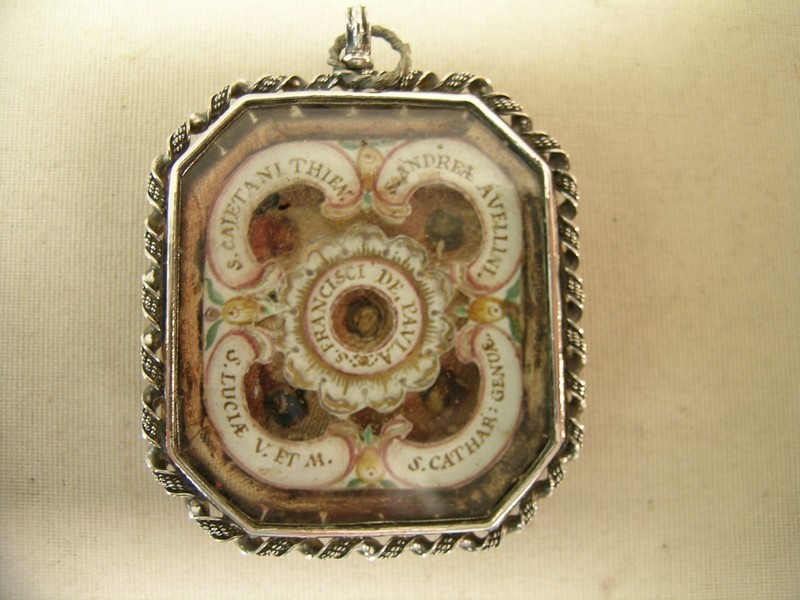
Antique reliquary Saint Francis of Paola, Lucy, Andrew Avellino, Catherine

When you click on links to various merchants on this site and make a purchase, this can result in this site earning a commission. Affiliate programs and affiliations include, but are not limited to, the eBay Partner Network.

Antique reliquary Saint Francis of Paola, Lucy, Andrew Avellino, Catherine:
$1220.00
This is a very nice antique silver pendant, inside relics of SaintFrancis of Paola, Saint Lucy of Syracuse, Saint Andrew Avellino, SaintCatherine of Genoa and Saint Cajetan. One relic loose.Wax seal and threadsintact.Measures 2,2x2,7 inch.Comes from a convent in Italy.Shipping andhandling US$ 39.00 by insured priority mail and tracking number. All my itemsare securely packet, to avoid all possible damage ( look at my response).
Please contact me if you have anyquestions. Items cannot be returned.
As per policy,this reliquary does not contain human remains but only objects ofdevotion.
The saleis for the frame, the relic is a gift.
Please be carefull when buying relics online. Fake relics areincreasingly more and more of a problem. Most of the relics I sell are fromconvents in Belgium and Italy. I have been collecting relics for more than 25years. I consider myself an expert. Please contact me if youhave any questions.
Please see my other sales formore vestments,reliquary’s, relic’s and antiques items
Ionly sell antique items and no copies or new made fakes!
SaintCajetan
Also known as
- Cajetan the Theatine
- Cajetan of Thiene
- Cajetanus
- Cayetano
- Gaetano
- Gaetanus
- Gaetano dei Conti di Tiene
- Gaetano da Thiene
Memorial
- 7 August
Profile
Cajetan was born the second son of pious andnoble parents, Caspar de Thienna and Maria Porta, who dedicated him as an infant tothe Blessed Virgin Mary. From childhood he was known as “theSaint”, and in later years as “the hunter of souls.” A distinguished student,he studied law in Padua, Italy, and was offeredpositions in the government, but he turned them down and left his native townto seek a religious vocation and obscurity in Rome. Found out, he wasforced at age 28 to accept a position at the court of Pope JuliusII. He was ordained a priest at age 36.
On the death of Pope Julius,Cajetan returned to Vicenza and disgusted his relatives by joiningthe Confraternity of Saint Jerome,whose members normally were drawn from the lowest and poorest classes. Cajetanspent his fortune in building hospitals, and devoted himself to nursingthe plague–stricken. He founded a bank to help the poor andoffer an alternative to loan sharks; it later became the Bank of Naples. He wasknown for a gentle game he played with parishioners in which he wouldbet prayers, rosaries or devotional candles on whether he wouldperform some service for them; he always did, and they always had to “pay” bysaying the prayers.
To renew the lives of the clergy, on 3May 1524 in Rome, with the help of three others, including thefuture Pope Paul IV, he formed the Congregation of Clerks Regular, known as the Theatines. They devoted themselvesto preaching, the administration of the Sacraments, and the carefulperformance of the Church‘s rites and ceremonies. Saint Cajetanwas the first to introduce the FortyHours’ Adoration of the Blessed Sacrament as an antidote to theheresy of Calvinism. When the Germans, under the Constable Bourbon, sackedRome, Saint Cajetan was scourged to extort money from him; what his attackersdid not understand was that he had long before spent his worldly wealth on goodworks.
Cajetan had a great devotion to the BlessedVirgin Mary. His piety was rewarded one Christmas eve when she appeared to himand placed the Infant Jesus in his arms. When Saint Cajetan was on hisdeath-bed, resigned to the will of God, she appeared to him again, this timesurrounded by ministering angels. He said, “Lady, bless me!” Mary replied,“Cajetan, receive the blessing of my Son, and know that I am here as a rewardfor the sincerity of your love, and to lead you to Paradise.” She then told himto have patience with the illness that had attacked him, and gaveorders to the choirs of angels to escort his soul to heaven.“Cajetan,” she said, “my Son calls you. Let us go in peace.” And so, he did.
Born
- October 1480 at Vicenza, Italy as Gaetano dei Conti di Tiene
Died
- 1547 at Naples, Italy of natural causes
Beatified
- 8 October 1629 by Pope Urban VIII
Canonized
- 12 April 1671 by Pope Clement X
Patronage
- job seekers
- unemployed people
- Theatines
- in Italy
- Chieti
- Naples
- Santo Stefano Medio, Messina
- Vicenza
Saint Catherine of Genoa
Also known as
- Apostle of Purgatory
- Caterina Fieschi Adorno
- Caterina of Genoa
- Caterinetta
Memorial
- 15 September
- formerly 22 March
Profile
Daughter of Jacopo Fieschi and Francesca diNegro, Geonese nobles; she was related to Pope Innocent V and Pope AdrianV, and her father became viceroy of Naples, Italy. Youngestof five children. A pious and prayerful girl, she earlyfelt a call to religious life, tried to enter a convent at age13, was turned away because of her youth. At 16 she entered into anarranged marriage with a young Genoese nobleman, GiulianoAdorno. They were a childless couple, he was careless andunsuccessful as a husband and provider, often cruel, violent and unfaithful,and reduced them to bankruptcy. Catherine became indifferent to her faith,and fell into a depression.
In 1473, while going to Confession ina convent in Genoa, Catherine was struck down by a vision,the revelation of God‘s love and her own sinfulness, and fell into areligious ecstasy; her interior state, and her contact with the truth shehad received in the vision, stayed with her the rest of her life. Shereturned home, helped lead her husband to the faith, and the two livedtogether chastely the rest of their lives, working with the sick and poor tillthe death of Julian in 1497. She became a Franciscan tertiary,serving as a tertiary directress in 1490. Caught andsurvived the plague in 1493. Spiritual student of Father CattaneoMarabotti in 1499, and he helped her to write and arrangedescriptions of what she had seen and learned in her visions. It isher writings that have continued her fame today; during her canonization inquiry,the Holy Office announced that her writings alone were enough toprove her sanctity. Online and downloadable versions are linked below.
Born
- 1447 at Genoa, Italy as Caterina Fieschi Adorno
Died
- 15 September 1510 at Genoa, Italy of natural causes
Beatified
- 6 April 1675 by Pope Clement X
Canonized
- 16 June 1737 by Pope Clement XII
Patronage
- against adultery
- against temptation
- brides
- childless people
- difficult marriages
- people ridiculed for their piety
- sick people of Italy (proclaimed on 15 September 1943 by Pope Pius XII)
- victims of adultery
- victims of unfaithfulness
- widows
Saint Andrew Avellino
Also known as
- Andrea Avellino
- Lancelotto
- Lorenzo Avellino
Memorial
- 10 November
Profile
Studied humanities and philosophy at Venice, Italy.Doctor of civil and ecclesiastical law. Ordained atage 26.
Lawyer at the ecclesiastical courtat Naples, Italy. During a heated courtroom argument on behalf of afriend, he supported his position with a lie; in that setting, he hadcommitted perjury. It shook him so badly, he gave up the legal profession,and settled into a life of penance.
Commissioned by his archbishop toreform the convent of Sant’ Arcangelo at Naples, a house of suchlax discipline it had became a topic of gossip in the city. Through goodexample, constant work, and the backing of his bishop Lorenzo managedto restore celibate discipline to the house, but was nearly killedfor his efforts when he was attacked by people who had been ordered off thepremises.
The night of the attack, he was taken to thehouse of the Theatine ClerksRegular. He was so impressed with them that he joined the Theatines at age 35, taking thename Andrew inreference to the crucified Apostle. Master of novices for tenyears. Superior of the Order.Founded Theatine houses in Milan, Italy and Piacenza, Italy andhelped establish others. Eloquent preacher, and popular missioner andspiritual director, bringing many back to the Church. Writer andextensive correspondent. Friend and advisor of Saint Charles Borromeo.
Suffered a stroke whilecelebrating Mass, and died soon after. Legend says that hisblood bubbled and liquified after death, which led some to think thathis stroke had left him catatonic, and that he was buried alive;a papal investigator found no credibility to any of this.
Born
- 1521 at Castronuovo, Sicily as Lorenzo (called Lancelotto by his mother)
Died
- 10 November 1608 at Naples, Italy of a stroke
- relics enshrined at the Church of Saint Paul in Naples
Beatified
- 14 October 1624 by Pope Urban VIII
Canonized
- 22 May 1712 by Pope Clement XI
Patronage
- against apoplexy; apoplexics
- against paralysis; paralyzed people
- against strokes; stroke victims
- against sudden death
- for a holy death
- stroke victims
- Badolato, Italy
- Naples, Italy
- Sicily, Italy
Saint Lucy of Syracuse
Also known as
- Lucia
- Lucie
Memorial
- 13 December
Profile
Rich, young Christian of Greek ancestry.Raised in a pious family, she vowed her life to Christ. Her Roman father died whenshe was young. Her mother, Eutychia, arranged a marriage forher. For three years she managed to keep the marriage on hold. Tochange the mother‘s mind about the girl‘s new faith, Lucy prayed atthe tomb of Saint Agatha, and her mother‘s long haemorrhagic illnesswas cured. Her mother agreed with Lucy’s desire to live for God,and Lucy became known as a patron of those with maladies likeher mother‘s.
Her rejected pagan bridegroom,Paschasius, denounced Lucy as a Christian to the governor of Sicily.The governor sentenced her to forced prostitution, but when guards wentto fetch her, they could not move her even when they hitched her to a team ofoxen. The governor ordered her killed instead. After torture thatincluded having her eyes torn out, she was surrounded by bundles ofwood which were set afire; they went out. She prophesied against herpersecutors, and was executed by being stabbed to death witha dagger. Her name is listed in the prayer “Nobis quoque peccatoribus” inthe Canon of the Mass.
Legend says her eyesight wasrestored before her death. This and the meaning of her name led to herconnection with eyes, the blind, eye trouble, etc.
Born
- c.283 at Syracuse, Sicily
Died
- stabbed in the throat c.304 at Syracuse, Sicily
- her relics are honoured in churches throughout Europe
Canonized
- Pre-Congregation
Saint Francis of Paola
Also known as
- Franciscus de Paula
- Francis the Fire Handler
- Francesco di Paola
- Francisco de Paula
Memorial
- 2 April
Profile
Francis’s parents were childless formany years, but following prayers for the intercession of Saint Francisof Assisi, they had three children; Francis was the oldest. Followinga pilgrimage in his teens to Rome and Assisi in Italy,he became a hermit in a cave near Paola. Before he was 20 yearsold he began to attract followers. By the 1450‘s the followers had becomeso numerous that he established a Rule for them and sought Church approval.This was the founding of the Hermitsof Saint Francis of Assisi, who were approved by the Holy See in 1474.In 1492 they were renamed the Franciscan Order of Minim Fiars, which means they countthemselves the least of the family of God.
Prophet. Miracle worker. Reputed toread minds. In 1464 Francis wanted to cross the Straits of Messina toreach Sicily, but a boatman refused to take him. Francis laidhis cloak on the water, tied one end to his staff to make a sail, andsailed across with his companions. Franz Liszt wrote a piece of music inspiredby the incident.
Defender of the poor and oppressed.Gave unwanted counsel and admonitions to King Ferdinand of Naples andhis sons. Traveled to Paris at the request of Pope SixtusIV to help Louis XI prepare for death. Used this position toinfluence the course of national politics, helping restore peace between France and Brittany byadvising a marriage between the ruling families, and between France and Spain bypersuading Louis XI to return some disputed land.
In an old tradition that has certain saints opposingon an equivalent demon, Francis is the adversary of Belial since hissimple humility cancels the demons raging pride.
Born
- 27 March 1416 at Paola, Calabria, Kingdom of Italy (part of modern Italy)
Died
- 2 April 1507 (Good Friday) at Plessis, France of natural causes
- in 1562 Huguenots broke open his tomb, found his body incorrupt, and burned it; the bones were salvaged by Catholics, and distributed as relics to various churches
Canonized
- 1519 by Pope Leo X
Patronage
- against fire
- against plague
- against sterility
- boatmen
- fishermen
- hermits
- lifeguards
- mariners
- naval officers
- sailors
- travellers
-
Antique reliquary Saint Francis of Paola, Lucy, Andrew Avellino, Catherine:
$1220.00
Related Items: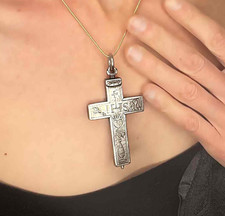
Renaissance Silver Reliquary Cross Passion of Christ Engraved
$23419.20
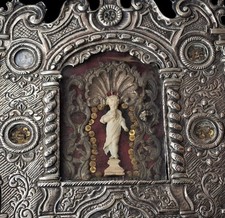
Antique European Medieval Reliquary with Relics Devotional Christianity Ca XV
$19900.00
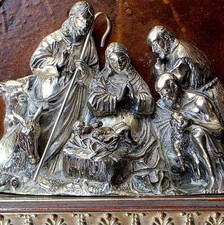
Antique Rare Hard t Find Wood Carved Silver Nativity Holy Family Altar Reliquary
$9900.00