AUTHENTIC Graham Glasgow Michigan Football Hand-Written Playbook Notebook - RARE


When you click on links to various merchants on this site and make a purchase, this can result in this site earning a commission. Affiliate programs and affiliations include, but are not limited to, the eBay Partner Network.

AUTHENTIC Graham Glasgow Michigan Football Hand-Written Playbook Notebook - RARE:
$5000.00
These images show a 9x11 inch spiral notebook with "MICHIGAN FOOTBALL" on the cover and the name "G. Glasgow" on the front. The interior pages contain some handwritten football plays, sketches on sceneries in the hand o Glasgow, and tons of detailed notes. Graham Michael Glasgow is an American professional football center for the Detroit Lions of the National Football League. He played college football for the Michigan Wolverines, and was selected by the Lions in the third round of the 2016 NFL draft. He has previously played for the Denver Broncos.
RARE, authentic, spiral-bound playbook used by Michigan Football player Graham Glasgow. This notebook contains handwritten notes across several training days, detailing specific offensive screens/draws, special plays (like 'Duck'), and complex defensive calls and adjustments. Includes notes on fundamental training, such as pad level, footwork, and block technique. A unique piece of memorabilia for any Wolverines collector, offering a direct insight into the team's strategies and preparation.
The Ultimate Piece of Wolverines and Lions MemorabiliaThis is an incredibly rare and authentic University of Michigan football spiral notebook, hand-written by current Detroit Lions offensive lineman and former Wolverine Graham Glasgow. The cover features the iconic "MICHIGAN FOOTBALL" logo and has "G. GLASGOW" handwritten at the top.
The notebook contains several pages of handwritten notes that appear to be Michigan Wolverines playbook and scheme notes, including:
Offensive and Defensive calls (e.g., "Ducks," "On Duo")
Special Situations and Play Calls ("Hurry-Hurry, Set-Hut")
Diagrams (though mostly blank, the outlines are for play diagrams)
Personal reminders, notes on technique, and philosophy ("We're going to win the championship," "Project - treat people with respect").
This is a unique, one-of-a-kind item that connects Glasgow's college career at the University of Michigan with his professional tenure with the Detroit Lions.
Player Bio: Graham Glasgow (U-M & Detroit Lions)Graham Michael Glasgow (Born August 19, 1992) is a veteran interior offensive lineman in the NFL, currently with the Detroit Lions.
University of Michigan (2011–2015)Glasgow began his career at Michigan as a walk-on in 2011, earning a scholarship in 2013.
He became a highly versatile and reliable starter, seeing action in 42 career games and making 37 starts at both center and guard.
In his final year (2015), he was awarded the Hugh R. Rader Memorial Award as the team's top offensive lineman and earned Honorable Mention All-Big Ten honors.
Glasgow was selected by the Detroit Lions in the third round (95th overall) of the 2016 NFL Draft.
He played his first four seasons (2016–2019) with the Lions, starting 42 of 62 games, establishing himself as a reliable interior lineman playing left guard, center, and right guard.
He spent three seasons (2020–2022) with the Denver Broncos before re-signing with the Detroit Lions in 2023, a key move in bolstering the offensive line for their successful run. He continues to be a vital part of the Lions' offensive line rotation, known for his consistency and versatility across the interior positions.
This playbook is a must-have for any serious collector of Michigan Wolverines or Detroit Lions Michael Glasgow (born August 19, 1992) is an American professional football center for the Detroit Lions of the National Football League (NFL). He played college football for the Michigan Wolverines, and was selected by the Lions in the third round of the 2016 NFL draft. He has previously played for the Denver Broncos.
College career
Glasgow in 2014Glasgow came to Michigan as a walk-on in 2011, but earned a scholarship in the spring practice portion of the 2013 season. Glasgow appeared in 42 career games along the offensive line and made 37 starting assignments. Glasgow made a total of 22 starts at center (13 in 2015, nine in 2013) with his other 15 appearances coming at the guard position. Following the 2015 season, Glasgow was named the team's Hugh R. Rader Memorial Award recipient as the top offensive lineman and earned honorable mention All-Big Ten Conference accolades from both the coaches and media.[1]
Professional career
Pre-draftComing out of Michigan, Glasgow was projected by some analysts to be selected in the third or fourth round. He was ranked as the eighth-best offensive guard out of the 203 available by NFLDraftScout.com.
Pre-draft measurables Height Weight Arm length Hand span 40-yard dash 10-yard split 20-yard split 20-yard shuttle Three-cone drill Vertical jump Broad jump Bench press
6 ft 5+7⁄8 in
(1.98 m) 307 lb
(139 kg) 33+5⁄8 in
(0.85 m) 10+3⁄4 in
(0.27 m) 5.13 s 1.76 s 2.98 s 4.63 s 7.63 s 25 in
(0.64 m) 8 ft 10 in
(2.69 m) 23 reps
All values from NFL Combine[2][3][4]
Detroit Lions (first stint)
Glasgow (right) in a game against the Washington Redskins in 2019.Glasgow was drafted in the third round with the 95th overall pick by the Detroit Lions in the 2016 NFL draft.[5] Halfway through the season he took over as the Lions starting left guard after struggles from former first-round pick Laken Tomlinson.In 2017, Glasgow was named the starting left guard, starting in all 16 games.[6]In 2018, Glasgow was named the starting center following the departure of Travis Swanson in free agency, and started all 16 games.[7]In 2019, Glasgow started in all 15 games he appeared in.[8]
Denver BroncosOn March 23, 2020, Glasgow signed a four-year, $44 million contract with the Denver Broncos.[9] He was placed on the reserve/COVID-19 list by the team on October 30, 2020,[10] and activated on November 11.[11] He started in all 13 games he appeared in the 2020 season.[12]In Week 9 of the 2021 season, Glasgow suffered an ankle injury and was placed on season-ending injured reserve on November 9, 2021.[13] He appeared in and started seven games in the 2021 season.[14]In the 2022 season, Glasgow appeared in all 17 games and started 13.[15]On March 13, 2023, Glasgow was released by the Broncos.[16]
Detroit Lions (second stint)On March 20, 2023, Glasgow re-signed with the Lions.[17] He started 15 games in 2023 primarily at right guard with a few games at left guard and center.[18]On March 11, 2024, Glasgow signed a three-year, $20 million contract extension with the Lions.[19]Glasgow played the 2024 season at left guard, then switched to center for 2025 upon the retirement of Frank Ragnow.
Personal lifeGraham Glasgow is married to Allison Davis. Glasgow is the older brother of defensive tackle Ryan Glasgow, with whom he was teammates at Michigan and formerly played for the New Orleans Saints. Glasgow's second younger brother, Jordan Glasgow, is a linebacker who formerly played for the Indianapolis Colts.[20][21]Glasgow was arrested on March 15, 2014, for driving under the influence. On July 14, 2014, he was sentenced to one year of probation, after entering a guilty plea to operating while visibly impaired. He also received six days of community service and $885 in fines and court costs.[22] On March 15, 2015, Graham violated his probation, and had six months added to his year-long probation, after registering a .086 on a breathalyzer test.[23]In April 2022, Glasgow became part-owner of Limitless, an Esports organization with teams in Rocket League, Valorant and Counter-Strike: Global Offensive.[24][25]The Detroit Lions are a professional American football team based in Detroit. The Lions compete in the National Football League (NFL) as a member of the National Football Conference (NFC) North division. The team plays their home games at Ford Field in Downtown Detroit.The franchise was founded in Portsmouth, Ohio, as the Portsmouth Spartans in 1928 and joined the NFL on July 12, 1930.[1][7] Amid financial struggles, the franchise was relocated to Detroit in 1934 and renamed the Lions in reference to the city's Major League Baseball (MLB) franchise, the Detroit Tigers.[7][8]The Lions won four NFL Championship Games between 1935 and 1957. Following the 1957 championship, the franchise did not win a playoff game until the 1991 season and did not win another until the 2023 season. They are the only franchise operational for the entirety of the Super Bowl era to not appear in the Super Bowl.[9][10]
History
Main article: History of the Detroit Lions
Logos and uniforms
Billy Sims (No. 20) rushing the ball against the Los Angeles Rams on September 7, 1980Aside from a brief change to scarlet and black from 1948 to 1950 instituted by then head coach Bo McMillin, which was influenced by his years as coach at Indiana, the Lions' uniforms have basically remained the same since they moved to Detroit in 1934–silver helmets, silver pants, and either blue or white jerseys.[11][12]Glenn Presnell, the then last surviving member of the 1934 Lions, recalled that after the Portsmouth Spartans relocated to Detroit, team owner George A. Richards asked him and his wife to pick the Lions' colors from combinations that included red and white, orange and black, and blue and silver. The Presnells liked blue and silver the best, so Richards selected it. The blue used by the Lions is officially known as "Honolulu blue", which is inspired by the color of the waves off the coast of Hawaii.[12][13]There have been minor changes to the uniform design throughout the years, such as changing the silver stripe patterns on the jersey sleeves, and changing the colors of the jersey numbers. "TV numbers", which are auxiliary uniform numbers to help TV broadcasters identify players from the line of scrimmage, were added to the jersey sleeves in 1956.[12] White trim was added to the logo in 1970, with outlines (white on the blue jersey, silver on the white jersey) added to the numbers in 1972; the color arrangement on the numbers on the blue jerseys was reversed in 1982.[11] The silver facemasks became blue in 1984. In 1998, the team wore blue pants with their white jerseys along with gray socks but dropped that combination after the season.[11][14] In 1999, the "TV numbers" on the sleeves were moved to the shoulders.[15]In 1994, every NFL team wore throwback jerseys,[16] and the Lions' were similar to the jerseys worn during their 1935 championship season. The helmets and pants were solid silver, the jerseys Honolulu blue with silver numbers and the jersey did not have "TV numbers" on the sleeves. The team wore solid blue socks and black cleats. The helmets also did not have logos, as helmets were simple leather back then.[11] The Lions also wore 1950s-style jerseys during their traditional Thanksgiving Day games from 2001 to 2004 as the NFL encouraged teams to wear throwback jerseys on Thanksgiving Day.[17]In 2003, the team added black trim to their logo and jerseys. The facemasks on the helmet changed from blue to black with the introduction of the new color. In 2005, the team introduced an alternate black jersey.[11][18]For 2008, the team dropped the black jersey in favor of a throwback uniform to commemorate the franchise's 75th anniversary. The throwback uniform became the team's permanent alternate jersey in 2009, replacing the former black alternate.[19] The Lions officially unveiled a new logo and uniforms on April 20, 2009. The logo was given a flowing mane and fangs, while the typeface featured a modern font.[20]
The Detroit Lions' uniform design from 2017 through 2023.On February 1, 2017, the Lions announced a new typeface, logo, and the complete removal of the color black from the team identity. While the previous logo was retained, the border was changed from black to silver.[21][18] The Lions then unveiled the new uniforms on April 13, 2017, which included the white jersey and blue pants combo for the first time since 1998. They introduced an alternate all-gray uniform, an alternate all-Honolulu blue uniform, and a helmet with a silver face mask.[22][23] The Lions also added the initials "WCF" to the left sleeve as a permanent tribute to William Clay Ford, who owned the team from 1963 until his death in 2014. The sleeve addition replaced the black "WCF" patch on the left breast that was added after Ford's death.[24]On September 20, 2021, the Lions wore white pants with their road white uniforms against the Green Bay Packers. The white pants, which lacked striping, were previously worn during the "scarlet and black" era in the 1948 and 1949 seasons.[25]On April 12, 2023, the Lions announced they would celebrate their 90th season in franchise history during the 2023 season with a commemorative logo and jersey patch. The inspiration for the patch is an homage to their logo from 1961 to 1969, which is also honored in the WCF memorial logo and the 60th commemorative season logo.[26] On June 21, 2023, the Lions unveiled an alternate blue helmet. The helmet, which features the 1960s logo, was paired with the gray uniform. This was the first time the Lions wore a blue helmet since 1955.[27][28]On April 18, 2024, the Lions unveiled a new jersey set. The home jersey, referred to as "One Pride", features a redefined Honolulu blue with white block numbers trimmed in silver and sleeves striped in silver with white accents. The home jersey is paired with silver pants with Honolulu blue stripes with white accents or solid Honolulu blue pants. The road white jersey, referred to as "the 313", features Honolulu blue block numbers, stripes trimmed in silver, and a Honolulu blue "Detroit" wordmark on the front. The road jersey is paired with solid Honolulu blue or solid white pants. The primary silver helmet with a Honolulu blue face mask and Honolulu blue stripes with white accents is worn with the home and road jerseys. The black alternate jersey, referred to as "Motor City Muscle", features Honolulu blue numbers and stripes trimmed in silver along with a "Lions" wordmark on the front. It is worn with the alternate Honolulu blue helmet featuring black stripes with silver accents and the leaping lion logo in black with silver accents. The black jersey is paired with solid black or solid Honolulu blue pants.[3][29]The black jersey was a favorite of head coach Dan Campbell, who wore the original version during his playing days. According to Lions team president Rod Wood, it was Campbell who lobbied for the black jersey to return, which happened after the Lions won the NFC North division title in 2023.[30] The throwback jersey was retained and updated with the refreshed Honolulu blue. The throwback jersey is paired with a silver helmet that is worn with a silver or a Honolulu blue face mask. The William Clay Ford (WCF) memorial decal has been placed on the back of the primary and alternate helmets.[3][29]Throughout the 2024 season, the silver pants were only worn once (a Week 2 defeat against the Tampa Bay Buccaneers), and the throwbacks were not worn at all. Instead, they mainly wore either the all-blue or all-white uniforms, with the Lions winning all of their regular season games in either combination.[31] The throwback uniforms were initially scheduled to wear in Week 18 against the Minnesota Vikings, but the Lions decided to wear their all-black alternate uniforms instead. Detroit went 2–1 in the all-black uniforms.[32]
Thanksgiving Day tradition
The Lions, seen here during the 2007 Thanksgiving game against their division rival Green Bay Packers, have played on Thanksgiving since 1934 with the exception of the years during World War II.In 1934, then team owner George A. Richards, who also was the owner of a major radio affiliate of the NBC Blue Network, WJR in Detroit, the forerunner to today's ABC, negotiated an agreement with NBC to carry his Thanksgiving game live across all of the network's stations.[33] Excluding the years of 1939–1944, due to World War II, the Lions have played on Thanksgiving ever since.[34][35]
Current roster and former players of note
Main article: List of Detroit Lions players
Current roster
Detroit Lions roster vteQuarterbacks (QB) 8 Kyle Allen
16 Jared GoffRunning backs (RB) 0 Jahmyr Gibbs
5 David Montgomery
13 Craig Reynolds
25 Jacob Saylors
33 Sione VakiWide receivers (WR) 19 Dominic Lovett
11 Kalif Raymond
14 Amon-Ra St. Brown
18 Isaac TeSlaa
1 Jameson WilliamsTight ends (TE) 82 Ross Dwelley
87 Sam LaPorta
89 Brock Wright Offensive linemen (OL) 74 Kayode Awosika LG
57 Trystan Colon C
68 Taylor Decker LT
60 Graham Glasgow C
73 Christian Mahogany LG
69 Tate Ratledge RG
58 Penei Sewell RT
70 Dan Skipper RTDefensive linemen (DL) 97 Aidan Hutchinson DE
79 Quinton Jefferson DT
78 Tyler Lacy DT
51 Roy Lopez DT
54 Alim McNeill DT
96 Al-Quadin Muhammad DE
95 Pat O'Connor DE
98 D. J. Reader DT
91 Tyleik Williams DT
99 Tyrus Wheat DE
94 Mekhi Wingo DT Linebackers (LB) 34 Alex Anzalone OLB
55 Derrick Barnes ILB
46 Jack Campbell ILB
53 Trevor Nowaske ILB
15 Grant Stuard OLBDefensive backs (DB) 6 Terrion Arnold CB
32 Brian Branch SS
36 Erick Hallett S
12 Thomas Harper S
31 Kerby Joseph FS
29 Avonte Maddox CB
27 Arthur Maulet CB
21 Amik Robertson NB
35 Jammie Robinson FS
38 Nick Whiteside CB
23 Rock Ya-Sin CBSpecial teams (ST) 39 Jake Bates K
3 Jack Fox P
49 Hogan Hatten LS Practice squad 66 Myles Adams DT
17 C. J. Beathard QB
50 Andre Carter II DE
77 Devin Cochran RT
80 Malik Cunningham WR
65 Kingsley Eguakun C
26 Tre Flowers CB
41 Kendall Fuller CB
40 Zach Horton TE
85 Tom Kennedy WR
83 Jackson Meeks WR
63 Mason Miller G
62 Michael Niese C
90 Chris Smith DT
24 Loren Strickland S
42 Ty Summers OLBReserve 52 Zach Cunningham ILB (IR)
92 Marcus Davenport DE (IR)
30 Khalil Dorsey CB (IR)
71 Miles Frazier G (PUP)
76 Justin Herron LT (IR)
28 Dan Jackson S (IR)
72 Jamarco Jones RT (IR)
59 Giovanni Manu LT (IR)
-- Levi Onwuzurike DT (PUP)
93 Josh Paschal DE (NF-Inj.)
9 Ennis Rakestraw Jr. CB (IR)
4 D. J. Reed CB (IR)
25 Kye Robichaux RB (IR)
44 Malcolm Rodriguez OLB (PUP)
75 Colby Sorsdal RT (IR)
2 Daniel Thomas SS (IR)
47 Ezekiel Turner ILB (IR)
88 Kenny Yeboah TE (IR)
84 Shane Zylstra TE (IR)
53 active, 16 practice squad, 19 reserve
As of October 22, 2025. Rookies in italics.
RosterDepth chartTransactionsCalvin Johnson
Bobby Layne
Barry Sanders
Charlie Sanders
Joe Schmidt
Doak Walker
Retired numbers
Detroit Lions retired numbers
No. Player Position Tenure Retired
7 Dutch Clark B 1931–1932
1934–1938 October 15, 1939[1][36][37]
20 Lem Barney CB 1967–1977 November 25, 2004[38][39]
Billy Sims RB 1980–1984
Barry Sanders RB 1989–1998
22 Bobby Layne QB, K 1950–1958 [1]
37 Doak Walker HB, K, P 1950–1955 December 11, 1955[1][40][41]
56 Joe Schmidt 1 LB 1953–1965 [1]
85 Chuck Hughes 2 WR 1970–1971 October 28, 1971[1][42]Notes: 1 The No. 56 was temporarily unretired with Schmidt's blessing when the Lions acquired linebacker Pat Swilling from the New Orleans Saints. No player has worn it since Swilling left.[43]
2 Posthumous. Hughes died of a heart attack during a game on October 24, 1971, and his No. 85 was retired.[1][44] Over the years, however, the number has been reissued.[45][42]Special cases The Lions retired No. 93 for the 2009 season after Corey Smith disappeared, presumed dead, when a boat he was fishing in with friends capsized off the Florida coast.[46] The Lions also wore 93 decals on their helmets that season.[47] The number was assigned to Kyle Vanden Bosch in 2010.[48]Pro Football Hall of Fame members
Main article: List of Detroit Lions in the Pro Football Hall of Fame
Pride of the Lions
Main article: Pride of the Lions
75th Season All-Time TeamOn November 9, 2008, the Lions honored the 75th Season All-Time Team during halftime against the Jacksonville Jaguars.[49][50] The team was chosen via an online fan poll and selection committee.[49] Bold indicates those elected to the Pro Football Hall of Fame.
75th Season All-Time Team
No. Player Position Tenure
6 Jim Arnold P 1986–1993
60 Al Baker DE 1978–1982
20 Lem Barney CB 1967–1977
36 Bennie Blades DB 1988–1996
75 Lomas Brown T 1985–1995
76 Roger Brown DT 1960–1966
19, 24 Jack Christiansen DB 1951–1958
7, 12, 19 Dutch Clark QB 1931–1932
1934–1938
89 Gail Cogdill WR 1960–1968
76 Lou Creekmur G/T 1950–1959
25 Jim David DB 1952–1959
44 Don Doll DB 1949–1952
78 Doug English DT 1975–1985
54 Ed Flanagan C 1965–1974
53 Kevin Glover C 1985–1997
75 John Gordy OG 1957–1967
23 Mel Gray KR/PR 1989–1994
4 Jason Hanson 1 K 1992–2012
71 Alex Karras DT 1958–1962
1964–1970
81 Dick "Night Train" Lane CB 1960–1965
28 Yale Lary DB, P 1952–1953
1956–1964
22 Bobby Layne QB 1950–1958
24, 44 Dick LeBeau DB 1959–1972
84 Herman Moore WR 1991–2001
3 Eddie Murray K 1980–1991
91 Robert Porcher DE 1992–2003
20 Barry Sanders RB 1989–1998
88 Charlie Sanders TE 1968–1977
30 Cory Schlesinger FB 1995–2006
56 Joe Schmidt LB 1953–1965
66 Harley Sewell OG 1953–1962
20 Billy Sims RB 1980–1984
54 Chris Spielman LB 1988–1995
37 Doak Walker HB 1950–1955
55 Wayne Walker LB 1958–1972
30, 50 Alex Wojciechowicz C, LB 1938–1946Note: 1 Hanson was active at the time of the selection.[50]Lions All-Time TeamOn September 29, 2019, the Lions honored their All-Time Team in celebration of the NFL's centennial during halftime against the Kansas City Chiefs. The team was chosen via fan voting, contributions from the Detroit Lions Legends Community, team executives, and select members of the media.[51] Bold indicates those elected to the Pro Football Hall of Fame.
Lions All-Time Team
No. Player Position Tenure
60 Al Baker DE 1978–1982
20 Lem Barney CB 1967–1977
36 Bennie Blades DB 1988–1996
75 Lomas Brown T 1985–1995
76 Roger Brown DT 1960–1966
19, 24 Jack Christiansen DB 1951–1958
7, 12, 19 Dutch Clark QB 1931–1932
1934–1938
89 Gail Cogdill WR 1960–1968
76 Lou Creekmur G/T 1950–1959
25 Jim David DB 1952–1959
44 Don Doll DB 1949–1952
7, 20, 56 Ox Emerson G, C, LB 1931–1937
78 Doug English DT 1975–1985
54 Ed Flanagan C 1965–1974
53 Kevin Glover C 1985–1997
23 Mel Gray KR/PR 1989–1994
4 Jason Hanson K 1992–2012
81 Calvin Johnson WR 2007–2015
71 Alex Karras DT 1958–1962
1964–1970
81 Dick "Night Train" Lane CB 1960–1965
28 Yale Lary DB, P 1952–1953
1956–1964
22 Bobby Layne QB 1950–1958
24, 44 Dick LeBeau DB 1959–1972
53 Mike Lucci LB 1965–1973
84 Herman Moore WR 1991–2001
48 Don Muhlbach 1 LS 2004–2020
33 Nick Pietrosante FB 1959–1965
91 Robert Porcher DE 1992–2003
20 Barry Sanders RB 1989–1998
88 Charlie Sanders TE 1968–1977
30 Cory Schlesinger FB 1995–2006
56 Joe Schmidt LB 1953–1965
66 Harley Sewell OG 1953–1962
20 Billy Sims RB 1980–1984
54 Chris Spielman LB 1988–1995
9 Matthew Stafford 1 QB 2009–2020
63 Dick Stanfel OG 1952–1955
37 Doak Walker HB 1950–1955
30, 50 Alex Wojciechowicz C, LB 1938–1946Note: 1 Stafford and Muhlbach were active at the time of the selection.[51]Michigan Sports Hall of Fame
Main article: Michigan Sports Hall of Fame
Staff
Current staff
Detroit Lions staff vte Front office Owner – Sheila Ford Hamp
Vice chairpeople – William Clay Ford Jr., Martha Ford Morse, Elizabeth Ford Kontulis
President/CEO – Rod Wood
Executive vice president & general manager – Brad Holmes
Chief operating officer – Mike Disner
Special assistant/chairperson – Chris Spielman
Assistant general manager – Ray Agnew
Director of scouting – Dwayne Joseph
Director of college scouting – Brian Hudspeth
Director of pro scouting – Rob Lohman
Assistant director of pro scouting - Joe Kelleher
Senior personnel executive – John Dorsey
Senior director of football administration - Charlie AdkinsHead coaches Head coach – Dan Campbell
Assistant head coach/wide receivers – Scottie MontgomeryOffensive coaches Offensive coordinator – John Morton
Passing game coordinator – David Shaw
Quarterbacks – Mark Brunell
Running backs – Tashard Choice
Tight ends – Tyler Roehl
Assistant tight ends – Seth Ryan
Run game coordinator/offensive line – Hank Fraley
Assistant offensive line – Steve Oliver
Offensive assistant – Bruce Gradkowski
Offensive assistant – Marques Tuiasosopo
Offensive quality control – Justin Mesa Defensive coaches Defensive coordinator – Kelvin Sheppard
Run game coordinator/defensive line – Kacy Rodgers
Linebackers – Shaun Dion Hamilton
Passing game coordinator/defensive backs – Deshea Townsend
Senior defensive assistant/outside linebackers – David Corrao
Defensive assistant – Caleb Collins
Defensive assistant – August Mangin
Defensive assistant/safeties – Jim O'Neil
Defensive quality control – Dré ThompsonSpecial teams coaches Special teams coordinator – Dave Fipp
Assistant special teams – Jett ModkinsStrength and conditioning Director of sports performance – Mike Clark
Director of sports science – Jill Costanza
Head strength & conditioning – Josh Schuler
Assistant strength & conditioning – Thaddeus Jackson
Assistant strength & conditioning - Cameron Josse→ Coaching staff
→ Front office
→ More NFL staffs
Head coaches
Main article: List of Detroit Lions head coaches
Dan Campbell, the head coach of the Detroit LionsThe Lions have had 30 head coaches throughout their franchise history. Their first head coach was Hal Griffen, who compiled a 5–6–3 (.464) overall record with the team of 1930. Wayne Fontes was the longest-tenured head coach in Lions history, serving from 1988 to 1996.[52] The current head coach of the Lions is Dan Campbell, who was hired on January 20, 2021.[53]
Offensive coordinators
Name Tenure
No offensive coordinator 1934–1966
Bill McPeak 1967–1972
No offensive coordinator 1973–1975
Ken Shipp 1976
Ed Hughes 1977
Bob Schnelker 1978–1981
Ted Marchibroda 1982–1983
Bill Nelsen 1984
Bob Baker 1985–1988
Dave Levy 1991
Dan Henning 1992–1993
Dave Levy 1994
Tom Moore 1994–1996
Sylvester Croom 1997–2000
Gary Moeller 2000
Maurice Carthon 2001–2002
Sherman Lewis 2003–2004
Ted Tollner 2005
Mike Martz 2006–2007
Jim Colletto 2008
Scott Linehan 2009–2013
Joe Lombardi 2014–2015
Jim Bob Cooter 2015–2018
Darrell Bevell 2019–2020
Anthony Lynn 2021
Ben Johnson 2022–2024
John Morton 2025–present
Defensive coordinators
Name Tenure
No defensive coordinator 1934–1951
Buster Ramsey 1952–1959
No defensive coordinator 1960
Don Shula 1961–1962
No defensive coordinator 1963–1966
Jim David 1967–1972
No defensive coordinator 1973–1976
Fritz Shurmur 1977
No defensive coordinator 1978–1979
Maxie Baughan 1980–1982
Ed Beard 1983–1984
Wayne Fontes 1985–1988
Woody Widenhofer 1989–1992
Hank Bullough 1993
Herb Paterra 1994–1995
Jim Eddy 1996
Larry Peccatiello 1997–2000
Vince Tobin 2001
Kurt Schottenheimer 2002–2003
Dick Jauron 2004–2005
Donnie Henderson 2006
Joe Barry 2007–2008
Gunther Cunningham 2009–2013
Teryl Austin 2014–2017
Paul Pasqualoni 2018–2019
Cory Undlin 2020
Aaron Glenn 2021–2024
Kelvin Sheppard 2025–present
Special teams coordinators
Name Tenure
John Bonamego 2019
Brayden Coombs 2020
Dave Fipp Bears
Main article: Bears–Lions rivalryThe Lions and Chicago Bears first met in 1930 when the Lions were known as the Portsmouth Spartans.[54] The Bears and Lions have been division rivals since 1933.[55][56] As of the 2025 season, the Bears lead the series 105–81–5.[57]
Green Bay Packers
Main article: Lions–Packers rivalryThe Lions and Green Bay Packers first met in 1929 when the Lions were known as the Portsmouth Spartans.[7][58] The Lions and Packers have been division rivals since 1933.[55][56][59] As of the 2025 season, the Packers lead the series 107–78–7.[60]
Minnesota Vikings
Main article: Lions–Vikings rivalryThe Lions and Minnesota Vikings have played twice annually since the Vikings entered the NFL in 1961, excluding 1982 due to the strike that occurred that season.[61][62] As of the 2024 season, the Vikings lead the all-time series 80–45–2.[63]
Former
Tampa Bay BuccaneersThe Lions and the Tampa Bay Buccaneers were also division opponents in the NFC Central from 1977 to 2001.[64] As of the 2025 season, the Lions lead the all-time series 34–30.[65]
Historic
Cleveland BrownsThe Lions also share a rivalry with the Cleveland Browns, which began in the 1950s when the Browns and Lions played each other in four NFL Championship Games. The Lions won three of those championships, while the Browns won one. This was one of the NFL's best rivalries in the 1950s.[66] Since the AFL–NFL merger of 1970, the teams have met much less frequently due to the Browns' move to the American Football Conference (AFC).[67] From 2002 to 2014, the two teams played an annual preseason game known as the "Great Lakes Classic".[68] As of the 2025 season, the Lions lead the all-time series 20–6, with three of those wins coming in postseason play.[69]
Los Angeles RamsThe Lions have played the Rams more than any other non-divisional team with 89 total matchups over the years dating back to 1937. In the 2023–24 playoffs, the Rams and Lions met for their first postseason matchup since 1952. The Lions won 24–23 in Matthew Stafford's first game back in Detroit since being traded to the Rams.[70] As of the 2024 season, the Rams lead the all-time series 45–43–1.[71]
Radio and television
Main article: List of Detroit Lions broadcasters
Radio
Main article: Detroit Lions Radio NetworkThe Lions' Flagship radio station is WXYT-FM.[72] Dan Miller does play-by-play, Lomas Brown does color commentary, and T. J. Lang is the sideline reporter.[73][74]In 2015, the team announced that they were moving from WXYT-FM to WJR for the 2016 NFL season, ending a 20-year relationship with CBS Radio.[75] The decision to part with WXYT was reportedly instigated by a demand by the team for the station to fire on-air personality Mike Valenti, who has had a history of making critical comments about the Lions during his drivetime show, as a condition of any future renewal. A CBS Radio spokesperson stated that their refusal was meant to maintain the station's integrity.[75][76]The Lions' Flagship station returned to WXYT-FM starting with the 2021 season.[77]
TV
Preseason
Main article: Detroit Lions Television NetworkIn 2015, WJBK took over from WXYZ-TV as the Flagship station for Lions preseason games.[78] In 2025, the announcers were Jason Benetti with play-by-play, T. J. Lang with color commentary, and Dannie Rogers with sideline reports.[79] Games are produced by FanDuel Sports Network Detroit.[80][81][82]
Regular seasonRegular season games are broadcast regionally on Fox, except when the Lions play an AFC team in Detroit, in which case the game airs regionally on CBS; however, since 2014, with the institution of the NFL's "cross flex" broadcast rules, any Lions game slated to air on Fox can be moved to CBS.[83][84] The Thanksgiving Day game in Detroit is always televised nationally, alternating between Fox in odd years and CBS in even years.[34] In 2011, the Lions became the last NFC team to play on NBC's Sunday Night Football since the network began airing Sunday night games in 2006.[85]
Blackouts
Main article: National Football League television blackout policiesThe Lions' winless performance in 2008 and 2–14 season in 2009, coupled with the effects of the Great Recession in Michigan, led to several local broadcast blackouts, as local fans did not purchase enough tickets by the 72-hour blackout deadline. The first blackout in the then seven-year history of Ford Field was on October 26, 2008, against the Washington Redskins. The previous 50 regular season home games had been sellouts.[86] The second home game of the 2009 season in which the Lions broke the losing streak, also against the Redskins, was blacked out locally, as well as the comeback victory over the Cleveland Browns.[87][88][89] The Lions had only one blackout in 2010, yet another Redskins game, which the Lions won 37–25.[90] However, in 2015, the NFL suspended its blackout policies, meaning that all Lions games will be shown on local TV, regardless of tickets sold.[91]Games were also often blacked out at the Lions' previous home, the 80,000-seat Pontiac Silverdome, despite winning seasons and the success and popularity of star players such as Barry Sanders.[92][93]
Lions cheerleaders
Main article: Detroit Lions CheerleadersOn June 13, 2016, the Lions announced the addition of cheerleaders to the organization.[94] The team also announced that Rebecca Girard-Smoker, formerly the director of the Detroit Pistons dance team, would be the coach of the cheerleading squad. It marked the first time in over 40 years the team had an official cheerleading squad. The cheerleading squad is a part of the entertainment during football games, and active at community events.[95]
Season-by-season recordThe Michigan Wolverines football team represents the University of Michigan in college football at the NCAA Division I Football Bowl Subdivision (FBS) level. Michigan has the most all-time wins in college football history.[2][3] The team is known for its distinctive winged helmet, its fight song, its record-breaking attendance figures at Michigan Stadium,[4] and its many rivalries, particularly its annual, regular season-ending game against Ohio State, known simply as "The Game," once voted as ESPN's best sports rivalry.[5]Michigan began competing in intercollegiate football in 1879. The Wolverines joined the Big Ten Conference at its inception in 1896, and other than a hiatus from 1907 to 1916, have been members since. Michigan has won or shared 45 league titles, and since the inception of the AP poll in 1936, has finished in the top ten a total of 39 times. The Wolverines claim twelve national championships, including three (1948, 1997, 2023) from the major wire-service: the AP Trophy and/or Coaches' Trophy.[6]From 1900 to 1989, Michigan was led by a series of nine head coaches, each of whom has been inducted into the College Football Hall of Fame either as a player or as a coach. Fielding H. Yost became Michigan's head coach in 1901 and guided his "Point-a-Minute" squads to a streak of 56 games without a defeat, spanning from his arrival until the season finale in 1905, including a victory in the 1902 Rose Bowl, the first college football bowl game ever played. Fritz Crisler brought his winged helmet from Princeton University in 1938 and led the 1947 Wolverines to a national title and Michigan's second Rose Bowl win. Bo Schembechler coached the team for 21 seasons (1969–1989) in which he won 13 Big Ten titles and 194 games, a program record. The first decade of his tenure was underscored by a fierce competition with his former mentor, Woody Hayes, whose Ohio State Buckeyes squared off against Schembechler's Wolverines in a stretch of the Michigan–Ohio State rivalry dubbed "The Ten Year War".Following Schembechler's retirement, the program was coached by two of his former assistants, Gary Moeller and then Lloyd Carr, who maintained the program's overall success over the next 18 years, Carr winning a national championship in 1997. However, the program's fortunes declined under the next two coaches, Rich Rodriguez and Brady Hoke, who were both fired after relatively short tenures. Following Hoke's dismissal, Michigan hired Jim Harbaugh on December 30, 2014.[7] Harbaugh is a former quarterback for the team, having played for Michigan from 1982 to 1986 under Schembechler. Harbaugh led the Wolverines to three consecutive Big Ten titles and College Football Playoff appearances during his final three years as head coach, from 2021 to 2023. His final team, the 2023 Michigan Wolverines won the program's first national championship since 1997, and first undisputed national championship since 1948 after beating Washington in the 2024 National Championship Game. Following the championship victory, Harbaugh left Michigan to return to coaching in the National Football League (NFL). Currently, the head coach position is held by Sherrone Moore, who had been on Harbaugh's coaching staff since 2018, and had been an offensive coordinator since 2021. He was the acting head coach for four games during the national championship-winning 2023 season. He won them all, including games against ranked opponents Penn State and Ohio State. The Wolverines promoted Moore on January 26, 2024, two days after Harbaugh's departure.[8][9]The Michigan Wolverines have featured 89 selections that have garnered consensus honors on the College Football All-America Team. Three Wolverines have won the Heisman Trophy: Tom Harmon in 1940, Desmond Howard in 1991, and Charles Woodson in 1997. Gerald Ford, who later became the 38th president of the United States, started at center and was voted most valuable player by his teammates on the 1934 team.
History
See also: List of Michigan Wolverines football seasons
Early history (1879–1900)
Main article: History of Michigan Wolverines football in the early years
The 1879 squad, the first team fielded by the universityOn May 30, 1879, Michigan played its first intercollegiate football game against Racine College at White Stocking Park in Chicago. The Chicago Tribune called it "the first rugby-football game to be played west of the Alleghenies."[10] Midway through "the first 'inning',"[11] Irving Kane Pond scored the first touchdown for Michigan.[12][13] According to Will Perry's history of Michigan football, the crowd responded to Pond's plays with cheers of "Pond Forever."[10] In 1881, Michigan played against Harvard in Boston. The game that marked the birth of intersectional football.[14] On their way to a game in Chicago in 1887, Michigan players stopped in South Bend, Indiana and introduced football to students at the University of Notre Dame. A November 23 contest marked the inception of the Notre Dame Fighting Irish football program and the beginning of the Michigan–Notre Dame rivalry.[15] In 1894, Michigan defeated Cornell, which was the "first time in collegiate football history that a western school defeated an established power from the east."[16]
The 1898 Michigan Wolverines, the first Michigan team to win a conference titleIn 1896, the Intercollegiate Conference of Faculty Representatives—then commonly known as the Western Conference and later as the Big Ten Conference—was formed by the University of Michigan, the University of Chicago, the University of Illinois, the University of Minnesota, the University of Wisconsin, Northwestern University, and Purdue University.[17] The first Western Conference football season was played in 1896, with Michigan going 9–1, but losing out on the inaugural Western Conference title with a loss to the Chicago Maroons to end the season.[18][19] By 1898 Amos Alonzo Stagg was fast at work at turning the University of Chicago football program into a powerhouse. Before the final game of the 1898 season, Chicago was 9–1–1 and Michigan was 9–0; a game between the two teams in Chicago decided the third Western Conference championship. Michigan won, 12–11, capturing the program's first conference championship in a game that inspired "The Victors", which later became the school's fight song.[20] Michigan went 8–2 and 7–2–1 in 1899 and 1900, results that were considered unsatisfactory relative to the 10–0 season of 1898.[21]
Yost era (1901–1928)
Main article: History of Michigan Wolverines football in the Yost era
Fielding Yost in 1902.After the 1900 season, Charles A. Baird, Michigan's first athletic director, wrote to Fielding H. Yost, "Our people are greatly roused up over the defeats of the past two years", and gave Yost an offer to come to Michigan to coach the football team.[22] The New York Times reported that Michigan's margin of victory was "one of the most remarkable ever made in the history of football in the important colleges."[23] At the end of the season, Michigan participated in the inaugural Rose Bowl.[24] Michigan dominated the game so thoroughly that Stanford's captain requested the game be called with eight minutes remaining. Neil Snow scored five touchdowns in the game, which is still the all-time Rose Bowl record.[25] The next year, 1902, Michigan outscored its opponents 644 to 12 and finished the season 11–0. In 1903, Michigan played a game against Minnesota that started the rivalry for the Little Brown Jug, the oldest rivalry trophy in college football.[26] The game marked the only time from 1901 to 1904 that Michigan failed to win.[21] Michigan finished the season at 11–0–1. In 1904, Michigan once again went undefeated at 10–0 while recording one of the most lopsided defeats in college football history, a 130–0 defeat of the West Virginia Mountaineers.[19]From 1901 through 1904, Michigan didn't lose a single game.[21] The streak was finally halted at the end of the 1905 season by Amos Alonzo Stagg's Chicago Maroons, a team that went on to win two Big 9 (as the Western Conference was now being called with the addition of Iowa and Indiana) titles in the next three years.[18] The game, dubbed "The First Greatest Game of the Century,"[27] broke Michigan's 56-game unbeaten streak and marked the end of the "Point-a-Minute" years. The 1905 Michigan team had outscored opponents 495–0 in its first 12 games. The game was lost in the final ten minutes of play when Denny Clark was tackled for a safety as he attempted to return a punt from behind the goal line. Michigan tied for another Big 9 title in 1906 before opting to go independent for the 1907 season.[19] The independent years were not as kind to Yost as his years in the Big 9. Michigan suffered one loss in 1907.[21] In 1908, Michigan got battered by Penn (a team that went 11–0–1 that year) in a game in which Michigan center Germany Schulz took such a battering as to have to be dragged off the field.[28] In 1909, Michigan suffered its first loss to Notre Dame, leading Yost to refuse to schedule another game against Notre Dame; the schools did not play again until 1942.[19] In 1910, Michigan played their only undefeated season of the independent years, going 3–0–3.[21] Overall from 1907 to 1916, Michigan lost at least one game every year (with the exception of 1910).[21]
Benny Friedman in 1929.Michigan rejoined the Big 9 in 1917, after which it was called the Big Ten. Yost immediately got back to work. In 1918, Michigan played the first game against Stagg's Chicago Maroons since Chicago ended Michigan's winning streak in 1905.[19] Michigan defeated the Maroons, 18–0, on the way to a 5–0 record.[19][21] The next three years were lean, with Michigan going 3–4, 5–2, and 5–1–1, in 1919, 1920, and 1921.[21] However, in 1922 Michigan managed to spoil the "Dedication Day" for Ohio Stadium, defeating the Buckeyes 19–0.[19] Legend has it that the rotunda at Ohio Stadium is painted with maize flowers on a blue background due to the outcome of the 1922 dedication game.[29] Michigan went 5–0–1 in 1922, capturing a Big Ten title.[18][21] In 1923, Michigan went 8–0, winning another conference championship.[18][21] The 1924 Wolverines, coached by George Little, saw their 20-game unbeaten streak end at the hands of Red Grange.[19] After the 1924 season, Little left Michigan to accept the head coach and athletic director positions at Wisconsin, returning athletic director Yost to the head coaching position.[30] Although the 1925 and 1926 seasons did not include a conference title, they were memorable due to the presence of the famous "Benny-to-Bennie" combination, a reference to Benny Friedman and Bennie Oosterbaan. The two helped popularize passing the ball in an era when running held dominance. Oosterbaan became a three-time All-American and was selected for the All-Time All-American team in 1951,[31] while Friedman went on to have a Hall of Fame NFL career.[32] Also during 1926, Michigan was retroactively awarded national titles for the 1901 and 1902 seasons via the Houlgate System, the first national titles awarded to the program. Other major selectors (such as the National Championship Foundation and Jeff Sagarin) later retroactively awarded Michigan with titles in the 1903, 1904, 1918, 1923, 1925, and 1926 seasons.[33] Michigan claims titles in the 1901, 1902, 1903, 1904, 1918, and 1923 seasons.[34]Yost stepped aside in 1926 to focus on being Michigan's athletic director, a post he had held since 1921, thus ending the greatest period of success in the history of Michigan football.[35] Under Yost, Michigan posted a 165–29–10 record, winning ten conference championships and six national championships.[18][19][34] One of his main actions as athletic director was to oversee the construction of Michigan Stadium. Michigan began playing football games in Michigan Stadium in the fall of 1927. At the time Michigan Stadium had a capacity of 72,000, although Yost envisioned eventually expanding the stadium to a capacity well beyond 100,000.[36] Michigan Stadium was formally dedicated during a game against the Ohio State Buckeyes that season to the tune of a 21–0 victory.[37] Tad Wieman became Michigan's head coach in 1927. That year, Michigan posted a modest 6–2 record.[21] However, the team ended 1928 with a losing 3–4–1 record and Wieman was fired.[38][39]
Kipke years (1929–1937)
Main article: History of Michigan Wolverines football in the Kipke years
Future U.S. president Gerald Ford during practice as a center on Wolverines football team, 1933In 1929, Harry Kipke, a former player under Yost, took over as head coach.[40] From 1930 to 1933, Kipke returned Michigan to prominence. During that stretch, Michigan won the Big Ten title every year and the national championship in 1932 and 1933.[18][34] In 1932, quarterback and future College Football Hall of Famer Harry Newman was a unanimous first-team All-American, and the recipient of the Douglas Fairbanks Trophy as Outstanding College Player of the Year (predecessor of the Heisman Trophy), and the Helms Athletic Foundation Player of the Year Award, the Chicago Tribune Silver Football trophy as the Most Valuable Player in the Big Ten Conference.[41] During this span Kipke's teams only lost one game, to Ohio State.[19][21] After 1933, however, Kipke's teams compiled a 12–22 record from 1934 to 1937.[21] The 1934 Michigan team only won one game, against Georgia Tech in a controversial contest. Georgia Tech coach and athletic director W. A. "Bill" Alexander refused to allow his team to take the field if Willis Ward, an African-American player for Michigan, stepped on the field. Michigan conceded, and the incident reportedly caused Michigan player Gerald R. Ford to consider quitting the team.[42] Overall, Kipke posted a 49–26–4 record at Michigan, winning four conference championships and two national championships.[18][21][34]
Crisler years (1938–1947)
Main article: History of Michigan Wolverines football in the Crisler years
Fritz Crisler in 1948In 1938, Michigan hired Fritz Crisler as Kipke's successor.[43] Crisler had been head coach of the Princeton Tigers and reportedly wasn't excited to leave Princeton.[43] Michigan invited him to name his price, and Crisler demanded what he thought would be unacceptable: the position of athletic director when Yost stepped down and the highest salary in college football.[44] Michigan accepted, and Crisler became the new head coach of the Michigan football program.[43]Upon arriving at Michigan, Crisler introduced the winged football helmet, ostensibly to help his players find the receivers down field.[45] Whatever the reasoning, the winged helmet has since become one of the iconic marks of Michigan football.[46] Michigan debuted the winged helmet in a game against Michigan State in 1938.[47] Two years later in 1940, Tom Harmon led the Wolverines to a 7–1 record on his way to winning the Heisman Trophy.[21][48] Harmon ended the season by scoring three rushing touchdowns, two passing touchdowns, four extra points, intercepting three passes, and punting three times for an average of 50 yards in a game against the Ohio State Buckeyes.[49] The 1943 season included a No. 1 (Notre Dame) vs. No. 2 (Michigan) match-up against Notre Dame, a game the Wolverines lost 35–12.[19] Michigan ended the season at 8–1, winning Crisler's first Big Ten championship.[18][21]Crisler had reversed the misfortune of the end of the Kipke era and returned Michigan to one and two-loss seasons. From 1938 to 1944, Michigan posted a 48–11–2 record,[50] although the period lacked a national title and only contained one conference title.[21] Yet, Crisler's biggest mark on the game of football was made in 1945, when Michigan faced a loaded Army squad that featured two Heisman trophy winners, Doc Blanchard and Glenn Davis. Crisler didn't feel that his Michigan team could match up with Army, so he opted to take advantage of a 1941 NCAA rule that allowed players to enter or leave at any point during the game.[44] Crisler divided his team into "offensive" and "defensive" specialists, an act that earned him the nickname "the father of two-platoon football."[51] Michigan still lost the game with Army 28–7,[19] but Crisler's use of two-platoon football shaped the way the game was played in the future. Eventually, Crisler's use of the platoon system propelled his team to a conference championship and a national title in 1947, his final season.[18][19][34] The 1947 team, nicknamed the "Mad Magicians" due to their use of two-platoon football, capped their season with a 49–0 victory over the USC Trojans in the 1948 Rose Bowl.[19] Crisler finished with a 116–32–9 record at Michigan, winning two conference titles and one national title.[18][21][34][50]
Oosterbaan years (1948–1958)
Main article: History of Michigan Wolverines football in the Oosterbaan years
Bennie OosterbaanCrisler continued as athletic director while Bennie Oosterbaan, the same Bennie that had electrified the world while making connections with Benny Friedman 20 years earlier, took over the football program.[52] Things started off well for Oosterbaan in 1948 with the Wolverines earning a quality mid-season victory over No. 3 Northwestern.[19][52] Michigan finished the season undefeated at 9–0, thus winning another national championship.[21][34] Initially, Oosterbaan continued Crisler's tradition of on-field success, winning conference titles each year from 1948 to 1950 and the national title in 1948.[18][34] The 1950 season ended in interesting fashion, with Michigan and Ohio State combining for 45 punts in a game that came to be known as the "Snow Bowl." Michigan won the game 9–3, winning the Big Ten conference and sending the Wolverines off to the 1951 Rose Bowl.[18][19] Subsequently, Michigan's football team began to decline under Oosterbaan. From 1951 to 1958, Michigan compiled a record of 42–26–2, a far cry from the success under Crisler and Yost.[21] Perhaps more importantly, Oosterbaan posted a 2–5–1 record against Michigan State and a 3–5 record against Ohio State over the same time period.[19] Under mounting pressure, Oosterbaan stepped down after 1958.[52]
Elliott years (1959–1968)
Main article: History of Michigan Wolverines football in the Elliott yearsIn place of Oosterbaan stepped Bump Elliott, a former Michigan player of Crisler's.[53] Elliott continued many of the struggles that began under Oosterbaan, posting a 51–42–2 record from 1959 through 1968 (including a 2–7–1 record against Michigan State and a 3–7 record against Ohio State).[21] Michigan's only Big Ten title under Elliott came in 1964, a season that included a win over Oregon State in the 1965 Rose Bowl.[18][19] Following a 50-14 drubbing at the hands of Ohio State in 1968,[19] Elliott resigned.
Schembechler era (1969–1989)
Bo Schembechler in 1975.It only took 15 minutes for Don Canham to be sold on Bo Schembechler, resulting in Schembechler becoming the 15th coach in Michigan football history.[54] At the time, Schembechler's employer, the Miami RedHawks, could have thrown more money at Schembechler, but Canham managed to sell Schembechler on Michigan's tradition and prestige.[55] Schembechler's first team got off to a moderate start, losing to rival Michigan State and entering the Ohio State game with a 7–2 record.[21] Ohio State, coached by icon Woody Hayes, entered the game at 8–0 and poised to repeat as national champions.[56] The 1969 Ohio State team was hailed by some as being the "greatest college football team ever assembled" and came into the game favored by 17 points over Michigan.[57] Michigan shocked the Buckeyes, winning 24–12, going to the Rose Bowl, and launching The Ten Year War between Hayes and Schembechler.[19] From 1969 to 1978, one of either Ohio State or Michigan won at least a share of the Big Ten title and represented the Big Ten in the Rose Bowl every season.[18] In 1970 Schembechler failed to repeat on the magic of 1969, that year losing to Ohio State 20–9 and finishing at 9–1.[19] However, in 1971, Schembechler led Michigan to an undefeated regular season, only to lose to the Stanford Indians in the Rose Bowl to finish at 11–1.[21] From 1972 to 1975, Michigan failed to win a game against Ohio State (powered by phenom running back Archie Griffin).[19] However, Michigan did tie Ohio State in 1973, only missing out on the Rose Bowl due to a controversial vote that sent Ohio State to the Rose Bowl and left Michigan at home.[19] Another notable event occurred during the 1975 season, with the first of Michigan's record streak of games with more than 100,000 people in attendance occurring during a game against the Purdue Boilermakers.
Rick Leach, who played quarterback for Michigan from 1975 through 1978.From 1976 to 1978, Michigan asserted its own dominance of the rivalry, beating Ohio State, going to the Rose Bowl, and posting a 10–2 record every year.[19][21] After the 1978 season, Woody Hayes was fired for punching an opposing player during the 1978 Gator Bowl, thus ending The Ten Year War.[58] Michigan had a slight edge in the war, with Schembechler going 5–4–1 against Hayes. However, while Schembechler successfully placed great emphasis on the rivalry, Michigan's bowl performances were sub-par. Michigan failed to win their last game of the season every year during The Ten Year War.[19] The only year in which Michigan didn't lose its last game of the season was the 1973 tie against Ohio State.[19] After the end of the Ten Year War, Michigan's regular season performance declined, but its post season performance improved. The 1979 season included a memorable game against Indiana that ended with a touchdown pass from John Wangler to Anthony Carter with six seconds left in the game.[59] Michigan went 8–4 on the season, losing to North Carolina in the 1979 Gator Bowl.[19][21] In 1980, Michigan went 10–2 and got their first win in the Rose Bowl under Schembechler, a 23–6 win over Washington.[19][21] Michigan went 9–3 in 1981 to get Schembechler's second bowl win in the 1981 Bluebonnet Bowl.[19][21] In 1982, Michigan won the Big Ten championship while being led by three-time All-American wide receiver Anthony Carter.[18][60] Michigan fell to UCLA Bruins in the 1983 Rose Bowl.[19] Without Anthony Carter, the Wolverines did not win the Big Ten title in 1983, going 9–3.[21] In 1984, the Wolverines suffered their worst season under Schembechler, going 6–6 with a loss to national champion BYU in the 1984 Holiday Bowl.[19][21]Michigan needed to reverse its fortunes in 1985, and they began doing so with new quarterback Jim Harbaugh.[61] Harbaugh led the Wolverines to a 5–0 record, propelling them to a No. 2 ranking heading into a game with the No. 1 Iowa Hawkeyes.[62] Michigan lost 12–10,[19] but did not lose another game the rest of the season to finish at 10–1–1 with a victory over Tom Osborne's Nebraska Cornhuskers in the 1986 Fiesta Bowl.[21] In 1986 Michigan won the Big Ten at 11–2, suffering a loss to the Arizona State Sun Devils in the 1987 Rose Bowl.[19][21] The departure of Harbaugh after 1986 once again left Michigan on tough times, by Michigan standards, as Schembechler's team stumbled to an 8–4 record in 1987.[21] However, Michigan bounced back again in 1988 and 1989, winning the Big Ten title outright both years at 9–2–1 and 10–2 with trips to Rose Bowl.[18][21] From 1981 through 1989, Michigan went 80–27–2, winning four Big Ten titles and going to a bowl game every year (with another Rose Bowl win obtained against USC Trojans after the 1988 season).[19] Bo Schembechler retired after the 1989 season, handing the job over to his offensive coordinator Gary Moeller.[63] Under Schembechler, Michigan posted a 194–48–5 record[64] (11–9–1 against Ohio State), and won 13 Big Ten championships.[64]
Moeller years (1990–1994)
Coach MoellerGary Moeller took over from Schembechler for the 1990 season, becoming the 16th head coach in Michigan football history.[65] Moeller inherited a talented squad that had just played in the 1990 Rose Bowl, including wide receiver Desmond Howard. Moeller led Michigan to a 9–3 record in his first season,[21] tying for the Big Ten championship but losing out on a Rose Bowl offer to Iowa.[18][19] The next two years, Moeller's teams won the conference outright, setting marks of 10–2 and 9–0–3.[18][21] In 1991, Desmond Howard had a memorable season that propelled him to win the Heisman Trophy, the award given to college football's most outstanding player.[66] The 1992 team, led by quarterback Elvis Grbac, posted a 9–0–3 record,[21] defeating Washington in the 1993 Rose Bowl.[19] Moeller led Michigan to 8–4 records in both 1993 and 1994.[21] The 1994 season was marked by an early-season loss to Colorado that included a Hail Mary pass from Kordell Stewart to Michael Westbrook to end the game, leading to the game being dubbed "The Miracle at Michigan."[67] Moeller was forced out after the 1994 season when intoxicated at a Southfield, MI restaurant in an incident in which Moeller was caught on tape throwing a punch in a police station. According to his lawyers, Moeller was fired, but allowed to publicly save face by resigning.[68][69][70][71][72]
Carr years (1995–2007)Michigan's athletic director appointed Lloyd Carr, an assistant at Michigan since 1980, as interim head coach for the 1995 season.[73] However, after an 8–2 start, Michigan dropped the interim tag from Carr's title and named him its 17th head coach.[74] Michigan finished his first season at 9–4.[21][75] Carr had similar success in his second season, going 8–4 and earning a trip to the 1997 Outback Bowl.[21] Carr returned a strong squad for the 1997 season, led by cornerback and punt returner Charles Woodson.[76] Michigan went undefeated in 1997.[19][21] Overall, the Michigan defense only allowed 9.5 points per game and ended the season ranked No. 1 in the AP Poll, giving Michigan its first national championship since 1948 with a victory in the 1998 Rose Bowl.[77][78][19][34] For his efforts, Woodson won the Heisman Trophy and was selected 4th overall in the 1998 NFL draft by the Oakland Raiders.[79]With Tom Brady as quarterback,[80] Michigan went 10–3 and repeated as Big Ten champions in 1998, but in 1999 Michigan lost out on the conference championship at 10–2 to the Wisconsin Badgers.[18][21] Drew Henson led Michigan to a 9–3 record and a tie for the Big Ten championship in 2000.[18][21] Ohio State, Michigan's chief rival, fired their coach John Cooper,[81] who was 2–10–1 against Michigan while at Ohio State, after the 2000 season and replaced him with Jim Tressel.[82][83] Tressel immediately ushered in a new era in the Ohio State-Michigan rivalry, upsetting the Wolverines 26–20 in 2001.[84] This came on the heels of another last-second loss in which Michigan State defeated Michigan with a pass in the last second of the game in a controversial finish that led to the game being referred to as "Clockgate."[85] Despite these setbacks, Michigan's 2001 squad, led by John Navarre, went 8–4 with an appearance in the 2002 Florida Citrus Bowl.[86][19][21] Again under Navarre in 2002, Michigan compiled a 10–3 record,[87] but included another loss to Ohio State, who went on to win the national championship.[88][19][21] Carr got over the hump against Tressel in 2003 as John Navarre and Doak Walker Award winner Chris Perry led the Wolverines to a 10–3 record,[89] a Big Ten championship, and an appearance in the 2004 Rose Bowl.[18][19][21]
2006 Michigan Wolverines huddle during a game against the Central Michigan Chippewas.For the 2004 season, Carr turned to highly rated recruit Chad Henne to lead the Wolverines at quarterback.[90] Michigan went 9–3 in 2004[91] to tie for another Big Ten championship and earn a trip to the 2005 Rose Bowl, but the season again included a loss to Ohio State,[92] who only went 8–4 on the season.[18][19][21]In 2005, Michigan struggled to make a bowl game, only going 7–5, with the season capped with another loss to Ohio State.[19][21] Expectations were tempered going into the 2006 season; however, a 47–21 blowout of No. 2 Notre Dame and an 11–0 start propelled Michigan to the No. 2 rankings going into "The Game" with No. 1 Ohio State.[93] The 2006 Ohio State-Michigan game was hailed by the media as the "Game of the Century." The day before the game, Bo Schembechler died, leading Ohio State to honor him with a moment of silence, one of the few Michigan Men to be so honored in Ohio Stadium.[94] The game itself was a back-and-forth affair, with Ohio State winning 42–39 for the right to play in the 2007 BCS National Championship Game.[19] Michigan lost to USC in the 2007 Rose Bowl, ending the season at 11–2.[19][21]Going into 2007, Michigan had high expectations.[95] Standout players Chad Henne, Mike Hart, and Jake Long all opted to return for their senior seasons for one last crack at Ohio State and a chance at a national championship, causing Michigan to be ranked fifth in the preseason polls.[96] However, Michigan's struggles against the spread offense reared its ugly head again as the Wolverines shockingly lose the opener to the Appalachian State Mountaineers.[97][98][19] The game marked the first win by a Division I-AA team over a team ranked in the Associated Press Poll.[99] The next week, Michigan was blown out by Oregon.[100][19] Despite the early rough start, Michigan won their next eight games and went into the Ohio State game with a chance to win the Big Ten championship.[19] However, Michigan once again fell to the Buckeyes, this time 14–3.[101][19] After the game, Lloyd Carr announced that he would retire as Michigan head coach after the bowl game.[102] In the 2008 Capital One Bowl, Carr's final game, Michigan defeated the defending national champion Florida Gators, led by Heisman Trophy winner Tim Tebow, 41–35.[103] Carr's accomplishments at Michigan included a 122–40 record, five Big Ten championships, and one national championship.[18][19][34]
Rodriguez years (2008–2010)
Rich Rodriguez at Michigan in 2008.Following Carr's retirement, Michigan launched a national coaching search that ultimately saw Rich Rodriguez lured away from his alma mater, West Virginia.[104] Rodriguez's arrival marked the beginning of major upheaval in the Michigan football program. Rodriguez, a proponent of the spread offense, installed it in place of the pro-style offense that had been used by Carr. The offseason saw significant attrition in Michigan's roster. The expected starting quarterback Ryan Mallett departed the program, stating that he would be unable to fit in a spread offense. Starting wide receivers Mario Manningham and Adrian Arrington both decided to forgo their senior seasons and enter the NFL draft.[105] Michigan lost a good deal of its depth and, when the 2008 season began, was forced to start players with very little playing experience. The 2008 season was disappointing for Michigan, finishing at 3–9 and suffering its first losing campaign since 1967. Michigan also missed a bowl game invitation for the first time since 1974.The week before the 2009 season began, the Detroit Free Press accused the team of violating the NCAA's practice time limits.[106] While the NCAA conducted investigations, Michigan won its first four games, including a last second victory against its rival Notre Dame. The season ended in disappointment, however, as Michigan went 1–7 in its last eight games and missed a bowl for the second straight season.Rodriguez's final season began with new hope in the program, as Robinson was named the starting quarterback over Forcier. Robinson led the Wolverines to a 5–0 start, but after a defeat to Michigan State at home, the Wolverines finished the season 2–5 over their last seven games. Michigan did, however, qualify for a bowl game with a 7–5 record, and clinched its bowl berth in dramatic fashion against Illinois, with Michigan winning 67–65 in three overtime periods. The game was the highest combined scoring game in Michigan history, and saw Michigan's defense give up the most points in its history.[107] Michigan was invited to the Gator Bowl to face Mississippi State, losing 52–14. The Michigan defense set new school records as the worst defense in Michigan history. In the middle of the season, the NCAA announced its penalties against Michigan for the practice time violations. The program was placed on three of years probation and docked 130 practice hours, which was twice the amount Michigan had exceeded.[108]Rodriguez was fired following the bowl game, with athletic director Dave Brandon citing Rodriguez's failure to meet expectations as the main reason for his dismissal.[109][110] Rodriguez left the program winless against rivals Michigan State and Ohio State and compiled a 15–22 record, the worst record of any head coach in Michigan history.[111]
Hoke years (2011–2014)
Coach HokeOn January 11, 2011, Michigan announced the hiring of new head coach Brady Hoke.[112][113] He became the 19th head coach in Michigan football history.[114] Hoke had previously been the head coach at his alma mater Ball State and then San Diego State after serving as an assistant at Michigan under Lloyd Carr from 1995 to 2002.[115] In his first season, Hoke led the Wolverines to 11 wins, beating rival Notre Dame with a spectacular comeback in Michigan's first night game at Michigan Stadium. Despite losing to Iowa and Michigan State, the Wolverines finished with a 10–2 regular season record with their first win over Ohio State in eight years. The Wolverines received an invitation to the Sugar Bowl in which they defeated Virginia Tech, 23–20, in overtime. This was the program's first bowl win since the season of 2007.In Hoke's second season, the Wolverines dropped their season opener to eventual national champions, Alabama in Dallas, Texas. U-M won the next two games at home in non-conference bouts against Air Force and UMass. Michigan then traveled to face eventual national runner-up Notre Dame. They fell to the Fighting Irish by a 13–6 final. After back-to-back wins over Purdue and Illinois, they defeated in-state rival Michigan State for the first time since 2007. The win was the 900th in program history, becoming the first program to reach the milestone. U-M finished the season with wins over Minnesota, Northwestern and Iowa as well as losses to Nebraska and Ohio State to finish the regular season. Michigan was selected to participate in the Outback Bowl, where they fell to South Carolina by a 33–28 score.In the 2013 campaign, Michigan finished with a 7–6 record, including a 3–5 record in Big Ten play and a loss to Kansas State in the Buffalo Wild Wings Bowl 31–14.[116] On December 2, 2014, Hoke was fired as the head coach after four seasons following a 5–7 record in 2014.[117][118] This marked only the third season since 1975 in which Michigan missed a bowl game.[119] Hoke compiled a 31–20 record, including an 18–14 record in Big Ten play.[120]
Harbaugh years (2015–2023)
Coach HarbaughOn December 30, 2014, the University of Michigan announced the hiring of Jim Harbaugh as the team's 20th head coach.[121][122] Harbaugh, who was a starting quarterback for the Wolverines in the mid-1980s under Bo Schembechler, had most recently served as head coach of the NFL's San Francisco 49ers.[123] He also led an impressive turnaround of the Stanford Cardinal football program as the head coach.[124] Harbaugh signed a seven-year contract worth seven million dollars annually, excluding incentives.[125] In his first season in 2015, Harbaugh led Michigan to a 10–3 record, including a 41–7 win over the Florida Gators in the 2016 Citrus Bowl.[126]The 2016 Wolverines won their first nine games of the season, including wins over No. 8 ranked Wisconsin and rival Michigan State, and reached No. 2 in the College Football Playoff rankings. The team then lost at Iowa and again at Ohio State two weeks later. The season ended with a 33–32 loss to Florida State in the Orange Bowl on December 30, resulting in a second straight 10–3 record. Jabrill Peppers, who played linebacker and defensive back as well as special teams and offense, was a finalist for the Heisman Trophy, finishing fifth.[127]In 2017, the team lost many key players on the offensive and defensive side of the ball prior to Harbaugh's third season. The Wolverines went 8–4 in the regular season losing to their main rivals, Michigan State and Ohio State. They also lost to South Carolina in the Outback Bowl, becoming the only team in the Big Ten Conference to lose its bowl game in the 2017–2018 bowl season, finishing the year 8–5.[128]Harbaugh's fourth season in 2018 started with a loss to rival Notre Dame, followed by ten consecutive wins. Wins over ranked Big Ten opponents Michigan State, Wisconsin, and Penn State, all of whom beat Michigan the previous year, led to the team rallying and referring to the season as a "revenge tour."[129] The Wolverines rose to No. 4 in the College Football Playoff rankings, but were upset by rival Ohio State by a score of 62–39 to end the regular season. Ohio State's 62 points set a record for the most points scored against Michigan in regulation. A blowout loss to Florida in the Peach Bowl ended the season, as they finished at 10–3 for the third time in Harbaugh's four years.During Harbaugh's fifth season in 2019, the Wolverines lost to Wisconsin 35–14 and to Penn State 28–21, both on the road. Michigan went on to beat rivals Notre Dame 45–14 and Michigan State 44–10, but once again lost to No. 1 ranked Ohio State by a score of 56–27 to end the regular season. Michigan later lost to Alabama 16–35 in the Citrus Bowl, ending the season with a record of 9–4.For the 2020 season, COVID-19 precautions delayed the start of Big Ten play. The Wolverines started with a dominating 49–24 win against Minnesota. However, in a highly physical game against Michigan State, the Wolverines incurred many player injuries and narrowly lost 27–24. The next week, Michigan lost to Indiana 38–21. Michigan had beaten Indiana in the previous 24 matchups, not having lost to the Hoosiers since the 1987 season.[130] Michigan hosted Wisconsin and suffered its largest halftime deficit at home since Michigan Stadium opened in 1927 (28–0), as well as its largest home loss (49–11) since 1935.[131][132] It was also Harbaugh's first loss at Michigan Stadium to a team other than Michigan State or Ohio State. Michigan hosted Penn State and for the first time in Michigan football history lost to a team that was 0–5 or worse.[133] Michigan was winless at home during the 2020 season, marking the first time in program history that they did not win any games at home.[134] The final three scheduled games of the season, against Maryland, Ohio State and Iowa were canceled due to COVID-19 concerns. Michigan did not play in a postseason bowl game for the first time under Harbaugh. On January 8, 2021, the Michigan administration and Jim Harbaugh agreed to a contract extension with a pay-cut through 2025.[135]The Wolverines started the 2021 season unranked, but quickly found surged into the rankings. They won their first seven games, which included blowout wins against Washington and Wisconsin. The team rose to No. 6 in the polls before a top-ten showdown with rival No. 8 ranked Michigan State. Michigan narrowly lost to their instate rival, but rebounded with wins against Indiana, Penn State and Maryland in their subsequent three games, setting up a winner-take-all matchup for the Big Ten East division against arch-rival Ohio State. In a top-five showdown, Michigan used a dominant second half performance to beat Ohio State 42–27, giving the Wolverines their first win against the Buckeyes since 2011, and a berth into their first-ever Big Ten Championship Game. In the Big Ten Championship Game against Big Ten West champions Iowa, the No. 2 ranked Wolverines dominated the Hawkeyes 42–3 to win their first outright Big Ten Championship since 2003. As the second seed in the College Football Playoff, the Wolverines lost the semifinal in the Orange Bowl to the eventual national champion Georgia Bulldogs 34–11, finishing the season 12–2. Michigan was ranked No. 3 in the final AP and Coaches Poll of the season. Defensive end Aidan Hutchinson finished runner-up in voting for the 2021 Heisman Trophy.[136]In 2022, Michigan began the season ranked No. 8.[137] They won a top-10 showdown against 6-0 No. 10 Penn State 41-17,[138] and beat Michigan State 29–7.[139] The Wolverines defeated 11-0 No. 2 Ohio State 45–23 in Columbus, marking their first win at Ohio Stadium since 2000 and the first time Harbaugh and Michigan beat both Michigan State and Ohio State in the same season. Michigan's perfect 12–0 regular season record earned them their second straight Big Ten East Division championship and an appearance in the Big Ten Championship Game.[140] Michigan would defeat the West Division champions Purdue 43–22, and repeat as conference champions and earn a second consecutive College Football Playoff appearance.[141] In the semifinal Fiesta Bowl, Michigan lost to TCU 51–45, finishing the season 13–1. Michigan's 13 wins set a school record for most wins in a single-season and the team was again ranked third in the final AP and Coaches Poll of the season. This marked the first time since 1947 and 1948 that Michigan finished consecutive seasons ranked in the top three.[142] Running back Blake Corum finished seventh in the voting for the 2022 Heisman Trophy.[143]The 2023 season started with the university-imposed three-game suspension of Harbaugh for recruiting violations during the COVID-19 dead period.[144] The NCAA also opened an investigation into allegations regarding a Michigan sign-stealing operation against other teams.[145][146] The ensuing controversy led to the firing of linebackers coach Chris Partridge and the commissioner, Tony Petitti, imposing a suspension of Harbaugh for the final three games of the 2023 regular season.[147][148] Sherrone Moore took over as acting-head coach and the Wolverines continued to win games, including a road win against top-ten ranked Penn State, a record-setting 1,000th win against Maryland and a third straight victory over rival Ohio State.[149][150][151] After completing his suspension, Harbaugh coached Michigan to a 26–0 win over No. 16 Iowa in the 2023 Big Ten Championship Game.[152] Michigan was then ranked No. 1 in both major polls and by the College Football Playoff Committee, securing a playoff berth for the third consecutive season. Harbaugh coached Michigan to a 27–20 overtime victory over No. 4 Alabama in the Rose Bowl, improving their record to 14–0 on the season.[153] Harbaugh then coached Michigan to a 34–13 victory over Washington in the College Football Playoff National Championship, setting a single-season program record with 15 wins and zero losses for the season.[154] On January 24, 2024, Harbaugh accepted an offer to become the head coach of the NFL's Los Angeles Chargers.[155] In his nine-season tenure at Michigan, Harbaugh compiled an 89–25 record, winning three Big Ten championships and one national championship.
Moore years (2024–present)
Moore with the Wolverines in 2024On January 26, 2024, Michigan named Sherrone Moore as its 21st head football coach, making him the first African American to be hired as head coach by the program.[156] In Moore's first season, he led the Michigan Wolverines to an 8–5 record on the year, including wins over Michigan State, Ohio State and Alabama. Moore was the first Michigan head coach since Bennie Oosterbaan in 1948 to defeat Michigan State in his first year.[157] In the regular season finale against the No. 2 ranked Buckeyes, Moore led Michigan to a 13–10 upset victory at Ohio Stadium, despite entering as 20.5 point underdogs. It marked the fourth consecutive victory for Michigan, the longest streak since 1988 to 1991, and the largest upset in the series history.[158][159] On December 31, 2024, Moore won his first postseason game in the ReliaQuest Bowl, as Michigan defeated No. 11 Alabama, 19–13, after entering as 16.5 point underdogs.[160] Michigan became the only program in college football history to beat Alabama twice in the same calendar year (also winning the 2024 Rose Bowl), and the first team since 1978 to win back-to-back games as double digit underdogs.[161][162]
Conference affiliations Independent (1879–1891)
Intercollegiate Athletic Association of the Northwest (1892–1893)
Independent (1894–1895)
Western Conference (1896–1906)
Independent (1907–1916)
Big Ten Conference (1917–present)
Big Nine Conference (1946–1949)
Big Ten Conference (1917–1945, 1950–present)Bowl gamesMichigan has played in 53 bowl games in its history, compiling a record of 24–29. Before missing a bowl game in 2008, Michigan had made a bowl game 33 years in a row. From the 1921 to 1945 seasons, the Big Ten Conference did not allow its teams to participate in bowls. From the 1946 to 1974 seasons, only a conference champion or a surrogate representative was allowed to attend a bowl, the Rose Bowl, and no team could go two years in a row until the 1972 Rose Bowl, with the exception of Minnesota in 1961 and 1962.
Michigan defeated Stanford 49–0 in the first ever Rose Bowl on January 1, 1902
Date Bowl Opponent Result
January 1, 1902 Rose Bowl Stanford W 49–0
January 1, 1948 Rose Bowl USC W 49–0
January 1, 1951 Rose Bowl California W 14–6
January 1, 1965 Rose Bowl Oregon State W 34–7
January 1, 1970 Rose Bowl USC L 3–10
January 1, 1972 Rose Bowl Stanford L 12–13
January 1, 1976 Orange Bowl Oklahoma L 6–14
January 1, 1977 Rose Bowl USC L 6–14
January 2, 1978 Rose Bowl Washington L 20–27
January 1, 1979 Rose Bowl USC L 10–17
December 28, 1979 Gator Bowl North Carolina L 15–17
January 1, 1981 Rose Bowl Washington W 23–6
December 31, 1981 Bluebonnet Bowl UCLA W 33–14
January 1, 1983 Rose Bowl UCLA L 14–24
January 2, 1984 Sugar Bowl Auburn L 7–9
December 21, 1984 Holiday Bowl BYU L 17–24
January 1, 1986 Fiesta Bowl Nebraska W 27–23
January 1, 1987 Rose Bowl Arizona State L 15–22
January 2, 1988 Hall of Fame Bowl Alabama W 28–24
January 2, 1989 Rose Bowl USC W 22–14
January 1, 1990 Rose Bowl USC L 10–17
January 1, 1991 Gator Bowl Ole Miss W 35–3
January 1, 1992 Rose Bowl Washington L 14–34
January 1, 1993 Rose Bowl Washington W 38–31
January 1, 1994 Hall of Fame Bowl NC State W 42–7
December 30, 1994 Holiday Bowl Colorado State W 24–14
December 28, 1995 Alamo Bowl Texas A&M L 20–22
January 1, 1997 Outback Bowl Alabama L 14–17
January 1, 1998 Rose Bowl Washington State W 21–16
January 1, 1999 Citrus Bowl Arkansas W 45–31
January 1, 2000 Orange Bowl Alabama W 35–34 (OT)
January 1, 2001 Citrus Bowl Auburn W 31–28
January 1, 2002 Citrus Bowl Tennessee L 17–45
January 1, 2003 Outback Bowl Florida W 38–30
January 1, 2004 Rose Bowl USC L 14–28
January 1, 2005 Rose Bowl Texas L 37–38
December 28, 2005 Alamo Bowl Nebraska L 28–32
January 1, 2007 Rose Bowl USC L 18–32
January 1, 2008 Capital One Bowl Florida W 41–35
January 1, 2011 Gator Bowl Mississippi State L 14–52
January 3, 2012 Sugar Bowl Virginia Tech W 23–20 OT
January 1, 2013 Outback Bowl South Carolina L 28–33
December 28, 2013 Buffalo Wild Wings Bowl Kansas State L 14–31
January 1, 2016 Citrus Bowl Florida W 41–7
December 30, 2016 Orange Bowl † Florida State L 32–33
January 1, 2018 Outback Bowl South Carolina L 19–26
December 29, 2018 Peach Bowl † Florida L 15–41
January 1, 2020 Citrus Bowl Alabama L 16–35
December 31, 2021 Orange Bowl (CFP Semifinal) † Georgia L 11–34
December 31, 2022 Fiesta Bowl (CFP Semifinal) † TCU L 45–51
January 1, 2024 Rose Bowl (CFP Semifinal) † Alabama W 27–20OT
January 8, 2024 CFP National Championship Washington W 34–13
December 31, 2024 ReliaQuest Bowl Alabama W 19–13
Total 53 bowl games 24–29 1,237–1,168† New Year's Six bowl gameBowl record by gameBowl # W L %
Alamo Bowl 2 0 2 .000
Bluebonnet Bowl 1 1 0 1.000
Buffalo Wild Wings Bowl 1 0 1 .000
Citrus Bowl (Capital One Bowl) 6 4 2 .667
CFP National Championship Game 1 1 0 1.000
Fiesta Bowl 2 1 1 .500
Gator Bowl 3 1 2 .333
Holiday Bowl 2 1 1 .500
Orange Bowl 4 1 3 .250
Peach Bowl 1 0 1 .000
ReliaQuest Bowl (Hall of Fame/Outback Bowl) 7 4 3 .571
Rose Bowl 21 9 12 .428
Sugar Bowl 2 1 1 .500
Venues
Washtenaw County Fairgrounds (1883–1892)
Main article: Washtenaw County FairgroundsIn the early days of Michigan football, Michigan played smaller home games at the Washtenaw County Fairgrounds with larger games being held in Detroit at the Detroit Athletic Club.[163] The Fairgrounds were originally located at the southeast intersection of Hill and Forest, but in 1890 moved to what is now called Burns Park.[163]
Regents Field (1893–1905)
Main article: Regents Field
Regents Field just before kickoff during the 1904 game between Michigan and ChicagoIn 1890, the Board of Regents authorized $3,000 ($78,947.37 in 2014 dollars) for the purchase of a parcel of land along South State Street.[164] In 1891 a further $4,500 ($118,421.05 in 2014 dollars) was authorized "for the purpose of fitting up the athletic field."[164] Michigan began play on Regents Field in 1893, with capacity being expanded to over 15,000 by the end of the field's use.[164]
Ferry Field (1906–1926)
Main article: Ferry FieldBy 1902 Regents Field had grown inadequate for the uses of the football team as a result of the sport's increasing popularity.[165] Thanks to donations from Dexter M. Ferry, work began on planning the next home stadium for the Michigan football team. Powered by a $30,000 donation from Ferry, Ferry Field was constructed with a maximum temporary capacity of 18,000 for the 1906 season.[165] Ferry Field was expanded to a capacity of 21,000 in 1914 and 42,000 in 1921.[165] However, attendance was often over-capacity with crowds of 48,000 cramming into the small stadium.[165] This prompted athletic director Fielding Yost to contemplate the construction of a much larger stadium.
Michigan Stadium (1927–present)
Main article: Michigan Stadium
Michigan Stadium on September 17, 2011Fielding H. Yost anticipated massive crowds as college football's popularity increased and wished to build a stadium with a capacity of at least 80,000.[36] Ultimately, the final plans authorized the construction of a stadium with a capacity of 72,000 with footings to be set in place to expand it beyond 100,000 later.[36] Michigan Stadium was dedicated in 1927 during a game against the Ohio State Buckeyes, drawing an over-capacity crowd of 84,401.[166] After World War II, crowd sizes increased, prompting another stadium expansion to a capacity of 93,894 in 1949.[166] Michigan Stadium cracked the 100,000 mark by expanding to 101,001 in 1955.[166] Michigan Stadium temporarily lost the title of "largest stadium" to Neyland Stadium of the Tennessee Volunteers in 1996, but recaptured the title in 1998 with another expansion to 107,501.[167] In 2007, the Board of Regents authorized a $226 million renovation to add a new press box, 83 luxury boxes, and 3,200 club seats.[168] For the 2011 season, lights were installed at Michigan Stadium at the cost of $1.8 million.[169] This allowed Michigan to play its first night game at home against Notre Dame in 2011.[170] Michigan Stadium underwent a renovation for the 2023–2024 season, installing new screens and LED stadium lighting with color-changing fixtures.[171]
Rivalries
Ohio State
Main article: Michigan–Ohio State football rivalryMichigan and Ohio State is an arch-rivalry, first played in 1897. The rivalry was particularly enhanced during The Ten Year War, a period in which Ohio State was coached by Woody Hayes and Michigan was coached by Bo Schembechler. In 2000, the game was ranked by ESPN as the greatest North American sports rivalry ever.[172] Overall, the Buckeyes and Wolverines football programs have combined for 20 national titles, 84 conference titles, and 10 Heisman Trophy winners. Michigan holds a 62–51–6 advantage in the all-time series, last playing in 2024 and winning a fourth consecutive game.[173][158]
Michigan State
Main article: Michigan–Michigan State football rivalryMichigan and Michigan State first played each other in 1898. Since Michigan State joined the Big Ten Conference in 1953, the two schools have competed annually for the Paul Bunyan Trophy, with the winner retaining possession of the trophy until the next year's game. Michigan leads the trophy series 41–28–2. The Wolverines have possessed the trophy since 2022, last retaining the trophy with a 24–17 win over the Spartans in 2024. Michigan holds a 74–38–5 advantage in the all-time series.[174]
Minnesota
Main article: Little Brown Jug (college football trophy)Michigan first played Minnesota in 1892, and play for the Little Brown Jug trophy. The Little Brown Jug is the most regularly exchanged rivalry trophy in college football and the oldest trophy game in FBS college football.[175] Michigan has possessed the trophy since 2015 and leads the overall series 78–25–3, last playing in 2024.[176]
Notre Dame
Main article: Michigan–Notre Dame football rivalryMichigan and Notre Dame began playing each other in 1887 in Notre Dame's first football game.[177] The rivalry is notable due to the historical success of the football programs, as Michigan and Notre Dame both claim 12 national championships each.[178] Michigan and Notre Dame have played in 42 contests, with Michigan leading 25–17–1. The two teams last played in 2019, with the Wolverines defeating the Fighting Irish 45–14.[179]
Northwestern
Main article: George Jewett TrophyMichigan and Northwestern first played each other in 1892. In 2021, the two universities announced the creation of a new rivalry trophy to be awarded to the game's winner, the George Jewett Trophy. The trophy honors George Jewett, the first African American player in Big Ten Conference history, having played for both schools. The game is the first FBS rivalry game named for an African American player.[180] Since the inception of the trophy, the Wolverines hold a 2–0 advantage. Michigan leads 60–15–2 in the all-time series, last playing in 2024.[181]
Illinois
Main article: Illinois–Michigan football rivalryThe rivalry between Illinois is one of Michigan's more historic, with the two schools having first played in 1898 and playing 73 consecutive years from 1924 to 1996. Michigan leads the all-time series, 72–24–2. The teams last played in 2024, with the Fighting Illini defeating the Wolverines 21-7 in Champaign; that university’s first win versus Michigan since 2009.[182]
Penn State
Main article: Michigan–Penn State football rivalryMichigan's rivalry with Penn State is their newest, with the two schools having never played each other before the Nittany Lions joined the Big Ten in 1993. Many of the games have had Big Ten championship implications, with the two teams playing each season in the Big Ten east division, before the conference divisions were dissolved in 2024. Michigan leads the all-time series, 17–10. The two teams met most recently in 2023, when both teams came in ranked in the top ten in the College Football Playoff (CFP) rankings. Michigan went on to win 24-15 in Beaver Stadium under then-acting head coach Sherrone Moore, propelling the Wolverines to a national championship that championshipsMichigan has been selected 19 times as national champions by NCAA-designated major selectors, including 3 (1948, 1997, 2023) from the major wire-service: AP Poll and/or Coaches' Poll.[6] Michigan claims 12 (1901, 1902, 1903, 1904, 1918, 1923, 1932, 1933, 1947, 1948, 1997, and 2023) of these championships.[184][185][186] Before 1926, there were generally no contemporaneous selectors.[187]
Year Coach Selector Record Bowl Final AP Final Coaches
1901 Fielding H. Yost Billingsley,[188] Helms, Houlgate, NCF[189] 11–0 Won Rose
1902 Billingsley, Helms, Houlgate, NCF, Parke Davis[189] 11–0
1903 Billingsley,[188] NCF[189] 11–0–1
1904 10–0
1918 Billingsley, NCF[189] 5–0
1923 8–0
1932 Harry G. Kipke Dickinson, Parke Davis[189] 8–0
1933 Berryman (QPRS), Billingsley, Boand, CFRA, Dickinson, Helms, Houlgate, NCF, Parke Davis, Poling, Sagarin[189] 7–0–1
1947 Fritz Crisler Berryman (QPRS), Billingsley, Boand, CFRA, DeVold, Dunkel, Helms, Houlgate, Litkenhous, NCF, Poling, Sagarin,[189] Special post-bowl Associated Press poll[190][a] 10–0 Won Rose No. 2[190]
1948 Bennie Oosterbaan AP, Berryman (QPRS), Billingsley, CFRA, DeVold, Dunkel, Helms, Houlgate, Litkenhous, NCF, Poling, Sagarin, Williamson[189] 9–0 No. 1
1997 Lloyd Carr AP, Billingsley, FWAA, NCF, NFF, Sporting News[189] 12–0 Won Rose No. 1 No. 2
2023 Jim Harbaugh AP,[191] CCR,[192] College Football Playoff,[193] CFRA,[194] CM,[195] NFF,[196] MCFR,[197] SR,[198] USAT(Coaches Poll)[199] 15–0 Won Rose (CFP Semifinal)
Won CFP National Championship Game No. 1 No. 1 Not an NCAA-designated major selector.Michigan has also been selected an additional seven times by various NCAA-designated "major selectors", in 1910,[200] 1925, 1926, 1964, 1973, 1976,[201] and 1985.
Conference championshipsMichigan has won 45 conference championships, 19 outright and 26 shared.
Year Coach Overall record Big Ten record
1898 Gustave Ferbert 10–0 3–0
1901† Fielding H. Yost 11–0 4–0
1902 5–0
1903† 11–0–1 3–0–1
1904† 10–0 2–0
1906† 4–1 1–0
1918† 5–0 2–0
1922† 6–0–1 4–0
1923† 8–0
1925 7–1 5–1
1926† 5–0
1930† Harry Kipke 8–0–1
1931† 8–1–1 5–1
1932† 8–0 6–0
1933† 7–0–1 5–0–1
1943† Fritz Crisler 8–1 6–0
1947 10–0 6–0
1948 Bennie Oosterbaan 9–0 6–0
1949† 6–2–1 4–1–1
1950 6–3–1 4–1–1
1964 Bump Elliott 9–1 6–1
1969† Bo Schembechler 8–3
1971 11–1 8–0
1972† 10–1 7–1
1973† 10–0–1 7–0–1
1974† 10–1 7–1
1976† 10–2
1977†
1978†
1980 8–0
1982 8–4 8–1
1986† 11–2 7–1
1988 9–2–1 7–0–1
1989 10–2 8–0
1990† Gary Moeller 9–3 6–2
1991 10–2 8–0
1992 9–0–3 6–0–2
1997 Lloyd Carr 12–0 8–0
1998† 10–3 7–1
2000† 9–3 6–2
2003 10–3 7–1
2004† 9–3 7–1
2021 Jim Harbaugh 12–2 8–1
2022 13–1 9–0
2023 15–0 9–0† Co-champions
Division championshipsMichigan has won four division titles.[202][203]
Year Division Coach Opponent CG result
2018† Big Ten – East Jim Harbaugh N/A; lost tiebreaker to Ohio State
2021† Iowa W 42–3
2022 Purdue W 43–22
2023 Iowa W 26–0† Co-champions
Program records and achievements
Team records Most wins in college football history (1,017)[204]
Most winning seasons of any program (122)[205]
Most undefeated seasons of any program currently competing in Division I FBS (24)
Most appearances in the final AP Poll (62)[206]
More conference titles in the Big Ten than any other program with a single conference (45)
First team in college or professional football to win 1,000 games (defeated Maryland 31–24 on November 18, 2023)Head coaching history and current staff
Main article: List of Michigan Wolverines head football coaches
Personnel
Current coaching staff
Michigan Wolverines
Name Position Consecutive season(s) at Michigan in current position Previous position
Sherrone Moore Head coach 2nd Michigan – Offensive coordinator / offensive line (2021–2023)
Biff Poggi Associate head coach 1st Charlotte – Head coach (2023–2024)
Don Martindale Defensive coordinator 2nd New York Giants – Defensive coordinator (2022–2023)
Chip Lindsey Offensive coordinator / quarterbacks 1st North Carolina – Offensive coordinator / quarterbacks (2023–2024)
Steve Casula Co-offensive coordinator / tight ends 1st Michigan – Tight ends (2024)
Tony Alford Running backs 2nd Ohio State – Assistant head coach / running backs (2015–2023)
Ronald Bellamy Wide receivers 4th Michigan – Safeties (2021)
Grant Newsome Offensive line 2nd Michigan – Tight ends (2022–2023)
LaMar Morgan Defensive backs 2nd Louisiana – Defensive coordinator / defensive backs (2022–2023)
Brian Jean-Mary Linebackers 2nd Tennessee - Linebackers (2021–2023)
Lou Esposito Defensive line 2nd Western Michigan – Defensive coordinator / defensive line (2017–2023)
J.B. Brown Special teams coordinator 2nd Michigan – Special teams analyst (2021–2023)
Justin Tress Director of strength and conditioning 2nd Michigan – Associate director of strength and conditioning awards and honors
See also: Michigan Wolverines football statistical leaders
National award winners
Players Heisman Trophy 1940: Tom Harmon
1991: Desmond Howard
1997: Charles Woodson Maxwell Award 1940: Tom Harmon
1991: Desmond Howard Walter Camp Award 1991: Desmond Howard
1997: Charles Woodson Chic Harley Award 1964: Bob Timberlake
1986: Jim Harbaugh
1991: Desmond Howard
1997: Charles Woodson Dick Butkus Award 1991: Erick Anderson Jack Lambert Trophy 1991: Erick Anderson Paul Warfield Trophy 1991: Desmond Howard
2004: Braylon Edwards Jim Parker Trophy 1991: Greg Skrepenak
2000: Steve Hutchinson
2007: Jake Long Sammy Baugh Trophy 1992: Elvis Grbac Jack Tatum Trophy 1997: Charles Woodson Jim Thorpe Award 1997: Charles Woodson Chuck Bednarik Award 1997: Charles Woodson Bronko Nagurski Trophy 1997: Charles Woodson Doak Walker Award 2003: Chris Perry Jim Brown Trophy 2003: Chris Perry Fred Biletnikoff Award 2004: Braylon Edwards Rimington Trophy 2004: David Baas
2011: David Molk
2022: Olusegun Oluwatimi Lombardi Award 2006: LaMarr Woodley
2021: Aidan Hutchinson Ted Hendricks Award 2006: LaMarr Woodley
2021: Aidan Hutchinson Ozzie Newsome Award 2015: Jake Butt John Mackey Award 2016: Jake Butt Lott IMPACT Trophy 2016: Jabrill Peppers
2021: Aidan Hutchinson
2023: Junior Colson Paul Hornung Award 2016: Jabrill Peppers Lou Groza Award 2021: Jake Moody Joe Moore Award 2021: Offensive line
2022: Offensive line Outland Trophy 2022: Olusegun OluwatimiCoaches AFCA Coach of the Year 1947: Fritz Crisler
1948: Bennie Oosterbaan
1969: Bo Schembechler
1997: Lloyd Carr Paul "Bear" Bryant Award 1997: Lloyd Carr Eddie Robinson Coach of the Year 1969: Bo Schembechler Walter Camp Coach of the Year Award 1969: Bo Schembechler
1997: Lloyd Carr Bobby Dodd Coach of the Year Award 1977: Bo Schembechler
2007: Lloyd Carr Associated Press Coach of the Year 2021: Jim Harbaugh Sporting News Coach of the Year 1985: Bo Schembechler Woody Hayes Trophy 1985: Bo Schembechler
1997: Lloyd Carr George Munger Award 1989: Bo Schembechler
1997: Lloyd Carr
2011: Brady Hoke Broyles Award 1997: Jim Herrmann
2021: Josh Gattis AFCA Assistant Coach of the Year 2001: Fred JacksonHeisman Trophy votingTwenty-nine Heisman Trophy candidates have played at Michigan. Three have won the award: 1939: Tom Harmon, 2nd
1940: Tom Harmon, 1st
1941: Bob Westfall, 8th
1943: Bill Daley, 7th
1947: Bob Chappuis, 2nd
1955: Ron Kramer, 8th
1956: Ron Kramer, 6th
1964: Bob Timberlake, 4th
1968: Ron Johnson, 6th
1974: Dennis Franklin, 8th
1975: Gordon Bell, 8th
1976: Rob Lytle, 3rd
1977: Rick Leach, 8th
1978: Rick Leach, 3rd
1980: Anthony Carter, 10th
1981: Anthony Carter, 7th
1982: Anthony Carter, 4th
1986: Jim Harbaugh, 3rd
1991: Desmond Howard, 1st
1993: Tyrone Wheatley, 8th
1994: Tyrone Wheatley, 12th
1995: Tim Biakabutuka, 8th
1997: Charles Woodson, 1st
2003: Chris Perry, 4th
2004: Braylon Edwards, 10th
2006: Mike Hart, 5th
2010: Denard Robinson, 6th
2016: Jabrill Peppers, 5th
2021: Aidan Hutchinson, 2nd
2022: Blake Corum, 7th
2023: Blake Corum, 9th
2023: J. J. McCarthy, 10thAll-Americans
Main article: List of Michigan Wolverines football All-Americans
Team and conference MVPMichigan Most Valuable Player Award (1926–1959), Louis B. Hyde Memorial Award (1960–1994),[208] Bo Schembechler Award (1995–present); winners of the Chicago Tribune Silver Football as the Big Ten's MVP also noted:[209] 1926: Benny Friedman (also Big Ten MVP)
1927: Bennie Oosterbaan
1928: Otto Pommerening
1929: James Simrall
1930: Jack Wheeler
1931: Bill Hewitt
1932: Harry Newman (also Big Ten MVP)
1933: Herman Everhardus
1934: Gerald Ford
1935: William Renner
1936: Matt Patanelli
1937: Ralph Heikkinen
1938: Ralph Heikkinen
1939: Tom Harmon
1940: Tom Harmon (also Big Ten MVP)
1941: Reuben Kelto
1942: Albert Wistert
1943: Bob Wiese
1944: Don Lund
1945: Harold Watts
1946: Bob Chappuis
1947: Bump Elliott (also Big Ten MVP)
1948: Dominic Tomasi
1949: Dick Kempthorn
1950: Don Dufek
1951: Don Peterson
1952: Ted Topor
1953: Tony Branoff
1954: Fred Baer
1955: Terry Barr
1956: Dick Hill
1957: Jim Pace (also Big Ten MVP)
1958: Bob Ptacek
1959: Tony Rio
1960: Dennis Fitzgerald
1961: John Walker
1962: Dave Raimey
1963: Tom Keating
1964: Bob Timberlake (also Big Ten MVP)
1965: Bill Yearby
1966: Jack Clancy
1967: Ron Johnson
1968: Ron Johnson (also Big Ten MVP)
1969: Jim Mandich
1970: Henry Hill and Don Moorhead
1971: Billy Taylor
1972: Randy Logan
1973: Paul Seal
1974: Steve Strinko
1975: Gordon Bell
1976: Rob Lytle (also Big Ten MVP)
1977: Russell Davis
1978: Rick Leach (also Big Ten MVP)
1979: Ron Simpkins
1980: Anthony Carter
1981: Butch Woolfolk
1982: Anthony Carter (also Big Ten MVP)
1983: Steve Smith
1984: Mike Mallory
1985: Mike Hammerstein
1986: Jim Harbaugh (also Big Ten MVP)
1987: Jamie Morris
1988: Mark Messner
1989: Tony Boles
1990: Tripp Welborne
1991: Desmond Howard (also Big Ten MVP)
1992: Chris Hutchinson
1993: Buster Stanley
1994: Todd Collins
1995: Tim Biakabutuka
1996: Rod Payne
1997: Charles Woodson (also Big Ten MVP)
1998: Tai Streets
1999: Tom Brady
2000: Anthony Thomas
2001: Marquise Walker
2002: B. J. Askew
2003: Chris Perry (also Big Ten MVP)
2004: Braylon Edwards (also Big Ten MVP)
2005: Jason Avant
2006: David Harris and Mike Hart
2007: Mike Hart
2008: Brandon Graham
2009: Brandon Graham (also Big Ten MVP)
2010: Denard Robinson (also Big Ten MVP)
2011: Denard Robinson
2012: Jordan Kovacs
2013: Jeremy Gallon
2014: Jake Ryan
2015: Jehu Chesson
2016: Jabrill Peppers
2017: Maurice Hurst Jr.
2018: Chase Winovich
2019: Shea Patterson
2020: No award presented
2021: Aidan Hutchinson (also Big Ten MVP)
2022: Blake Corum (also Big Ten MVP)
2023: J. J. McCarthy
2024: Mason Graham and Kalel MullingsBig Ten Conference honors Player of the Year 1982: Anthony Carter
1986: Jim Harbaugh Graham–George Offensive Player of the Year 1990: Jon Vaughn (coaches)
1991: Desmond Howard
1992: Tyrone Wheatley
2003: Chris Perry
2004: Braylon Edwards
2010: Denard Robinson Griese–Brees Quarterback of the Year 2023: J. J. McCarthy Ameche–Dayne Running Back of the Year 2022: Blake Corum
2023: Blake Corum Rimington–Pace Offensive Lineman of the Year 1991: Greg Skrepenak
1998: Jon Jansen
2000: Steve Hutchinson
2004: David Baas
2006: Jake Long
2007: Jake Long
2011: David Molk
2012: Taylor Lewan
2013: Taylor Lewan Kwalick–Clark Tight End of the Year 2013: Devin Funchess
2015: Jake Butt
2016: Jake Butt Nagurski–Woodson Defensive Player of the Year 1997: Charles Woodson
2001: Larry Foote
2006: LaMarr Woodley
2016: Jabrill Peppers
2018: Devin Bush
2021: Aidan Hutchinson Smith–Brown Defensive Lineman of the Year 1985: Mike Hammerstein
1988: Mark Messner
1992: Chris Hutchinson
2006: LaMarr Woodley
2021: Aidan Hutchinson
2022: Mike Morris Thompson–Randle El Freshman of the Year 1995: Charles Woodson (coaches)
1997: Anthony Thomas (coaches and media)
2003: Steve Breaston (coaches)
2004: Mike Hart (coaches and media)
2015: Jabrill Peppers (coaches and media) Dave McClain / Hayes–Schembechler Coach of the Year 1972: Bo Schembechler (media)
1976: Bo Schembechler (media)
1980: Bo Schembechler (media)
1982: Bo Schembechler (coaches)
1985: Bo Schembechler (media and coaches)
1989: Bo Schembechler (coaches)
1991: Gary Moeller (media and coaches)
1992: Gary Moeller (media)
2011: Brady Hoke (media and coaches)
2022: Jim Harbaugh (media and coaches) Tatum–Woodson Defensive Back of the Year 2016: Jourdan Lewis Butkus–Fitzgerald Linebacker of the Year 2016: Jabrill Peppers
2018: Devin Bush Bakken–Andersen Kicker of the Year 2021: Jake Moody
2022: Jake Moody
2024: Dominic Zvada Eddleman–Fields Punter of the Year 2012: Will Hagerup
2018: Will Hart Rodgers–Dwight Return Specialist of the Year 2016: Jabrill PeppersRetired numbers
See also: List of NCAA football retired numbersThe following jersey numbers have been retired by the program:[210]
from left to right: Francis Wistert, Gerald Ford, and Tom Harmon, some of the players who have had their numbers retired by Michigan
Michigan Wolverines retired numbers
No. Player Pos. Tenure No. ret.
11 Francis Wistert T 1931–1933 1949
Albert Wistert T 1940–1942
Alvin Wistert T 1947–1949
21 Desmond Howard WR 1989–1991 2015
47 Bennie Oosterbaan E 1925–1927 1927
48 Gerald Ford C 1932–1934 1994
87 Ron Kramer E 1954–1956 1956
98 Tom Harmon HB 1938–1940 1940Beginning in 2011, previously retired numbers of "Michigan Football Legends" were assigned to and worn by players selected by the head coach. The Legends program was discontinued in July 2015, and the numbers again permanently retired.[211][212]
Hall of Fame inductees
College Football Hall of Fame
See also: College Football Hall of FameMichigan inductees into the College Football Hall of Fame as of 2024.[213]
= Inducted primarily due to contributions at different university
Name Position Inducted
Albert Benbrook G 1971
Dave Brown S 2007
Lloyd Carr Coach 2011
Anthony Carter WR 2001
Bob Chappuis HB 1988
Fritz Crisler Coach 1954
Tom Curtis S 2005
Dan Dierdorf T 2000
Bump Elliott HB 1989
Jumbo Elliott T 2020
Pete Elliott QB 1994
Benny Friedman QB 1951
Tom Harmon HB 1954
Willie Heston C 1954
Elroy Hirsch HB 1974
Desmond Howard WR 2010
Steve Hutchinson G 2024
Ron Johnson RB 1992
Harry Kipke HB 1958
Ron Kramer E 1978
George Little Coach 1955
Rob Lytle RB 2015
Name Position Inducted
Jim Mandich TE 2004
Johnny Maulbetsch FB 1973
Reggie McKenzie G 2002
Mark Messner DT 2022
Bill Morley HB 1971
David M. Nelson Coach 1987
Harry Newman QB 1975
Bennie Oosterbaan E 1954
Merv Pregulman T 1982
Tubby Raymond Coach 2003
Bo Schembechler Coach 1993
Germany Schulz C 1951
Neil Snow E 1978
Ernie Vick C 1983
Tad Wieman Coach 1956
Bob Westfall FB 1987
Francis Wistert T 1967
Albert Wistert T 1968
Alvin Wistert T 1981
Charles Woodson CB 2018
Fielding H. Yost Coach 1951Pro Football Hall of FameMichigan inductees to the Pro Football Hall of Fame as of 2021.[214]
Name Position Inducted
George Allen Coach 2002
Dan Dierdorf T 1996
Len Ford DE 1976
Benny Friedman QB 2005
Bill Hewitt E 1971
Elroy Hirsch HB/E 1968
Steve Hutchinson G 2020
Ty Law CB 2019
Tom Mack G 1999
Ralph Wilson Owner 2009
Charles Woodson CB 2021
Rose Bowl Hall of FameThe Rose Bowl Hall of Fame has inducted the following Michigan players and coaches.[215]
Name Position Inducted
Mel Anthony FB 2002
Lloyd Carr Coach 2013
Bob Chappuis HB/QB 1992
Bump Elliott HB 1989
Brian Griese QB 2012
Chuck Ortmann HB 2008
Bo Schembechler Coach 1993
Ron Simpkins LB 2021
Neil Snow E/FB 1990
Tyrone Wheatley RB 2015
Charles Woodson CB 2017
Butch Woolfolk HB 1998
NFL draft picks and active alumniThe University of Michigan has had 64 players selected in the first-round of the draft (AAFC, AFC and NFL), and had at least one player selected in any round in an NCAA record 87 consecutive NFL drafts dating back to 1938.[216][217]
First-round NFL draft picks
Draft Year Pick Player Selected by Position
1941 1 Tom Harmon Chicago Bears Back
1941 10 Forest Evashevski Washington Redskins Back
1942 5 Bob Westfall Detroit Lions Back
1944 7 Merv Pregulman Green Bay Packers Guard
1945 5 Elroy Hirsch Cleveland Rams Back
1945 7 Don Lund Chicago Bears Back
1947 1 Elmer Madar Miami Seahawks (AAFC) End
1947 8 Bob Chappuis Cleveland Browns (AAFC) Back
1949 N/A Dan Dworsky Los Angeles Dons (AAFC) Center
1949 N/A Pete Elliott Chicago Rockets (AAFC) Back
1949 N/A Gene Derricotte Cleveland Browns (AAFC) Back
1957 4 Ron Kramer Green Bay Packers End
1958 8 Jim Pace San Francisco 49ers Back
1960 N/A Don Deskins Minneapolis (AFL) Tackle
1960 N/A George Genyk New York Titans (AFL) Guard
1966 2 Tom Mack Los Angeles Rams Offensive tackle
1966 13 Bill Yearby New York Jets (AFL) Tackle
1967 20 Jim Detwiler Baltimore Colts Halfback
1969 20 Ron Johnson Cleveland Browns Running back
1972 18 Thom Darden Cleveland Browns Defensive back
1972 20 Mike Taylor New York Jets Linebacker
1973 7 Paul Seymour Buffalo Bills Offensive tackle
1974 20 Dave Gallagher Chicago Bears Defensive lineman
1975 26 Dave Brown Pittsburgh Steelers Defensive back
1978 13 Mike Kenn Atlanta Falcons Offensive tackle
1978 26 John Anderson Green Bay Packers Linebacker
1979 24 Jon Giesler Miami Dolphins Offensive tackle
1980 6 Curtis Greer St. Louis Cardinals Defensive end
1981 9 Mel Owens Los Angeles Rams Linebacker
1982 18 Butch Woolfolk New York Giants Running back
1985 17 Kevin Brooks Dallas Cowboys Defensive end
1987 26 Jim Harbaugh Chicago Bears Quarterback
1991 27 Jarrod Bunch New York Giants Fullback
1992 4 Desmond Howard Washington Redskins Wide Receiver
1993 14 Steve Everitt Cleveland Browns Center
1994 29 Derrick Alexander Cleveland Browns Wide receiver
1995 17 Tyrone Wheatley New York Giants Running back
1995 23 Ty Law New England Patriots Cornerback
1995 31 Trezelle Jenkins Kansas City Chiefs Offensive tackle
1996 8 Tim Biakabutuka Carolina Panthers Running back
1998 4 Charles Woodson Oakland Raiders Cornerback
2001 8 David Terrell Chicago Bears Wide receiver
2001 17 Steve Hutchinson Seattle Seahawks Offensive guard
2001 18 Jeff Backus Detroit Lions Offensive tackle
2004 26 Chris Perry Cincinnati Bengals Running back
2005 3 Braylon Edwards Cleveland Browns Wide receiver
2005 29 Marlin Jackson Indianapolis Colts Cornerback
2007 18 Leon Hall Cincinnati Bengals Cornerback
2008 1 Jake Long Miami Dolphins Offensive tackle
2010 13 Brandon Graham Philadelphia Eagles Defensive end
2014 11 Taylor Lewan Tennessee Titans Offensive tackle
2017 25 Jabrill Peppers Cleveland Browns Safety / linebacker
2017 28 Taco Charlton Dallas Cowboys Defensive end
2019 10 Devin Bush Jr. Pittsburgh Steelers Linebacker
2019 12 Rashan Gary Green Bay Packers Defensive end
2020 24 Cesar Ruiz New Orleans Saints Center
2021 21 Kwity Paye Indianapolis Colts Defensive end
2022 2 Aidan Hutchinson Detroit Lions Defensive end
2022 31 Daxton Hill Cincinnati Bengals Defensive back
2023 26 Mazi Smith Dallas Cowboys Defensive tackle
2024 10 J. J. McCarthy Minnesota Vikings Quarterback
2025 5 Mason Graham Cleveland Browns Defensive tackle
2025 10 Colston Loveland Chicago Bears Tight end
2025 13 Kenneth Grant Miami Dolphins Defensive tackle
Active alumni in the NFLUpdated as of October 2025.[218]
Players AJ Barner: Seattle Seahawks
Karsen Barnhart: Active free agent
Ronnie Bell: New Orleans Saints
Ben Bredeson: Tampa Bay Buccaneers
Devin Bush: Cleveland Browns
Nico Collins: Houston Texans
Junior Colson: Los Angeles Chargers
Blake Corum: Los Angeles Rams
Mike Danna: Kansas City Chiefs
Michael Dwumfour: Active free agent
Donovan Edwards: Washington Commanders
Rashan Gary: Green Bay Packers
Graham Glasgow: Detroit Lions
Brandon Graham: Philadelphia Eagles
Mason Graham: Cleveland Browns
Kenneth Grant: Miami Dolphins
Jaylen Harrell: Tennessee Titans
Hassan Haskins: Los Angeles Chargers
Ryan Hayes: Atlanta Falcons
LaDarius Henderson: Cleveland Browns
Daxton Hill: Cincinnati Bengals
Christopher Hinton: Active free agent
Myles Hinton: Philadelphia Eagles
Khaleke Hudson: Active free agent
Aidan Hutchinson: Detroit Lions
Kris Jenkins: Cincinnati Bengals
Cornelius Johnson: Baltimore Ravens
Will Johnson: Arizona Cardinals
Trevor Keegan: Dallas Cowboys
Jourdan Lewis: Jacksonville Jaguars
David Long: Indianapolis Colts
Colston Loveland: Chicago Bears
J. J. McCarthy: Minnesota Vikings
Braiden McGregor: New York Jets
Cameron McGrone: Active free agent
Sean McKeon: Indianapolis Colts
Josh Metellus: Minnesota Vikings
Jake Moody: Chicago Bears
Mike Morris: Seattle Seahawks
Kalel Mullings: Tennessee Titans
Drake Nugent: San Francisco 49ers
David Ojabo: Baltimore Ravens
Olu Oluwatimi: Seattle Seahawks
Michael Onwenu: New England Patriots
Makari Paige: Active free agent
Kwity Paye: Indianapolis Colts
Donovan Peoples-Jones: Active free agent
Jabrill Peppers: Pittsburgh Steelers
Josh Priebe: Miami Dolphins
Brad Robbins: Active free agent
Josh Ross: Active free agent
Cesar Ruiz: New Orleans Saints
Jon Runyan: New York Giants
Mike Sainristil: Washington Commanders
Luke Schoonmaker: Dallas Cowboys
Mazi Smith: Dallas Cowboys
Josaiah Stewart: Los Angeles Rams
Andrew Stueber: Active free agent
Ambry Thomas: Philadelphia Eagles
DJ Turner: Cincinnati Bengals
Josh Uche: Philadelphia Eagles
Luiji Vilain: Active free agent
William Wagner: Cincinnati Bengals
Josh Wallace: Los Angeles Rams
Roman Wilson: Pittsburgh Steelers
Zak Zinter: Cleveland Browns
Coaches Mike Elston: Los Angeles Chargers (DL)
Larry Foote: Tampa Bay Buccaneers (RGC/OLB)
Harold Goodwin: Carolina Panthers (Asst HC/RGC)
Jim Harbaugh: Los Angeles Chargers (HC)
Cato June: Indianapolis Colts (Asst LB)
Jeff Kastl: Tampa Bay Buccaneers (Asst TE)
Kevin Koger: Atlanta Falcons (TE)
Jordan Kovacs: Cincinnati Bengals (S)
John Spytek: Las Vegas Raiders (GM)
Adam Stenavich: Green Bay Packers (OC)Future non-conference opponentsAnnounced schedules as of May 15, 2024.[219][220]
2026 2027 2028 2029 2030 2033 2034
Western Michigan
(September 5) Buffalo
(September 4) Western Michigan
(September 1) Eastern Michigan
(September 7) Notre Dame
(September 3) at Notre Dame
(September 2)
Oklahoma
(September 12) at Texas
(September 11)
UTEP
(September 19) Eastern Michigan
(September 18)
THE MICHIGAN
STADIUM STORYMICHIGAN STADIUMThe Michigan Stadium StoryRegents Field served as Michigan’s first permanent home field. Originally accommodating just 400 fans, temporary
bleachers were erected to seat up to 17,000. The Wolverines compiled an 87-2-3 record at Regents Field.
The first University of Michigan
football game played on a home field
occurred on May 12, 1883, when
Michigan took on the Detroit
Industrial Team in Ann Arbor. For the
next 10 years, Michigan players would
call two sites in Ann Arbor, as well as
several fields in Detroit, home turf.
The Wolverines fared well in Detroit,
recording a 12-4-1 mark in games
played there, but had an even better
record in Ann Arbor, going 18-1 at the
locations where Waterman Gym was
later built and where Burns Park
stands today.
Following a successful Michigan
football season in 1890, the Michigan
Board of Regents authorized $3,000
for the purchase of land so a permanent home football field for the
Wolverines could be built. Twelve
months later, the Regents voted to add
$5,000 more to this allotment to
improve drainage and put the field into
shape. By the fall of 1893, this new
facility was ready, and on Oct. 7th,
Michigan played on a permanent
home field site for the first time,
defeating the Detroit Athletic Club, 60.
The new home of Michigan
Football, named Regents Field, was
located along South State Street,
where Schembechler Hall stands
today. Though Regents Field had a
single wooden bleacher section that
seated 400 people, many more would
show up for the Michigan home
games. The original seating area
burned down in 1895. The following
year, the Regents ordered construction
of another covered stand. This stand352doubled the seating capacity to 800 but
still fell far short of demand. Often
times, temporary seats were erected to
accommodate the throngs of
Wolverine faithful. Crowds of 5,000
were not uncommon in the early part
of the 20th Century.
In 1902, Detroit native Dexter M.
Ferry donated 21 acres of land to the
University, stretching from South State
Street to the railroad tracks. This donation united the land which now comprises the athletics campus of the
University of Michigan. In honor of
this gift, the University Regents
renamed the entire complex as Ferry
Field. Despite the name change, the
stadium still only had room for a small
number of fans. As Fielding Yost’s
“Point-A-Minute” teams continued to
win games, Ann Arborites,
Michiganders and people from around
the nation came to see the “Champions
of the West.”
Realizing the need to accommodate
more people, the Regents approved the
building of a new football field. The
new complex was to continue under
the name Ferry Field and would be
located closer to campus at the site
where the Michigan outdoor track now
lies. But while the name stayed the
same, much else about the new field
was different. Unlike the old field,
which was home to the football, baseball and track teams, the grass on Ferry
Field was for football use only.
Michigan had built separate practice
fields so that use of Ferry Field could
be restricted to game days only. In
addition, Ferry Field had the capacityto seat 18,000 fans. To facilitate media
coverage, Ferry Field included a press
box on the Hoover Street side, where
the Intramural Sports Building now
stands.
After compiling a record of 87-2-3
at Regents Field, many wondered
whether the new field could offer such
great success. Michigan quickly
answered that question in its new setting. On Oct. 6, 1906, Johnny Garrels
scored the first touchdown en route to a
28-0 victory over Case.
As Michigan continued to win at
home and fans lined up to pay $1 to
see a Michigan home football game
(conference rules required that students
pay no more than 50 cents), Fielding
Yost saw the need to increase the seating capacity of Ferry Field. In 1921,
Yost’s wish was granted as temporary
wooden bleachers were added to both
ends of the stadium to almost double
capacity from 21,000 to 40,000. This
substantial increase in stadium capacity
was not enough and Yost soon asked
the Regents for approval to build a new
stadium.
The “Roaring ‘20s” were a great
time for stadium building. In the previous five years, Michigan had already
played in the dedication game of the
home stadiums for Vanderbilt, Ohio
State, Michigan State and Illinois. In
addition, conference foes Minnesota,
Northwestern and Purdue had each
erected new facilities.
Fielding H. Yost envisioned a stadium that would seat between 100,000
and 150,000 people for each Michigan
home game. Because of the recent
expansion of Ferry Field, the Regentswere reticent to approve Yost’s
request. Once word of Yost’s idea
reached the public, the debate raged in
the Ann Arbor community. Some contended a new stadium with twice the
capacity would create no serious evils
and would provide greater convenience to the students, alumni and
general public. However, others
believed the new stadium would injure
the University academically, socially
and intellectually. Furthermore, it was
stated that the large stadium would
inevitably increase student attention to
football in conversation, publications
and in attendance at practice. The
increased interest would become a
detriment to the community as it
would overshadow academic and
scholastic honors. The building of a
new stadium would be a permanent
and undeniable concession - set in
concrete for years to come - to the
notion that “college is nothing more
than a Roman holiday.”
Through Yost’s dogged perseverance, the Regents approved the new
stadium on April 22, 1926. Although
Yost originally wanted to build the
new stadium where the Michigan Golf
Course is now located, that plan was
denied. Instead, this new structure was
to be built on land the University had
purchased in 1925, land that at one
time had been home to a barn, a
strawberry patch and an underground
spring. This underground spring had
been capable of delivering 300 gallons
of water per minute, which had served
the University’s water needs in the
early years. The water posed a problem to the construction, as the land
had to be lowered to take care of a
large underground lake. The underground lake also led to a surface
which nearly resembled quicksand. It
was this moist ground that during construction, engulfed a crane which,
according to legend, remains under the
stadium today. The high water table
also led to nearly three-quarters of the
stadium being built below ground
level.
After much debate, the Regents, the
University of Michigan and Fielding
Yost reached an agreement by which
the stadium would seat 72,000.
However, Yost was able to influence
the plans so the stadium could be
expanded to seat more than 100,000.
The construction would be financed
not by the taxpayers of the State of
Michigan, but by the sale of 3,000MICHIGAN STADIUM
$500 bonds. These bonds would entitle the bondholder to buy season tickets (guaranteed to be between the 30yard lines) for every season from 1927
until the bonds would be retired in
1936 (due to the Great Depression, not
a penny was paid on these bonds
between 1931 and 1936, and they
were not completely retired until
October 15, 1947).
With Yost’s successful promotion,
the bonds sold and construction began.
Fashioned after the Yale Bowl, 440
tons of reinforcing steel and 31,000
square feet of wire mesh went into the
building of the 44-section, 72-row,
72,000-seat stadium at a cost of
$950,000. The original seats consisted
of 22 miles of California Redwood
and the 360 x 160 foot grass playing
field included the planting of one four
leaf clover.
Despite the grandeur of the new
home, doubt still existed, as it was
written in an article on the last game at
Ferry Field, “Ferry Field passed on as
the home of Michigan Football
Saturday to give place to a larger, possibly better field…” Again the question of home field success arose, as
Michigan had gone 88-14-2 in games
played on Ferry Field.
As the stadium neared completion,
Yost requested an addition of 10,000
temporary seats for the concourse at
the top of the stadium. This request
was passed, and Michigan Stadium
opened at the corner of Main Street
and Stadium Boulevard with a capacity of 84,401 – the largest college
owned stadium of any team in theAs Fielding Yost’s “Point-A-Minute” teams gained fame and popularity, Michigan’s regents approved a new football complex. Ferry Field, completed in 1906, could seat 18,000 fans and offered a press box to facilitate growing
media coverage.Important Dates In University of Michigan Home Field History
1883 First home game played on May 12.1906 The home field of the Wolverines moves to a new site on the land that1890 The Regents of the University of Michigan authorize $3,000 for theDexter Ferry had donated the year before. The new field carries the Ferry Field
name and is located where the outdoor track now stands.purchase of 10 acres of land for a football field.1914 Concrete stands are erected at Ferry Field, increasing capacity to 25,000.
1891 The Regents approve $5,000 to “put the field in shape.”
1921 The stands around Ferry Field are completed, allowing Michigan’s home
1893 “The Athletic Field,” later known as Regents Field, opens with a capac-site to hold 40,000 people.ity of 400.1925 The land where Michigan Stadium now stands is purchased for $240,000.
October 7 – Michigan plays the Detroit Athletic Club in the opening game at
Regents Field. Michigan prevails, 6-0.This land is located where a spring had been, a source that had served the
University of Michigan’s water needs in its earlier days.1895 The original stands at Regents Field burn down.1926 The Athletic Association increases the capacity of Ferry Field by adding
wooden structures to both ends.1896 The Regents order the construction of another covered stand in order to
offer seating to 800 people.1902 Due to the donation of 21 acres by Detroit native Dexter Ferry, the
Regents change the name of the complex to Ferry Field.The Board of Athletics offers bonds at a price of $500 each to pay for the construction of Michigan Stadium. The bondholder was offered the right to purchase
tickets from the 1927 season through the 1936 campaign, when the bonds were
scheduled to be retired. The seats offered to these bondholders were guaranteed
to be between the 30-yard lines.353MICHIGAN STADIUM
nation.
On Oct. 1, 1927, Michigan played
Ohio Wesleyan in the first game at
Michigan Stadium. The game was a
success as Michigan started the scoring on a 28-yard pass from Louis
Gilbert to tight end Kip Taylor, and
prevailed easily, 33-0. Dedication of
the new stadium came three weeks
later, Oct. 22, 1927, against Ohio
State. The Buckeyes came into
Michigan Stadium seeking revenge for
a game five years earlier, when the
Wolverines spoiled the dedication of
Ohio Stadium with a 19-0 victory.
However, Michigan was not to be
denied on its big day, and the
Wolverines blanked the Buckeyes 210 before a capacity crowd of 84,401.
Before the 1927 season ended,
Michigan shattered its own attendance
mark again, drawing 84,423 to a game
against Minnesota.
After a successful season in which
the Wolverines drew nearly 300,000
fans, the capacity of Michigan Stadium was upped to 85,753 prior to the
start of the 1928 season. In 1930, the
University took advantage of new
technology and installed electronic
scoreboards at both ends of the stadium. In doing so, Michigan Stadium
became the first to use electronic
scoreboards for official game time.
With the end of World War II in
1945, Michigan Stadium was dedicat-ed to all the men and women who
gave their lives for the United States.
In their honor, a bronze eagle was
placed at the southwest entrance of the
stadium where it remains today.
The Wolverines continued to draw
crowds in the 80,000 range for 20
years, and in 1949 plans were drawn
up to increase the size of the stadium.
The most ambitious of the plans called
for the addition of a top deck entirely
around the stadium, increasing capacity to 125,300. Permanent steel stands
around the stadium complex were
finally settled upon, allowing for the
seating for 97,239 fans. Michigan also
replaced the temporary wooden
bleachers erected in 1927 with permanent steel ones. In its first game in the
enlarged stadium, Michigan drew a
then-record capacity crowd to the
game against Michigan State. In the
first season of official NCAA attendance records (1949), the final tally
showed Michigan leading the nation
in average home attendance with
93,894.
Seven years would pass before the
capacity of Michigan Stadium was
raised again with the building of the
Michigan Sports Communications
Center (press box). Built at a cost of
$700,000, the structure provided a
host of resources, including a press
area, a photo deck, darkrooms and
various other amenities. Dedicated onThe Eagle was erected in 1945 at the
southwest corner of
the stadium to commemorate those who
gave their lives for
the United States in
World War II.Sept. 22, 1956, the press box and the
additional seating constructed along
with it increased the capacity of
Michigan Stadium to 101,001. This
began a tradition of ending all
Michigan Stadium capacity numbers
with the digit “1”, the extra seat being
in honor of Fritz Crisler, the director
of athletics at the time. On Oct. 6,
1956, Michigan Stadium hosted over
100,000 people for the first time as aConcrete stands were constructed for Ferry Field in 1914 and in 1921. Temporary wooden bleachers were added to
both ends as seating was gradually increased to 40,000.354capacity crowd saw Michigan State
defeat Michigan, 9-0.
Though the Michigan football team
suffered some lean years in the 1960s,
the Ann Arbor faithful still packed the
stadium to the point where between
1959 and 1971, Michigan finished no
lower than fifth in the nation in average
attendance.
During this period, major changes
continued. In 1965, the benches were
redone in blue fiberglass to prevent
weathering and discoloration of the
seats. It was then that the yellow
“Block M” was created on the east
bleachers of the stadium, a design done
by former U-M player Dan Dworsky.
In August of 1968, at a cost of $75,000,
both scoreboards were replaced after 38
years of service. The new scoreboards
added the number of time outs left for
each team as well as the spot the ball
was on, in addition to the features
given on the old boards. These scoreboards, measuring 41 feet by 16 feet,
were in use at the north and south ends
of the stadium until 1998.
Based on evidence that artificial turf
could withstand any type of weather
and required less maintenance than
grass, the Regents of the University of
Michigan approved the installation of
artificial turf at Michigan Stadium. In
July 1969, a total of 88,285 feet of
Tartan Turf were installed at a cost of
$250,000. In its first game on the new
surface, Michigan defeated Vanderbilt,
42-14. However, the Wolverines would
drop their next home contest, 40-17 to
Missouri on Oct. 4, 1969. After this
defeat, Michigan would not lose atMICHIGAN STADIUM
home again until Nov. 22, 1975 – a
span of 41 games.
In the summer of 1973, renovations
called for the removal of many of the
rails in the stadium and replacement of
the box seats in the first three rows
with bleacher seats. This change
allowed for six hundred more seats in
the stadium, making capacity 101,701.
In 1974, Michigan led the nation in
average attendance, as it has done
every season since, except 1997.
Another game of note in the 1970s
was Michigan’s shutout of Purdue on
Nov. 8, 1975. That day, 102,415 fans
witnessed the beginning of a streak in
which Michigan played every home
game in front of more than 100,000
fans, a streak that continues into the
2002 season.
Michigan resurfaced the field with
artificial turf in 1975 and 1982. When
the time to do so arose again in 1990, a
decision was made to return to a natural surface in time for the 1991 season.
Michigan played its last home game
on artificial surface against Minnesota
on Nov. 17, 1990, winning, 35-18. The
Wolverines’ artificial turf home record
was an impressive 119-18-3 over 22
seasons.In May of 1991, 87,000 feet of prescription athletic turf were installed in a
comprehensive renovation of Michigan
Stadium. In addition to returning to
natural grass, the field was lowered by
three and a half feet to facilitate sightlines in the lower rows. The bill for
these improvements came to $2.25 million. Included was the addition of two
rows to the lower seating area of the
stadium, raising capacity to 102,501.
As Michigan closed out the 1993
regular season against Ohio State,
106,867 fans filed into the stadium,
breaking both the Michigan Stadium
and NCAA single game attendance
records. The number of people in
Michigan Stadium exceeded the population of all but 185 cities in the United
States and increased the Wolverine season tally to 739,560, a then NCAA
record.
The stadium continues to undergo
changes as it enters its 76th year of service. Prior to the 1996 season, the surface was torn up and the field crowned
to allow for better drainage.
Prior to Michigan's 1997 game
against Ohio State, the University of
Michigan Board of Regents approved
the expansion of Michigan StadiumMichigan Stadium opened in 1927 as the largest college-owned stadium in
the nation with a seating capacity of 84,401. In 1956, seating capacity was
increased for a third time (to 101,001) and a state-of-the-art press box was
added.
that added seats around the stadium
and video scoreboards in each end
zone.
During the 1997 national championship season, the schedule was highlighted by the 17th seven-game home
slate in Michigan Football history. Asingle-game Michigan Stadium record
crowd of 106,867 fans witnessed the
Wolverines 20-14 victory over Ohio
State that clinched the Big Ten title
and subsequent Rose Bowl berth. That
game closed out a 7-0 home slate that
saw Michigan draw a new NCAA1927 Michigan Stadium is con-1956 The capacity of Michigan Stadium is increased once again, and the “Bigstructed at a cost of $950,000. It
contains 70 rows and is designed to
seat 72,000 fans. Capacity was
increased to 84,401 with the addition of wooden bleachers.House” can now hold 101,001 people.October 1 – The first game in
Michigan Stadium is played as the
Wolverines defeat Ohio Wesleyan,
33-0.October 6 – Michigan Stadium hosts over 100,000 people for the first time, as
101,001 see Michigan and Michigan State square off.A state-of-the-art press box is added at a cost of $700,000. Dedicated on Sept.
22, 1956, it included a host of amenities, such as a press area, photo deck and
dark rooms.1968 August – The scoreboards at each end of Michigan Stadium are
replaced at a cost of $75,000.October 22 – In the dedication
game of Michigan stadium,
Michigan blanks Ohio State behind
a then Michigan Stadium record
crowd of 84,401.1928 Stadium capacity is uppedNovember 16 – Michigan crushes Wisconsin, 34-9, in the last Michigan
Stadium game on grass for the next 22 seasons.1969 June – Evidence that turf required less maintenance than grass and could
Game program from the 1927 dedication game vs. Ohio State.to 85,753.1930 Michigan erects electronic scoreboards at both ends of the stadium,
becoming the first stadium to use electronic scoreboards as official time.1946 Michigan breaks the half million mark in a season for the first timewithstand any type of weather led the Regents of the University of Michigan to
approve artificial turf for use at Michigan Stadium. At a cost of $250,000,
88,285 feet of Tartan Turf is installed in July.
September 20 – The Wolverines break in the newly installed Tartan Turf with a
42-14 defeat of Vanderbilt.as 514,598 fans filed into Michigan Stadium.October 4 – The Wolverines lose at home to Missouri, 40-17. Michigan would
not lose another game at home until Nov. 22, 1975, a streak of 41 games.1949 Permanent steel stands replace the wooden bleachers, raising capacity1972 The University of Michigan leads the nation in attendance as 513,398of Michigan Stadium to 97,239.(85,566 average) fans watch Michigan go 6-0 at home.1949 In the first year that NCAA attendance records are kept, Michigan1973 Michigan Stadium capacity is upped, to 101,701, as the box seats andleads the nation with an average of 93,894 for each of its six home games.
Michigan’s nearest competitor, Ohio State, averages 76,429.railing are removed from the first few rows and replaced with bleacher seats.1974 Michigan leads the nation in attendance, as it has done every season
since (except 1997).355MICHIGAN STADIUM
record as 745,134 fans (106,448 per
game average) watched the
Wolverines play at the "Big House.”
Michigan continued to rewrite the
NCAA record books in 1998, setting
single-game and season attendance
marks. Construction was completed on
the stadium prior to the season-opener
that raised the capacity to its current
107,501. With the added seating
capacity, the Wolverines went on to
set an NCAA single-game attendance
record of 111,238 vs. Michigan State
on Sept. 26, 1998. Michigan finished
the six-game home slate in 1998 with
a season average of 110,965 fans per
game, breaking Tennessee’s NCAA
record.The Wolverines led the nation in
average attendance for the fifth straight
season and 28th time in past 29 years
during the 2002 season. Michigan had
an average attendance of 110,576 fans
at its seven home games. The season
total of 774,033 fans at the “Big
House” set a new stadium record but
ranked third in NCAA total attendance
behind Penn State (857,911) and Ohio
State (827,904), which both played
eight home games. U-M had four
crowds over 111,000, including the
season’s largest attended game of
111,542 fans vs. Michigan State.
Michigan has tallied a 344-103-15
record in “The Big House” and has
drawn in excess of 35 million fans.
While there are many things known1975 The playing area is resurfaced with Tartan Turf.
November 8 – 102,415 fans are on hand as Michigan shuts out Purdue, 28-0.
This begins a streak of consecutive crowds over 100,000 at Michigan Stadium
that is still alive today.about Michigan Stadium, one aspect
that is not is the location of Fritz
Crisler’s seat. Despite this anonymity,
the legacies of Crisler and Yost live on
as Michigan continues to pack the stadium full of 100,000-plus fans game
after game.1996 Despite being overshadowed by Tennessee’s expanded Neyland
Stadium, Michigan averages 105,933 fans per game, leading the nation for the
23rd consecutive season.1997 Varsity Plaza is added as well as brick and wrought iron fencing around
stadium concourse.1976 The stadium seats are repainted and workers discover 19 new seats, 15
where the old box seats and rails were eliminated and four new ones above the
tunnel. The painting of the seats is part of a $250,000 face-lift the stadium undergoes.1982 The playing area is resurfaced, this time with All-Pro Turf.
1990 November 17 – Michigan defeats Minnesota, 35-18, in its last Michigan
Stadium game on artificial turf. From 1969, when the turf was installed,
Michigan compiled a 119-18-3 record while playing on artificial turf in
Michigan Stadium.1991 May – Michigan Stadium returns to grass as 87,000 feet of Prescription
Athletic Turf is installed. Eight thousand square yards of sod were brought in to
make up the actual playing surface. In addition, the playing surface was lowered
three and a half feet to facilitate better sightlines for those seated in lower rows.
The conversion from turf back to grass costs $2,250,000.
The rows in Michigan stadium number 91, up one from the 90 rows Michigan
had maintained since the 1950s.
September 14 – Michigan plays on grass on its field for the first time since 1968
as the Wolverines defeat Notre Dame, 24-14.
October 19 – Michigan draws 106,097 to its Homecoming game against
Indiana, the 100th consecutive crowd over 100,000 in Michigan Stadium.November 22 – Michigan set a new single-game attendance record at the “Big
House” as a crowd of 106,867 fans witnessed a 20-14 victory over Ohio State that
clinched the Big Ten title and Rose Bowl berth. The attendance also surpassed the
Wolverines’ previous NCAA record as 745,134 fans (106,448 per game average)
attended the seven-game home schedule that led to the national championship.1998 Michigan Stadium undergoes renovations that add 5,000 seats around
the stadium and two video scoreboards in each end zone. The Wolverine Plaza,
phase three of the Michigan Stadium Brick Program, was completed at the
northwest entrance to the stadium.
September 26 – Michigan sets an NCAA single-game attendance record as
111,238 fans watch the Wolverines defeat rival Michigan State, 29-17, in the
Big Ten Conference opener for both squads.
November 14 – The Wolverines completed the six-game home schedule
against Wisconsin, drawing 111,217 fans to the “Big House.” The secondlargest crowd in stadium history helped Michigan set a new NCAA season
average of 110,965 fans per game (665,787 total attendance).1999 September 4 -- Michigan set the NCAA single-game attendance record
in the season-opening 26-22 victory over Notre Dame. U-M drew 111,523 for
the home-opener, breaking the previous Michigan Stadium and NCAA attendance record set on September 26, 1998.
September 11 -- The Wolverines play their 150th consecutive game in front of at
least 100,000 fans. Michigan defeats Rice 37-3 before 110,501 fans in the "Big
House."1992 After nearly 20 years of constant capacity, Michigan Stadium begins the
1992 campaign with space for 800 more fans, now totaling 102,501. Michigan
also adds another row to its home field, giving it the 92 that it still has today.1993 November 20 – Michigan sets a stadium and then NCAA record with
attendance of 106,867 for the Ohio State game. This increases the Wolverines
total home attendance for the season to 739,560, an NCAA record, breaking the
one Michigan set in 1987.1994 November 12 – Michigan ends the home season with a crowd of
105,624 against Minnesota. The season average for the six Wolverine home
games is 106,217, breaking the NCAA record that the Wolverines set in 1992.356November 20 -- Michigan sets a pair of NCAA records in the season-ending victory against Ohio State (24-17). The Wolverines broke the single-game attendance record set against the Irish, topping 111,575 fans for "The Big Game."
The NCAA record crowd helps U-M sets a new NCAA season average of
111,008 fans per game (666,049 total attendance).MICHIGAN STADIUMMichigan Stadium Records
University Of Michigan Home Arbor Sites Field Field Stadium ..............1927-200246236610315Total Ann Arbor Record
In Detroit
Total Home All-Time Record at Home
Capacity (Yr)
400 (1893)
800 (1896)
18,000 (1906)
25,000 (1914)
40,000 (1921)
46,000 (1926)
72,000 (1927)
84,401 (1927)
85,753 (1928)
97,239 (1949)
101,001 (1956)
101,701 (1973)
102,501 (1992)
107,501 (1998)Head Coaches Records at Home
Coach
Mike Murphy &
Frank Crawford
Frank Barbour
William McCauley
W. Douglas Ward
Gustave Ferbert
Langdon Lea
Fielding Yost
George Little
Elton Wieman
Harry Kipke
Fritz Crisler
Bennie Oosterbaan
Bump Elliott
Bo Schembechler
Gary Moeller
Lloyd Game Records
Most Home Games Season: 11, 1905
Since 1950: 7, 1955, 1956, 1961, 1963, 1971, 1975, 1976, 1977, 1979, 1984, 1987,
1993, 1995, 1997
Most Home Wins, Season: 11, 1905
Since 1950: 7, 1971, 1976, 1977, 1997
Most Home Losses, Season: 4, 1934, 1936, 1958, 1959, 1965, 1967
Most Home Ties, Season: 2, 1963, 1975
Undefeated Home Seasons: 51, Last: 2000
Longest Home Winning Streak: 50, 1901-07
Since 1950: 28 Games, 1969-73
Longest Home Undefeated Streak: 95, 1893-07
Since 1950: 41 Games, 1969-75
Longest Home Losing Streak: 5, 1958-59Michigan Stadium Records
Single Game
Most Points: 70 vs. Navy, 1976 and
Illinois, 1981
Most Opponent Points: 51 by Florida
State, 1991
Most Combined Points: 91 (Michigan 70,
Illinois 21), 1981
Widest Margin of Victory: 69-0 vs.
Northwestern, 1975 and Pittsburgh, 1947
Widest Margin of Defeat: 0-40 vs.
Minnesota, 1935Miscellaneous
Won-Lost Record: 333-101-15
Last Tie Game: vs. Illinois, 1992 (22-22)
Consecutive Wins: 28 (1969-1973)
Consecutive Losses: 5 Wins: 7 in 1971, 1976, 1977, 1997
Most Losses: 4 in 1934, 1936, 1958, 1959,
1965, 1967
Most Points: 317 in 1976
Fewest Points: 21 in 1934
Most Opponent Points: 157 in 1994
Fewest Opponent Points: 13 in 1932357MICHIGAN STADIUMMichigan Stadium FactsMichigan Stadium -- 1927-2002 (76 Years)
Won 344, Lost 103, Tied 15
CAPACITY: 107,501—among the largest college-owned structures of its kind
designed solely for football—closer to the playing field with no running
track—no posts or other obstructions.
COMPLETION: 1927—at a cost in excess of $950,000 to seat 72,000 spectators.
Capacity raised to 84,401 by addition of temporary wooden bleachers until
1949 when permanent steel stands replaced the wooden bleachers, increasing
the capacity to 97,239. Seating capacity then raised to 101,001 in 1956,
101,701 in 1973, 102,501 in 1992 and 107,501 in 1998.
FIRST GAME: October 1, 1927—Michigan led by Captain Bennie Oosterbaan, defeated Ohio Wesleyan, 33-0. LaVerne (Kip) Taylor, Michigan end, scored first in
the stadium on a 28-yard pass from halfback Louis Gilbert.
DEDICATION GAME: October 22, 1927—Michigan defeated Ohio State, 21-0.
ATTENDANCE: Since 1927—37,431,722 fans have watched the Wolverines play
455 games (an average of 78,369). Stadium attendance record of 106,982 set
Nov. 22, 1997 against Ohio State. Since expansion of the “Big House” in 1998,
the single-game attendance record is 111,575 set against Ohio State on Nov.
20, 1999. NCAA season record of 745,139 set in 1997. Entering 2002 season,
173 consecutive crowds of over 100,000.
FIELD: 360 x 160 feet—Installed Prescription Athletic Turf in 1991, giving Michigan
its first natural grass field since 1968. Field was also lowered
3-1/2 feet allowing better sightlines for those seated in the lower rows.Notes on the building of Michigan Stadium
• The number of tons of reinforcing steel used in the construction was estimated at 440
(880,000 pounds).
• The 31,000 square feet of wire mesh used in building the stadium could, at that time,
imprison all the inmates of Sing Sing, and the federal prisons of Atlanta and
Leavenworth.
• “Nature” Magazine estimated that it would take 14,000 woodchucks, working eight
hour days, 11 1/2 months to move an amount of dirt equal to the 240,000 square
yards that were excavated out of the Michigan Stadium site before the cement was
poured.
• 45,000,000 words were typed before the stadium was even authorized, and 4,500
yards of type were devoted to the construction process. Of these 4,500 yards of type,
3,000 were made up of adjectives.
• It was estimated that there were 106,000,000 blades of grass making up the field at
Michigan Stadium at the dedication game in 1927.358Michigan vs. All Opponents in Michigan Stadium
School
Air College
Bowling Green
California
Central Michigan
Florida State
Georgia
Georgia Tech
Great Pre-Flight
Kansas
Long Beach State
Maryland
Memphis
Miami (Fla.)
Miami (Ohio)
Michigan State
Minnesota
MissouriW L T
1 0 0
1 0 0
2 0 0
4 3 0
1 0 1
2 0 0
1 0 0
2 1 0
1 0 0
5 0 0
2 1 0
1 0 0
2 0 0
1 0 0
1 0 0
5 0 0
3 0 0
1 1 0
1 1 0
1 0 0
2 0 0
2 0 0
2 0 0
27 9 1
27 7 0
20 4 3
1 1 0
1 0 0
1 0 0
3 0 0
1 0 0
1 1 0
2 0 0
31 16 3
28 9 1
2 2 L T
Mt. Union
1 0 0
Navy
11 3 0
Nebraska
0 1 0
North Carolina
0 1 0
Northwestern
27 5 2
Notre Dame
5 5 0
Ohio State
20 15 3
Ohio Wesleyan
1 1 0
Oklahoma State
1 0 0
Oregon
3 0 0
Oregon State
3 0 0
Pennsylvania
4 0 0
Penn State
3 2 0
Pittsburgh
2 0 0
Princeton
1 0 0
Purdue
21 4 0
Rice
2 0 0
South Carolina
0 1 0
Southern California 1 0 0
Southern Methodist 1 0 0
Stanford
3 1 1
Syracuse
0 1 0
Texas A&M
2 0 0
Tulane
2 0 0
UCLA
5 1 0
Utah
1 0 0
Vanderbilt
1 0 0
Virginia
2 0 0
Wake Forest
2 0 0
Washington
3 1 0
Washington State
3 0 0
Western Michigan
3 0 0
Wisconsin
20 5 0
Yale
1 0 0
Totals
344 103 STADIUM
Attendance Totals173 StraightMichigan Stadium (1927-2002)The University of Michigan football
team has played 173 consecutive home
games in front of crowds in excess of
100,000 through the 2002 season. The
last time Michigan did not have 100,000
in attendance in Michigan Stadium was
on Oct. 25, 1975 vs. Indiana. A crowd of
93,857 was on hand for the 55-7
Michigan victory.
Since then, Michigan has set numerous NCAA attendance marks and the
Wolverines have led the nation for 28 of
the past 29 seasons in 147,611
445,252
1928
261,900 100,872
362,772
1929
267,655 130,047
397,702
1930
234,395 195,677
438,964
1941
299,283 105,999
405,282
1942
206,135 159,628
338,292
1945
309,506 206,615
516,121
1946
514,598 138,211
652,809
1947* 456,693 245,598
702,291
1948
408,057 241,357
649,414
1949
563,363 213,058
776,421
1950* 492,867 299,691
792,558
1951
445,635 147,964
593,599
1952
395,907 146,541
542,448
1953
353,860 183,723
537,583
1954
410,017 146,495
556,512
1955
545,143 119,586
664,729
1956
566,096 134,726
700,822
1957
504,879 154,978
659,857
1958
405,066 189,694
594,760
1959
457,963 125,021
582,984
1960
375,232 217,226
592,458
1961
506,891 104,077
610,968
1962
310,065 261,637
571,702
1963
400,637 117,917
518,554
1964* 380,309 320,133
700,442
1965
474,651 189,662
664,313
1966
413,599 255,399
668,998
1967
447,029 179,997
627,026
1968
407,948 202,423
610,371
1969* 428,780 308,525
737,305
1970
476,164 286,242
762,406
1971* 564,376 335,149
899,525
1972
513,398 292,971
806,369
1973
595,171 231,288
826,459
1974
562,105 313,197
875,302
1975* 689,146 317,373 1,006,519
1976* 722,113 322,067 1,044,180
1977* 729,418 356,140 1,085,558
1978* 629,697 409,219 1,038,916
1979* 730,315 319,917 1,050,232
1980* 625,861 430,693 1,056,554
1981* 632,990 369,986 1,002,976
1982* 631,743 423,684 1,055,427
1983* 626,916 411,344 1,038,260
1984* 726,734 316,442 1,043,176
1985* 633,530 431,765 1,065,295
1986* 631,261 477,102 1,108,363
1987* 731,281 308,797 1,040,078
1988* 628,807 413,466 1,042,273
1989* 632,135 428,032 1,060,167
1990* 627,046 373,113 1,000,159
1991* 632,024 385,348 1,017,372
1992* 635,201 375,497 1,010,698
1993* 739,560 349,027 1,088,587
1994* 637,300 398,633 1,035,933
1995* 726,370 395,257 1,121,627
1996* 635,589 331,682
967,271
1997*‡ 745,139 400,450 1,145,589
1998* 665,787 367,380 1,096,751
1999* 666,049 413,998 1,080,047
2000* 664,930 441,534 1,106,464
2001* 659,447 466,944 1,126,391
2002* 774,033 436,871 1,210,904
* Includes Bowl game attendance
‡ Stadium Record/NCAA RecordLargest Stadium CrowdsPress BoxAt Michigan (1927-1997)
Game
Ohio State
Ohio State
Notre Dame
Penn State
Michigan State
Ohio State
Michigan State
Ohio State
Wisconsin
Michigan State
Michigan State
Ohio State
Florida State
Michigan State
Notre Dame
Ohio State
Iowa
Ohio State
Michigan State
Indiana
Ohio State
Notre State
Baylor
Ohio State
Ohio College
Iowa
Notre The RoadAverage At Michigan(Regular regular-season recordSite
Penn State
Ohio State
Ohio State
Penn State
Penn State
Penn State
Penn State
Ohio State
Ohio State
Ohio State
Ohio State
Ohio State
Ohio State
Ohio State
Ohio State
Ohio State
Ohio State
Ohio State
Ohio State
Ohio State
UCLA
Ohio State
Stanford
Ohio State
Ohio State
Ohio Stadium Crowds
At Michigan (1998-2002)
Game
Year Attendance
Ohio State
1999
111,575*
Ohio State
2001
111,571
Michigan State
2002
111,542
Notre Dame
1999
111,523
Michigan State
2000
111,514
Penn regular-season recordMichigan Stadium is one of the few collegiate stadiums to have a video
scoreboard in each end zone.359MICHIGAN STADIUMConsecutive 100,000+ Crowds
Nov. 8, 1975. Not many things have remained consistent since that Saturday 28 years
ago. Nearly 33 percent of the United States population today was not even born when
102,415 fans filed into Michigan Stadium to begin a streak that continues on to the
present day. Entering the 2003 season, Michigan has drawn in excess of 100,00 fans
for 173 consecutive games at Michigan Stadium. Since 1975, 18,329,230 fans
(105,949 avg.) have seen the Wolverines compile a record of 144-28-1 (.835).
Following is a list of Michigan Stadium’s 173 consecutive crowds of 100,000-plus:
W
LMichigan Stadium
Situational AttendanceThe Michigan football program enters its 77th season in the "Big
House." The Wolverines carry a 344-103-15 all-time record at
Michigan Stadium into 2003. The largest college football stadium in
the country, it was completed in 1927 at a cost of $950,000, initially
seating 72,000 fans. Michigan won the first game played at Michigan
Stadium, defeating Ohio Wesleyan, 33-0, on Oct. 1, 1927. The stadium
was officially dedicated on Oct. 22, 1927, with a 21-0 shutout over
Ohio State.
Since that inaugural season, the capacity of Michigan Stadium has
increased eight times to its present 107,501. The Wolverines have led
the nation in attendance 28 times in the past 29 years, and hold the
NCAA single-game (111,575) and season (745,135) attendance
records.
The Wolverines enter the 2003 season having drawn crowds of
100,000-plus for 173 consecutive games. On football Saturdays in Ann
Arbor, Michigan Stadium ranks as the fourth-largest "city" in the state
of Michigan, surpassing the population of Ann Arbor itself.
With the first game of the 2001 season, Michigan Stadium hosted
its 35 millionth fan.
Michigan Stadium was the only college-owned football facility
with a video scoreboard above both end zones. It was also the first stadium to use electronic scoreboards for official time when, in 1930, two
were installed.
AUTHENTIC Graham Glasgow Michigan Football Hand-Written Playbook Notebook - RARE:
$5000.00
Related Items:
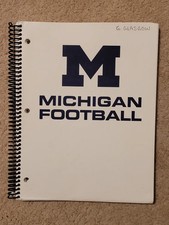
AUTHENTIC Graham Glasgow Michigan Football Hand-Written Playbook Notebook - RARE
$5000.00
Alexander Graham Bell Authentic Signed & Framed 1915 Typed Letter BAS #A04949
$3499.99
Alexander Graham Bell Telephone Inventor Autograph Display JSA Authenticated
$3475.00