wwii rescued jews yad vashem signed Palenque. Władysław Smólski scarce book


When you click on links to various merchants on this site and make a purchase, this can result in this site earning a commission. Affiliate programs and affiliations include, but are not limited to, the eBay Partner Network.

wwii rescued jews yad vashem signed Palenque. Władysław Smólski scarce book:
$7498.50
Najbardziej serdeczne wyrazy uścisku dłoniWT SmólskiWarszawa 11/VII 1962 r.
Which translates to English as:
The most cordial expressions of a handshakeWT SmólskiWarsaw 11/VII/1962WŁADYSŁAW SMOLSKIPALENQUEA PLAY IN 1 ACT33REPERTORY LIBRARY OF "ŚWIETLICA WORK"The Yad Vashem Institute awarded Władysław Smólski with the Righteous Among the Nations title in 1982. I have not seen another copy of this book/play.
Step into the dramatic world of "Palenque," a captivating Polish one-act play by Władysław Smólski, part of the "Biblioteczka Repertuarowa 'Pracy Świetlicowej'" series. This print (likely 1950s-1960s, given its context) offers a unique glimpse into Polish and its to historical .
The play is inspired by the of Aleksander Łukiński, a Polish officer from the November Uprising, who, exiled in 19th-century Mexico, grapples with his homeland's fate while living among the Mayan ruins of Palenque. His altruistic spirit and tragic end, intertwined with the discoveries of American archaeologists, form the core of this poignant drama.
Key Features:
Historical Context: Explores themes of national liberation, exile, and personal sacrifice against the backdrop of the 1849 Spring of and the November Uprising.
Unique Setting: Set in the exotic village of Palenque, Mexico, near ancient Mayan ruins, adding a rich cultural and historical layer.
Character Depth: Features a Polish , Łukiński, whose to leads to a dramatic and heartbreaking conclusion.
Theatrical Insights: Includes extensive directorial notes on staging, lighting, and costumes, making it a for enthusiasts, , or collectors interested in Polish dramatic arts.
Rare Collectible: A piece of Polish theatrical , perfect for collectors of plays, historical drama, or Polonica.
This listing is for a physical copy of the play "Palenque" by Władysław Smólski. The item is in good condition for its age, with all pages intact and readable. (Add specific condition details here, e.g., "minor wear on cover," "some foxing on pages," etc.)
It appears to be a one-act play titled "Palenque" byWładysław Smolski, and it's number 33 in a series called the"Repertory Library of 'Świetlica Work'." A "świetlica"is a Polish word for a community center or common room, oftenassociated with cultural or educational activities.
This play was composed on the basisof the rights - a strange occurrence. Grave of Lukinsky, formerofficer of the uprising - November, you can still watch on ementa -the ruins of the village of Palenque, at the foot of the ancientMayan city, and archaeologist Stephens, accompanied by cartoonistCatherwood. Indeed, in the fifth decade of the XIX century, theyvisited the Yucatan peninsula. They discovered the shrouded in thewilderness monuments ancient civilizations, often for tens of dollars- the trenches acquired the territories in which they conducted thesearch. The story of the love and death of the Polish Faust, who somuch services rendered to the local population, you can still hear -coming from the mouths of Mexican peasants.
Thus, he arrives at the national treasure of the souls of thevictims - one more name of a lost pole on the roads of the world: thePole - who loved wol so much that he could not survive the news ofthe fall and defeat of Spring Peoples, after which oswobo probablypromised himself - the birth of the fatherland. His despair was notassuaged by the beauty of his arms - neither the love of the Indiansthat surrounds him. He shot himself in the head, with fantasy, inPolish, leaving a romantic farewell - NY remembrance: a poem writtenbefore death. This plot I tried to give back as faithfully as I couldin my one-act. It belongs to these romantic stories created through alife where the writer's imagination has little left to give.
Story of Rescue - Smólski WładysławShare
Władysław Smólski and his family lived in Warsaw during the occupation. He was one of the young writers who had made their debut before 1939. He authored, among other works, a play entitledBłędny bokser[Boxer Errant]. Many of his friends and acquaintances ended up in the ghetto which the Germans created in Warsaw.
He helped them on anad hocbasis until the summer of 1942 as much as his health and finances would allow him to. He was so shocked by the great liquidation action in the ghetto and the transportation of most of its inhabitants to gas chambers in Treblinka that he devoted most of his time and efforts to saving Jews. He recalled this as follows: “Even my illnesses left me. I wanted with all my heart to do everything I could to save those who managed to avoid death so far”.
He helped individual people at first. One day, a five-year-old girl was left under his care. She had no one else to rely on. In order to make it possible for her to survive, Władysław had to sell his belongings as he had no sources of income at the time. After several months, he placed the child at an orphanage ran by Franciscan Sisters in Płudy near Warsaw. Afterwards, he found a place for the girl in Hotel Polski from where Jews were to be transported to neutral countries. However, he soon became suspicious and was lucky enough to have successfully taken her away from there on time. He also met D. Guzik, one of the directors of the American-Jewish Joint Distribution Committee in Warsaw, by chance.
This chance meeting made it possible for Władysław to extend the scope of his aid. Guzik asked him to work together with him on providing people hiding on the “Aryan side” with money. This way, Smólski became involved with organised structures for helping Jews functioning in Warsaw. He took part in the activity of “Żegota”. He continued such activity along the Pruszków-Podkowa Leśna line also after the Warsaw Uprising.
Thanks to his help, Bronisław Alken, Tadeusz Reinberg, Wanda Hac, and many others, survived the war. He helped others selflessly and he often resorted to his own meagre funds to support others.
The literary activity of Władysław Smólski was also devoted to a considerable extent to the martyrdom of Jewish people. After the war, he wrote books about the Holocaust and operations aimed at helping Jews. Such books included:Losy dziecka [The Fate of a Child] (1961),Zaklęte lata [Spellbound Years](1964), andZa to groziła śmierć [This was punishable with death](1981).
The Yad Vashem Institute awarded Władysław Smólski with the Righteous Among the Nations title in 1982.
This Polish theatrical one-act play, "Palenque" by Władysław Smólski, published in the "Praca Świetlicowa" repertoire series, tells the tragic story of Aleksander Łukiński, a Polish November Uprising officer and emigrant in Mexico[cite: 1, 6, 9]. The play is set in 1849 in the village of Palenque, near ancient Mayan ruins[cite: 6, 29].The narrative is inspired by a true event, with Łukiński's grave still visible in the Palenque village cemetery[cite: 6]. The plot revolves around Łukiński's selfless dedication to the freedom of his homeland, Poland, which he prioritizes over his personal happiness, including his engagement to Conchita, a local girl[cite: 9, 10, 114, 130, 578]. He is a respected figure in the village, having saved many lives during a cholera epidemic and helped the villagers with various improvements, earning him the admiration of the community, who see him as a leader and even a "sorcerer" due to his poem-writing[cite: 44, 45, 343, 344, 367, 368, 369, 370, 576].
The drama unfolds as two American archaeologists, John Lloyd Stephens and Frederick Catherwood, arrive in Palenque, exploring the ancient Mayan cities, including the "King's Tomb"[cite: 6, 7, 18, 185, 205, 235]. They discover that the Mayan king buried in the tomb was of white race, adding to the mystery of the ancient civilization and its connection to a legend of a white leader[cite: 253, 258, 263]. The archaeologists also bring devastating news to Łukiński: the Spring of Nations revolutions in Europe, including the Polish uprising, have been suppressed, and tyranny has triumphed[cite: 275, 288, 294, 550]. This news shatters Łukiński's hopes for his homeland's liberation, leading him to take his own life, leaving behind a poignant farewell poem[cite: 11, 455, 487, 580]. His death, a protest against the "triumph of evil," deeply affects the villagers, who mourn their hero[cite: 461, 471, 472, 487].
The play includes detailed production notes covering staging, lighting, and costumes, emphasizing the contrast between the civilized world of the archaeologists and the indigenous Mexican culture[cite: 555, 616, 620, 624, 637].
wwii rescued jews yad vashem signed Palenque. Władysław Smólski scarce book:
$7498.50
Related Items:

Antique Judaica lise schlanger hanau cup saved rescued jews wwii amazing scarce
$14450.99

wwii rescued jews yad vashem signed Palenque. Władysław Smólski scarce book
$7498.50
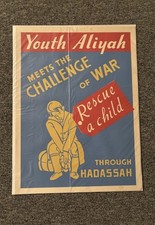
Original WWII Poster Youth Aliyah Meets Challenge Of War Rescue A Child Hadassah
$3800.00