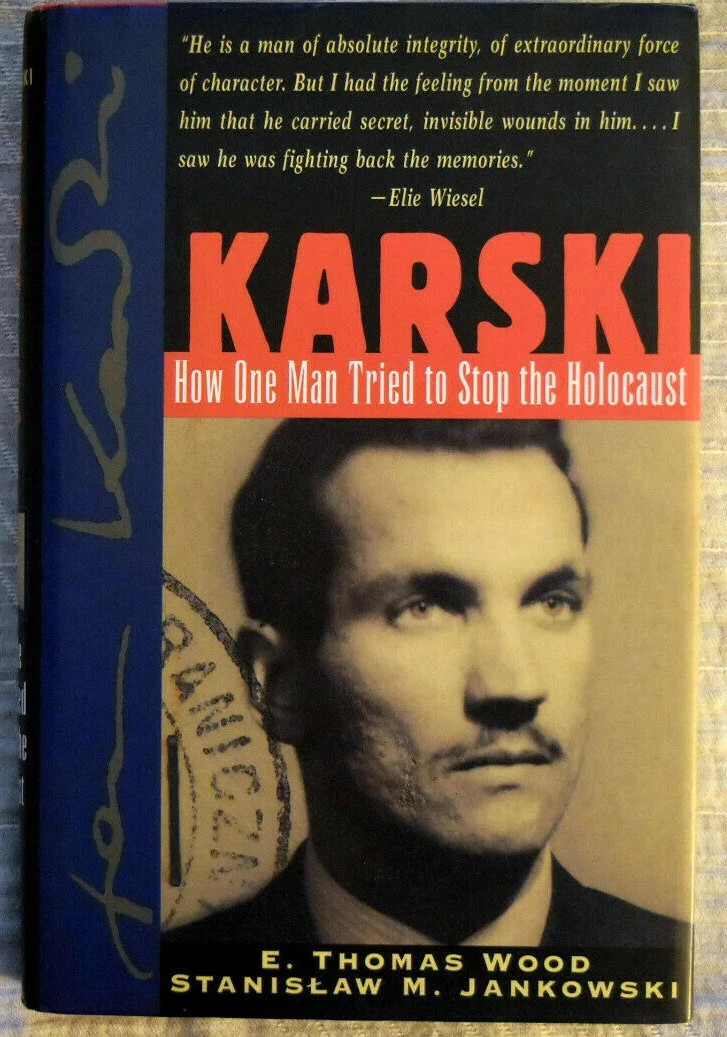
Holocaust Hero Polish WWII Jan Karski book 1st Edition Karski Wood & Jankowski

When you click on links to various merchants on this site and make a purchase, this can result in this site earning a commission. Affiliate programs and affiliations include, but are not limited to, the eBay Partner Network.

Holocaust Hero Polish WWII Jan Karski book 1st Edition Karski Wood & Jankowski:
$1000.00
Offered here is a rare signed first edition of "Karski: How One Man Tried to Stop the Holocaust" by E. Thomas Wood and Stanisław M. Jankowski. This hardcover copy is personally inscribed and signed by Jan Karski himself, dated March 3, 1995.
Jan Karski was a legendary Polish underground courier who provided the first eyewitness accounts of the Holocaust to the Allied powers. This book is an essential piece of history for collectors of World War II memorabilia, Holocaust studies, and Polish history.
Condition: Excellent/Fine condition with original dust jacket.
Signature: Authentic blue ink inscription: "To Leon Gutovich with best wishes, Jan Karski 3/3/95"
Publisher: John Wiley & Sons, Inc. (1994)
Features: First Edition, Hardcover, Dust Jacket.
Quote: "He is a man of absolute integrity, of extraordinary force of character. But I had the feeling from the moment I saw him that he carried secret, invisible wounds in him... I saw he was fighting back the memories." — Elie Wiesel
Title: KARSKI: How One Man Tried to Stop the Holocaust
Authors: E. Thomas Wood, Stanisław M. Jankowski
Spine: Karski - Wood/Jankowski - Wiley Logo
Lech Walesa: "As a courier, at the risk of his life, Jan Karski carried information of great political and military importance... In November 1942, he delivered to the West documentation of Hitler's crime—the total extermination of the Jews."
Zbigniew Brzezinski: "A significant account of personal heroism... A superb read."
Abraham Foxman (ADL): "Jan Karski emerges from these pages as truly one of the 'righteous among nations'..."
George M. Szabad: "...portray the strengths and weaknesses of the Polish underground and society..."
Kenneth L. Adelman: "Here is the stirring tale of a stirring life... I will never forget his courage."
Inscription: "To Leon Gutovich with best wishes, Jan Karski 3/3/95"
Copyright Page: Copyright © 1994 by E. Thomas Wood and Stanisław M. Jankowski. Published by John Wiley & Sons, Inc. Printed in the USA. ISBN 0-471-01856-2.
Jan Karski (born Jan Kozielewski) was a young Polish diplomat when World War II erupted in 1939. After being captured by the Red Army and narrowly escaping a Soviet POW camp (where most of his fellow officers were later executed in the Katyn Massacre), he joined the Polish Resistance (Armia Krajowa).
His photographic memory and fluency in multiple languages made him the perfect courier. Karski began a series of perilous missions, smuggling intelligence between the Polish Government-in-Exile in London and the underground in occupied Poland. In 1940, he was captured and tortured by the Gestapo; fearing he would break, he attempted suicide. He was eventually rescued by the Polish underground in a daring hospital raid.
Part II: Witness to the HolocaustIn 1942, Jewish leaders in the Warsaw Ghetto learned of Karski’s upcoming mission to London. They contacted him with a desperate plea: tell the world what is happening. To provide an undeniable eyewitness account, Karski was smuggled into the Warsaw Ghetto twice. He also entered a transit camp (Izbica) disguised as a Ukrainian guard, where he witnessed thousands of Jews being herded onto trains to their deaths at Belzec.
Karski traveled across occupied Europe to London and then to Washington D.C. He met with British Foreign Secretary Anthony Eden and eventually President Franklin D. Roosevelt. Karski pleaded for Allied intervention to stop the genocide. Despite his vivid testimony, his reports were often met with disbelief or strategic coldness; many leaders prioritized military victory over the "humanitarian" rescue of the Jews.
Part III: Legacy of "The Righteous"After the war, Karski remained in the United States, earning a PhD and becoming a beloved professor at Georgetown University for 40 years. For decades, he remained silent about his wartime activities until filmmaker Claude Lanzmann interviewed him for the documentary Shoah (1985).
Karski was eventually recognized as a Righteous Among the Nations by Yad Vashem and was posthumously awarded the Presidential Medal of Freedom. He is remembered as "The Man Who Tried to Stop the Holocaust," a symbol of the individual's moral obligation to speak truth to power.
Jan Karski (born Jan Kozielewski, 24 June 1914[a] – 13 July 2000) was a Polish soldier, resistance-fighter, and diplomat during World War II. He is known for having acted as a courier in 1940–1943 to the Polish government-in-exile and to Poland's Western Allies about the situation in German-occupied Poland. He reported about the state of Poland, its many competing resistance factions, and also about Germany's destruction of the Warsaw Ghetto and its operation of extermination camps on Polish soil that were murdering Jews, Poles, and others.Emigrating to the United States after the war, Karski completed a doctorate and taught for decades at Georgetown University in international relations and Polish history. He lived in Washington, D.C., until the end of his life. Karski did not speak publicly about his wartime missions until 1981 when he was invited as a speaker to a conference on the liberation of the camps. Karski was featured in Claude Lanzmann's nine-hour film Shoah (1985), about the Holocaust, based on oral interviews with survivors, a historian, witnesses who lived near death camps, and several German officials involved in the destruction of European Jewry. After the fall of the Soviet Union, Karski was honored by the new Polish government, other European nations, and the US for his wartime role.
Early lifeJan Karski was born Jan Romuald Kozielewski on 24 June 1914 in Łódź,[a] Poland.[1][4] Karski was born on St John's Day, and named Jan (the Polish equivalent of John), following the Polish custom of naming children after the saint(s) of their birthday. His baptismal record—in error—listed 24 April as his birthdate, as Karski explained later in interviews on several occasions (see Waldemar Piasecki's biography of Karski, One Life, as well as published interviews with his family).[1]
Jan Kozielewski's handwritten pre-WWII document showing birthdate from Lviv archivesKarski had two brothers and one sister.[citation needed] Among his sibling was Marian Kozielewski [pl], a police inspector in Warsaw. The children were raised as Catholics and Karski remained a Catholic throughout his life.[4] His father died when he was young, and the family struggled financially. Karski grew up in a multi-cultural neighborhood, where a majority of the populace was Jewish.[citation needed]After military training at the school for mounted artillery officers in Włodzimierz Wołyński, he graduated with a First in the Class of 1936 and was ordered to the 5th Regiment of Mounted Artillery, the same unit where Colonel Józef Beck, later Poland's Foreign Affairs Minister, served.[citation needed]Karski completed his diplomatic apprenticeship between 1935 and 1938 at various posts in Romania (twice), Germany, Switzerland, and the United Kingdom, and joined the diplomatic service. After completing and gaining a First in Grand Diplomatic Practice, on 1 January 1939 he started work in the Polish Ministry of Foreign Affairs.[citation needed]
World War IIDuring the Polish September Campaign, Karski's 5th Regiment was part of the Kraków Cavalry Brigade, under General Zygmunt Piasecki, a unit of the Armia Kraków defending the area between Zabkowice and Częstochowa. After the Battle of Tomaszów Lubelski on 10 September 1939, some units, including Karski's 1st Battery, 5th Regiment, tried to reach Hungary but were captured by the Red Army between 17 and 20 September. Karski was held prisoner in the Kozielszczyna camp (presently in Ukraine). He successfully concealed his true rank of second lieutenant and, after a uniform exchange, was identified by the NKVD commander as a private. He was transferred to the Germans as a person born in Łódź, which was incorporated into the Third Reich, and thus escaped the Katyn massacre of Polish officers by the Soviets.[citation needed]
Resistance
Jan Karski's missionsIn November 1939 Karski was among POWs on a train bound for a POW camp in the General Government zone, a part of Poland that had not been fully incorporated into The Third Reich. He escaped and made his way to Warsaw. There he joined the SZP (Służba Zwycięstwu Polski)—the first resistance movement in occupied Europe, organized by General Michał Karaszewicz-Tokarzewski, the predecessor to ZWZ, later the Home Army (AK).About that time Karski (until then, Kozielewski) adopted the nom de guerre, Jan Karski, which he later made his legal name. Other names used by him during World War II included Piasecki, Kwaśniewski, Znamierowski, Kruszewski, Kucharski, and Witold. In January 1940 Karski began to organize courier missions to transport dispatches from the Polish underground to the Polish government-in-exile, then based in Paris. As a courier, Karski made several secret trips between France, Britain, and Poland. During one such mission in July 1940, he was arrested by the Gestapo in the Tatra Mountains in Slovakia. Tortured, he was transported to a hospital in Nowy Sącz, from which he was smuggled out with the help of Józef Cyrankiewicz. After a short period of rehabilitation, he returned to active service in the Information and Propaganda Bureau of the headquarters of the Polish Home Army.[citation needed]In 1942, Karski was selected by Cyryl Ratajski, the Polish Government Delegate's Office at Home, to undertake a secret mission to see prime minister Władysław Sikorski in London. Karski was to contact Sikorski and various other Polish politicians and brief them on Nazi atrocities in occupied Poland. In order to gather evidence, Karski met Bund activist Leon Feiner. He was twice smuggled by the Jewish underground into the Warsaw Ghetto in order to directly observe what was happening to Polish Jews.[5] My job was just to walk. And observe. And remember. The odour. The children. Dirty. Lying. I saw a man standing with blank eyes. I asked the guide: what is he doing? The guide whispered: “He’s just dying”. I remember degradation, starvation and dead bodies lying on the street. We were walking the streets and my guide kept repeating: “Look at it, remember, remember” And I did remember. The dirty streets. The stench. Everywhere. Suffocating. Nervousness.[5]Disguised as a Ukrainian camp guard (although in some of his writings Karski stated he was disguised as an Estonian guard, for security and political reasons) he also visited a Durchgangslager ('transit camp') for Bełżec death camp located in the town of Izbica Lubelska,[6] midway between Lublin and Bełżec.[7] While Karski accurately reported the location in his initial reports, written in 1943, in his book published in the USA during the war, Karski identified the camp as the Bełżec death camp, which has led to some confusion among historians. According to Thomas Wood and Stanislaw Jankowski, Karski was initially told he was going to be taken to see Bełżec and in his book, Karski was referring to the overall system of murder centered on Bełżec rather than the camp itself.[6]
Reporting Nazi atrocities to the Western Allies
The Mass Extermination of Jews in German Occupied Poland, by the Polish government-in-exile, publicized the Raczyński's Note addressed to the wartime allies of the then-United Nations on 10 December 1942
Main article: Karski's reports
See also: Witold's Report and Raczyński's NoteStarting in 1940,[8] Karski reported to the Polish, British, and US governments on the situation in Poland, especially on the destruction of the Warsaw Ghetto and the Nazi extermination of Polish Jews. He smuggled out of Poland microfilm with further information from the underground movement on the extermination of European Jews in German-occupied Poland. His reports were transcribed and translated by Walentyna Stocker, the personal secretary and interpreter for Sikorski.[9] Based on Karski's microfilm, Polish Foreign Minister Count Edward Raczyński provided the Allies with one of the earliest and most accurate accounts of the Nazi Holocaust. Raczyński's Note, addressed to the governments of the United Nations on 10 December 1942, was later published along with other documents in a widely distributed leaflet entitled The Mass Extermination of Jews in German Occupied Poland.[10]Karski met with Polish politicians in exile including the prime minister, as well as members of political parties such as the Socialist Party, National Party, Labor Party, People's Party, Jewish Bund and Poalei Zion. He also spoke to the British Foreign Secretary Anthony Eden, giving a detailed account of what he had seen in Warsaw and Bełżec.Karski also traveled to the United States, where on 28 July 1943 he met with President Franklin D. Roosevelt in the Oval Office, the first eyewitness to tell Roosevelt of the situation in Poland and the Jewish Holocaust.[11] Roosevelt asked no questions about the Jews.[12] Karski met with many other government and civic leaders in the United States, including Supreme Court Justice Felix Frankfurter, Cordell Hull, William Joseph Donovan, and Rabbi Stephen Wise. Karski presented his report to media, bishops of various denominations (including Cardinal Samuel Stritch), members of the Hollywood film industry and artists, but without result, as most people could not comprehend the scale of extermination that he recounted.[13][14][11] But Karski's accounts of the problems of stateless people and their vulnerability to murder helped inspire the formation of the War Refugee Board,[15] changing US governmental policy from neutrality to support for war refugees and civilians in Europe,[16] and after the war, inspiring the creation of the Office of High Commissioner for Refugees.[citation needed]
US stamp from 1943, a tribute to Polish Underground StateIn 1944, Karski published Courier from Poland: The Story of a Secret State (a selection was featured in Collier's magazine six weeks before the book's publication).[17][18]According to historian Adam Puławski, Karski's main mission as a courier was to alert the government-in-exile of the conflicts within Polish underground movements. He discussed the Warsaw Ghetto liquidation as part of that account, almost incidentally.[19] Without diminishing Karski's contributions, Puławski notes that facts about the Holocaust were available to the Allies for at least a year and a half before Karski met with Roosevelt, thus saying that his mission was primarily to report on the Holocaust is in error.[19]
Life in the United StatesAt the war's end, Karski remained in the United States in Washington, D.C. He began graduate studies at Georgetown University, receiving his Ph.D. in 1952.[20] In 1954, Karski became a naturalized citizen of the United States.Karski taught Eastern European affairs, comparative government, and international affairs at Georgetown University for 40 years. In 1985, he published the academic study The Great Powers and Poland, based on research during a Fulbright fellowship in 1974 to his native Poland.
Jan Karski with General Colin Powell at the 1993 opening of the United States Holocaust Memorial Museum.Karski's 1942 report on the Holocaust and the London Polish government's appeal to the United Nations were briefly recounted by Walter Laqueur in his history The Terrible Secret: Suppression of the Truth about Hitler's Final Solution (1980).Karski did not speak publicly about his wartime mission until 1981 when he was invited by activist Elie Wiesel to serve as keynote speaker at the International Liberators Conference in Washington, D.C.[21]French filmmaker Claude Lanzmann interviewed Karski at length in 1978, as part of his preparation for his documentary Shoah, but the film was not released until 1985. Lanzmann had asked participants not to make other public statements during that time, but Karski got a release for the conference.[21] The nine-and-a-half hour film included a total of 40 minutes of testimony by Karski, an excerpt from the first of two days of Lanzmann interviewing Karski.[5] It ends with Karski saying that he made his report to leaders.[22] Lanzman later said that, on the second day of interviews, Karski recounted in detail his meetings with Roosevelt and other high US officials. Lanzman said that the tone and style of Karski's second interview were so different, and the interview so long, that it did not fit with his vision of the film and was thus not used.[23] Unhappy with how he was presented in the film, Karski published an article, later a book, Shoah, a Biased Vision of the Holocaust (1987), in the French journal Kultura. He argued for another documentary to include his missing testimony and also to show more of the help given to Jews by many Poles (some are now recognized by Israel as the Polish Righteous among the Nations).[24][25]Following the fall of communism in Poland in 1989, Karski's wartime role was officially acknowledged by the new government. He was awarded the Order of the White Eagle, the highest Polish civil decoration, and the Order Virtuti Militari, the highest military decoration awarded for bravery in combat.In 1994, E. Thomas Wood and Stanisław M. Jankowski published a biography, Karski: How One Man Tried to Stop the Holocaust. They noted that Karski had urged the production of another documentary to correct what he thought was the bias in Lanzmann's Shoah.[citation needed]During an interview with Hannah Rosen in 1995, Karski discussed the Allies' failure to rescue most of the Jews from mass murder: It was easy for the Nazis to kill Jews, because they did it. The Allies considered it impossible and too costly to rescue the Jews, because they didn't do it. The Jews were abandoned by all governments, church hierarchies and societies, but thousands of Jews survived because thousands of individuals in Poland, France, Belgium, Denmark, Holland helped to save Jews. Now, every government and church says, "We tried to help the Jews", because they are ashamed, they want to keep their reputations. They didn't help, because six million Jews perished, but those in the government, in the churches they survived. No one did enough.[26]The documentary film My Mission (1997), directed by Waldemar Piasecki and Michal Fajbusiewicz, presented the full details of Karski's wartime mission. In 1999, Piasecki published Tajne Panstwo (Secret State, edited and adapted from Karski's wartime book), which became a bestseller. In the same year, the Museum of the City of Łódź opened "Jan Karski's Room", displaying memorabilia, documents, and decorations, all organized under Karski's supervision.
After Karski's deathIn 2010, French author Yannick Haenel published a novel Jan Karski, drawn from the courier's World War II activities and memoir. Haenel also added a third part in which he inserted his own views into Karski's "character", particularly in his approach to Karski's meeting with President Roosevelt and other US leaders. Claude Lanzmann criticized the author strongly and argued that Haenel ignored important historic elements of the time. Haenel said that was part of his freedom in fiction.[21][22]In response, Lanzmann released the second half of his interview with Karski as a 49-minute documentary in 2010, edited and entitled The Karski Report, also on ARTE.[23][22] It is mostly about Karski's meeting with President Roosevelt and other American leaders.[22]Karski's wartime book was re-published posthumously by Georgetown University Press as My Report to the World: The Story of a Secret State (2013).[27] A Tribute to Jan Karski panel discussion was held at the university that year in conjunction with the book's release. It featured a discussion of Karski's legacy by School of Foreign Service Dean Carol Lancaster, Georgetown University Board Chair Paul Tagliabue, former Secretary of State Madeleine Albright, former National Security Advisor Zbigniew Brzezinski, Polish Ambassador Ryszard Schnepf, and Rabbi Harold S. White.[28]
Personal lifeKarski had several siblings, mostly brothers: Marian, Boguslaw, Cyjrian, Edmund, Stefan, and Uzef and a sister Laura.Karski's eldest brother, Marian Kozielewski (b. 1898), reached the rank of colonel in the military and was also considered a hero in World War II. He had been arrested by the Germans in Warsaw in 1940 and was among Catholic Poles who survived being imprisoned as political prisoners at Auschwitz concentration camp. After being released in 1941, he returned to Warsaw and joined the resistance. The Kozielewski brothers admired Jozef Pilsudski and members of the "forgotten army", who had suffered many deeply personal wounds. After the war, Marian emigrated initially to Canada, where he married. He struggled as a refugee, holding low-level jobs after settling in Washington, D.C., in 1960 near his brother Jan. Marian Kozielewski committed suicide there in 1964 and is buried at Mount Olivet Cemetery.In 1965, Karski married Pola Nireńska, a 54-year-old Polish Jew who was a dancer and choreographer. With the exception of her parents, who had emigrated to Israel in 1939 shortly before the Nazi invasion of Poland, all of her family had been murdered in the Holocaust. She committed suicide in 1992.Karski died of unspecified heart and kidney disease in Washington, D.C., in 2000. He died at Georgetown University Hospital.[29] He was interred at Mount Olivet Cemetery in Washington, next to the graves of his wife, Pola Nirenska, and brother Marian. He and Pola had no children.
Honors and legacy
Jan Karski Statue in Tel Aviv University
Jan Karski's Bench in front of the Consulate General of the Republic of Poland in New York City
A mural He who does not condemn, acquiesces commemorating Karski at 30/32 Lubelska Street in Warsaw.On 2 June 1982, Yad Vashem recognised Jan Karski as Righteous Among the Nations.[30] A tree bearing a memorial plaque in his name was planted that same year at Yad Vashem's Avenue of the Righteous Among the Nations in Jerusalem.In 1991, Karski was awarded the Wallenberg Medal of the University of Michigan. Statues honoring Karski have been placed in New York City at the corner of 37th Street and Madison Avenue (renamed as "Jan Karski Corner")[31] and on the grounds of Georgetown University[32] in Washington, DC.[33] Additional benches, which were made by the Kraków-based sculptor Karol Badyna, are located in Kielce, Łódź, and Warsaw in Poland, and on the campus of Tel Aviv University in Israel. The talking Karski bench in Warsaw near the Museum of the History of Polish Jews has a button to activate a short talk by Karski about the war. Georgetown University, Oregon State University, Baltimore Hebrew College, Warsaw University, Maria Curie-Skłodowska University, and the University of Łódź all awarded Karski honorary doctorates.In 1994, Karski was made an honorary citizen of Israel in honor of his efforts on behalf of Polish Jews during the Holocaust. Karski was nominated for the Nobel Prize and formally recognized by the UN General Assembly shortly before his death.Shortly after his death, the Jan Karski Society was established, initiated by his close friend, collaborator and biographer, Professor Waldemar Piasecki. The society preserves his legacy and administers the Jan Karski Eagle Award, which he established in 2000. The list of laureates includes: Elie Wiesel, Shimon Peres, Lech Walesa, Aleksander Kwaśniewski, Tadeusz Mazowiecki, Bronisław Geremek, Jacek Kuroń, Adam Michnik, Karol Modzelewski, Oriana Fallaci, Dagoberto Valdés Hernández, Stanisław Dziwisz, Tygodnik Powszechny magazine, the Hoover Institution, and the United States Holocaust Memorial Museum.After Karski's death, his estate was involved in a legal dispute with YIVO over a legacy gift that Karski made. The Maryland Court of Appeals (now known as the Supreme Court of Maryland) settled the dispute.[34]In April 2011, the Jan Karski US Centennial Campaign was created to increase interest in the life and legacy of the late Polish diplomat, as the centennial year of his birth in 2014 approached. In November 2012, having met its major goals, the Jan Karski US Centennial Campaign was succeeded by the Jan Karski Educational Foundation, which continues to promote Karski's legacy and values. The president of the foundation is Polish-American author Wanda Urbanska. The foundation sponsored three major conferences about Karski in his centennial birth year, at Georgetown University in Washington, at Loyola University in Chicago, and in Warsaw.[35]The campaign group was seeking to obtain the Presidential Medal of Freedom for Karski in advance of his anniversary. In addition, they wanted to promote educational activities, including workshops, artistic performances, and a reprint of his 1944 book, Story of a Secret State. In December 2011, the support of 68 US Representatives and 12 US Senators was obtained and a supporting nomination for the medal was submitted to the White House.[36] On 23 April 2012, US President Barack Obama announced that Karski would receive the country's highest civilian honor, the Presidential Medal of Freedom.[37] The medal was awarded posthumously by President Obama on 29 May 2012 and presented to Adam Daniel Rotfeld, the former Foreign Minister of Poland and himself a Jewish Holocaust survivor.[38] Jan Karski's family was not invited to the presentation ceremony, which they strongly protested. The medal, along with other honors given to Karski, is on display at the "Karski office" in Łódź Museum. This is in accordance with the wishes of his surviving family, led by his niece and goddaughter Dr. Kozielewska-Trzaska.A controversy erupted when a misspoken word in Barack Obama's Presidential Medal of Freedom speech came to be known as Gafa Obamy or 'Obama's gaffe',[39] when the president referred to "a Polish death camp" instead of "a death camp in Poland" when talking of the Nazi German transit death camp that Karski had visited. "Polish death camps" is a term often used to refer to Nazi concentration camps in Poland, as opposed to (as may be implied) Polish concentration camps. The terms "Polish death camp" or "Polish concentration camp" reportedly originated with ex-Nazis working for the West German secret services. Historian Leszek Pietrzak explains the propaganda strategies from the 1950s.[40] President Obama later characterized his term as a misstatement and his characterization was accepted by Polish President Bronisław Komorowski.[41]In early February 2014, the Jan Karski Society and the Karski family appealed to President of Poland Bronisław Komorowski to posthumously promote Jan Karski to the rank of brigadier general in recognition of his contribution to the war effort as well as all couriers and emissaries of the underground Polish state. The appeal received no response for a year. Member of the Polish parliament Professor Tadeusz Iwiński recently openly criticized the president of Poland for inaction on Karski's behalf.[citation needed]On 24 June 2014, the "Jan Karski Mission Accomplished" Conference took place in Lublin under the patronage of Professor Elie Wiesel, Nobel Peace Prize Laureate, Aleksander Kwaśniewski, President of Poland (1995–2005), Moshe Kantor, President of the European Jewish Congress, and Michael Schudrich, Chief Rabbi of Poland.In November 2018, a new street connecting the South Bay Mall to the Polish Triangle neighborhood of Dorchester, Boston in Massachusetts was named Jan Karski Way after consulting with the Polish-American Club of Boston.[42]
Remembrance
Grave of Jan Karski and Pola Nirenska at Mount Olivet Cemetery in Washington, D.C.Former Foreign Minister of Poland Władysław Bartoszewski, in his speech at the ceremony of the 60th anniversary of the liberation of the concentration camp at Auschwitz-Birkenau, 27 January 2005, said: "The Polish resistance movement kept informing and alerting the free world to the situation. In the last quarter of 1942, thanks to the Polish emissary Jan Karski and his mission, and also by other means, the Governments of the United Kingdom and of the United States were well informed about what was going on in Auschwitz-Birkenau."[43]A full-length play on Karski's life and mission, Coming to See Aunt Sophie (2014), written by Arthur Feinsod, was produced in Germany and Poland. An English translation was produced in Bloomington, Indiana at the Jewish Theatre in June 2015, and in Australia in August of that year.A new play, My Report to the World, written by Clark Young and Derek Goldman, premiered at Georgetown University during the conference honoring Karski's centennial year. It starred Oscar-nominated actor David Strathairn as Karski. It was performed in Warsaw before being produced in New York in July 2015; Strathairn played the Karski role in all productions. Goldman directed the play in both Washington DC and New York. The July performances were presented in partnership with The Museum of Jewish Heritage, The Laboratory for Global Performance and Politics at Georgetown University, Bisno Productions, and the Jan Karski Educational Foundation.
Awards and decorations Order of the White Eagle
Silver Cross of the Virtuti Militari, twice
Home Army CrossIn Poland, the resistance movement during World War II was led by the Home Army. The Polish resistance is notable among others for disrupting German supply lines to the Eastern Front (damaging or destroying 1/8 of all rail transports), and providing intelligence reports to the British intelligence agencies (providing 43% of all reports from occupied Europe). It was a part of the Polish Underground State.
OrganizationsThe largest of all Polish resistance organizations was the Armia Krajowa (Home Army, AK), loyal to the Polish government in exile in London. The AK was formed in 1942 from the Union of Armed Struggle (Związek Walki Zbrojnej or ZWZ, itself created in 1939) and would eventually incorporate most other Polish armed resistance groups (except for the communists and some far-right groups).[2][3] It was the military arm of the Polish Underground State and loyal to the Polish government in Exile.[2]Most of the other Polish underground armed organizations were created by a political party or faction, and included: The Bataliony Chłopskie (Peasants' Battalions). Created by the leftist People's Party around 1940–1941, it would partially merge with AK around 1942–1943.[4]
The Gwardia Ludowa WRN (People's Guard of WRN) of Polish Socialist Party (PPS) (joined ZWZ around 1940, subsequently merged into AK)[5][6]
The Konfederacja Narodu (Confederation of the Nation). Created in 1940 by far-right Obóz Narodowo Radykalny-Falanga (National Radical Camp Falanga).[7] It would partially merge with ZWZ around 1941 and finally join AK around fall 1943.
The Narodowa Organizacja Wojskowa (National Military Organisation), established by the National Party in 1939, mostly integrated with AK around 1942.[8]
Narodowe Siły Zbrojne (National Armed Forces); created in 1943 from dissatisfied NOW units, which refused to be subordinated to the AK.[8][9][10]
The Obóz Polski Walczącej (Camp of Fighting Poland), established by the Obóz Zjednoczenia Narodowego (Camp of National Unity) around 1942, subordinated to AK.[11] in 1943.The largest groups that refused to join the AK were the National Armed Forces and the pro-Soviet and communist People's Army (Polish Armia Ludowa or AL), backed by the Soviet Union and established by the Polish Workers' Party (Polish Polska Partia Robotnicza or PPR).[12]Regarding the scale and scope of the Polish resistance, Reichsfuhrer-SS Heinrich Himmler noted on 31 December 1942:[13] Within the framework of the entire enemy intelligence operations directed against Germany, the intelligence service of the Polish resistance movement assumed major significance. The scope and importance of the operations of the Polish resistance movement, which was ramified down to the smallest splinter group and brilliantly organized, have been in (various sources) disclosed in connection with carrying out of major police security operations.SizeIn February 1942, when AK was formed, it numbered about 100,000 members.[3] In the beginning of 1943, it had reached a strength of about 200,000.[3] In the summer of 1944 when Operation Tempest began, AK reached its highest membership numbers, though the estimates vary from 300,000[14] to 500,000.[15] The strength of the second largest resistance organization, Bataliony Chłopskie (Peasants' Battalions), can be estimated for summer 1944 (at which time they were mostly merged with AK[4]) at about 160,000 men.[16] The third largest group include NSZ (National Armed Forces) with approximately 70,000 men around 1943–1944; only small parts of that force were merged with AK.[9] At its height in 1944, the communist Armia Ludowa, which never merged with AK, numbered about 30,000 people.[12] One estimate for the summer 1944 strength of AK and its allies, including NSZ, gives its strength at 650,000.[1] Overall, the Polish resistance have often been described as the largest or one of the largest resistance organizations in World War II Europe.[a]
Actions, operations, and intelligence, 1939–1945
1939
Witold Pilecki – founder of the TAP organisation and the secret agent of Polish resistance in AuschwitzOn 9 November 1939, two soldiers of the Polish army – Witold Pilecki and Major Jan Włodarkiewicz – founded the Secret Polish Army (Tajna Armia Polska, TAP), one of the first underground organizations in Poland after defeat.[17] Pilecki became its organizational commander as TAP expanded to cover not only Warsaw but Siedlce, Radom, Lublin and other major cities of central Poland.[18] By 1940, TAP had approximately 8,000 men (more than half of them armed), some 20 machine guns and several anti-tank rifles. Later, the organization was incorporated into the Union for Armed Struggle (Związek Walki Zbrojnej), later renamed and better known as the Home Army (Armia Krajowa).[19]
1940
Major Henryk Dobrzański aka "Hubal"In March 1940, a partisan unit of the first guerrilla commanders in the Second World War in Europe under Major Henryk Dobrzański "Hubal" destroyed a battalion of German infantry in a skirmish near the village of Huciska. A few days later in an ambush near the village of Szałasy it inflicted heavy casualties upon another German unit. To counter this threat the German authorities formed a special 1,000 men strong counter-insurgency unit of combined SS–Wehrmacht forces, including a Panzer group. Although the unit of Major Dobrzański never exceeded 300 men, the Germans fielded at least 8,000 men in the area to secure it.[20][21]In 1940, Witold Pilecki, an intelligence officer for the Polish resistance, presented to his superiors a plan to enter Germany's Auschwitz concentration camp, gather intelligence on the camp from the inside, and organize inmate resistance.[22] The Home Army approved this plan, provided him a false identity card, and on 19 September 1940, he deliberately went out during a street roundup (łapanka) in Warsaw and was caught by the Germans along with other civilians and sent to Auschwitz. In the camp he organized the underground organization – Związek Organizacji Wojskowej – ZOW.[23] From October 1940, ZOW sent its first report about the camp and the genocide in November 1940 to Home Army Headquarters in Warsaw through the resistance network organized in Auschwitz.[24]
"Hubal" and his partisan unit –winter 1940During the night of 21–22 January 1940, in the Soviet-occupied Podolian town of Czortków, the Czortków Uprising started; it was the first Polish uprising during World War II. Anti-Soviet Poles, most of them teenagers from local high schools, stormed the local Red Army barracks and a prison, in order to release Polish soldiers kept there.At the end of 1940 Aleksander Kamiński created a Polish youth resistance organization, known as "Wawer".[25] It was part of the Szare Szeregi (the underground Polish Scouting Association). This organisation carried out many minor sabotage operations in occupied Poland. Its first action was drawing graffiti in Warsaw around Christmas Eve of 1940 commemorating the Wawer massacre.[26] Members of the AK Wawer "Small Sabotage" units painted "Pomścimy Wawer" ("We'll avenge Wawer") on Warsaw walls. At first they painted the whole text, then to save time they shortened it to two letters, P and W. Later they invented Kotwica – "Anchor" – which became the symbol of all Polish resistance in occupied Poland.[27]
1941
łapanka, possibly the one in which Witold Pilecki was captured in autumn 1941, Warsaw, Żoliborz.From April 1941 the Bureau of Information and Propaganda of the Union for Armed Struggle started Operation N headed by Tadeusz Żenczykowski. It involved sabotage, subversion and black-propaganda activities.[28]From March 1941, Witold Pilecki's reports were forwarded to the Polish government in exile and through it, to the British and other Allied governments. These reports informed the Allies about the Holocaust and were the principal source of intelligence on Auschwitz-Birkenau for the Western Allies.[29]On 7 March 1941, two Polish agents of the Home Army killed Nazi collaborator actor Igo Sym in his apartment in Warsaw. In reprisal, 21 Polish hostages were executed. Several Polish actors were also arrested by the Nazis and sent to Auschwitz, among them such notable figures as directors Stefan Jaracz and Leon Schiller.In July 1941 Mieczysław Słowikowski (using the codename "Rygor" – Polish for "Rigor") set up "Agency Africa", one of World War II's most successful intelligence organizations.[30] His Polish allies in these endeavors included Lt. Col. Gwido Langer and Major Maksymilian Ciężki. The information gathered by the Agency was used by the Americans and British in planning the amphibious November 1942 Operation Torch[31] landings in North Africa. These were the first large-scale Allied landings of the war, and their success in turn paved the way for the Allies' Italian campaign.
1942
Polish partisan Zdzisław de Ville "Zdzich", member of AK "Jędrusie" with Polish version of the M1918 BAROn 20 June 1942, the most spectacular escape from Auschwitz concentration camp took place. Four Poles, Eugeniusz Bendera,[32] Kazimierz Piechowski, Stanisław Gustaw Jaster and Józef Lempart made a daring escape.[33] The escapees were dressed as members of the SS-Totenkopfverbände, fully armed and in an SS staff car. They drove out the main gate in a stolen Steyr 220 automobile with a smuggled report from Witold Pilecki about the Holocaust. Three of the escapees remained free until the end of the war; Jaster, who joined the Polish Underground, was recaptured in 1943 and died shortly afterwards in German custody.[34]In September 1942 "The Żegota Council for the Aid of the Jews" was founded by Zofia Kossak-Szczucka and Wanda Krahelska-Filipowicz ("Alinka") and made up of Polish Democrats as well as other Catholic activists. Poland was the only country in occupied Europe where there existed such a dedicated secret organization. Half of the Jews in Poland who survived the war (thus over 50,000) were aided in some way by Żegota.[35] The best-known activist of Żegota was Irena Sendler, head of the children's division, who saved 2,500 Jewish children by smuggling them out of the Warsaw Ghetto, providing them with false documents, and sheltering them in individual and group children's homes outside the ghetto.[36]In 1942 Jan Karski reported to the Polish, British and U.S. governments on the situation in Poland, especially the Holocaust of the Jews. He met with Polish politicians in exile including the prime minister, and members of political parties such as the Socialist Party, National Party, Labor Party, People's Party, Jewish Bund and Poalei Zion. He also spoke to Anthony Eden, the British foreign secretary, and included a detailed statement on what he had seen in Warsaw and Bełżec.[37][38]The Zamość Uprising was an armed uprising of Armia Krajowa and Bataliony Chłopskie against the forced expulsion of Poles from the Zamość region under the Nazi Generalplan Ost.[39] The Germans attempted to remove the local Poles from the Greater Zamość area (through forced removal, transfer to forced labor camps, or, in some cases, mass murder) to get it ready for German colonization. It lasted from 1942 until 1944 and despite heavy casualties suffered by the Underground, the Germans failed.[40][41]On the night from 7 to 8 October 1942 Operation Wieniec started. It targeted rail infrastructure near Warsaw. Similar operations aimed at disrupting and harrying German transport and communication in occupied Poland occurred in the coming months and years. It targeted railroads, bridges and supply depots, primarily near transport hubs such as Warsaw and Lublin.[41]
1943
Soldiers from Kolegium "A" of Kedyw on Stawki Street in Wola district – Warsaw Uprising 1944
Polish partisans from Kielce area – unit "Jędrusie" 1945
Page 5 of Stroop Report describing German fight against "Juden mit polnischen Banditen" – "Jews with Polish bandits".[42]In early 1943 two Polish janitors[43] of Peenemünde's Camp Trassenheide provided maps,[44] sketches and reports to Armia Krajowa Intelligence, and in June 1943 British intelligence had received two such reports which identified the "rocket assembly hall', 'experimental pit', and 'launching tower'. When reconnaissance and intelligence information regarding the V-2 rocket became convincing, the War Cabinet Defence Committee (Operations) directed the campaign's first planned raid (the Operation Hydra bombing of Peenemünde in August 1943) and Operation Crossbow.[45]On 26 March 1943 in Warsaw Operation Arsenal was launched by the Szare Szeregi (Gray Ranks) Polish Underground The successful operation led to the release of arrested troop leader Jan Bytnar "Rudy". In an attack on the prison, Bytnar and 24 other prisoners were freed.[citation needed]In 1943 in London Jan Karski met the then much known journalist Arthur Koestler. He then traveled to the United States and reported to President Franklin D. Roosevelt. His report was a major factor in informing the West. In July 1943, again personally reported to Roosevelt about the situation in Poland. He also met with many other government and civic leaders in the United States, including Felix Frankfurter, Cordell Hull, William Joseph Donovan, and Stephen Wise. Karski also presented his report to media, bishops of various denominations (including Cardinal Samuel Stritch), members of the Hollywood film industry and artists, but without success. Many of those he spoke to did not believe him, or supposed that his testimony was much exaggerated or was propaganda from the Polish government in exile.[37]
Main article: Ghetto ActionIn April 1943 the Germans began deporting the remaining Jews from the Warsaw ghetto provoking the Warsaw Ghetto Rising, 19 April to 16 May. Polish Underground State ordered Ghetto Action – a series of combat actions carried out by the Home Army during the uprising between 19 April 1943 and May 16, 1943.[46]Some units of the AK tried to assist the ghetto rising, but for the most part, the resistance was unprepared and unable to defeat the Germans. One Polish AK unit, the National Security Corps (Państwowy Korpus Bezpieczeństwa), under the command of Henryk Iwański ("Bystry"), fought inside the ghetto along with ŻZW. Subsequently, both groups retreated together (including 34 Jewish fighters). Although Iwański's action is the most well-known rescue mission, it was only one of many actions undertaken by the Polish resistance to help the Jewish fighters.[47] In one attack, three cell units of AK under the command of Kapitan Józef Pszenny ("Chwacki") tried to breach the ghetto walls with explosives, but the Germans defeated this action.[43] AK and GL engaged the Germans between 19 and 23 April at six different locations outside the ghetto walls, shooting at German sentries and positions and in one case attempting to blow up a gate.[43][46] Participation of the Polish underground in the uprising was many times confirmed by a report of the German commander – Jürgen Stroop.[48] When we invaded the Ghetto for the first time, the Jews and the Polish bandits succeeded in repelling the participating units, including tanks and armored cars, by a well-prepared concentration of fire. (...) The main Jewish battle group, mixed with Polish bandits, had already retired during the first and second day to the so-called Muranowski Square. There, it was reinforced by a considerable number of Polish bandits. Its plan was to hold the Ghetto by every means in order to prevent us from invading it. (...) Time and again Polish bandits found refuge in the Ghetto and remained there undisturbed, since we had no forces at our disposal to comb out this maze. (...) One such battle group succeeded in mounting a truck by ascending from a sewer in the so-called Prosta [Street], and in escaping with it (about 30 to 35 bandits). (...) The bandits and Jews – there were Polish bandits among these gangs armed with carbines, small arms, and in one case a light machine gun – mounted the truck and drove away in an unknown direction.[48]AK members recovering V-2 from the Bug River.In August 1943 the headquarters of the Armia Krajowa ordered Operation Belt which was one of the large-scale anti-Nazi operations of the AK during the war. By February 1944, 13 German outposts were destroyed with few losses on the Polish side.[49]Operation Heads began: the serial executions of German personnel who had been sentenced to death by Polish underground Special Courts for crimes against Polish citizens in German-occupied Poland.[41]On 7 September 1943, the Home Army killed Franz Bürkl during Operation Bürkl. Bürkl was a high-ranking Gestapo agent responsible for the murder and brutal interrogation of thousands of Polish Jews and resistance fighters and supporters. In reprisal, 20 inmates of Pawiak were murdered in a public execution by the Nazis.[41]In November 1943, Operation Most III started. The Armia Krajowa provided the Allies with crucial intelligence on the German V-2 rocket. In effect some 50 kg of the most important parts of the captured V-2, as well as the final report, analyses, sketches and photos, were transported to Brindisi by a Royal Air Force Douglas Dakota aircraft. In late July 1944, the V-2 parts were delivered to London.[41][50]In early 1943 the strength of the forest-based groups can be estimated at 40 groups numbering in total 1,200 to 4,000 fighters, but the numbers grew significantly next year.[51]
1944
Polish resistance soldiers from Batalion Zośka during 1944 Warsaw UprisingOn 11 February 1944 the Resistance fighters of Polish Home Army's unit Agat executed Franz Kutschera, SS and Reich's Police Chief in Warsaw in action known as Operation Kutschera.[52][53] In a reprisal of this action 27 February 140 inmates of Pawiak – Poles and Jews – were shot in a public execution by the Germans.13–14 May 1944 the Battle of Murowana Oszmianka the largest clash between the Polish anti-Nazi Armia Krajowa and the Nazi Lithuanian Territorial Defense Force a Lithuanian volunteer security force subordinated to Nazi Germany.[54] The battle took place in and near the village of Murowana Oszmianka in the Generalbezirk Litauen of Reichskommissariat Ostland. The outcome of the battle was that the 301st LVR battalion was routed and the entire force was disbanded by the Germans soon afterwards.[55]On 14 June 1944 the Battle of Porytowe Wzgórze took place between Polish and Russian partisans, numbering around 3,000, and the Nazi German units consisted of between 25,000 and 30,000 soldiers, with artillery, tanks and armored cars and air support.[citation needed]On 25–26 June 1944 the Battle of Osuchy – one of the largest battles between the Polish resistance and Nazi Germany in occupied Poland during World War II – was fought, in what was essentially a continuation of the Zamość Uprising.[56]In 1943 the Home Army built up its forces in preparation for a national uprising. The plan of national anti-Nazi uprising on areas of prewar Poland was code-named Operation Tempest.[57] Preparation began in late 1943 but the military actions started in 1944. Its most widely known elements were Operation Ostra Brama, Lwów Uprising and the Warsaw Uprising.[58][59][60][61]On 7 July, Operation Ostra Brama started. Approximately 12,500 Home Army soldiers attacked the German garrison and managed to seize most of the city center. Heavy street fighting in the outskirts of the city lasted until 14 July. In Vilnius' Eastern suburbs, the Home Army units cooperated with reconnaissance groups of the Soviet 3rd Belorussian Front.[62] The Red Army entered the city on 15 July, and the NKVD started to intern all Polish soldiers. On 16 July, the HQ of the 3rd Belorussian Front invited Polish officers to a meeting and arrested them.[63][64][65]
"Gray Wolf" with Polish Flag: German Sd.Kfz. 251 armored vehicle captured by the 8th Krybar Regiment of the Warsaw resistance on 14 August 1944 from the 5th Wiking SS Panzer DivisionOn 23 July the Lwów Uprising – the armed struggle started by the Armia Krajowa against the Nazi occupiers in Lwów during World War II – started. It started in July 1944 as a part of a plan of all-national uprising codenamed Operation Tempest. The fighting lasted until 27 July and resulted in liberation of the city.[66] However, shortly afterwards the Polish soldiers were arrested by the invading Soviets and either forced to join the Red Army or sent to the Gulags. The city itself was occupied by the Soviet Union.[67]July 25-26, 1944, Operation Most III took place as recalled in Polish documents cited below translated to English.[68] This was a World War II operation in which the Armia Krajowa in Poland provided information regarding the German V-2 Rockets to the Allies. Apart from the Armia Krajowa, several inhabitants of the town of Przybysławice also took part in the operation. Almost the entire town, specifically the youth of the town of Przybysławice, joined the Polish resistance or underground fight against the German enemy. A larger part of intelligence from the cities hid in this town during the war due to being pursued by the Gestapo. The most distinguished members of the resistance from this part of Poland during wartime included Paweł Lata, Tomasz Biś, Jan Szpara, Kazimierz Król, Jan Lechowicz, Mieczysław and Józef Wasiowie, Władysław Myśliński, Wawrzyniec Kusior, Jan and Roman Kuma, and Stanisław Gucwa. One of these members, Jan Szpara, was a headmaster of the school in Przybysławice who taught the youth the spirit of patriotism. He also prepared students for participation in choral and stage groups, which were highly valued in the area after the war.[69] The photo of Jan on his wagon attached is owned and was added by a family member. He had been responsible for the transport of the rocket from the storage area in barns to eventually transport it to England during Most (Wildhorn)|Operation III Most.[70][71][72]In August 1944, as the Soviet armed forces approached Warsaw, the government in exile called for an uprising in the city, so that they could return to a liberated Warsaw and try to prevent a communist take-over. The AK, led by Tadeusz Bór-Komorowski, launched the Warsaw Uprising.[73] Soviet forces were less than 20 km away but on the orders of Soviet High Command they gave no assistance. Stalin described the uprising as a "criminal adventure". The Poles appealed to the Western Allies for help. The Royal Air Force, and the Polish Air Force based in Italy, dropped some munitions, but it was almost impossible for the Allies to help the Poles without Soviet assistance.The fighting in Warsaw was desperate. The AK had between 12,000 and 20,000 armed soldiers, most with only small arms, against a well-armed German Army of 20,000 SS and regular Army units. Bór-Komorowski's hope that the AK could take and hold Warsaw for the return of the London government was never likely to be achieved. After 63 days of savage fighting the city was reduced to rubble, and the reprisals were savage. The SS and auxiliary units were particularly brutal.After Bór-Komorowski's surrender, the AK fighters were treated as prisoners-of-war by the Germans, much to the outrage of Stalin, but the civilian population were ruthlessly punished. Overall Polish casualties are estimated to be between 150,000 and 300,000 killed, 90,000 civilians were sent to labor camps in the Reich, while 60,000 were shipped to death and concentration camps such as Ravensbrück, Auschwitz, Mauthausen and others. The city was almost totally destroyed after German sappers systematically demolished the city. The Warsaw Uprising allowed the Germans to destroy the AK as a fighting force, but the main beneficiary was Stalin, who was able to impose a communist government on postwar Poland with little fear of armed resistance.
1945
Main article: Cursed soldiersIn March 1945, a staged trial of 16 leaders of the Polish Underground State held by the Soviet Union took place in Moscow – (Trial of the Sixteen).[74][75][76][77] The Government Delegate, together with most members of the Council of National Unity and the C-i-C of the Armia Krajowa, were invited by Soviet general Ivan Serov with agreement of Joseph Stalin to a conference on their eventual entry to the Soviet-backed Provisional Government. They were presented with a warrant of safety, yet they were arrested in Pruszków by the NKVD on 27 and 28 March.[78][79] Leopold Okulicki, Jan Stanisław Jankowski and Kazimierz Pużak were arrested on 27th with 12 more the next day. A. Zwierzynski had been arrested earlier. They were brought to Moscow for interrogation in the Lubyanka.[80][81][82] After several months of brutal interrogation and torture,[83] they were presented with the forged accusations of "collaboration with Nazi Germany" and "planning a military alliance with Nazi Germany".[84][85]In the latter years of the war, there were increasing conflicts between Polish and Soviet partisans. Cursed soldiers continued to oppose the Soviets long after the war. The last cursed soldier – member of the militant anti-communist resistance in Poland was Józef Franczak who was killed with pistol in his hand by ZOMO in 1963.[citation needed]On 5 May 1945 in Bohemia, the Narodowe Siły Zbrojne brigade liberated prisoners from a Nazi concentration camp in Holiszowo, including 280 Jewish women prisoners.[86] The brigade suffered heavy casualties.[citation needed]On 7 May 1945 in the village of Kuryłówka, southEastern Poland, the Battle of Kuryłówka started. It was the biggest battle in the history of the Cursed soldiers organization – National Military Alliance (NZW). In battle against Soviet Union's NKVD units anti-communist partisans shot 70 NKVD agents. The battle ended in a victory for the underground Polish forces.[87]On 21 May 1945, a unit of the Armia Krajowa, led by Colonel Edward Wasilewski, attacked a NKVD camp in Rembertów on the Eastern outskirts of Warsaw. The Soviets kept there hundreds of Poles,[88][89][90] members of the Home Army,[91] whom they were systematically deporting to Siberia. However, this action of the pro-independence Polish resistance freed all Polish political prisoners from the camp. Between 1944 and 1946, cursed soldiers attacked many communist prisons in Soviet-occupied Poland – see Raids on communist prisons in Poland (1944–1946).[citation needed]From 10 to 25 June 1945, Augustów chase 1945 (the Polish Obława augustowska) took place. It was a large-scale operation undertaken by Soviet forces of the Red Army, the NKVD and SMERSH, with the assistance of Polish UB and LWP units against former Armia Krajowa soldiers in the Suwałki and Augustów region in Poland. The operation also covered territory in occupied Lithuania. More than 2,000 alleged Polish anticommunist fighters were captured and detained in Russian internment camps. 600 of the "Augustów Missing" are presumed dead and buried in an unknown location in the present territory of Russia. The Augustów Roundup was part of an anti-guerilla operation in Lithuania.
List of confirmed sabotage-diversionary actions of the Union of Armed Struggle (ZWZ) and Home Army (AK) from 1 January 1941 to 30 June 1944[92]
Formations Antyfaszystowska Organizacja Bojowa
Armia Krajowa
Armia Ludowa
Bataliony Chłopskie
Brygada Swiętokrzyska
Gwardia Ludowa
Gwardia Ludowa WRN
Narodowa Organizacja Wojskowa
Narodowe Siły Zbrojne
Obóz Polski Walczącej
Państwowy Korpus Bezpieczeństwa
Polish People's Army PAL
Szare Szeregi
Tajna Organizacja Wojskowa Gryf Pomorski
Związek Odwetu
Związek Walki Zbrojnej
Żydowska Organizacja Bojowa
Związek Organizacji Wojskowej
Żydowski Związek Wojskowy
Związek Syndykalistów PolskichSee also Anti-fascism
Bratnia Pomoc
Execution of Tczew hostages
History of Poland (1939–1945)
V-1 and V-2 intelligence
Resistance in Lithuania during World War II
Polish areas annexed by Nazi Germany
Territories of Poland annexed by the Soviet Union
Polish resistance in France during World War II
Resistance movementDuring World War II, Poland was occupied by Nazi Germany and the Soviet Union (and Slovakia) following the invasion in September 1939, and it was formally concluded with the defeat of Germany by the Allies in May 1945. Throughout the entire course of the occupation, the territory of Poland was divided between Nazi Germany and the Soviet Union (USSR), both of which intended to eradicate Poland's culture and subjugate its people.[1] In the summer-autumn of 1941, the lands which were annexed by the Soviets were overrun by Germany in the course of the initially successful German attack on the USSR. After a few years of fighting, the Red Army drove the German forces out of the USSR and crossed into Poland from the rest of Central and Eastern Europe.Sociologist Tadeusz Piotrowski argues that both occupying powers were hostile to the existence of Poland's sovereignty, people, and the culture and aimed to destroy them.[2] Before Operation Barbarossa, Germany and the Soviet Union coordinated their Poland-related policies, most visibly in the four Gestapo–NKVD conferences, where the occupiers discussed their plans to deal with the Polish resistance movement.[3]Around six million Polish citizens—nearly 21.4% of Poland's population—died between 1939 and 1945 as a result of the occupation,[4][5] half of whom were ethnic Poles and the other half of whom were Polish Jews. Over 90% of the deaths were non-military losses, because most civilians were deliberately targeted in various actions which were launched by the Germans and Soviets.[4] Overall, during German occupation of pre-war Polish territory, 1939–1945, the Germans murdered 5,470,000–5,670,000 Poles, including 3,000,000 Jews in what was described during the Nuremberg trials as a deliberate and systematic genocide.[6]In August 2009, the Polish Institute of National Remembrance (IPN) researchers estimated Poland's dead (including Polish Jews) at between 5.47 and 5.67 million (due to German actions) and 150,000 (due to Soviet), or around 5.62 and 5.82 million total.[5]
Administration
Main article: Administrative division of Polish territories during World War IIIn September 1939, Poland was invaded and occupied by two powers: Nazi Germany and the Soviet Union, acting in accordance with the Molotov–Ribbentrop Pact.[7] Germany acquired 48.4% of the former Polish territory.[8] Under the terms of two decrees by Hitler, with Stalin's agreement (8 and 12 October 1939), large areas of western Poland were annexed by Germany.[9] The size of these annexed territories was approximately 92,500 square kilometres (35,700 sq mi) with approximately 10.5 million inhabitants.[8] The remaining block of territory, of about the same size and inhabited by about 11.5 million,[8] was placed under a German administration called the General Government (in German: Generalgouvernement für die besetzten polnischen Gebiete), with its capital at Kraków. A German lawyer and prominent Nazi, Hans Frank, was appointed Governor-General of this occupied area on 12 October 1939.[10][11] Most of the administration outside strictly local level was replaced by German officials.[11][12] Non-German population on the occupied lands were subject to forced resettlement, Germanization, economic exploitation, and slow but progressive extermination.[11][12][13]A small strip of land, about 700 square kilometres (270 sq mi) with 200,000 inhabitants[8] that had been part of Czechoslovakia before 1938, was ceded by Germany to its ally, Slovakia.[14]Poles comprised an overwhelming majority the population of the territories that came under the control of Germany, in contrast the areas annexed by the Soviet Union contained a diverse array of peoples, the population being split into bilingual provinces, some of which had large ethnic Ukrainian and Belarusian minorities,[15] many of whom welcomed the Soviets due in part to communist agitation by Soviet emissaries. Nonetheless, Poles still comprised a plurality of the population in all territories annexed by the Soviet Union.[16]
German and Soviet soldiers stroll around Sambir after the German-Soviet invasion of Poland.[17]By the end of the invasion, the Soviet Union had taken over 51.6% of the territory of Poland (about 201,000 square kilometres (78,000 sq mi)), with over 13,200,000 people.[8] The ethnic composition of these areas was as follows: 38% Poles (≈5.1 million people), 37% Ukrainians, 14.5% Belarusians, 8.4% Jews, 0.9% Russians, and 0.6% Germans. There were also 336,000 refugees, mostly Jews (198,000), who fled from areas occupied by Germany.[18] All territory invaded by the Red Army was annexed to the Soviet Union (after a rigged election),[19][20] and split between the Belarusian SSR and the Ukrainian SSR, with the exception of the Wilno area taken from Poland, which was transferred to sovereign Lithuania for several months and subsequently annexed by the Soviet Union in the form of the Lithuanian SSR on 3 August 1940.[8][21] Following the German invasion of the Soviet Union in 1941, most of the Polish territories annexed by the Soviets were attached to the enlarged General Government.[22] The end of the war saw the USSR occupy all of Poland and most of Eastern Germany. The Soviets gained recognition of their pre-1941 annexations of Polish territory; as compensation, substantial portions of Eastern Germany were ceded to Poland, whose borders were significantly shifted westwards.[23]
Treatment of Polish citizens under German occupation
Generalplan Ost, Lebensraum and expulsion of Poles
See also: Nazi crimes against the Polish nation, The Holocaust in Poland, and Expulsion of Poles by Nazi GermanyFor months prior to the beginning of World War II in 1939, German newspapers and leaders had carried out a national and international propaganda campaign accusing Polish authorities of organizing or tolerating violent ethnic cleansing of ethnic Germans living in Poland.[24] British ambassador Sir H. Kennard sent four statements in August 1939 to Viscount Halifax regarding Hitler's claims about the treatment Germans were receiving in Poland; he came to the conclusion all the claims by Hitler and the Nazis were exaggerations or false claims.[25]
Expulsion of Poles from western Poland, with Poles led to the trains under German army escort, 1939.From the beginning, the invasion of Poland by Nazi Germany was intended as fulfilment of the future plan of the German Reich described by Adolf Hitler in his book Mein Kampf as Lebensraum ("living space") for the Germans in Central and Eastern Europe.[10][26] The goal of the occupation was to turn the former territory of Poland into ethnically German "living space", by deporting and exterminating the non-German population, or relegating it to the status of slave laborers.[27][28][29] The goal of the German state under Nazi leadership during the war was the complete destruction of the Polish people and nation.[30][31] The fate of the Polish people, as well as the fate of many other Slavs, was outlined in the genocidal Generalplan Ost (General Plan for the East)[32][33] and the closely related Generalsiedlungsplan (General Plan for Settlement).[34] Over a period of 30 years, approximately 12.5 million Germans would be resettled in the Slavic areas, including Poland; with some versions of the plan requiring the resettlement of at least 100 million Germans over a century.[34] The Slavic inhabitants of those lands would be eliminated as the result of genocidal policies;[32][35] and the survivors would be resettled further east, in less hospitable areas of Eurasia, beyond the Ural Mountains, such as Siberia.[34] At the plan's fulfillment, no Slavs or Jews would remain in Central and Eastern Europe.[34] Generalplan Ost, essentially a grand plan to commit ethnic cleansing, was divided into two parts, the Kleine Planung ("Small Plan"), covered actions which would be undertaken during the war, and the Grosse Planung ("Big Plan"), covered actions which would be undertaken after the war was won.[36][37] The plan envisaged that different percentages of the various conquered nations would undergo Germanization, be expelled and deported to the depths of Russia, and suffer other gruesome fates, including purposeful starvation and murder, the net effect of which would ensure that the conquered territories would take on an irrevocably German character.[37][38][39] Over a longer period of time, only about 3–4 million Poles, all of whom were considered suitable for Germanization, would be allowed to reside in the former territory of Poland.[40]
Public execution of Polish civilians randomly caught in a street roundup in German-occupied Bydgoszcz, September 1939Those plans began to be implemented almost immediately after German troops took control of Poland. As early as October 1939, many Poles were expelled from the annexed lands in order to make room for German colonizers.[10][41] Only those Poles who had been selected for Germanization, approximately 1.7 million including thousands of children who had been taken from their parents, were permitted to remain,[42] and if they resisted it, they were to be sent to concentration camps, because "German blood must not be utilized in the interest of a foreign nation".[43] By the end of 1940, at least 325,000 Poles from annexed lands were forced to abandon most of their property and forcibly resettled in the General Government district. There were numerous fatalities among the very young and very old, many of whom either perished en route or perished in makeshift transit camps such as those in the towns of Potulice, Smukal, and Toruń. The expulsions continued in 1941, with another 45,000 Poles forced to move eastwards, but following the German invasion of the Soviet Union, the expulsions slowed down, as more and more trains were diverted for military logistics, rather than being made available for population transfers. Nonetheless, in late 1942 and 1943, large-scale expulsions also took place in the General Government, affecting at least 110,000 Poles in the Zamość–Lublin region.[10] Tens of thousands of the expelled, with no place to go, were simply imprisoned in the Auschwitz (Oświęcim) and Majdanek concentration camps.[10] By 1942, the number of new German arrivals in pre-war Poland had already reached two million.[44]The Nazi plans also called for Poland's 3.3 million Jews to be exterminated; the non-Jewish majority's extermination was planned for the long term and initiated through the mass murder of its political, religious, and intellectual elites at first, which was meant to make the formation of any organized top-down resistance more difficult. Further, the populace of occupied territories was to be relegated to the role of an unskilled labour-force for German-controlled industry and agriculture.[10][43] This was in spite of racial theory that falsely regarded most Polish leaders as actually being of "German blood",[45] and partly because of it, on the grounds that German blood must not be used in the service of a foreign nation.[43]After Germany lost the war, the International Military Tribunal at the Nuremberg Trials and Poland's Supreme National Tribunal concluded that the aim of German policies in Poland – the extermination of Poles and Jews – had "all the characteristics of genocide in the biological meaning of this term."[46][47]
German People's List
Nur für Deutsche ("For Germans only") sign, on Kraków line-8 streetcar
Main article: Deutsche VolkslisteThe German People's List (Deutsche Volksliste) classified the willing Polish citizens into four groups of people with ethnic Germanic heritage.[43] Group One included so-called ethnic Germans who had taken an active part in the struggle for the Germanization of Poland. Group Two included those ethnic Germans who had not taken such an active part, but had "preserved" their German characteristics. Group Three included individuals of alleged German stock who had become "Polonized", but whom it was believed, could be won back to Germany. This group also included persons of non-German descent married to Germans or members of non-Polish groups who were considered desirable for their political attitude and racial characteristics. Group Four consisted of persons of German stock who had become politically merged with the Poles.After registration in the List, individuals from Groups One and Two automatically became German citizens. Those from Group Three acquired German citizenship subject to revocation. Those from Group Four received German citizenship through naturalization proceedings; resistance to Germanization constituted treason because "German blood must not be utilized in the interest of a foreign nation," and such people were sent to concentration camps.[43] Persons ineligible for the List were classified as stateless, and all Poles from the occupied territory, that is from the Government General of Poland, as distinct from the incorporated territory, were classified as non-protected.[43]
Encouraging ethnic strifeAccording to the 1931 Polish census, out of a prewar population of 35 million, 66% spoke the Polish language as their mother tongue, and most of the Polish native speakers were Roman Catholics. With regards to the remainder, 15% were Ukrainians, 8.5% Jews, 4.7% Belarusians, and 2.2% Germans.[10][48] Germans intended to exploit the fact that the Second Polish Republic was an ethnically diverse territory, and their policy aimed to "divide and conquer" the ethnically diverse population of the occupied Polish territory, to prevent any unified resistance from forming. One of the attempts to divide the Polish nation was a creation of a new ethnicity called "Goralenvolk".[10] Some minorities, like Kashubians, were forcefully enrolled into the Deutsche Volksliste, as a measure to compensate for the losses in the Wehrmacht (unlike Poles, Deutsche Volksliste members were eligible for military conscription).[10][49] In addition, Germans encouraged Ukrainians and Poles to kill each other during the Volyn massacre.[50][51]
Polish teachers guarded by members of ethnic German Selbstschutz battalion before executionIn a top-secret memorandum, "The Treatment of Racial Aliens in the East", dated 25 May 1940, Heinrich Himmler, head of the Schutzstaffel (SS), wrote: "We need to divide the East's different ethnic groups up into as many parts and splinter groups as possible".[52][53]
Forced labour
Further information: Forced labour under German rule during World War IIAlmost immediately after the invasion, Germans began forcibly conscripting laborers. Jews were drafted to repair war damage as early as October, with women and children 12 or older required to work; shifts could take half a day and with little compensation.[54] The labourers, Jews, Poles and others, were employed in SS-owned enterprises (such as the German Armament Works, Deutsche Ausrustungswerke, DAW), but also in many private German firms – such as Messerschmitt, Junkers, Siemens, and IG Farben.[54][55]Forced labourers were subject to harsh discriminatory measures. Announced on 8 March 1940 was the Polish decrees which were used as a legal basis for foreign labourers in Germany.[56][57] The decrees required Poles to wear identifying purple P's on their clothing, made them subject to a curfew, and banned them from using public transportation as well as many German "cultural life" centres and "places of amusement" (this included churches and restaurants).[10][56][58] Sexual relations between Germans and Poles were forofferden as Rassenschande (race defilement) under penalty of death.[10][56][59] To keep them segregated from the German population, they were often housed in segregated barracks behind barbed wire.[10] Nonetheless, many Polish women were sexually enslaved in German camp and military brothels.[60] Polish-forced-workers' badge
Polish-forced-workers' badge
Poster in German and Polish listing decrees of labour obligations
Poster in German and Polish listing decrees of labour obligations
Notice of death penalty for Poles refusing to work during harvest
Notice of death penalty for Poles refusing to work during harvestLabor shortages in the German war economy became critical especially after German defeat in the battle of Stalingrad in 1942–1943. This led to the increased use of prisoners as forced labourers in German industries.[61] Following the German invasion and occupation of Polish territory, at least 1.5 million Polish citizens, including teenagers, became labourers in Germany, few by choice.[10] Historian Jan Gross estimates that "no more than 15 per cent" of Polish workers volunteered to go to work in Germany.[62] A total of 2.3 million Polish citizens, including 300,000 POWs, were deported to Germany as forced laborers.[63] They tended to have to work longer hours for lower wages than their German counterparts.[10]
Concentration and extermination camps
Polish Franciscan, Saint Maximilian Kolbe, at Auschwitz, volunteered to die in place of another prisoner.
Further information: German camps in occupied Poland during World War IIA network of Nazi concentration camps were established on German-controlled territories, many of them in occupied Poland, including one of the largest and most infamous, Auschwitz (Oświęcim).[64] Those camps were officially designed as labor camps, and many displayed the motto Arbeit macht frei ("Work brings freedom").[55][64] Only high-ranking officials knew that one of the purposes of some of the camps, known as extermination camps (or death camps), was mass murder of the undesirable minorities;[64][65][66] officially the prisoners were used in enterprises such as production of synthetic rubber, as was the case of a plant owned by IG Farben, whose laborers came from Auschwitz III camp, or Monowitz.[54] Laborers from concentration camps were literally worked to death. in what was known as extermination through labor.[54][67]Auschwitz received the first contingent of 728 Poles on 14 June 1940, transferred from an overcrowded prison at Tarnów. Within a year the Polish inmate population was in thousands, and begun to be exterminated, including in the first gassing experiment in September 1941.[10] According to Polish historian Franciszek Piper, approximately 140,000–150,000 Poles went through Auschwitz, with about half of them perishing there due to executions, medical experiments, or due to starvation and disease.[10] About 100,000 Poles were imprisoned in Majdanek camp, with similar fatality rate. About 30,000 Poles died at Mauthausen, 20,000 at Sachsenhausen and Gross-Rosen each, 17,000 at Neuengamme and Ravensbrueck each, 10,000 at Dachau, and tens of thousands perished in other camps and prisons.[10]
The Holocaust
1941 announcement of death penalty for Jews caught outside the Ghetto, and for Poles helping Jews
Further information: Jewish ghettos in German-occupied Poland and The Holocaust in PolandFollowing the invasion of Poland in 1939, most of the approximately 3.5 million Polish Jews were rounded up and put into newly established ghettos by Nazi Germany. The ghetto system was unsustainable, as by the end of 1941 the Jews had no savings left to pay the SS for food deliveries and no chance to earn their own keep.[68] At 20 January 1942 Wannsee Conference, held near Berlin, new plans were outlined for the total genocide of the Jews, known as the "Final Solution of the Jewish Question".[69] The extermination program was codenamed Operation Reinhard.[70] Three secret extermination camps set up specifically for Operation Reinhard; Treblinka, Belzec and Sobibor.[71] In addition to the Reinhard camps, mass killing facilities such as gas chambers using Zyklon B were added to the Majdanek concentration camp in March 1942[71] and at Auschwitz and Chełmno.[66]
Cultural genocide
Main articles: Polish culture during World War II and Cultural genocideNazi Germany engaged in a concentrated effort to destroy Polish culture. To that end, numerous cultural and educational institutions were closed or destroyed, from schools and universities, through monuments and libraries, to laboratories and museums. Many employees of said institutions were arrested and executed as part of wider persecutions of the Polish intellectual elite. Schooling of Polish children was curtailed to a few years of elementary education, as outlined by Himmler's May 1940 memorandum: "The sole goal of this schooling is to teach them simple arithmetic, nothing above the number 500; writing one's name; and the doctrine that it is divine law to obey the Germans. ... I do not think that reading is desirable".[10][72]
Extermination of elites
Photos from The Black Book of Poland, published in London in 1942 by the Polish government-in-exile.The extermination of the Polish elites was the first stage of the Nazis' plan to destroy the Polish nation and its culture.[73] The disappearance of the Poles' leadership was seen as necessary to the establishment of the Germans as the Poles' sole leaders.[73] Proscription lists (Sonderfahndungsbuch Polen), prepared before the war started, identified more than 61,000 members of the Polish elite and intelligentsia leaders who were deemed unfriendly to Germany.[74] Already during the 1939 German invasion, dedicated units of SS and police (the Einsatzgruppen) were tasked with arresting or outright killing of those resisting the Germans.[10][75][76]They were aided by some regular German army units and "self-defense" forces composed of members of the German minority in Poland, the Volksdeutsche.[10] The Nazi regime's policy of murdering or suppressing the ethnic Polish elites was known as Operation Tannenberg.[77] This included not only those resisting actively, but also those simply capable of doing so by the virtue of their social status.[10] As a result, tens of thousands of people found "guilty" of being educated (members of the intelligentsia, from clergymen to government officials, doctors, teachers and journalists) or wealthy (landowners, business owners, and so on) were either executed on spot, sometimes in mass executions, or imprisoned, some destined for the concentration camps.[10] Some of the mass executions were reprisal actions for actions of the Polish resistance, with German officials adhering to the collective guilt principle and holding entire communities responsible for the actions of unidentified perpetrators.[10]One of the most infamous German operations was the Außerordentliche Befriedungsaktion (AB-Aktion in short, German for Special Pacification), a German campaign during World War II aimed at Polish leaders and the intelligentsia, including many university professors, teachers and priests.[78][79] In the spring and summer of 1940, more than 30,000 Poles were arrested by the German authorities of German-occupied Poland.[10][78] Several thousands were executed outside Warsaw, in the Kampinos forest near Palmiry, and inside the city at the Pawiak prison.[10][79] Most of the remainder were sent to various German concentration camps.[78] Mass arrests and shootings of Polish intellectuals and academics included Sonderaktion Krakau[80][81] and the massacre of Lwów professors.[82][83]
Public execution of Polish priests and civilians in Bydgoszcz's Old Market Square on 9 September 1939.The Nazis also persecuted the Catholic Church in Poland and other, smaller religions. Nazi policy towards the Catholic Church was at its most severe in the territories it annexed to Greater Germany, where they set about systematically dismantling the Church – arresting its leaders, exiling its clergymen, closing its churches, monasteries and convents. Many clergymen and nuns were murdered or sent to concentration and labor camps.[10][84] Already in 1939, 80% of the Catholic clergy of the Warthegau region had been deported to concentration camps.[85] Primate of Poland, Cardinal August Hlond, submitted an official account of the persecutions of the Polish Church to the Vatican.[86] In his final observations for Pope Pius XII, Hlond wrote: "Hitlerism aims at the systematic and total destruction of the Catholic Church in the... territories of Poland which have been incorporated into the Reich...".[85][86] The smaller Evangelical churches of Poland also suffered. The entirety of the Protestant clergy of the Cieszyn region of Silesia were arrested and deported to concentration camps at Mauthausen, Buchenwald, Dachau and Oranienburg.[85] Protestant clergy leaders who perished in those purges included charity activist Karol Kulisz, theology professor Edmund Bursche, and Bishop of the Evangelical Church of the Augsburg Confession in Poland, Juliusz Bursche.[85]
Boys' roll call at main children's concentration camp in Łódź (Kinder-KZ Litzmannstadt). A sub-camp was KZ Dzierżązna, for Polish girls as young as eight.
Germanization
Main articles: Germanisation in Poland (1939–1945), Polish areas annexed by Nazi Germany, and Expulsion of Poles by Nazi Germany (1939–1944)
See also: Germanization, Kidnapping of Polish children by Nazi Germany, and Kinder KZIn the territories annexed to Nazi Germany, in particular with regards to the westernmost incorporated territories—the so-called Wartheland— the Nazis aimed for a complete "Germanization", i.e. full cultural, political, economic and social assimilation. The Polish language was forofferden to be taught even in elementary schools; landmarks from streets to cities were renamed en masse (Łódź became Litzmannstadt, and so on). All manner of Polish enterprises, up to small shops, were taken over, with prior owners rarely compensated.[10] Signs posted in public places prohibited non-Germans from entering these places warning: "Entrance is forofferden to Poles, Jews, and dogs.", or Nur für Deutsche ("Only for Germans"), commonly found on many public utilities and places such as trams, parks, cafes, cinemas, theaters, and others.[10][87][88]The Nazis kept an eye out for Polish children who possessed Nordic racial characteristics.[89] An estimated total of 50,000 children, majority taken from orphanages and foster homes in the annexed lands, but some separated from their parents, were taken into a special Germanization program.[10][43] Polish women deported to Germany as forced labourers and who bore children were a common victim of this policy, with their infants regularly taken.[10][90] If the child passed the battery of racial, physical and psychological tests, they were sent on to Germany for "Germanization".[91]At least 4,454 children were given new German names,[92] forofferden to use the Polish language,[93] and reeducated in Nazi institutions.[10] Few were ever reunited with their original families. Those deemed as unsuitable for Germanization for being "not Aryan enough" were sent to orphanages or even to concentration camps like Auschwitz, where many were murdered, often by intracardiac injections of phenol.[10] For Polish forced laborers, in some cases if an examination of the parents suggested that the child might not be "racially valuable", the mother was forced to have an abortion.[10][90] Infants who did not pass muster would be removed to a state orphanage (Ausländerkinder-Pflegestätte), where many were murdered through calculated malnourishment, neglect, and unhygienic conditions.[94][95][96]
Nazi plunder in PolandFollowing the German invasion of Poland in September 1939 and the occupation of Poland by German forces, the Nazi regime attempted to destroy Polish culture.[97] As part of that policy, the Nazis confiscated Polish national heritage assets and much private property.[98][99] Acting on the legal decrees of 19 October and 16 December (Verordnung über die Beschlagnahme Kunstgegeständen im Generalgouvernement), several German agencies began the process of looting Polish museums and other collections, ostensibly considered necessary for the "securing" of German national interests.[100]Nazi plunder included private and public art collections, artefacts, precious metals, books, and personal possessions. Hitler and Göring in particular were interested in acquiring looted art treasures from occupied Europe,[101] the former planning to use the stolen art to fill the galleries of the planned Führermuseum (Leader's Museum),[102] and the latter for his personal collection. Göring, having stripped almost all of occupied Poland of its artworks within six months of Germany's invasion, ultimately grew a collection valued at over 50 million World War II partisan unit, commanded by Henryk "Hubal" Dobrzański, winter 1939
Main article: Polish resistance movement in World War IIDespite the military defeat of the Polish Army in September 1939, the Polish government itself never surrendered, instead evacuating West, where it formed the Polish government in Exile.[10] The government in exile was represented in the occupied Poland by the Government Delegation for Poland, headed by the Government Delegate for Poland.[103] The main role of the civilian branch of the Underground State was to preserve the continuity of the Polish state as a whole, including its institutions. These institutions included the police, the courts, and schools.[104] By the final years of the war, the civilian structure of the Underground State included an underground parliament, administration, judiciary (courts and police), secondary and higher-level education, and supported various cultural activities such as publishing of newspapers and books, underground theatres, lectures, exhibitions, concerts and safeguarded various works of art.[103][105] It also dealt with providing social services, including to the destitute Jewish population (through the council to Aid Jews, or Żegota).[103] Through the Directorate of Civil Resistance (1941–1943) the civil arm was also involved in lesser acts of resistance, such as minor sabotage, although in 1943 this department was merged with the Directorate of Covert Resistance, forming the Directorate of Underground Resistance, subordinate to the Armia Krajowa (AK) (Polish Home Army).[105]
German Panther tank captured by the Poles during 1944 Warsaw Uprising, with Batalion Zośka armored platoon commanded by Wacław MicutaIn response to the occupation, Poles formed one of the largest underground movements in Europe.[106] Resistance to the Nazi German occupation began almost at once. The Armia Krajowa, loyal to the Polish government in exile in London and a military arm of the Polish Underground State, was formed from a number of smaller groups in 1942.[107] There was also the Armia Ludowa (AL) (Polish People's Army), backed by the Soviet Union and controlled by the Polish Workers' Party (Polish Polska Partia Robotnicza or PPR), though significantly less numerous than the Home Army.[10][108] In February 1942, when AK was formed, it numbered about 100,000 members. In the beginning of 1943, it had reached a strength of about 200,000. In the summer of 1944, when Operation Tempest begun AK reached its highest membership numbers. Estimates of AK membership in the first half of 1944 and summer that year vary, with about 400,000 being common.[109]With the imminent arrival of the Soviet army, the AK launched the Warsaw Uprising against the German army on 1 August 1944. The uprising, receiving little assistance from the nearby Soviet forces, eventually failed, significantly reducing the Home Army's power and position.[10] About 200,000 Poles, most of them civilians, lost their lives in the Uprising.[110]
Effect on the Polish populationThe Polish civilian population suffered under German occupation in many ways. Large numbers were expelled from land intended for German colonisation, and forced to resettle in the General-Government area. Hundreds of thousands of Poles were deported to Germany for forced labour in industry and agriculture, where many thousands died. Poles were also conscripted for labour in Poland, and were held in labour camps all over the country, again with a high death rate. There was a general shortage of food, fuel for heating and medical supplies, and there was a high death rate among the Polish population as a result. Finally, thousands of Poles were killed as reprisals for resistance attacks on German forces or for other reasons. In all, about three million Poles died as a result of the German occupation, more than 10% of the pre-war population. When this is added to the three million Polish Jews who were killed as a matter of policy by the Germans, Poland lost about 22% of its population, the highest proportion of any European country in World War II.[111][112]
Walling-off Świętokrzyska Street seen from Marszałkowska Street on the 'Aryan side' of the Warsaw Ghetto, 1940Poland had a large Jewish population, and according to Davies, more Jews were both killed and rescued in Poland, than in any other nation, the rescue figure usually being put at between 100,000 and 150,000.[113] Thousands of Poles have been honoured as Righteous Among the Nations – constituting the largest national contingent.[114] When AK Home Army Intelligence discovered the true fate of transports leaving the Jewish Ghetto, the council to Aid Jews (Zegota) was established in late 1942, in cooperation with church groups. The organisation saved thousands. Emphasis was placed on protecting children, as it was nearly impossible to intervene directly against the heavily guarded transports. The Germans implemented several different laws to separate Poles and Jews in the ghettos with Poles living on the "Aryan Side" and the Jews living on the "Jewish Side", despite the risk of death many Poles risked their lives by forging "Aryan Papers" for Jews to make them appear as non-Jewish Poles so they could live on the Aryan side and avoid Nazi persecution.[115] Another law implemented by the Germans was that Poles were forofferden from buying from Jewish shops in which, if they did, they were subject to execution.[116] Jewish children were also distributed among safe houses and church networks.[113] Jewish children were often placed in church orphanages and convents.[117]Some three million gentile Polish citizens perished during the course of the war, over two million of whom were ethnic Poles (the remainder being mostly Ukrainians and Belarusians). The vast majority of those killed were civilians, mostly killed by the actions of Nazi Germany and the Soviet Union.[118][119]Aside from being sent to Nazi concentration camps, most ethnic Poles died through shelling and bombing campaigns, mass executions, forced starvation, revenge murder, ill health, and slave labour. Along with Auschwitz II-Birkenau, the main six extermination camps in occupied Poland were used predominantly to exterminate Jews. Stutthof concentration camp was used for mass extermination of Poles. A number of civilian labour camps (Gemeinschaftslager) for Poles (Polenlager) were established inside Polish territory. Many Poles died in German camps. The first non-German prisoners at Auschwitz were Poles who were the majority of inmates there until 1942 when the systematic killing of the Jews began. The first killing by poison gas at Auschwitz involved 300 Poles and 700 Soviet prisoners of war. Many Poles and other Central and Eastern Europeans were also sent to concentration camps in Germany: over 35,000 to Dachau, 33,000 to the camp for women at Ravensbrück, 30,000 to Mauthausen and 20,000 to Sachsenhausen.[120]The population in the General Government's territory was initially about 12 million in an area of 94,000 square kilometres (36,000 mi2), but this increased as about 860,000 Poles and Jews were expelled from the German-annexed areas and "resettled" in the General Government. Offsetting this was the German campaign of extermination of the Polish intelligentsia and other elements thought likely to resist (e.g. Operation Tannenberg). From 1941, disease and hunger also began to reduce the population. Poles were deported in large numbers to work as forced labour in Germany: eventually about a million were deported, and many died in Germany.
Treatment of Polish citizens under Soviet occupation
Identifying ethnic German prisoners massacred by Soviet secret police NKVD near Tarnopol, July 1941
Main article: Soviet repressions of Polish citizens (1939–1946)
Further information: Soviet annexation of Eastern Galicia and Volhynia and Vilnius Region under Lithuanian administration (1939–1940)By the end of the initial invasion of Poland (the "Polish Defensive War"), the Soviet Union took over 52.1% of Poland's territory (≈200,000 km2), with over 13,700,000 people. The estimates vary; Prof. Elżbieta Trela-Mazur gives the following numbers in regards to the ethnic composition of these areas: 38% Poles (ca. 5.1 million people), 37% Ukrainians, 14.5% Belarusians, 8.4% Jews, 0.9% Russians and 0.6% Germans. There were also 336,000 refugees from areas occupied by Germany, most of them Jews (198,000).[18] Areas occupied by the USSR were annexed to Soviet territory, with the exception of the Wilno area, which was transferred to Lithuania, although it was soon attached to the USSR once Lithuania became a Soviet republic.Initially the Soviet occupation gained support among some members of the linguistic minorities who had chafed under the nationalist policies of the Second Polish Republic. Much of the Ukrainian population initially welcomed the unification with the Soviet Ukraine because twenty years earlier their attempt at self-determination failed during both the Polish–Ukrainian War and the Ukrainian–Soviet War.[121]There were large groups of prewar Polish citizens, notably Jewish youth and, to a lesser extent, the Ukrainian peasants, who saw the Soviet power as an opportunity to start political or social activity outside their traditional ethnic or cultural groups. Their enthusiasm however faded with time as it became clear that the Soviet repressions were aimed at all groups equally, regardless of their political stance.[122]British historian Simon Sebag Montefiore states that Soviet terror in the occupied Eastern Polish lands was as cruel and tragic as the Nazis' in the west. Soviet authorities brutally treated those who might oppose their rule, deporting by 10 November 1940 around 10% of total population of Kresy, with 30% of those deported dead by 1941.[123] They arrested and imprisoned about 500,000 Poles during 1939–1941, including former officials, officers, and natural "enemies of the people" like the clergy, but also noblemen and intellectuals. The Soviets also executed about 65,000 Poles. Soldiers of the Red Army and their officers behaved like conquerors, looting and stealing Polish treasures. When Stalin was told about it, he answered: "If there is no ill will, they [the soldiers] can be pardoned".[124]
Sovietization propaganda poster addressed to the Ukrainian population residing within Polish borders. The text reads "Electors of the working people! Vote for joining of Western Ukraine into the Soviet Ukraine"The Soviet Union had ceased to recognize the Polish state at the start of the invasion.[125][126] As a result, the two governments never officially declared war on each other. The Soviets therefore did not classify Polish military prisoners as prisoners of war but as rebels against the new legal government of Western Ukraine and Western Byelorussia.[n] The Soviets killed tens of thousands of Polish prisoners of war. Some, like General Józef Olszyna-Wilczyński, who was captured, interrogated and shot on 22 September, were executed during the campaign itself.[127][128] On 24 September, the Soviets killed 42 staff and patients of a Polish military hospital in the village of Grabowiec, near Zamość.[129] The Soviets also executed all the Polish officers they captured after the Battle of Szack, on 28 September.[130] Over 20,000 Polish military personnel and civilians perished in the Katyn massacre.[131][132]The Poles and the Soviets re-established diplomatic relations in 1941, following the Sikorski-Mayski Agreement; but the Soviets broke them off again in 1943 after the Polish government demanded an independent examination of the recently discovered Katyn burial pits.[citation needed] The Soviets then lobbied the Western Allies to recognize the pro-Soviet Polish puppet government of Wanda Wasilewska in Moscow.[133]On 28 September 1939, the Soviet Union and Germany had changed the secret terms of the Molotov–Ribbentrop Pact. They moved Lithuania into the Soviet sphere of influence and shifted the border in Poland to the east, giving Germany more territory.[134] By this arrangement, often described as a fourth partition of Poland,[132] the Soviet Union secured almost all Polish territory east of the line of the rivers Pisa, Narew, Western Bug and San. This amounted to about 200,000 square kilometres of land, inhabited by 13.5 million Polish citizens.[135]The Red Army had originally sowed confusion among the locals by claiming that they were arriving to save Poland from the Nazis.[136] Their advance surprised Polish communities and their leaders, who had not been advised how to respond to a Bolshevik invasion. Polish and Jewish citizens may at first have preferred a Soviet regime to a German one,[137] but the Soviets soon proved as hostile and destructive towards the Polish people and their culture as the Nazis.[138][139] They began confiscating, nationalising and redistributing all private and state-owned Polish property.[4] During the two years following the annexation, they arrested approximately 100,000 Polish citizens[140] and deported between 350,000 and 1,500,000, of whom between 150,000 and 1,000,000 died, mostly civilians.[b][141][5][142]
Removal of Polish governmental and social institutionsWhile Germans enforced their policies based on racism, the Soviet administration justified their Stalinist policies by appealing to the Soviet ideology,[143] which in reality meant the thorough Sovietization of the area. Immediately after their conquest of Eastern Poland, the Soviet authorities started a campaign of Sovietization[144][145] of the newly acquired areas. No later than several weeks after the last Polish units surrendered, on 22 October 1939, the Soviets organized staged elections to the Moscow-controlled Supreme Soviets (legislative body) of Western Byelorussia and Western Ukraine.[20] The result of the staged voting was to become a legitimization of Soviet annexation of Eastern Poland.[146]
Residents of a town in Eastern Poland (now West Belarus) assembled to greet the arrival of the Red Army during the Soviet invasion of Poland in 1939. The Russian text reads "Long Live the great theory of Marx, Engels, Lenin-Stalin" and contains a spelling error. Such welcomings were organized by the activists of the Communist Party of West Belarus affiliated with the Communist Party of Poland, delegalized in both countries by 1938.[147]Subsequently, all institutions of the dismantled Polish state were closed down and reopened under the Soviet appointed supervisors. Lwow University and many other schools were reopened soon but they were restarted anew as Soviet institutions rather than continuing their old legacy. Lwow University was reorganized in accordance with the Statute Books for Soviet Higher Schools. The tuition, that along with the institution's Polonophile traditions, kept the university inaccessible to most of the rural Ukrainophone population, was abolished and several new chairs were opened, particularly the chairs of Russian language and literature. The chairs of Marxism-Leninism, Dialectical and Historical Materialism aimed at strengthening of the Soviet ideology were opened as well.[18] Polish literature and language studies ware dissolved by Soviet authorities. Forty-five new faculty members were assigned to it and transferred from other institutions of Soviet Ukraine, mainly the Kharkiv and Kiev universities. On 15 January 1940 the Lviv University was reopened and started to teach in accordance with Soviet curricula.[148]Simultaneously, Soviet authorities attempted to remove the traces of Polish history of the area by eliminating much of what had any connection to the Polish state or even Polish culture in general.[18] On 21 December 1939, the Polish currency was withdrawn from circulation without any exchange to the newly introduced rouble, which meant that the entire population of the area lost all of their life savings overnight.[149]All the media became controlled by Moscow. Soviet authorities implemented a political regime similar to a police state,[150][151][152][153] based on terror. All Polish parties and organizations were disbanded. Only the Communist Party was allowed to exist along with organizations subordinated to it.All organized religions were persecuted. All enterprises were taken over by the state, while agriculture was made collective.[154]
Rule of terrorAn inherent part of the Sovietization was a rule of terror started by the NKVD and other Soviet agencies. The first victims of the new order were approximately 250,000 Polish prisoners of war captured by the USSR during and after the Polish Defensive War (see Polish prisoners of war in Soviet Union (after 1939)).[155] As the Soviet Union did not sign any international convention on rules of war, they were denied the status of prisoners of war and instead almost all of the captured officers were then murdered (see Katyn massacre) or sent to a Gulag.[156] Ordinary soldiers who were ethnic minorities living in the territories that the Soviet Union planned to annex were released and allowed to go home. Those who lived in the German zone of occupation were transferred to the Germans. "Military settlers" were excluded from home release. About 23,000 of POWs were separated from the rest and sent to construct a highway, with a planned release in December 1939.[157] Thousands of others would fall victim to NKVD massacres of prisoners in mid-1941, after Germany invaded the Soviet Union.[citation needed]Similar policies were applied to the civilian population as well. The Soviet authorities regarded service for the pre-war Polish state as a "crime against revolution"[158] and "counter-revolutionary activity",[159] and subsequently started arresting large numbers of Polish intelligentsia, politicians, civil servants and scientists, but also ordinary people suspected of posing a threat to the Soviet rule. Among the arrested members of the Polish intelligentsia were former prime ministers Leon Kozłowski and Aleksander Prystor, as well as Stanisław Grabski, Stanisław Głąbiński and the Baczewski family. Initially aimed primarily at possible political opponents, by January 1940 the NKVD aimed its campaign also at its potential allies, including the Polish communists and socialists. Among the arrested were Władysław Broniewski, Aleksander Wat, Tadeusz Peiper, Leopold Lewin, Anatol Stern, Teodor Parnicki, Marian Czuchnowski and many others.[160]
Deportation
During 1942–1945, nearly 30,000 Poles were deported by the Soviet Union to Karachi (then under British rule). This photo shows a memorial to the refugees who died in Karachi and were buried at the Karachi graveyard.In 1940 and the first half of 1941, the Soviets deported more than 1,200,000 Poles, most in four mass deportations. The first deportation took place 10 February 1940, with more than 220,000 sent to northern European Russia; the second on 13 April 1940, sending 320,000 primarily to Kazakhstan; a third wave in June–July 1940 totaled more than 240,000; the fourth occurred in June 1941, deporting 300,000. Upon resumption of Polish-Soviet diplomatic relations in 1941, it was determined based on Soviet information that more than 760,000 of the deportees had died – a large part of those dead being children, who had comprised about a third of deportees.[161]Approximately 100,000 former Polish citizens were arrested during the two years of Soviet occupation.[162] The prisons soon got severely overcrowded.[122] with detainees suspected of anti-Soviet activities and the NKVD had to open dozens of ad hoc prison sites in almost all towns of the region.[163] The wave of arrests led to forced resettlement of large categories of people (kulaks, Polish civil servants, forest workers, university professors or osadniks, for instance) to the Gulag labour camps and exile settlements in remote areas of the Soviet Union.[145] Altogether roughly a million people were sent to the east in four major waves of deportations.[164] According to Norman Davies,[165] almost half of them were dead by the time the Sikorski-Mayski Agreement had been signed in 1941.[166]According to the Soviet law, all residents of the annexed area, dubbed by the Soviets as citizens of former Poland,[167] automatically acquired Soviet citizenship. However, actual conferral of citizenship still required the individual's consent and the residents were strongly pressured for such consent.[146] The refugees who opted out were threatened with repatriation to Nazi controlled territories of Poland.[4][168][169]
Exploitation of ethnic tensionsIn addition, the Soviets exploited past ethnic tension between Poles and other ethnic groups, inciting and encouraging violence against Poles calling the minorities to "rectify the wrongs they had suffered during twenty years of Polish rule".[170] Pre-war Poland was portrayed as a capitalist state based on exploitation of the working people and ethnic minorities. Soviet propaganda claimed that unfair treatment of non-Poles by the Second Polish Republic was a justification of its dismemberment. Soviet officials openly incited mobs to perform killings and robberies.[171] The death toll of the initial Soviet-inspired terror campaign remains unknown.
Casualties
Main article: World War II casualties of Poland
Monument to the Fallen and Murdered in the East, WarsawAround six million Polish citizens – nearly 21.4% of the pre-war population of the Second Polish Republic — died between 1939 and 1945.[172] Over 90% of the death toll involved non-military losses, as most civilians were targets of various deliberate actions by the Germans and Soviets.[172]Both occupiers wanted not only to gain Polish territory, but also to destroy Polish culture and the Polish nation as a whole.[2]Tadeusz Piotrowski, Professor of Sociology at the University of New Hampshire has provided a reassessment of Poland's losses in World War II. Polish war dead included 5,150,000 victims of Nazi crimes against ethnic Poles and the Holocaust, the treatment of Polish citizens by occupiers included 350,000 deaths during the Soviet occupation in 1940–41 and about 100,000 Poles were killed in 1943–44 in Ukraine. Of the 100,000 Poles killed in Ukraine, 80,000 perished during the massacres of Poles in Volhynia and Eastern Galicia by the Ukrainian Insurgent Army. Losses by ethnic group were 3,100,000 Jews; 2,000,000 ethnic Poles; 500,000 Ukrainians and Belarusians.[118]In August 2009, the Polish Institute of National Remembrance (IPN) researchers estimated Poland's dead (including Polish Jews) at between 5.47 and 5.67 million (due to German actions) and 150,000 (due to Soviet), or around 5.62 and 5.82 million total.[5]The official Polish government report prepared in 1947 listed 6,028,000 war deaths out of a population of 27,007,000 ethnic Poles and Jews; this report excluded ethnic Ukrainian and Belarusian losses. However some historians in Poland now believe that Polish war losses were at least two million ethnic Poles and three million Jews as a result of the war.[173]Another assessment, Poles as Victims of the Nazi Era, prepared by USHMM, lists 1.8 to 1.9 million ethnic Polish dead in addition to three million Polish Jews.[10]Prisoner of war deaths totaled 250,000; in Germany (120,000) and in the USSR (130,000).[174]The genocide of Romani people (porajmos) was 35,000 persons.[175] Jewish Holocaust victims totaled 3,000,000.[176]
See also Arbeitsamt in occupied Poland
Chronicles of Terror
The Holocaust in Poland
Nazi crimes against the Polish nation
Polish minority in GermanyJan Kozielewski (he later took on his non de guerre Karski) was born in Lodz. In 1935, he completed demography studies at Lwow University, and embarked on a career of a civil servant at the Polish Ministry of Foreign Affairs. This was cut short four years later by the war, and when Poland was occupied by Germany, Kozielewski joined the Polish underground – the Home Army (Armia Krajowa). His photographic memory made him ideal for the job of courier between the underground in Poland and the Polish government-in-exile that was seated first in France and moved to London, after the fall of France.In October 1942, at the height of the destruction of Polish Jewry, Karski was ordered to clandestinely go to the West and deliver a report on the situation of occupied Poland to the Polish government-in-exile in London. The situation of the Jews in Poland was to be one section of that report. Since the government in exile was concerned with the internal politics of the Poland’s underground parties, Karski held meetings with the different factions, including the Jewish Zionist and the Jewish Socialist Bund movements. Thus, shortly before his departure, Karski met with two Jewish leaders who asked him to inform the world’s statesmen of the desperate plight of Polish Jewry and of the hopelessness of their situation. Their message was: "Our entire people will be destroyed".The Jewish leaders' appeals touched Karski and he decided to see things with his own eyes in order to make his report. With great risk to his life, he was smuggled into the Warsaw ghetto and into a camp in the Lublin area. The horrors he witnessed marked him deeply and propelled him to become not only the messenger of the Polish underground, but to concentrate on giving voice to the suffering of the dying Jews.In November 1942, Karski reached London, delivered the report to the Polish government-in-exile, and set out to meet Winston Churchill, other politicians, journalists, and public figures. Upon completing his mission, Karski went on to the United States, where he met with President Roosevelt and other dignitaries, and tried in vain to stir up public opinion against the massacre of the Jews. In 1944, while in the United States, Karski wrote a book on the Polish Underground (Story of a Secret State), with a long chapter on the Jewish Holocaust in Poland.After the war, Karski stayed in the United States where he was later appointed Professor at Georgetown University, Washington DC. He became committed to perpetuating the memory of the Holocaust victims, identified whole-heartedly with the tragedy and suffering of the Jewish people, and was unable to come to terms with the world’s silence at the slaughter of six million Jews. These notions were well reflected in a speech he delivered in 1981 to a meeting of American military officers who had liberated the concentration camps. He stated that he had failed to fulfill his wartime mission, and said: “And thus I myself became a Jew. And just as my wife’s entire family was wiped out in the ghettos of Poland, in its concentration camps and crematoria – so have all the Jews who were slaughtered become my family. But I am a Christian Jew… I am a practicing Catholic… My faith tells me the second original sin has been committed by humanity. This sin will haunt humanity to the end of time. And I want it to be so”.On 2 June 1982, Yad Vashem recognized Jan Karski as Righteous Among the Nations.Although he had not saved individual Jews, The Commission for the Designation of the Righteous decided that he had risked his life in order to alert the world to the murder. He had incurred enormous risk in penetrating into the Warsaw ghetto and a camp, and then committed himself wholly to the case of rescuing the Jews. Karski’s case is quite exceptional in many ways. While other rescuers had taken the difficult decision to leave the side of the bystanders, not to remain silent and to stand up and act, Karski, after he reached the West, brought this dilemma to the doorstep of the free world's leaders.In 1994, Professor Karski was awarded honorary citizenship of Israel. In a speech he gave on the occasion, he stated: “This is the proudest and the most meaningful day in my life. Through the honorary citizenship of the State of Israel, I have reached the spiritual source of my Christian faith. In a way, I also became a part of the Jewish community… And now I, Jan Karski, by birth Jan Kozielewski – a Pole, an American, a Catholic – have also become an Israeli.”Jan Karski was born Jan Kozielewski in Poland, in 1914. He received a degree in Law and Diplomacy in 1935 and served as a liaison officer of the Polish Underground during World War II. Among the first to relate accounts of the Holocaust to the world, he met with President Roosevelt in 1943 to plead for Allied intervention. His memoir, Story of a Secret State, was published in 1944 and became a best-seller. After the war, he earned a Ph.D. at Georgetown University and served on the faculty of its School of Foreign Service for forty years. He died in Washington, D.C., in 2000. He was recognized with many honors, including Righteous Among the Nations by Yad Vashem and the Presidential Medal of Freedom, awarded to him posthumously in 2012.
The chronology below, while not intended to be exhaustive, presents some key events in his life.
1914Born in Łódź, Poland on April 24
1935Earns degrees in law and diplomacy at Jan Kazimierz University in Lviv
1939Enters the Polish diplomatic service in January and begins work at the Foreign Ministry in Warsaw. Is mobilized at the end of August, captured by Soviet troops on September 18 and sent to a labor camp in the Soviet Union. Escapes and returns to Warsaw where he joins the resistance and is quickly selected as a courier
1940Travels to France on his first mission where he reports to the Polish Prime Minister-in-exile General Władysław Sikorski, returning to German-Nazi occupied Poland with instructions for the resistance. Returns to France in May. Is captured by the Gestapo while travelling through Slovakia in June and tortured. Escapes from a hospital after the resistance bribes and sedates guards
1942Acts as a courier to the Polish Government in exile in London. While serving in this role, relays messages from the Jewish community in Poland to Allied leaders and describes his visits to the Warsaw Ghetto and the transit camp in Izbica Lubelska
1943Is sent to Washington in the late spring. Meets with President Roosevelt at the White House in July. Returns to London where the Polish Prime Minister tells him he will not return to Poland but will instead serve as an unofficial representative of Poland in the U.S.
1944Story of Secret State is published by Houghton-Mifflin
1945Begins to teach classes on underground movements for the FBIMarries Isabel Kerpel-Fronius, the daughter of the former Venezuelan Ambassador, on August 12. This marriage is subsequently annulled
1949Is first appointed to the Georgetown faculty
1952Earns his Ph.D. from Georgetown; the title of his dissertation is Material Towards a Documentary History of the Fall of Eastern Europe (1938-1948)Is appointed Assistant Professor in the Government Department
1954Becomes a U.S. citizen
1955Is awarded tenure
1956-1957Undertakes a State Department-sponsored tour of Pakistan, Ceylon, Burma, Thailand, Cambodia, Hong Kong, and the Philippines to lecture on communism, the U.S, and current world problems
1960Is promoted to Associate Professor
1962-1963Teaches at Columbia University as a Visiting Professor
1965Marries dancer and choreographer Pola Nirenska
1966-1967Takes a five-month sabbatical from teaching at Georgetown to embark on a State Department-sponsored lecture tour of 17 Asian and African countries in the fall. Lectures on Eastern European Affairs, comparative governments, and practical and theoretical communism
1970Is awarded the Vicennial Medal for 20 years of service to Georgetown
1971Is promoted to full professor
1974Travels to Poland as a Fulbright Scholar for the first time since WWII to conduct research for his book, Great Powers and Poland (1919-1945). This book is published in 1985
1977Is interviewed by director Claude Lanzmann for his documentary, Shoah
1980Article called “Holocaust: So Horrible No One Believed It Was True” by Marjorie Hyer appears in The Washington Post on March 28 and mentions Karski’s wartime roleA poll of SFS seniors names him as the professor who has had the greatest impact on the Senior Class. Similar votes occur in 1982-1986
1981Elie Weisel enlists him to speak at the 1981 International Liberators Conference held in Washington, D.C., in October
1982Tree bearing his name is dedicated in the Garden of the Righteous Gentiles at Yad Vashem, the World Holocaust Remembrance Center in Jerusalem
1983Participates in an Interfaith service to commemorate the victims of the Holocaust (1939-1945) held in Dahlgren Chapel on April 14 to coincide with the 40th anniversary of the Warsaw Ghetto UprisingIs awarded an honorary degree by Georgetown on April 16
1984Retires from full-time teaching
1985Director Claude Lanzmann releases his documentary Shoah on April 30. Karski appears in it for over 40 minutesUniversity Press of America publishes his book, Great Powers and Poland198619th century Czechoslovakian Torah, rescued from the Holocaust, is presented to Georgetown University in his honor in a ceremony at the Embassy of Israel
1990Anti-Defamation League of B’nai B’rith and the Archdiocese of Washington present him with the league's first Pope Pius XI’s Award on November 28
1992Pola Nirenska dies on July 25; her death is ruled a suicide
1993American Jewish Committee presents him with its highest honor, the American Liberties Medallion, on May 6
1994Israeli Government grants him honorary Israeli citizenship on May 12
1995Retires from teaching
2000Dies on July 13 in Washington, D.C. Mass of Christian Burial is held at St. Matthew’s Cathedral on July 18
2001Tribute to him is held at the U.S. Holocaust Memorial Museum on January 31Memorial Mass for him and other European Catholic intellectuals is held in Dahlgren Chapel on April 30
2002Statue of his likeness on Copley Lawn, next to the white-Gravenor Building, is formally dedicated on September 10
2012Posthumously awarded the Presidential Medal of Freedom on May 29
2013A tribute to Jan Karski is held on March 18 at Georgetown University to celebrate publication of the new U.S. edition of Story of a Secret State by the Georgetown University Press. This event is co-sponsored by the School of Foreign Service and the Jan Karski Educational Foundation. A distinguished panel, including former U.S. Secretary of State Madeleine Albright, former National Security Advisor Zbigniew Brzezinski, Polish Ambassador Ryszard Schnepf, and Rabbi Harold S. White, formerly Senior Jewish Chaplain in Georgetown University's Campus Ministry, discusses his legacy and recounts personal recollections of him
2019Remember This: The Lesson of Jan Karski starring David Strathairn premieres in Gaston Hall on November 15 during the centennial celebrations of the School of Foreign Service
The story of Jan Karski (according to the latest research)
ShareJan Karski is a legendary political emissary of the Polish Underground State and the Polish Government-in-Exile during World War II. He completed three successful missions between occupied Poland and the seat of the Polish government in France and United Kingdom, delivering messages and documents. In 1942, as an eyewitness to the liquidation of the Warsaw ghetto, he also informed the Polish authorities and Allied politicians about the extermination of Jews.
Table of contents Łódź and Lviv. Jan Karski's early years ⇩
1939: Karski's combat trail and the Soviet captivity ⇩
Marian Kozielewski and the beginning of Karski's underground activities ⇩
From occupied Poland to Angers in France. Karski's first report ⇩
Emissary of the Polish Government in Exile ⇩
Arrest. Activities in the occupied country ⇩
Report on the extermination of Jews ⇩
Karski's meeting with activists of the Jewish underground ⇩
Witness of the extermination of Jews. The Warsaw ghetto and the transit ghetto in Izbica Lubelska ⇩
Not only Karski. Informing the world about Holocaust ⇩
The Polish Underground State in the face of the Holocaust ⇩
Meeting with Roosevelt. Karski's mission in the United States ⇩
Bestseller: The Secret State. Karski's propaganda activity ⇩
Karski's fate after the war ⇩
Honouring Karski ⇩Łódź and Lviv. Jan Karski's early yearsJan Karski (birthname Kozielewski) was born in Łódź in 1914, into a poor craftsmen’s family. Jan’s father died early, and he was brought up by his mother, to whom he owed his zealous religiosity. An important role in Karski's life was played by seventeen years older brother Marian - a legionnaire, member of the Polish Military Organisation, a high-ranking officer of the State Police in reborn Poland. In Jan’s youth, Marian served as his protector, a life guide and to some extent a promoter of his professional career.The Kozielewski family home was deeply Catholic and patriotic, but in the spirit of Piłsudski, not of the National Democratic Party. Although Jan attended a Jesuit-run primary school, where he had no opportunity to meet classmates Jews, he later established several friendships with Jews in a state secondary school. “From the early years of my youth, at Marshal Piłsudski's secondary school in Łódź, I was getting kindness, friendship and help from Jews,” he recalled years later.After graduating from school, Jan began law studies at the Jan Kazimierz University in Lviv, where at that time his brother was the provincial police commander. During his studies and after graduation, Karski completed diplomatic and consular internships at posts in Romania, Germany, Switzerland and United Kingdom. In 1938, after completing a higher diplomatic and consular course and passing the exam with the top mark, he was employed in the Consular Department of the Ministry of Foreign Affairs, where he encountered the anti-Jewish emigration policy of the Polish government. A short time later he became the secretary of Wiktor Tomir Drymmer, considered the power behind the throne in the Ministry of Foreign Affairs. The promising diplomatic career was interrupted by the outbreak of the war.
1939: Karski's combat trail and the Soviet captivityAs a graduate of the Artillery Reserve Cadet School, Jan Karski was assigned to the 5th Regiment of Mounted Artillery in Oświęcim (in 1940, in the same barracks, the Germans were to establish the Auschwitz concentration camp). His unit was part of the Krakow Cavalry Brigade and followed the combat trail from the Dąbrowa Basin, through the Kielce region to the Zamość region, where it was defeated by the Germans on September 23, 1939. Kozielewski's unit decided to break through to Hungary, but the next day he was captured by the Soviets near Bełżec.Karski showed good intuition: he ripped off the cadet's insignia from his uniform and gave a distorted surname during the registration of prisoners so that he would not be associated with his brother. He purported to be a private, and as such he was included in the Soviet-German prisoner exchange and transported to a POW camp in Radom in November 1939. His fellow officers, with whom he was captured by the Red Army, were murdered in the Katyn massacre.
Marian Kozielewski and the beginning of Karski's underground activitiesAfter a short period in German captivity, Karski managed to escape from a train to a POW camp and found his way to Warsaw. There he met his brother. Marian Kozielewski, who for the last few years before the war served as the commander of the State Police in Warsaw, and after its capitulation, in agreement with the president of the city, Stefan Starzyński, he continued to hold this post. As the Warsaw commander of the Polish Police of the General Government (the so-called blue police) subordinated to the German occupier, he also organized underground structures, trying to draw patriotic policemen into them. It was Marian Kozielewski who swore Jan to the underground. In September 1939, Jan was promoted to the rank of second lieutenant.On his brother’s recommendation Karski contacted a group of political associates of General Władysław Sikorski, who formed the so-called Political Bureau and Central Committee of Independence Organizations (Centralny Komitet Organizacji Niepodległościowych – CKON). The leading figure in this circle was Marian Borzęcki, in the 1920s the commander-in-chief of the State Police (this explains his relationship with Marian Kozielewski), and later the vice-president of Warsaw. This milieu had the ambition to play the role of the main centre of civil political conspiracy, and this caused some strife between it and the military conspiracy dominated by Piłsudski’s followers as well as members of traditional political parties. Karski was ordered to make a trip to the territories incorporated into the Third Reich and the USSR. The result of this mission, during which he visited Łódź, Kraków, Lublin, Lviv, and possibly also Poznań, was a report on the situation under both occupations which he wrote together with his brother. The report was successfully delivered to the Polish government-in-exile through a Yugoslav diplomat.
From occupied Poland to Angers in France. Karski's first reportIt is not entirely clear who was the main initiator of sending Karski on a courier mission to the government of General Sikorski in Angers, France. Was it, as Karski himself wrote, Borzęcki – in that case Karski would have to be recognised as an emissary of the CKON – or else, as documents drawn up in Paris in 1940 suggest, he was rather his brother's personal envoy (this is the opinion of Karski's biographer, Andrzej Żbikowski). For the CKON it was important to convey to the government its own evaluation of the political situation in the underground and to obtain confirmation of its position, while Marian Kozielewski wanted to provide, through the most trusted person, a declaration of loyalty to the Polish government and information about the police conspiracy network he was creating.On January 20, 1940, Karski set out via Slovakia, Hungary, Yugoslavia and Italy to France. In Angers, he dictated a comprehensive report on the situation in the country. It included a description of the conditions under both occupations, an account of the political situation and social moods as well as the society attitude towards the government in exile. A separate part of this so-called Karski's first report was devoted to the situation of the Jewish population. Karski compassionately described the German repressions against Jews, the deprivation of their rights, acts of humiliation, and the conditions in a refugee camp on the German-Soviet border. He incisively noted that the German policy was aimed at the destruction of Jews. In turn, citing widespread opinions about the enthusiastic attitude of Jews towards the Soviet administration, he nuanced it with references to their experience of discrimination in pre-war Poland.Karski devoted a significant part of this account to the relations between Poles and Jews, without disguising the hostility towards Jews, which persisted in wide circles of Polish society: “Their attitude towards Jews is mostly ruthless, often merciless. Most of them use the advantages that the new situation gives them. They often use them, often even abuse them. To some extent this brings them closer to the Germans."In fueling and using Polish anti-Semitism by the Germans, he saw the danger of moral decline of the Poles. “The nation hates its mortal enemy - Karski wrote - but this issue creates a kind of narrow footbridge, on which a large part of Polish society and the Germans a g r e e a b l y meet each other”.Karski's analysis written sine ira et studio testified to his great objectivity. However, the truth about the anti-Jewish moods in the occupied country turned out to be unprintable and Karski was asked to edit the report. In the second version, the more drastic enunciations were softened, and diagnoses about the use of anti-Semitism by the Germans as a common ground with the occupied nation were replaced with warnings of a potential danger.
Emissary of the Polish Government in ExileWith his gift of astute observation, analytical talent, and excellent photographic memory, Karski made the best impression in Angers. He gained the sympathy and trust of one of General Sikorski's closest associates, Professor Stanisław Kot. A brave and disciplined young officer, a devoted patriot, distinguished by diplomatic experience and knowledge of foreign languages, he was perfectly suitable for the position of political emissary of the government. His task was to convey to the most important people of the underground the views of General Sikorski and Minister Kot, who was responsible for contacts with the country, on the desired model of the emerging structures of the Polish Underground State (especially the relations between the Government Delegate for Poland, the commander of the Union of Armed Struggle (Związe4k Walki Zbrojnej – ZWZ) and the Political Consultative Committee of underground political parties). Thus, Karski had a much more important mission than that of an ordinary courier. While preparing for it, he thoroughly learned the secrets of political life in exile and in the occupied country.Karski arrived in Warsaw in May 1940 and, after holding a series of meetings with national politicians, he went back to France. The uniqueness of Karski's mission as a political emissary - both in 1940 and later in 1942 - consisted of two matters.He had deep knowledge of its extraordinary importance; entrusting it to one man was in fact extremely risky for conspiratorial reasons, but the weakness at that time of the communication channels between the country and the government in exile left no other option. At the same time, Karski had to strictly and impartially convey to the addressees the often contradictory positions of the conflicting entities. He recalled:“I was the sworn depositary of all the most important plans, secrets and details concerning the internal affairs of the Underground. But not only that. I gave an oath to individual parties to be a courier on a mission to their representatives in Sikorski's office. I swore that I would deliver the entrusted messages only and solely to the person for whom they are intended and that I would never use my knowledge against any political party or for the benefit of my own career. I was clearly put in the role of a confessor, or rather a kind of confessional »channel« between Warsaw and Paris”.Everyone who came into contact with Karski at that time confirmed that he performed this task impeccably.
Arrest. Activities in the occupied countryKarski's second mission failed. He was arrested in Slovakia and handed over to the Gestapo. Tortured in prison, fearing that he might reveal secret information, he attempted suicide, fortunately unsuccessfully. The Germans took him to a hospital in Nowy Sącz and there he managed to contact the underground. Organizing his escape from the hospital was a joint action of the Union for Armed Struggle and the Polish Socialist Party of Krakow. For the next six months, Karski was recovering under conspiratorial quarantine in the nearby estate of Kąty.He resumed the underground activities in 1941, being assigned to the Information and Propaganda Bureau of the ZWZ, first in Krakow and later in Warsaw. His duties included analysing the underground press of various political trends and listening to foreign radio stations. “My third function was to maintain communication between the General Headquarters and individual political centres in the country. [...] Notwithstanding the foregoing, the Government Delegation (Department of the Interior) entrusted me from time to time with the task of making contact on behalf of the Government Delegation with smaller political groups."Thus, Karski was one of the persons most familiar with the meanders of underground political life in occupied Poland. This predestined him to play once again the role of political emissary - in 1942. This time, the mission to the government in London was formally entrusted to him by the Polish Government Delegate’s Office at Home and the Political Consultative Committee of underground political parties. On their behalf, and at the request of the commander-in-chief of the Home Army, Karski was to transfer to the government the verbally conveyed and written information about the situation in the occupied country and deliver microfilmed documents. Apart from this, he was to convey information face-to-face and postulates of political parties to their representatives in exile, as well as a message from several other organizations and people with whom he met with the consent of the Government Delegate."The aforementioned materials - wrote Karski after arriving in London - I am obliged under oath to transfer with all faithfulness, accuracy and to the best of my will, fully guided by the principles of impartiality. I have no right to officially explain, elucidate or analyse the works and persons of the aforementioned centres. [...] I am aware of the difficulties and delicacy of my mission from the political point of view. I understand how much trust was placed in me by the Government Delegate’s Office, the Parties and the Commander in Chief, giving me verbal and many a time contradictory descriptions of the political situation in our homeland.”Karski set off on his next courier journey on September 27, 1942. After three days he reached Lyon. Due to conspiratorial reasons, in his book The Story of a Secret State published in 1944, he wrote that his path led through Paris. In reality, however, he headed straight to the southern, unoccupied by Germans part of France, the so-called the Vichy France. At his destination, he handed over to the head of the Polish underground organization in France, the keys with the microfilmed documents soldered inside them. Himself, due to a “giveaway” in the organization that coincided with his arrival, was got stuck in Lyon for over a month. For this reason, Karski's mail reached London via Lisbon on November 13, while he himself arrived in England via Madrid and Gibraltar on November 26, 1942, and two days later - after being questioned by British counterintelligence - he visited the Deputy Prime Minister Stanisław Mikołajczyk.
Report on the extermination of JewsUntil now, the historiography attributed to Karski delivering to London a 12-page report prepared at the Home Army's Information and Propaganda Bureau on the so-called great liquidation action of the Warsaw ghetto carried out by the Germans from 22nd July till 21st September 1942. The report also contained information about the functioning of the Belzec extermination camp.As it transpires from the latest research by Adam Puławski, this report, along with the study "Anti-Jewish Action 1942", was sent by another courier route, via Budapest and Bern to Lyon. From there it was shipped further together with Karski's keys. That was the reason why in London it was wrongly thought that both dispatches were parts of the mail carried by Karski. Due to a similar mistake, the historiography refers to a two-page excerpt from these reports in English, prepared by the Polish government, submitted to the British authorities and made available to the press on November 24, i.e. before the emissary's arrival in London. Concerning the materials on the extermination of Jews, the microfilm transported by Karski included - according to Puławski's findings - a letter from the Bund socialist party to Szmul Zygielbojm and the famous Protest! by Zofia Kossak.Karski knew Zofia Kossak personally and held her in high esteem. The Catholic organization which she founded, the Polish Rebirth Front (Front Odrodzenia Polski), was on the list of organizations represented by him as an emissary, that he drew up after his arrival in London (perhaps he was even its member). It seems that Karski shared the moral views of the writer, who in her underground journalism condemned the demoralization of Polish society in the context of the extermination of Jews (participation in pogroms, blackmails and denunciations). By a coincidence, on the day when Karski left for London, the Konrad Żegota Social Committee to Aid Jews (Społeczny Komitet Pomocy Żydom im. Konrada Żegoty) was established. Kossak was its co-founder.In his memoirs, Karski modestly compared his own role to a "live phonograph record", which was to faithfully convey the received message. However, he was much more than that - an outstanding analyst and expert on the political problems of the occupied country. Apart from meetings with ministers and politicians in exile, being part of his mandate as an emissary, he spent the first weeks after his arrival in London dictating hundreds of pages of reports on the situation in occupied Poland intended for the government of General Sikorski. For his services, Lieutenant Jan Karski was awarded the Silver Cross of the Order of Virtuti Militari.The most important problems raised in Karski's analyses were the divergences between the Government Delegation, the main political parties and the command of the Home Army, relating to the issue of primacy in the structures of the Polish Underground State. Another pressing problem - emphasized especially by the commander-in-chief of the Home Army - was the functioning on Polish territory (both the government and the country held the position of Polish sovereignty within the borders of 1939) of Soviet guerrilla units and the communist Polish Workers' Party considered to be a Soviet agentry. Their subversive activities were considered a serious threat to both the Polish underground and the civilian population, against whom The Germans retaliated. Due to the allied - although just entering the crisis phase - Polish-Soviet relations, the AK commander had his hands tied in this matter.
Karski's meeting with activists of the Jewish undergroundWhile preparing for his mission, Karski also met representatives of the Jewish underground: Leon Feiner, the leader of the Bund, and a Zionist whose identity Karski never learned. He might have been Menachem Kirszenbaum or Adolf Berman.Years later, Karski related their dramatic meeting as follows: “During this conversation, as well as in the following conversations, I learned horrible things. Both interlocutors were extremely distressed. They were aware that the deportations from the Warsaw ghetto, which began this summer, as well as from other ghettos throughout the country, meant the extermination of the entire nation. […] I remember the words of the Bund representative: »You Poles also suffer, many of you will die, but after the war, Poland will be rebuilt, the wounds will heal. But then there will be no Polish Jews anymore. Hitler will lose this war, but he will win the war against Jews«. […] They described the general situation more or less in this way: The systematic extermination of Jews in occupied Poland is not motivated by the military requirements of the ongoing war. Hitler plans to exterminate Jews before the end of the war regardless of its outcome. Polish Jews are completely defenceless. They do not have their own country, their own representation in the authorities of the allied countries. They can count neither on the Polish underground nor on Polish society as such. Poles can save individuals; they are not able to interrupt or even delay the extermination. In this state of affairs, the historical responsibility lies with the governments of the Allied countries, which must take extraordinary measures”.Among these measures, Jewish activists suggested: the announcement by the Allied States that stopping the Holocaust is one of the goals of the war;
by dropping leaflets and radio broadcasts informing the German society about the Holocaust, the methods of carrying it out and the names of the criminals;
bombing of specific facilities in Germany, liquidating German prisoners of war and civilians interned by the Allies;They also called for money to be sent for prisoners of ghettos and camps, and for Jews in hiding. Representatives of Jewish organizations in the West called for active protests: strikes, demonstrations, hunger strikes, and if that does not help - for demonstrative suicide. The President of the Republic of Poland, Władysław Raczkiewicz, was requested to ask Pope Pius XII to excommunicate the criminals.
Witness of the extermination of Jews. The Warsaw ghetto and the transit ghetto in Izbica LubelskaOn Feiner's initiative, Jan Karski entered the walled Warsaw ghetto twice to see the conditions there with his own eyes. It was probably at the turn of August and September 1942, during a short break in the German deportation action. He was shocked by what he saw - these emotions were still alive in his account to Claude Lanzmann 35 years later: “Streets full. Full of people. As if they all lived outside. They exchange their miserable wares. Everyone wants to sell what they have. Three onions. Two onions. A few biscuits. Everyone sells. Everyone is begging. Cry. Hunger. Those terrible kids. Some run alone. Others sit with their mothers. It wasn't Humanity. It was kind of… kind of… hell. […] Suddenly panic. Jews are fleeing the street where I am now. We jump into some house. [...] He pushes me towards the window: »Please look out, mister, look out!«. I saw two boys. Pleasant faces, Hitler Youth uniforms. They walked. With every step they take, the Jews run away, they disappear. They chatted. Suddenly one of them reaches into his pocket with his hand, at a drop of a hat. Shot! The sound of broken glass. Screams. The other one congratulates him, they leave. I stood petrified. Then this Jewish woman - she must have realized that I was not a Jew - gave me a hug: 'You better go, it's not for you'. […] Everywhere you were choking. Polluted streets. Traffic. Tension. Madness. […] We walked for about an hour. From time to time he stopped: 'Have a look at this Jew!'. A motionless Jew, he stands. I asked: 'Is he dead'. He: 'No, no, he's alive. Mister Witold, remember! He is dying. He is dying. Please look at him! Tell them there! You saw. Don't forget!'”.A few days after his visit to the ghetto, Feiner was to tell Karski that it was possible to enter the extermination camp in Belzec. In fact, Karski visited the transit ghetto in Izbica Lubelska. It is not entirely clear whether Karski was really convinced that he had got to Belzec - the location of which he knew well from his repeated trips to Lviv - or whether in The Story of a Secret State he used the name as a camouFlage.Disguised as a Ukrainian guard, he was there when Jews were loaded into goods wagons. Those scenes - shooting into the crowd, cramming people into lime-poured wagons, choking, screams - caused him nervous shock, and the memory of them haunted him all his life.
Not only Karski. Informing the world about the HolocaustContrary to the popular version of Karski's biography, informing the Polish government and the Allies about the extermination of Jews was not Jan Karski's main task as an emissary. On the list of organizations whose mandate he had, "the Bund (on behalf of all Jewry)" was on the 11th place (right behind the Polish Rebirth Front), and on the list of issues he discussed during meetings with Polish and British politicians in London the "Jewish question" was at the last place. Karski was not, needless to say, the first one to inform the Allies about the Holocaust.Information about Jews being murdered by the Germans had earlier come through various channels. For example, the BBC broadcast on June 26, 1942 was based on a Bund letter sent to London through a Swedish businessman; it included information about the first centre of immediate extermination in Chełmno on the Ner river and about mass executions of Jews in the East. One of the important signals that reached the Allied governments was a telegram sent on August 11 by the representative of the World Jewish Congress in Geneva, Gerhard Riegner who obtained information from Berlin about German plans to murder all Jews.
The Polish Underground State in the face of the HolocaustMessages about German crimes against Jews were included in the situational reports of the Polish Underground State, but they usually arrived in London late via courier (priority was given to the information on the acts of repression against the Polish population, provided on an ongoing basis). In 1942, the full scale of the unprecedented crime of the Holocaust was not yet known or fully understood, and the Polish authorities - both in Poland and in exile - managed information about crimes against Jews in such a way that they would not obscure the image of the German terror against the Polish population.This does not mean, however, that the information provided by Karski was not significant, especially since its importance was strengthened by the status of the emissary as an eyewitness. The reports on the Holocaust, which reached London in autumn 1942, became the basis of the Polish diplomatic action, which resulted in the publication of a declaration of the Allied States on December 17, 1942, condemning the extermination of the Jews and announcing that the perpetrators would be punished.Karski himself, in his talks with British politicians and journalists in London - apart from his basic message on political issues - spoke about the fate of the Jews with great personal commitment. It was an issue that he was personally concerned about. Under the influence of these talks, the well-known journalist Arthur Koestler prepared a broadcast for the BBC about the tragedy of Polish Jews.
Meeting with Roosevelt. Karski's mission in the United StatesIn June 1943, Karski was sent by the government to the United States. Using modern language, the essence of this mission can be described as building good public relations by Poland’s government at a particularly difficult moment - after the disclosure of the Katyn massacre and the severance of relations between Poland and USSR. Karski's task was to win the sympathy of the American establishment for the Polish cause. He talked about the underground state and the uncompromising fight against the occupier. He presented Poland as a faithful ally of the Western powers, a country without a Quisling, one that did not become stained by collaborating with Germany. He alerted about the Soviet threat, which, incidentally, was often not understood in the then sympathetic to the USSR America. Finally, he spoke about the fate of the Jews. “I prepared very thoroughly for each of these meetings. I knew I had to be brief, because my interlocutor could decide to end the meeting at any moment. I generally prepared a 20-minute general report in which I spent 4 to 5 minutes on Jewish matters” he later recalled.Karski, whose activities in the United States were overseen by Ambassador Jan Ciechanowski, managed to obtain an audience with the President of the United States, Franklin D. Roosevelt. The emissary's information about the Polish underground drew the President’s interest so much that he extended the meeting by as much as half an hour. Gaining Roosevelt's sympathy helped Karski in organising meetings with other important members of the American administration and political elite.As in London, also in the United States, Karski raised the issue of German crimes against Jews. This generated various levels of interest among his interlocutors (Roosevelt did not take up this matter, probably having had information from other sources for a long time). On the one hand, it seems that the peak of interest in this problem occured six months earlier in connection with the Allied declaration in December, on the other hand, for many Americans, even in Jewish circles, the extermination of European Jews was a problem difficult to imagine.Karski was very surprised by the reaction of President Roosevelt's close friends: “When I reported on the fate of Polish Jews to the judge of the Supreme Court of the United States, Feliks Frankfurter, he concluded: »I do not believe you«. The conversation took place in the presence of our ambassador to Washington, Jan Ciechanowski. Hearing this, the ambassador become outraged: »Lieutenant Karski is on an official mission, the authority of my government is behind him. You cannot tell him that he is lying«. Frankfurter replied: »I did not say that he is lying; I said that I don’t believe him, and that is the difference«. As a matter of fact, I have met disbelief many times”.The postulates of Jewish activists from Poland conveyed by Karski were not met with understanding. For example, to the request of retaliatory bombing of Germany, the head of the British Special Operations Executive, Lord Selborne replied that, apart from the technical difficulties, it would be undesirable for political reasons, because it would confirm the thesis of the German propaganda that the war was caused by Jews. Absorbing an unimaginable truth meant breaking a serious psychological barrier, which took time. The authors of the report "The Liquidation of the Warsaw Ghetto" were aware of this when they wrote:“An attempt to present the scale of this historically unprecedented murder must begin with a call to people in England or America: You’ve got to believe what’s unbelievable. You’ve got to accept that what comes to your consciousness is, above all, the truth".Meanwhile, the Germans murdered Polish Jews in the period of their greatest victories on the fronts, when real counteracting, be it by the Polish underground or Western allies, was practically impossible. When Karski was talking to Roosevelt in Washington, the extermination of Polish Jews had been already in general completed.
Bestseller: The Secret State. Karski's propaganda activityWhen Karski returned from across the Ocean in September 1943, the Polish government in London did not have any good idea how to use him further. Due to his recognizability, return to underground work in the country was out of the question. The authorities also did not agree to his request to be assigned to the Polish Armed Forces in the West. In a way, the knowledge Karski had about the backstage of big politics - especially regarding the dissonance between the government and the country over possible territorial concessions to the USSR - was bothersome to London politicians. As a result, in February 1944 he was sent back to the United States.His second trip to the United States was for propaganda purposes. He published articles in the press, gave lectures and recorded radio broadcasts about the Polish underground, the German occupation and the extermination of Jews. But above all, he wrote a book within a few months – The Story of a Secret State, which was released in November 1944; the whole edition of 400 thousand copies was sold. In the sphere of unrealized plans was a film about the Polish underground which the London authorities commissioned him to make for the money of the Polish community.The Secret State, written in the convention of a sensational emissary's autobiography, serves as one of the basic sources of knowledge about Karski's missions. However, this reading requires caution, because for both conspiratorial and political reasons the author changed some facts in his story and camouFlaged the reality. Due to the opposition of the American publisher, such issues as, for example, the Polish-Soviet conflicts, had to be avoided in spite of the fact that they constituted one of the main themes of Karski's last courier mission. In turn, to maintain the anti-Sanction stereotype, compatible with the political line of the London government, he falsely presented the fate of his unit in September 1939, writing that it was dispersed in the first days of the war, while in fact it fought bravely against the Germans for the period of three weeks.
Karski's fate after the warAfter the war, Karski decided to stay in the United States. The royalties for the bestseller The Secret State and the contacts he established earlier made it a bit easier for him to start in America. He enrolled in the diplomacy department at the Georgetown University in Washington and after getting a PhD in political science he became a lecturer there. His most important work is the book “The Great Powers and Poland, 1919–1945: from Versailles to Yalta”, published in 1985. In the 1950s and 1960s, commissioned by the State Department, he made several trips around the world with lectures promoting the American model of democracy. Faithful to anti-Soviet views, he also lectured at FBI and Pentagon courses. He also got involved with the CIA, but the details of this collaboration remain unknown. Interestingly, in 1954 he translated the testimony of Józef Światło, an officer of the security apparatus, before a US Congress Committee.In 1965, after a short and unsuccessful marriage with the daughter of a South American diplomat, he married Pola Nireńska, a Jewish dancer and choreographer. During the war Nireńska stayed in England, but her family perished in the Holocaust. Due to the related trauma, she refused to speak Polish even with her husband.Karski cut himself off from the circles of Polish war emigration. Perhaps this was influenced by his insight into the backstage of Polish political hell. For years, no one knew his past. He did not talk in public about his war experiences. The emissary was rediscovered by Walter Laqueur, who in 1980 published a ground-breaking book on Allied knowledge about the extermination of Jews, and by Claude Lanzmann, author of the 1985 documentary - Shoah, in which Karski, if front of the camera, for the first time spoke about his courier mission and about what he saw in the Warsaw ghetto and Izbica Lubelska. From Lanzmann's film, the world learned about his mission (Władysław Bartoszewski had earlier written about it in Poland).
Honouring KarskiIn 1982, the Yad Vashem Institute in Jerusalem recognised Jan Karski as Righteous Among the Nations, and a decade later he was granted the honorary citizenship of the State of Israel. In 1995, the President of the Republic of Poland, Lech Wałęsa, awarded him with the Order of the White Eagle. He was nominated for the Nobel Peace Prize.Jan Karski is the patron of the prestigious award of the American Centre for Polish Culture in Washington and the Freedom House organization as well as the Freedom Award granted by the US Embassy in Warsaw. The Karski marriage fund donates for the Jan Karski and Pola Nireńska Award, granted annually to authors of publications on the contribution of Jews to Polish culture and to talented dancers.Jan Karski died in Washington on July 13, 2000. “As for the Jewish part of my mission, as you know, it ended in failure. Six million Jews died and no one gave them effective help. Neither any government, nor nation, nor church. Only individuals gave help, heroic help. […] Everyone who wanted to know about German crimes against Jews could know, not only thanks to me. There were many more accounts. The point is that this truth could not ‘get through’ and not only due to ill will. After all, the Holocaust, the systematic extermination of the entire nation, happened for the first time in history, mankind was not prepared for such a thing. Hence probably the subconscious rejection of even the most credible evidence”, Jan Karski thought.
Holocaust Hero Polish WWII Jan Karski book 1st Edition Karski Wood & Jankowski:
$1000.00
Related Items:
Holocaust Hero WWII RAOUL WALLENBERG document scarce
$3000.00
OSKAR & EMILIE SCHINDLER PSA AUTHENTICATED PHOTO WORLD WAR II HOLOCAUST HEROES
$1795.00
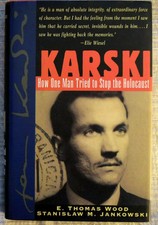
Holocaust Hero Polish WWII Jan Karski book 1st Edition Karski Wood & Jankowski
$1000.00