ANTIQUE MEXICAN WAR LT IRONS TX KIA BATTLE CHURUBUSCO SILHOUETTE AUGUSTE EDOUART

When you click on links to various merchants on this site and make a purchase, this can result in this site earning a commission. Affiliate programs and affiliations include, but are not limited to, the eBay Partner Network.

ANTIQUE MEXICAN WAR LT IRONS TX KIA BATTLE CHURUBUSCO SILHOUETTE AUGUSTE EDOUART:
$11249.99
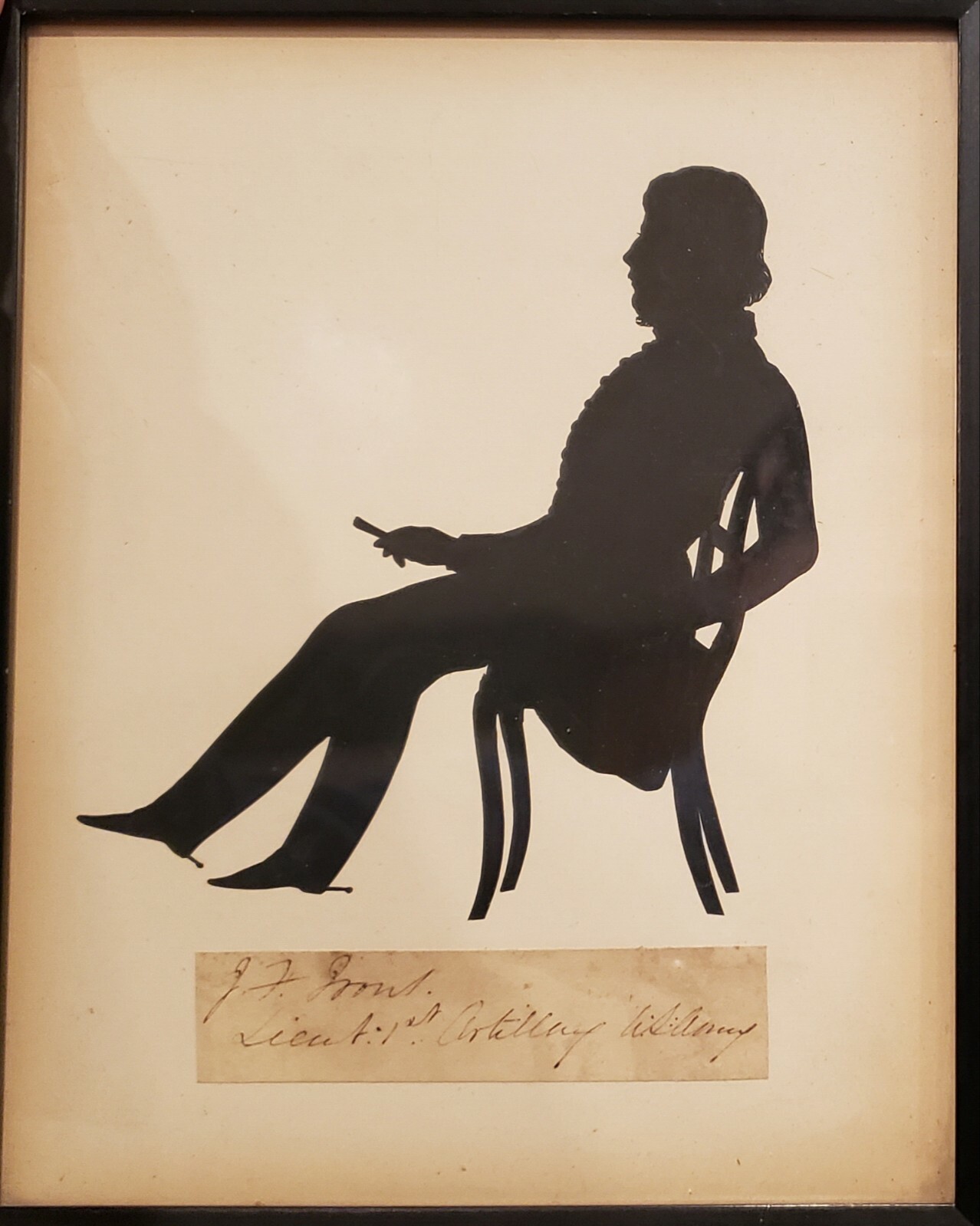
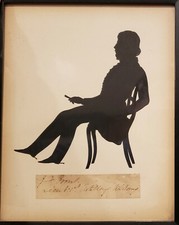
A rare silhouette by master French born artist Auguste Edouart, 5th of February circa 1840, of United States Lieutenant J.F. Irons, First Regiment of Artillery, aide-de-camp to Brigadier General George Cadawalder, mortally wounded during the Mexican War in the battle of Churubusco. Created in New York City by Edouart and measuring approximately 10 x 8 inches behind glass in a later frame. See more information attached regarding Irons and below for an overview of his regiment during the Mexican War, major battles he fought and died in, Edouart, and General Cadawalder, below. The back is also covered by glass and nondescript with the exception of the visible ink. I have not examined it outside of the frame. Last origin Washington, DC. Shipped with USPS Priority Mail. Thanks for looking.
In the campaign of 1846-47 on Taylor's line in Texas and northern Mexico, Companies B, C, D, E and Battery K, took an active part, the regiment being represented by one or more of its companies in the battles of Palo Alto, Resaca de la Palma, Monterey and Buena Vista. The campaign of 1847 in central Mexico under General Scott brought the greater part of the regiment under fire, and Companies B, D, F, G, H and Batteries I and K, some or all of them, took part in the siege of Vera Cruz and the battles or skirmishes of Cerro Gordo, La Hoya, Oka Lake, Contreras, Churubusco, Chapultepec and City of Mexico. Company I was made a light battery after the battle of Cerro Gordo. There was then no retired list, and the field officers of the regiment were so infirm or so far advanced in years as to be wholly unable to undergo the fatigues of active service. From this it resulted that, after Vera Cruz and Cerro Gordo had been fought, the senior captain presentBrevet Major Justin Dimickcommanded the battalion. The campaign was one of the most brilliant recorded in history. More recent military operations on a very much larger scale have dimmed the memory of its successes, but the military student will always admire the extreme audacity which prompted it, and the manner in which the troopsthe whole armycoperated to make it a success. The First Artillery received the commendation of its brigade and division commanders for each and every action in which it was present, and its losses21 per cent. of its whole strength in killed and woundedattest its military zeal and fidelity to duty. The battle of Churubusco was especially fatal, for it cost the regiment the lives of Capt. E. A. Capron, Capt. M. J. Burke, Lieut. J. F. Irons, and Lieut. Satterlee Hoffman. Lieutenants Martin and Boynton were among the wounded, and the total loss in officers and men was 45 out of a total of less than 300. In the campaign of 1846-47 on Taylor's line in Texas and northern Mexico, Companies B, C, D, E and Battery K, took an active part, the regiment being represented by one or more of its companies in the battles of Palo Alto, Resaca de la Palma, Monterey and Buena Vista. The campaign of 1847 in central Mexico under General Scott brought the greater part of the regiment under fire, and Companies B, D, F, G, H and Batteries I and K, some or all of them, took part in the siege of Vera Cruz and the battles or skirmishes of Cerro Gordo, La Hoya, Oka Lake, Contreras, Churubusco, Chapultepec and City of Mexico. Company I was made a light battery after the battle of Cerro Gordo. There was then no retired list, and the field officers of the regiment were so infirm or so far advanced in years as to be wholly unable to undergo the fatigues of active service. From this it resulted that, after Vera Cruz and Cerro Gordo had been fought, the senior captain presentBrevet Major Justin Dimickcommanded the battalion. The campaign was one of the most brilliant recorded in history. More recent military operations on a very much larger scale have dimmed the memory of its successes, but the military student will always admire the extreme audacity which prompted it, and the manner in which the troopsthe whole armycoperated to make it a success. The First Artillery received the commendation of its brigade and division commanders for each and every action in which it was present, and its losses21 per cent. of its whole strength in killed and woundedattest its military zeal and fidelity to duty. The battle of Churubusco was especially fatal, for it cost the regiment the lives of Capt. E. A. Capron, Capt. M. J. Burke, Lieut. J. F. Irons, and Lieut. Satterlee Hoffman. Lieutenants Martin and Boynton were among the wounded, and the total loss in officers and men was 45 out of a total of less than 300. Source: US Army
TheBattle of Churubuscotook place on August 20, 1847, whileSanta Anna's army was in retreat from theBattle of Contreras or Battle of Padiernaduring theMexicanAmerican War. It was the battle where theSan Patricio Battalion, made up largely of American deserters, made their last stand against U.S. forces. The U.S. Army was victorious, outnumbering more than two-to-one the defending Mexican troops. After the battle, the U.S. Army was only 5 miles (8km) away from Mexico City. About 50 of the captured San Patricio's were later hanged. Battle of Palo Alto, (May 8, 1846), first clash intheMexican War, fought at a small site in southEasternTexasabout 9 miles (14.5 km) northeast ofMatamoros, Mex. Mexican troops had crossed theRio Grandeto besiege Fort Brown and to threaten GeneralZachary Taylorssupply centre. General Taylor and his army met the invaders atPalo Altowith superior artillery. Despite the greater numbers and crack cavalry units of the Mexican army, commanded by General Mariano Arista, the Mexicans suffered heavier casualties. Disheartened by their lack of success, they retired the next day to a defensive position farther south. Source: Brittanica
RESACA DE LA PALMA, BATTLE OF. The battle of Resaca de la Palma was the second engagement of theMexican War. It was fought on May 9, 1846, a few miles north of Matamoros, Tamaulipas, the day after the retreat of the Mexican army at Palo Alto. The Mexican troops under the command of Maj. Gen.Mariano Aristaand the Americans under Maj. Gen.Zachary Taylorhad fought to a draw at thebattle of Palo Altoon May 8. During the night Arista had withdrawn and established new positions in a dry streambed or resaca, Resaca de la Palma, which crossed the road between Matamoros and Port Isabel and provided the Mexicans with a strong defensive position. Sometime after 2:00 P.M. Taylor ordered the attack. After considerable difficulty with the Mexican artillery the American Dragoons and light infantry forced the Mexicans out of the resaca. The Mexicans counterattacked twice, were beaten back both times, and fled in panic, leaving behind all manner of baggage. Among the items left were 474 muskets and carbines, eight pieces of artillery, Arista's correspondence and silver service, and the colors of the Tampico Battalion. Of the 1,700 Americans engaged in the battle, thirty-three were killed and eighty-nine wounded. Of an estimated force of 4,000, the official records show the Mexican losses as 154 killed, 205 wounded, and 156 missing, many probably drowned trying the cross the Rio Grande at night. Taylor claimed to have buried 200 Mexican dead.See alsoRESACAS. BIBLIOGRAPHY:K. Jack Bauer,The Mexican War, 18461848(New York: Macmillan, 1974). Source: Texas Historical Association
Auguste Amant Constant Fidle Edouart(17891861) was a French-born portrait artist who worked in England, Scotland and the United States in the 19th century. He specialized insilhouetteportraits. Born inDunkerque, he left France in 1814, and established himself in London, where he began his career making portraits from hair. In 1825, he began work as a silhouette portraitist, taking full-length likenesses in profile by cutting out black paper with scissors. Edouart spent fifteen years touring England and in 1829 arrived inEdinburgh. He remained there for three years, during which time he produced some 5,000 likenesses. Edouart travelled in the United States in about 183949, visiting New York,Boston, and other locales. He later returned to France. where he worked on smaller silhouettes. They included one of the most notable writer of this period,Victor Hugo. Source: wiki. Silhouettes must have first appeared in England in about 1700, when William and Mary reportedly had their profiles done. By the 1720s, silhouettes—or shades as they were known in Great Britain—had become an established novelty, and by the end of the century their popularity had spread to France. By the end of the eighteenth century, a few French silhouettists had introduced profiles to the United States; however, it was not until the summer of 1839 that Auguste Edouart, the most prolific silhouettist ever to work in the United States, arrived in New York.
Driven from France by hard times under Napoleon, Edouart first immigrated to England in 1815, where he worked as a French teacher and made portraits of animals in wax. In 1825, he cut his first silhouette, supposedly at a dinner party in response to a dare to produce a better profile than one owned by his host; many more silhouettes of English men and women followed. Upon his arrival in New York, Edouart traveled to Saratoga where he was to spend five summers and created hundreds of silhouettes of vacationers, those of Frank and Helen Johnson among them. Edouart's delicate rendering of Johnson's trumpet is typical of his meticulous work. During his extensive travels throughout the United States, Edouart cut silhouettes of many eminent Americans, creating a visual record of the period. His last silhouette was cut on August 16, 1845.
The artist set sail on the "Oneida" with the intention of returning to France in 1849. The ship was wrecked off the coast of Guernsey, and Edouart escaped the disaster with ten albums of British silhouettes and six albums of American silhouettes; approximately forty albums were lost. Edouart gave all of his surviving silhouettes to the Lukis family, who cared for him until he was well enough to return to France. Eventually, all but one of the albums were broken up and sold to descendants of the sitters. The 861 unsold silhouettes were purchased by the Reverend Glenn Tilley Morse of Newburyport and bequeathed to the Metropolitan Museum in 1950. Source: Metropolitan Museum of Art
George Cadwalader May 18, 1806 - February 3, 1879 George Cadwalader was born on May 16, 1806, into a prominent Philadelphia family. His grandfather was General John Cadwalader of revolutionary war fame; his father was a general in the Pennsylvania Militia during the War of 1812. Following his graduation from the University of Pennsylvania in 1823, George Cadwalader studied law and was admitted to the bar. He was a successful lawyer and real estate investor, eventually managing the business interests of the Penn family. In 1824 Cadwalader formed the Philadelphia Grays, an artillery company in the Pennsylvania State Militia, serving as captain. In 1832 he was elected brigadier general of the First Brigade, First Division of the Pennsylvania State Militia. In that capacity he was involved in the Philadelphia anti-Catholic riots of 1844. In early July, during three days of rioting in Southwark, a largely Catholic neighborhood in South Philadelphia, Cadwalader ordered his troops to fire into the crowd of nativists trying to break into a church. The street battle resulted in the deaths of twelve rioters and two militiamen. In the U.S.-Mexico War, Cadwalader, a Democrat, was appointed brigadier general of Volunteers following passage of the Ten Regiment bill in February 1847. Arriving in Vera Cruz on June 1, he marched a week later with 500 men in response to a call for assistance from Colonel James McIntosh. Commanding a supply column of 700 men, 130 wagons, and 500 pack mules, McIntosh had encountered strong guerrilla activity along the National Road and was forced to halt at Paso de Ovejas, 25 miles west of Vera Cruz. The guerillas may have known that McIntosh was transporting $350,000 in specie destined for General Scotts army. On June 11, Cadwalader and McIntosh fought Mexican guerillas at the National Bridge, taking the bridge at a cost of ten U.S. troops killed and thirty wounded. Guerrillas ambushed the column the following day, and again on June 19. Led by Father Caledonio Domeco Jarauta, the guerrillas planned to ambush the column at the La Hoya pass, ten miles west of Jalapa. Colonel Francis M. Wynkoop, commander of the U.S. garrison at the castle of Perote, twenty miles further west, learned of the planned ambush and sent four infantry companies and Captain Samuel Walkers company of Mounted Rifles to attack the guerillas from the west. With this assistance, Cadwalader managed to push through the pass and on to Perote. Cadwalader played a major role in the battles outside the Mexican capital in early September 1847. When his commanding officer, General Gideon Pillow, was wounded as the attack on Chapultepec began, Cadwalader led the 3rd divisions three attacking columns and stormed the castle. After the fortress surrendered, he accepted the sword of General Nicolas Bravo. For his actions at Chapultepec, he was brevetted major general in the regular army. Cadwalader returned to the United States in the spring of 1848. At the outbreak of the Civil War, Governor Andrew Curtin appointed Cadwalader a major general in the Pennsylvania Volunteers. In April 1862, he commanded a division in the Army of the West at Corinth, Mississippi. Later that year he was recalled to Washington, D.C., where he served in a series of minor assignments until his retirement in 1865. Following the Civil War he helped found the Military Order of the Loyal Legion of the United States, a fraternal organization for former army and navy officers which still exists today. He was a member of the New York Yacht Club and maintained a house in Newport, Rhode Island. He died in Philadelphia on February 3, 1879, at age 73. Bibliography Cadwalader Family Papers, Collection 1454, Historical Society of Pennsylvania. Johnson, Timothy D.A Gallant Little Army: The Mexico City Campaign. Lawrence, KS: The University of Kansas Press, 2007. The Philadelphia Grays Collection of Official Reports of Brigadier General George Cadwaladers Services During the Campaign of 1847 in Mexico. Philadelphia: T.K. and P.G. Collins, Printers, 1848. Source: University of Texas
ANTIQUE MEXICAN WAR LT IRONS TX KIA BATTLE CHURUBUSCO SILHOUETTE AUGUSTE EDOUART:
$11249.99
Related Items:
Antique Big Mexican Snake Spurs
$25000.00
Antique Mexican Silver Spurs Western Charro Cowboy Heavy Made
$18500.00
ANTIQUE MEXICAN WAR LT IRONS TX KIA BATTLE CHURUBUSCO SILHOUETTE AUGUSTE EDOUART
$14999.99