Polychrome Pair of Glass Mandarin Ducks Chinese Wedding or Annv. Present

When you click on links to various merchants on this site and make a purchase, this can result in this site earning a commission. Affiliate programs and affiliations include, but are not limited to, the eBay Partner Network.

Polychrome Pair of Glass Mandarin Ducks Chinese Wedding or Annv. Present:
$9250.00
ANCIENT CIVILIZATIONS
Artifacts, Antiques, & Fine Collectibles
Two Chinese MandarinDuck Love Birds
Made of Layered Opaque & Translucent PolychromeGlass
Wedding Gift &Symbol of Love
These solid-glass pair of Mandarin Ducks were obtained from an old collection that once was held in Henan, China. The collection was reportedly moved to Hong Kong in the 1960s. This is the first time it has been offered for sale in the UnitedStates. This museum quality set is ExtremelyRARE!
This itemis legal to buy/sell under U.S. Statute covering cultural patrimony Code 2600,CHAPTER 14.
SUMMARY
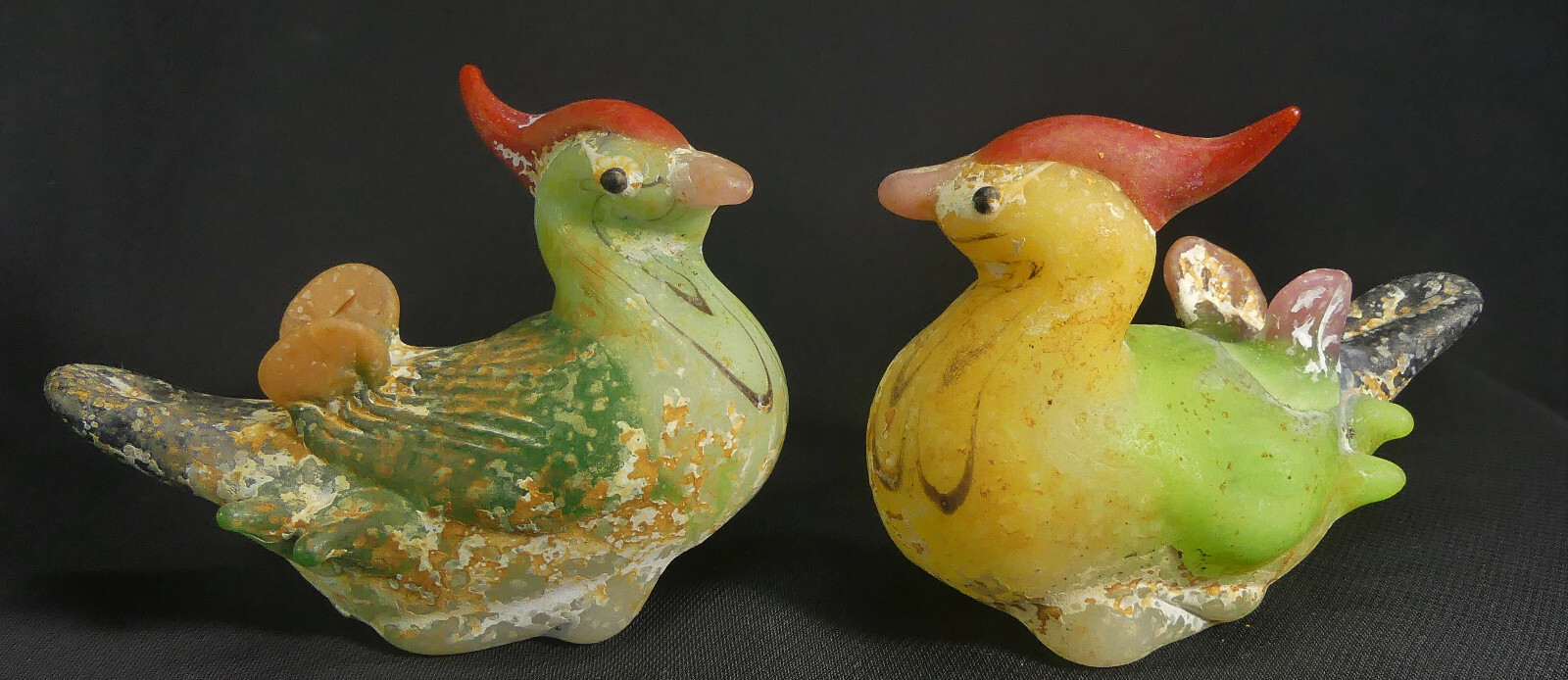
This beautiful pair of polychromeglass birds, Chinese Mandarin Ducks are made from translucent and opaque glass; the smaller female has a green headand chest. The various colors ofpolychrome, muti-colored glass are stunning and were likely a wedding gift forsome lucky couple!
Each Mandarin Duck measures about:
·Female: 3.6 oz. (102 gr.) and is about 2.86” (73 mm)long.
·Male:4.1 oz. (115 gr.) and is about 2.97” (75 mm) long.
Each duck is made of solid glass in astunning array of soft pastel colors that flow from one color to the next. Boththe male and female have bright red crests in nature, and this is also the casein both of these glass figurines. However,the crest is larger and more pronounced on the male, who is this case has a yellowhead and chest. (See reference photo # 12 for color photo of two Mandarin Ducks. For reference only.)
There also appears to be several Chinesecharacters that show up under the white calcium deposits on the base of eachduck. Although nearly illegible, it appearsthat they are animals, such as a dragon. (see photo # 6)
Provenance: This lovely pair of ducks was recovered decadesago near the modern Chinese city of Xi’an, in the province of Shaanxi andamazingly. They were originally acquired from aprivate collection in LuoYangShi, Henan, China, and this is the first time theyhave been for sale in the United States after purchase in Hong Kong.
Condition: Each duck has some white calcium deposits andiron-red mineral deposits on the surface that are period correct from beingburied for centuries in iron-rich, damp soil of China. The male duck has had one of his tiny, pinkglass wings repaired on his back when it unfortunately broke off duringshipping. The glass pair of ducks havenot been cleaned and are in “as found” museum quality condition.
DETAILS:
Why Are Mandarin Ducks Viewed as Symbolsof Love and Marriage?
In traditional Chinese culture, Mandarinducks are believed to be lifelong couples; however, they actually pair up onlyfor one season, like all ducks. But formillennia in Chinese folklore, they are regarded as a symbol of eternal love,conjugal affection, and fidelity, and are frequently featured in Chinese artand often given as wedding gifts. Both the males and females have crests, but the crest ismore pronounced on the male. Mandarinducks are also thought to represent peace, fidelity, and plentiful offspring.
A cruel fact is, the male Mandarin ducks arenot as loyal as legends have it. Male mandarins do love their partners, butonly for one breeding season. It is highly likely that they go find a new"true love" next year, without feeling guilty. Most mandarinducklings do not have the opportunity to meet their father. A male mandarinducks may keep his partner company for a time during incubation, but will leavebefore the ducklings hatch and never returns.
The Chinese refer to Mandarin ducks as yuanyang(simplified Chinese: 鸳鸯;traditional Chinese: 鴛鴦;pinyin: yuān yāng), where yuan (鴛)and yang (鴦),which respectively stand for male and female mandarin ducks.
A Chinese proverb for loving couples usesthe mandarin duck as a metaphor: "Two mandarin ducks playing in water"(simplified Chinese: 鸳鸯戏水;traditional Chinese: 鴛鴦戲水;pinyin: yuānyāng xì shuǐ). A mandarin duck symbol is also used inChinese weddings because in traditional Chinese lore, they symbolize weddedbliss and fidelity.
You may find it fascinating that theChinese name for mandarin duck is yuan yang! Yes, right there in the name isthe ancient Feng Shui concept of “yin and yang,” the complementary male andfemale energies upon which so much of the practical side of Feng Shui andrelated fields are based. Unlike other ducks, mandarin ducks were thought to matefor life and also show a great deal of affection for their partner.
In Feng Shui, mandarin ducks are theclassic “love birds.” They even show obvious signs of mourning if their partnerdies. Mandarin ducks are almost always represented at Chinese weddings. Theyrepresent fidelity and affection, for the long haul, through thick and thin, asthe old saying goes. This concept and symbolism are harmonious to the promisesmade during most wedding vows.
Mandarin ducks are native to Eastern Asia,the area where the practice of Feng Shui was originally developed thousands ofyears ago. In these ancient times, humans were much more in touch with natureand they watched the behaviors of animals very closely and took deep meaningfrom what they observed. In terms of physical appearance, mandarin ducks areshowy birds so it’s hard not to notice them when they’re around. Further,they’re not that skittish so it’s easy to assume that mandarin ducks happilywent about their business while these ancient Feng Shui masters studied andadmired them. It’s logical to assume that those who developed Feng Shui, alongwith the concepts of yin and yang, were profoundly influenced by their intimateknowledge of mandarin ducks.
COLOR SYMBOLISM IN BUDDHISM
Buddhism traveled from India into Chinaduring the 1st century AD, becoming part of Chinese life and culture alongsidethe other established belief systems. Statues and Buddhist-related figures likethese were commissioned by followers. During the Tang Dynasty, expensive gifts like this pair of Mandarin Love Ducks were often given as wedding gifts.
The colors used in these glass ducks were not chosen just for their beauty, but also for their symbolism in theBuddhist religion. Color symbolism is used in a wide variety of fascinatingways in Buddhist art and ritual. InBuddhism, each of five colors (pancha-varna: which are Blue, Black, Red, Greenand Yellow) symbolizes a state of mind, a celestial Buddha, a part of the body,a part of the mantra word Hum, or anatural element. It is believed that by meditating on the individual colors,which contain their respective essences and are associated with a particularBuddha or bodhisattva, spiritual transformations can be achieved.
REFERENCES:
1.Museum ofChinese History, Beijing
2.ShanghaiMuseum of Glass, Shanghai, China
3.HunanMuseum, China
4.PalaceMuseum, Beijing, China
5.HenanProvincial Museum, China
6.ShaanxiArchaeology Institute, China
7.TheAncestral Landscape, David N. Knightley,2000
8.TheGreat Bronze Age of China,edited by Wen Fong, MET, 1980
9.China: A Dawn of the Golden Age.
10. ChanghuaAnnals of the Republic of China(1911–1949)
11. British Museum, Jessica Rawson
12. Smithsonian Museum, Sackler & Freer Gallery, WDC
13. MET, New York
14. Chinese History Museum in Beijing, China, contains anoutstanding collection of early Chinese glass objects, including a small, glassaqua cup that was found in a Han Dynasty tomb in Guangxi Province, China.
15. See “Ancient Glass Research Along the Silk Road”Edited by Gan Fuxi (Chinese Academy of Sciences & Fudan University, China),Robert Brill (The Corning Museum of Glass, USA), & Tian Shouyun(Chinese Academy of Sciences, China). This book states that ancient Chineseglass from the Eastern Han Dynasty to the Tang Dynasty (200-700 AD) containedHigh Lead Silicate or PBO-SiO2. Althoughchemical tests have not been run on this glass Jue, it is believed thatit made from this glass composition.
16. See “Scientific Research in Early Chinese Glass”1991, Author: Robert H. Brill and John H. Martin, editors.
17. Kwan, Simon; Early Chinese Glass; Hong Kong, 2001.ISBN. 9627 101524
18. SusanWhitfield, The Silk Road, Trade, Travel, War and Faith, London, 2004
Chinese History Museum in Beijing containsan outstanding collection of early Chinese glass objects, including a smallaqua cup that was found in a Han Dynasty tomb in Guangxi Province, China.
offer with confidence--as I have Positive response from hundreds of satisfied customers from around the world!
Please look carefully at thephotos, taken with macro lens, since they are part of the description. Some photos taken indoors with a strong back light to show the beauty of the translucent glass figures.
See reference photo # 12 for color photo of two Mandarin Ducks. For reference only.
They would make a wonderful addition to your collection or a Super Wedding or Anniversary gift!
And please ask any questions before you buy.
Thanks!
International Buyers are responsible for all import duties, taxes, and shipping expenses.
No International Returns. Thank You!
Polychrome Pair of Glass Mandarin Ducks Chinese Wedding or Annv. Present:
$9250.00
Related Items:
Polychrome Pair of Glass Mandarin Ducks Chinese Wedding or Annv. Present
$18500.00

A Large Pair of Baroque Late 17th Century Gilt & Polychrome Decorated Torcheres
$5000.00
Pair of 18th Century Continental Figural Carved Polychrome & Gilt Candle Holders
$4500.00