1580 Portugal King Antonio Signed Illuminated Royal Charter Manuscript Document

When you click on links to various merchants on this site and make a purchase, this can result in this site earning a commission. Affiliate programs and affiliations include, but are not limited to, the eBay Partner Network.

1580 Portugal King Antonio Signed Illuminated Royal Charter Manuscript Document:
$250000.00
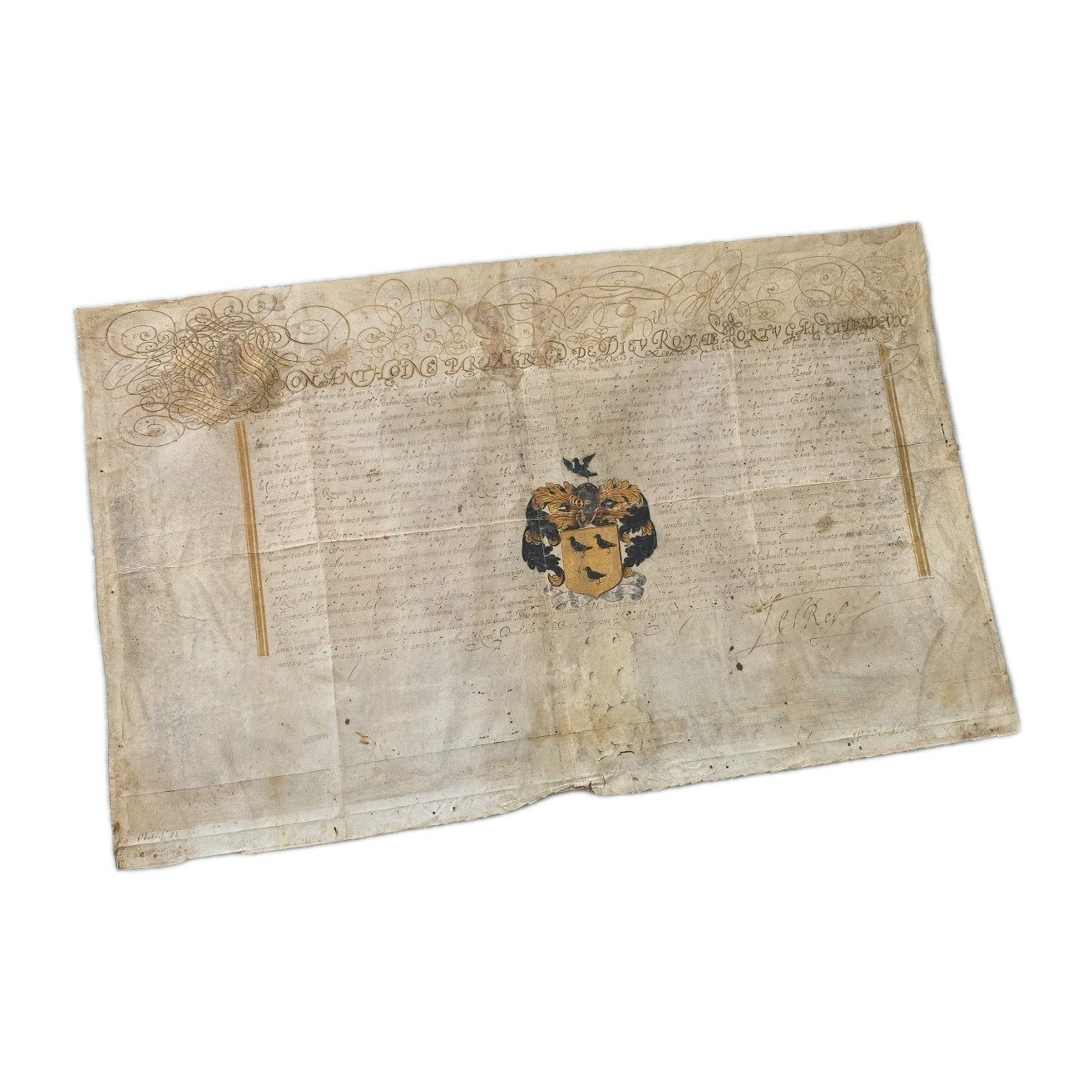
For your consideration this is an exceedingly rare and museum-quality illuminated royal charter of nobility, issued in exile by Dom António I of Portugal (1531–1595), Prior of Crato, during the decisive phase of the Portuguese Succession Crisis following 1580. Executed on vellum measuring approximately 25.5 by 16.25 inches and personally signed by António with the sovereign autograph “El Rey,” the document constitutes a fully authoritative act of royal government exercised outside Portugal and stands among the most important survivals of his brief and contested reign.
Fully illuminated, formally sealed, and issued in direct defiance of Spanish Habsburg authority, it represents the highest and rarest category of António’s exile chancery output, examples of which are extraordinarily scarce due to the subsequent suppression and destruction of his acts after Portugal’s absorption into the Iberian Union.
The charter is written in formal French chancery script, the international language of diplomacy, and is richly embellished with applied gold illumination. The upper, left, and right margins are ruled in gilt, and the head of the document is crowned by an expansive penwork chancery flourish, intricately looped and heightened in gold, enclosing a devotional motif. At center appears the painted armorial achievement of the ennobled recipient, executed with notable refinement: a golden shield charged with three sable birds proper with red beaks and legs, surmounted by a helm with black and gold mantling and crested with a sable bird displayed upon a wreath. The painted arms remain vivid, the gilding retains strong reflective brilliance, and the overall artistic execution places the manuscript firmly within the highest tradition of late Renaissance state and court production.
The full historical English translation of the charter is as follows:
Don Anthoyne by the grace of God King of Portugal and of the Two “Algnarais” of this side and beyond the sea of Africa, Lord of Guinea, of the Conquest. Navigation and Commerce of Ethiopia, Arabia, Persia and the Indies etc. To all present and to come; Hail. As our dear and well beloved Arnoult Gondt, native of Tournay, city of the low countries, at present Counsellor and Steward of Madame Louise de Colligny, princess dowager of Orange, and Countess of Nassau etc, has demonstrated to us and duly made appear by the testimony of persons of great quality worthy to be trusted, and sufficient verifications, that unawares and by injury of time, his letters of nobility obtained by the virtues, valour, and merits of his ancestors, have been lost, for this, has begged us, that it might be our good pleasure, by our authority and royal power, to honor him and give him other letters for the recognition, restoration and confirmation of the ancient nobility of his house, which by right we neither can nor will refuse him considering that neither he nor his, have ever done anything unworthy of a nobleman, but on the contrary have always sought and pursued virtue, we have said, declared, and pronounced by this letter, that the ancestors of the above requisitor, himself, Guillaume, Tehan surnamed Guislain, Martin, Phillipe, son of his late brother Jacques Antoinette and Barbe Gondt, all brothers, sisters, and neven of the above named Arnoult, bearing by right the same name and arms are born and extracted from a noble house and family, and as such, have held and reputed them, do hold and reprite them nobles and “gentlemen” of Italian origin, of whom the first who came into the country of Holande, in the year one thousand three hundred and twenty and named Adam Gondt was Squire of of the Duke of Bavaria, who made him Bailiff of the city of Flandenghem a very good and ancient city in the said County. And although without need, but only to prevent and obviate that within our kingdom, countries and lands in our jurisdiction, in times to come the said Arnoult should be held as a foreign nobleman, and thus prevented from possessing lands, seignories and other dignities which he or his might aquire. We have by our liberality, power and Royal authority ennobled, and do ennoble him by this letter, with his said brothers, sisters, neven, his relations bearing by right the same name and arms, with the entire posterity and all descendents of all and anyone aboved named, in order that they may enjoy all the privileges, honors, prerogatives, and franchises belonging to nobility, as enjoyed and used by the other noblemen of our realm. Thus we approve and confirm their former coat of arms, it being agreeable to us that they should retain and bear them, as they are accustomed and as they are stamped and blazoned in this letter. And besides this, on account of the good, loyal, faithful and acceptable services which we have received from the above said Arnoult Gondt, who intends to continue them, we have made and do make him domestic nobleman of our royal house, with the ordinary and accustomed wages, and advantages; and thus we wish, ordain and command, that as such he should be respected, held in honor and housed on the estate of our said house in order to enjoy the authorities, franchises, liberties and privileges which noblemen of ancient nobility are accustomed to enjoy in the house of Kings of Portugal our predecessors. And because such is our will, we also ordain and command to all: Viceroy, Lieutenant-General, Governors of Provinces, and all other “Justiciers” and Subjects dependant on our crown; and beg all: Kings, Princes, Lords, and others, our friends, that they would let the said Arnoult Gondt, his brothers, sisters, neven, his relations bearing by right the same name and arms with all their posterity and descendants of all and every one of the above named, enjoy, use fully and peacefully the said rights of nobility, authority, preeminenees, franchises, liberties, honors and privileges which belong to it; and in order that it may be a thing stable, firm and enduring, we have, at the request of the said Arnoult Gondt, our domestic nobleman dispatched the present letters in the French language in order to be of better use on all occasions. The which we have signed, and to which we have set our seal. Given in the city of Paris, on the twentieth day of June, one thousand five hundred and eighty.
The historical importance and rarity of this manuscript cannot be overstated. Illuminated royal charters issued by Dom António I are among the rarest survivals of early modern European statecraft, owing to the brevity of his authority, the contested nature of his kingship, and the deliberate eradication of his legal acts by the victorious Spanish Habsburg regime.
Fully illuminated vellum charters bearing António’s personal sovereign autograph occupy the highest tier of rarity within his surviving output. This document is not merely a noble grant but a direct assertion of kingship in exile, functioning simultaneously as a binding legal instrument, a dynastic declaration, and a political manifesto issued at one of the most consequential turning points in Iberian history.
Authentication is secured through multiple contemporary features, including António’s bold autograph “Le Roy,” a chancery countersignature attesting to legal regularity, and a period docketing inscription on the verso identifying the grantee, place, and date and aligning with António’s documented residence in exile in Paris. Puncture holes from the original pendant wax seal, together with folds, stains, and age toning, attest to genuine administrative use and long archival preservation.
Accompanying the charter are two early twentieth-century manuscript translations, one in French and one in English, on large-format W. Whatman 1909 laid paper, reflecting early scholarly engagement and significantly enhancing the provenance and interpretive completeness of the ensemble. Taken together, this is a one-of-a-kind survival of exile sovereignty—at once a supreme legal act, a work of Renaissance manuscript art, and a powerful witness to Portuguese dynastic struggle—fit for the highest tier of institutional or national collections.
1580 Portugal King Antonio Signed Illuminated Royal Charter Manuscript Document:
$250000.00
Related Items:
1580 Portugal King Antonio Signed Illuminated Royal Charter Manuscript Document
$200000.00